


There is an adage in wealth management that retina specialists may have heard: “time in the market beats timing the market.” As we approach the end of 2023, a year marked by market ups and downs, now is a good time to examine the lessons behind this phrase.
TIMING THE MARKET
Let’s begin with the opposite of time in the market—attempting to “time” the market by buying before runups, selling somewhere near the top, and then buying back in once prices drop. Market timing means selling assets when you think the market will continue to decline and buying back in when it feels like the market has bottomed out. Although enticing in theory, the evidence is overwhelming that most investors diminish their long-term returns with this approach. They are more likely to chase the market up and down and end up buying high and selling low. Market timing, while tempting, involves getting two nearly impossible decisions right: when to sell and when to get back in.
Historical Data
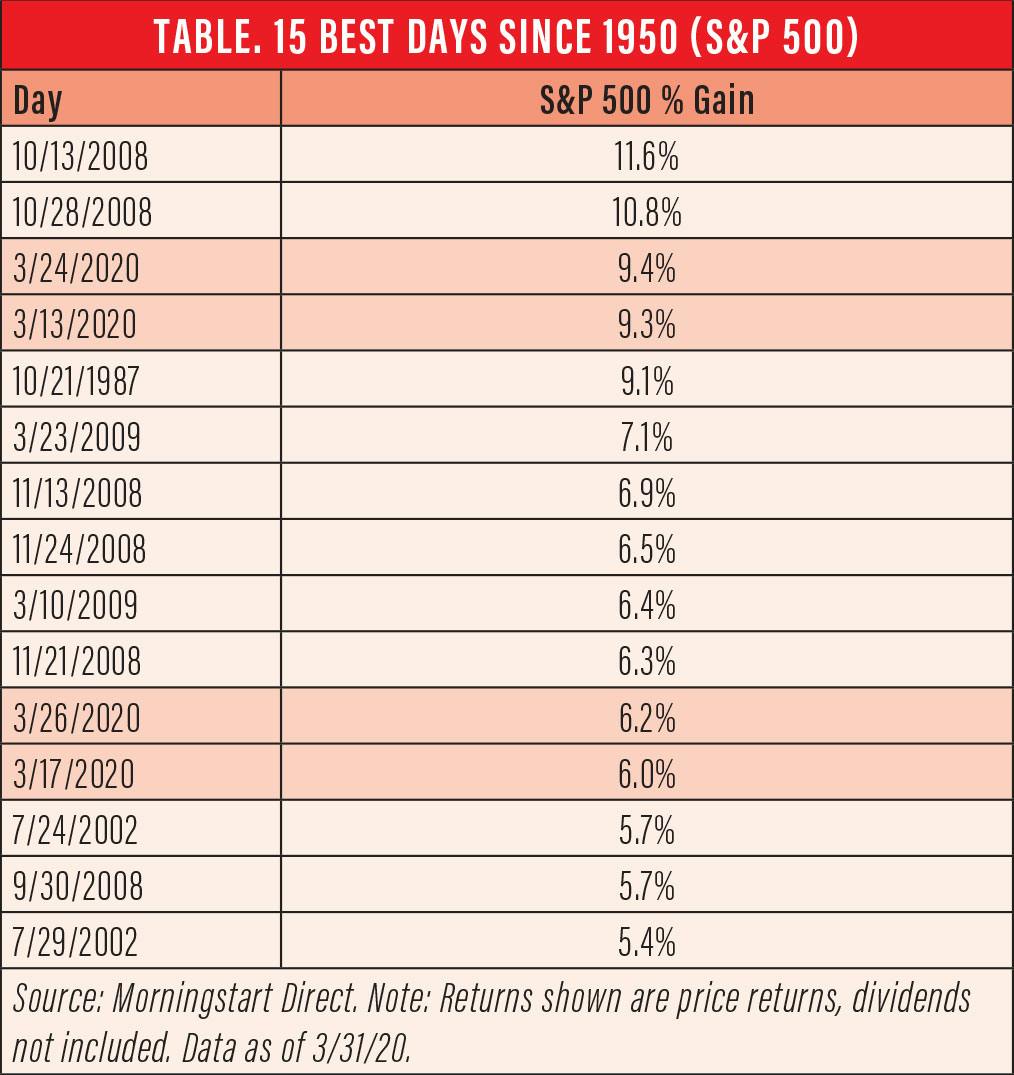
The 15 best days for the S&P 500 since 1950 all occurred within bear markets—not bull markets as you might expect (Table). In other words, the best days to be in the market have been when it is hardest to remain invested or when it is the most tempting to get out and wait for better days. Many of the best days are within dark times for the stock market: the 2008 financial crisis, the dot-com crash, and the Black Monday crash of 1987. A handful of these best days even happened in the first quarter of 2020, during the onset of the COVID-19 crisis. Thus, by trying to miss the worst days, investors are very likely to miss the best days. Let’s examine how detrimental this can be.
The Damage of Missing a Few Days
Missing just the 10 best days in a 20-year period can have a significant long-term effect on a portfolio. For example, an investor who invested $10,000 in the S&P 500 in 2003 finished with a portfolio value of more than $64,000 in December 2022 if they remained fully invested. However, the portfolio value for an investor who missed the 10 best days is less than $30,000. The results worsen as more of the market’s best days are missed, and returns on the portfolio are almost entirely eliminated if the investor missed 30 of the market’s best days in the 20-year period (Figure).
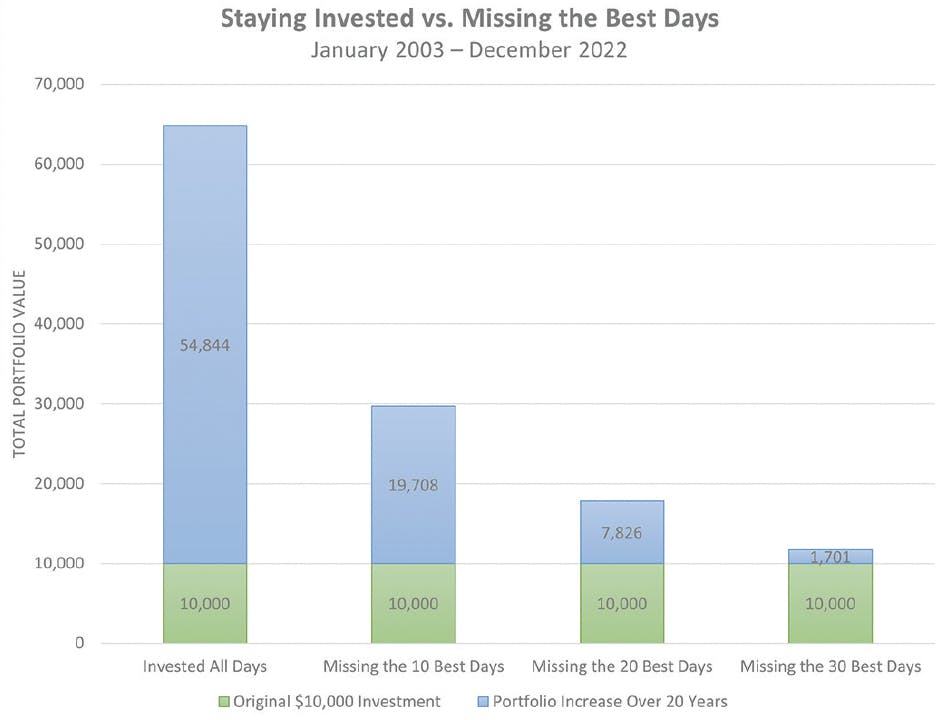
Figure. This chart shows the value of remaining invested to capture the best days, even in a bear market.
You don’t need a 20-year period to experience the lost opportunity from missing a few trading days. In fact, the benefit is just as obvious in a single year; let’s look at 2020. For example, a portfolio valued at $1 million on January 1 would have been reduced to $695,730 at the market’s lowest point on March 23. If no withdrawals were made throughout the year, the portfolio’s balance on December 31 would have reached $1,184,000. For this hypothetical investor, exiting the market at its low point versus remaining invested all year would have resulted in the difference between a 30.4% loss and an 18.4% gain.
Of course, it is unlikely an investor will miss only the best days if they attempt to time the market. They might also miss some of the historically worst days. However, the cautionary tale of attempting to time the market is the same: There can be an enormous cost if the market swings to the upside while you’re on the sidelines. It would take a crystal ball to get in and out of the market perfectly, particularly considering that it needs to be done in short order, given the market’s best and worst days tend to cluster close to one another. Investors should also be aware of the tax implications associated with attempts to time the market, which can often make the tactic even more painful.
TIME IN THE MARKET
Time in the market means sticking with your long-term plan. While this may mean adjusting allocations (and thus, selling and buying portions of a portfolio), the key is that the actions are taken with a long-term view and time horizon. Rather than trying to predict what will happen in the market tomorrow, next week, or even next year, you invest for long-term financial goals, such as children’s education costs or retirement, which can be decades away. In doing so, you can benefit from the long-term upward market trends, rather than the transitory ups and downs along the way.
Perhaps the best and most famous example of this long-term approach to investing is Warren Buffett. As of fall 2023, Warren Buffett’s net worth is in the range of $120 billion, making him one of the 10 richest people on the planet. Would you be surprised to learn that 99% of that net worth has accumulated since he was 50 years of age?1 At the age of 92, he has had the benefit of solid (certainly better than average) returns for the last 42 years, which has been a significant reason why he is where he is, financially. Rather than look for quick hits, Warren Buffett has been clear about investing in companies and sectors for the long term; he has not been trying to time the market’s tops and bottoms.
TIME VERSUS TIMING
When it comes to wealth management, remember that the time you spend in the market is often more important than the timing of your investment in the market. A professional advisor can help you determine your tolerance for risk so that you can remain invested during periods of market volatility and build wealth to achieve your long-term goals.
SPECIAL OFFERS: To receive free print copies or ebook downloads of Wealth Planning for the Modern Physician or Wealth Management Made Simple, text RETINA to 844-418-1212 or visit www.ojmbookstore.com and enter promotional code RETINA at checkout.
OJM Group, LLC. (“OJM”) is an SEC registered investment adviser with its principal place of business in the state of Ohio. SEC registration does not constitute an endorsement of OJM by the SEC nor does it indicate that OJM has attained a particular level of skill or ability. OJM and its representatives are in compliance with the current notice filing and registration requirements imposed upon registered investment advisers by those states in which OJM maintains clients. OJM may only transact business in those states in which it is registered or qualifies for an exemption or exclusion from registration requirements. For information pertaining to the registration status of OJM, please contact OJM or refer to the Investment Adviser Public Disclosure website www.adviserinfo.sec.gov.
For additional information about OJM, including fees and services, send for our disclosure brochure as set forth on Form ADV using the contact information herein. Please read the disclosure statement carefully before you invest or send money.
This article contains general information that is not suitable for everyone. The information contained herein should not be construed as personalized legal or tax advice, or as a recommendation of any particular security or strategy. There is no guarantee that the views and opinions expressed in this article will be appropriate for your particular circumstances. Tax law changes frequently, accordingly information presented herein is subject to change without notice. You should seek professional tax and legal advice before implementing any strategy discussed herein.
1. Jacobs D. Warren Buffett’s net worth over the years. Finmasters. October 2, 2023. Accessed October 12, 2023. finmasters.com/warren-buffett-net-worth/#gref


