


There are three main approaches to repair rhegmatogenous retinal detachments (RRDs): pneumatic retinopexy (PnR), scleral buckle (SB), and pars plana vitrectomy (PPV). Several factors go into deciding whether a patient with primary RRD, who is not a candidate for PnR, would benefit from PPV alone, PPV with SB, or SB alone. This decision varies among physicians, and vitreoretinal fellows have an opportunity to learn various surgical approaches. Here, Wills Eye faculty share how they select the best surgical approach for each patient.
ILLUSTRATIVE CASES
I asked the interviewees to review three cases and decide if they would choose PPV, PPV with SB, or SB (Figures 1-3).
LINNET RODRIGUEZ, MD: IF A PATIENT PRESENTS WITH A PRIMARY RRD AND IS NOT A CANDIDATE FOR PNR, HOW DO YOU DECIDE TO REPAIR WITH PPV, PPV WITH SB, OR SB?
Omesh P. Gupta, MD: The ideal patients for PPV are pseudophakic with a posterior vitreous detachment (PVD) and minimal superior and almost no inferior pathology. These patients benefit from vitrectomy since their RDs can have very small breaks that may be difficult to visualize during examination. Other candidates for PPV are phakic patients with superior detachments and no inferior pathology.
PPV with SB is typically reserved for RDs with multiple breaks, large RDs involving two or more quadrants, RDs that have been present for more than 2 to 3 weeks, vitreous hemorrhage (VH) that precludes sufficient scleral depression, primary proliferative vitreoretinopathy (PVR), RDs with giant retinal tears, RDs with associated choroidal detachment, and/or extensive inferior pathology. This combination approach should also be considered when the fellow eye has had a poor outcome from RD repair or there is a strong family history of retinal tear or detachment.
Finally, SBs are usually ideal for young phakic patients with no cataract. Patients with small peripheral breaks with minimal vitreous traction and exclusively anterior pathology and patients of any age with no PVD are favorable candidates as well. Surgeons should consider this procedure in high-risk eyes to minimize the risk of postoperative PVR.
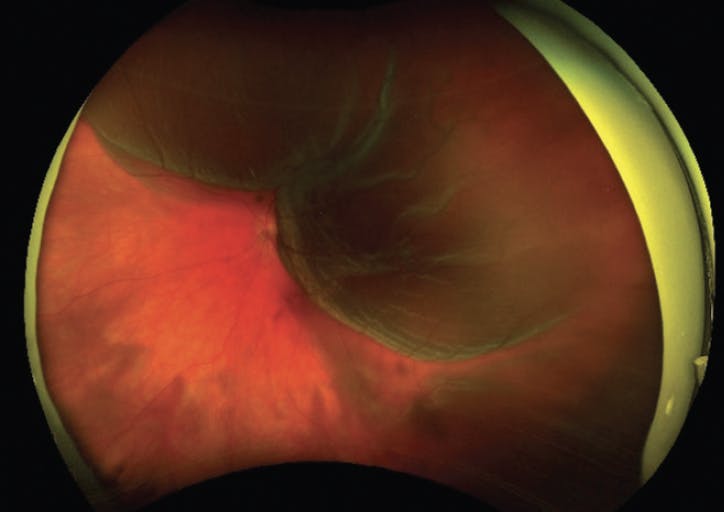
Figure 1. A 50-year-old woman presented with 1 day of decreased vision in the left eye. She was phakic with a PVD and a macula-off RD from the 10 to 5:30 clock hours with two large retinal tears at the 11 and 2:30 clock hours. How would you treat this patient?
Dr. Gupta: PPV with SB
Dr. Mehta: PPV
Dr. Garg: PPV with SB
Dr. Yonekawa: PPV
Dr. Regillo: PPV
Sonia Mehta, MD: I decide the surgical approach on an individual basis. If the patient is young and phakic with no PVD, I will likely use SB; if the patient is pseudophakic and has superior pathology with a PVD, then I usually prefer PPV.
If the patient is pseudophakic and has inferior or extensive pathology (eg, 360° lattice) with a PVD, I might consider PPV with SB. However, there are always exceptions, which is why my approach is personalized to the patient and their eye. For example, if a young phakic patient with Marfan syndrome has a very thin or no sclera, I would favor PPV over SB.
Jason Hsu, MD: In patients younger than age 50, a primary SB is preferred, especially if there is no evidence of a PVD. Separating the hyaloid in these patients can be very difficult. In addition, the risk of cataract development is higher.
PPV alone is more beneficial in pseudophakic patients who are 65 years of age or older. In these patients, a good shave of the vitreous base can be achieved without drastic changes in refractive error, which can occur with SB placement. Even if multiple breaks or lattice are present, circumferential endolaser can be performed. This procedure is also beneficial for localized RDs or RDs with one or two breaks. If there are multiple breaks or other peripheral pathology, combining SB and PPV may be a better option.
For patients between the ages of 50 and 65, SB with or without PPV depends on the lens. If the patient is phakic, consider SB. If the RD is more complex with multiple breaks in different quadrants and/or VH is present, then PPV with SB is more beneficial. For pseudophakic patients in this age group, also consider PPV with SB.
A combined procedure should also be considered for RD due to giant retinal tears. These patients have an abnormal vitreous base and would benefit from circumferential laser regardless of the lens status. If grade C or worse PVR is present, then PPV is preferred. I generally place a buckle in these situations even if I am doing a retinectomy. Supporting the peripheral retina and the edges of the retinectomy is beneficial. I would not place a buckle for a funnel RD where a retinectomy alone would probably be performed.
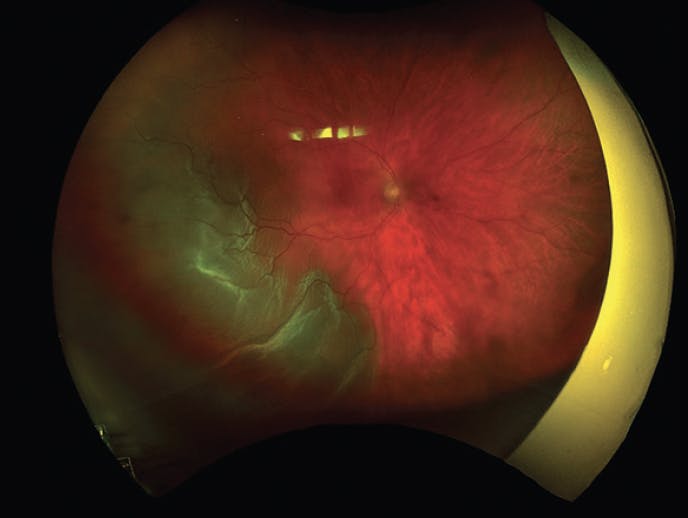
Figure 2. A 58-year-old man presented with 3 days of decreased vision in the right eye. The patient was pseudophakic with a PVD and a macula-on RD from the 6 to 11 clock hours with lattice and retinal tears at the 8 and 9 clock hours. What would be your surgical approach?
Dr. Gupta: PPV
Dr. Mehta: PPV
Dr. Garg: PPV with SB
Dr. Yonekawa: PPV
Dr. Regillo: PPV
Sunir J. Garg, MD: Patients 40 years of age or younger, or those without a PVD, often do best with SB alone. Unnecessarily manipulating the young vitreous can precipitate additional tears. I also find SB alone to be the best choice for retinal dialysis. In these cases, I place a small segmental sponge.
PPV alone is a great option for eyes that have a PVD and are pseudophakic. An older patient who already has a moderate cataract without other substantial vitreoretinal pathology would also be a good candidate.
I prefer combined PPV and SB for eyes with tears in multiple locations, abnormal/broad vitreous base, extensive lattice degeneration, a suboptimal RD outcome in the fellow eye, trauma, family history of RD, and/or patients at risk of PVR with the presence of VH or substantial smoking history.
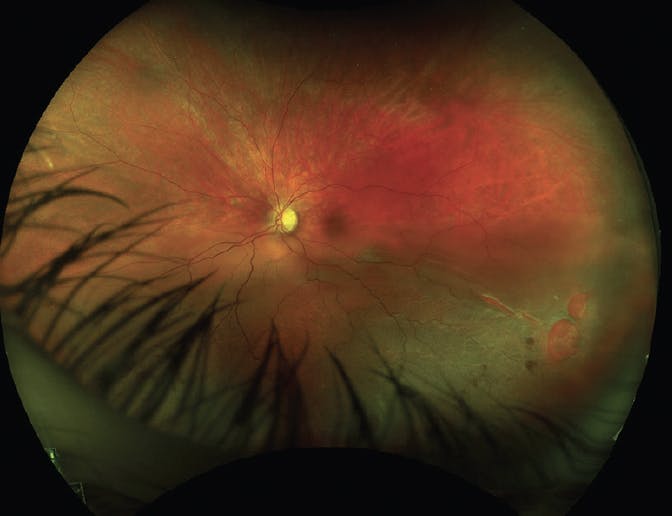
Figure 3. A 25-year-old woman presented with new floaters in the left eye. She was phakic with no PVD and had a macula-off RD from the 3 to 8 clock hours with multiple holes. Which surgical technique would you choose for this patient?
Dr. Gupta: SB
Dr. Mehta: SB
Dr. Garg: SB
Dr. Yonekawa: SB
Dr. Regillo: SB
Yoshihiro Yonekawa, MD: Many studies have shown that PPV alone provides excellent surgical outcomes. But the best single-surgery success rates are in pseudophakic eyes with PVDs.
When it comes to combined procedures, you will never regret adding a buckle to a vitrectomy, but you will often regret not adding one if a primary vitrectomy succumbs to PVR. I prefer placing an encircling SB in eyes at higher risk for recurrent RD. Of course, this is if the clinical picture forces me to do a vitrectomy. Many complex pathologies can be fixed with SB alone, which is preferred if possible.
In terms of SB alone, pediatric patients are always good candidates, as separating the hyaloid is nearly impossible. In addition, they have difficulty positioning and can get PVR after a failed PPV. Young adults almost always get primary buckles with me, as does any adult with no PVD. If the break is posterior, you can do a radial buckle. In some scenarios, you may do primary buckling even if you would normally opt for a primary PPV or PPV with SB. One such scenario is in patients with self-injurious behavior.
Carl D. Regillo, MD: For me, if it is PPV, it is almost always PPV only. Rarely do I add SB. The buckle adds very little, and you can still get good results without routinely doing PPV with SB. Most RDs can be repaired with PPV alone. They usually occur in patients 50 years or older with some preexisting cataract and flap tears, indicating a complete or partial PVD. The preference now is shifting toward PPV because you can eliminate induced myopia and other problems related to buckles. You can also clear the media at the same time. Adding SB to PPV may boost the success rate if there is extensive peripheral pathology or high-risk features for PVR.
Patients getting SB only are those younger than 50 years of age, as they typically do not have a PVD. They generally should not get PPV unless the media is not clear.


