


AT A GLANCE
- Imaging of the peripheral retina allows for better assessment of diabetic retinopathy (DR) lesions and assessment of retinal nonperfusion on ultra-widefield fluorescein angiography.
- Protocol AA is a 4-year study evaluating the ability of predominantly peripheral lesions (PPLs) to predict DR severity and progression.
- PPLs and higher nonperfusion areas on ultra-widefield fluorescein angiography can serve as predictors for DR progression.
Since the landmark Early Treatment Diabetic Retinopathy Study (ETDRS), the Diabetic Retinopathy Severity Scale (DRSS) has been the established method for grading diabetic retinopathy (DR) severity.1,2 Although this has been a reliable metric to determine baseline DR status and likelihood of progression, the DRSS has not been updated to account for imaging advances, such as ultra-widefield (UWF) technologies.
UWF images are defined as a single image, centered on the fovea, that captures beyond the posterior pole and includes anatomy anterior to the vortex veins in all four quadrants.3 These images capture approximately 82% of the retinal surface, including the midperipheral and peripheral retina.4 Imaging of the peripheral retina allows for better assessment of DR lesions and assessment of retinal nonperfusion on UWF fluorescein angiography (FA), which cannot be captured from color fundus photographs alone.5-8 Prior single-center studies have demonstrated predominantly peripheral lesions (PPLs) in DR, portending a higher baseline DR severity and an increased risk of progression.5-17
Diabetic Retinopathy Clinical Research (DRCR) Retina Network Protocol AA is a 4-year prospective observational study evaluating the ability of PPLs to predict DR progression and severity for eyes with nonproliferative DR (NPDR) without center-involving diabetic macular edema. Herein, we discuss the results of this study and the utility of UWF imaging in classifying DR severity and predicting progression.
PREDOMINANTLY PERIPHERAL LESIONS
PPLs are defined as lesions primarily (> 50%) located outside the ETDRS 7-standard-field images (Figure 1). Overall, PPLs were common in the Protocol AA cohort. Among the 544 study eyes with gradable color UWF images, PPLs were present at baseline in 41% and 46% of eyes on UWF color photography and UWF FA, respectively. Of the 542 eyes with gradable UWF color images and UWF FA, 25% had PPLs present at baseline on both UWF color imaging and UWF FA, 20% had PPLs on UWF FA only, and 16% had PPLs on UWF color images only, leaving 39% of eyes without evidence of PPLs on either imaging modality.18
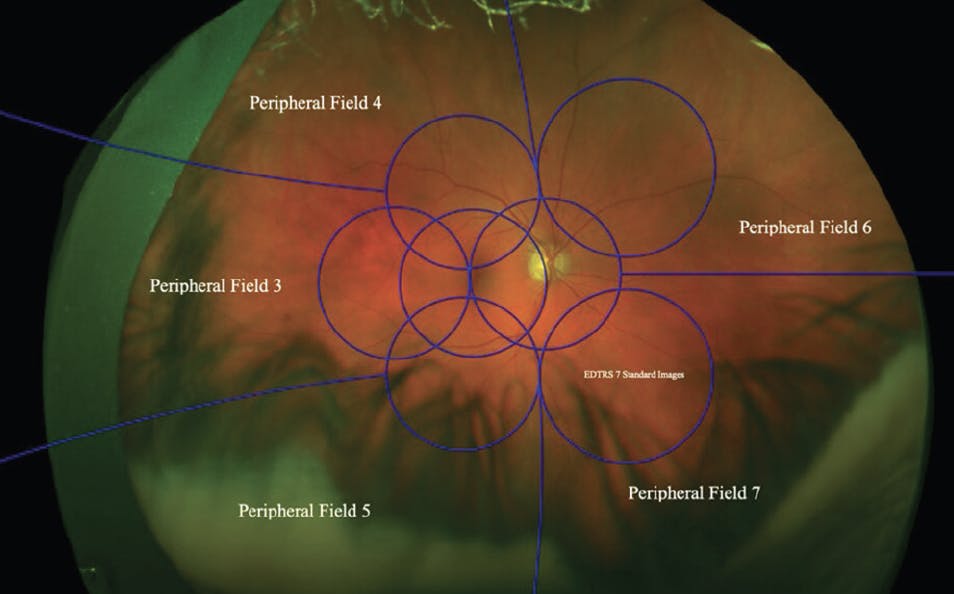
Figure 1. This UWF fundus color photograph demonstrates the ETDRS 7-standard-field images (blue circles) and peripheral fields 3-6.
(Image courtesy of Dennis Marcus, MD)
Hemorrhages and microaneurysms were the most common PPLs seen in 81% and 91% of UWF color images and UWF FA, respectively. PPLs were most likely in peripheral fields 3, 4, and 6. Baseline DRSS levels from ETDRS fields on UWF color imaging showed that 45%, 40%, 26%, and 43% of patients with mild, moderate, moderately severe, and severe NPDR, respectively, met the study’s primary objective (DRSS worsening by 2 or more steps) over the 4-year study period.18 It is unclear why these rates of DR progression are not consistent with the expected increase in progression rates usually seen with worsening baseline DRSS level; however, prior DRCR studies have demonstrated consistency between digital and film photographs, which were originally used in the ETDRS.19
Over the 4-year study period, the risk of DR progression was associated with PPLs seen on UWF FA, but not with those seen on UWF color photography (Figure 2). Eyes with PPLs on UWF FA had a 1.7-fold increased risk of DR progression compared with eyes without PPLs on UWF FA. Specifically, peripheral hemorrhages and microaneurysms and intraretinal microvascular abnormalities on UWF FA were associated with an increased risk of DRSS worsening.18
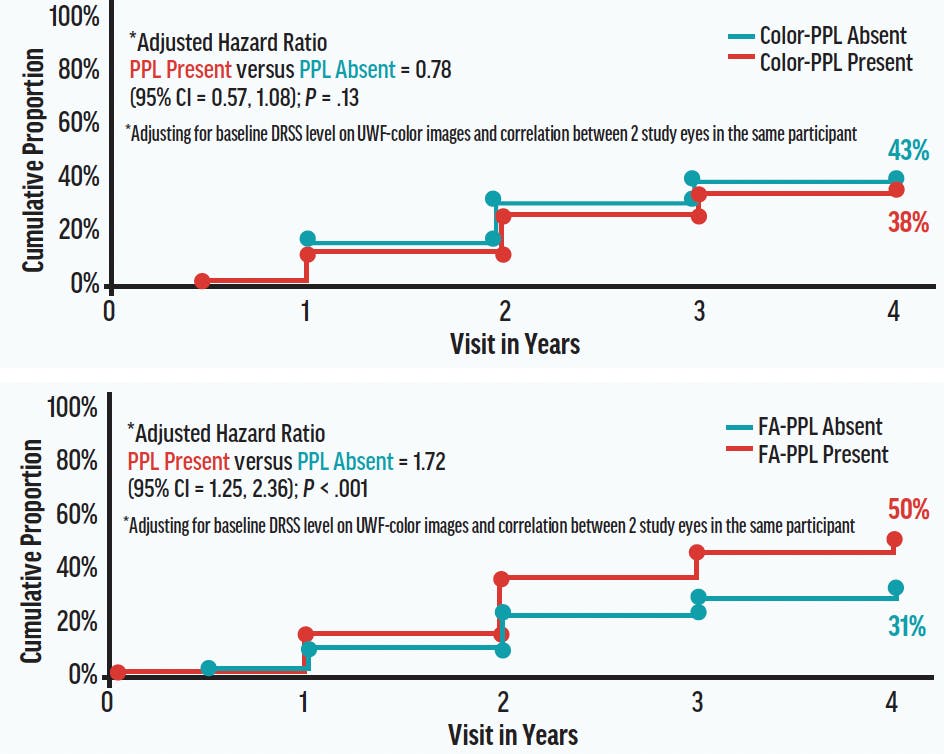
Figure 2. The proportion of eyes with PPLs on UWF color photography (top) and UWF FA (bottom) over 4 years in Protocol AA.18
(Images courtesy of DRCR Retina Network)
RETINAL NONPERFUSION INDEX
Protocol AA also assessed the association between retinal nonperfusion and PPL presence and DR severity worsening. The area of nonperfusion (mm2) and the nonperfusion index (NPI, the area of nonperfusion divided by the total gradable area) were the primary metrics evaluated (Figure 3). In this cohort of 508 eyes with NPDR and gradable UWF FA nonperfusion at baseline, only 9% of eyes had no nonperfusion.20
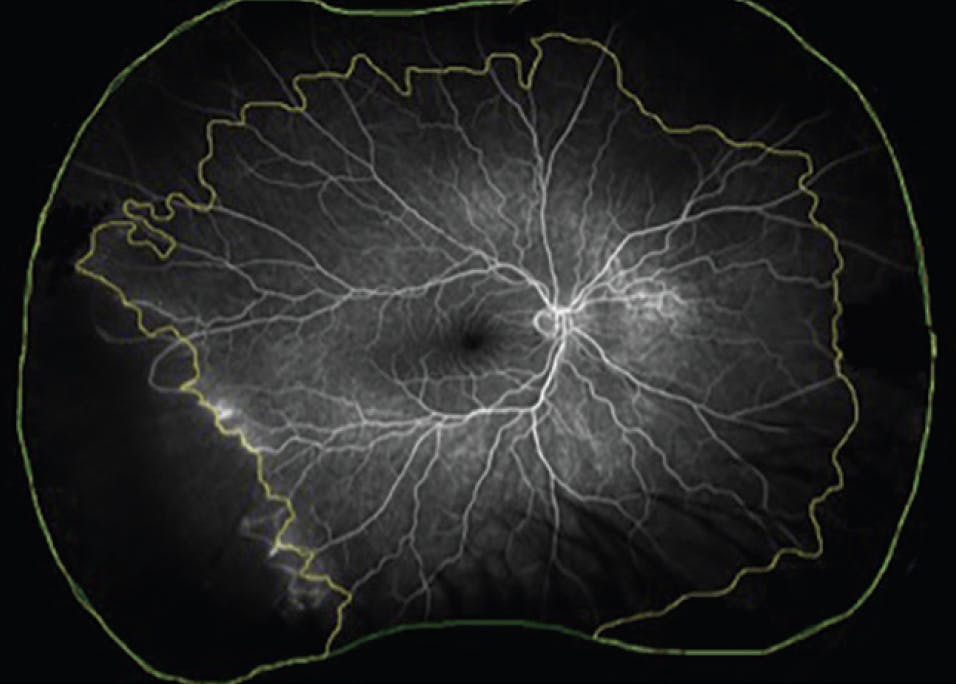
Figure 3. UWF FA demonstrates the total gradable area and area of nonperfusion used in calculating NPI. Area of nonperfusion is measured between the yellow and green lines. The total gradable area is measured within the green line.
(Images courtesy of DRCR Retina Network)
In the study, 26%, 43%, 38%, and 46% of eyes in the no, low, medium, and high nonperfusion subgroups, respectively, had worsening DR by at least 2 steps or required treatment. This suggests that increasing NPI is a significant risk factor for progression and may be useful in DR monitoring (Figure 4).20
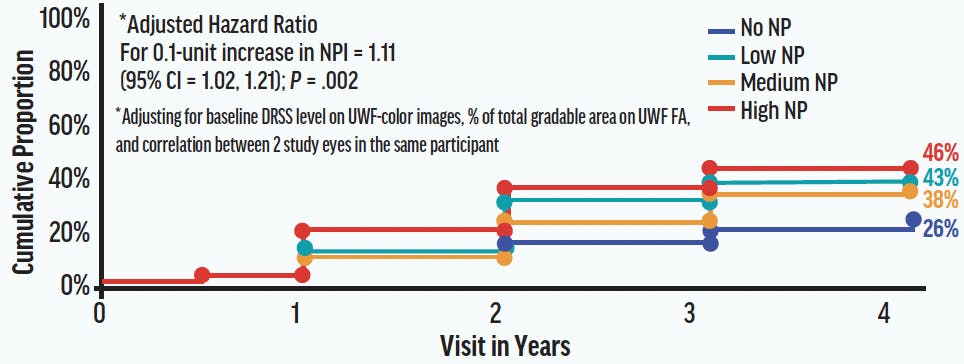
Figure 4. The proportion of eyes with no, low, medium, and high levels of nonperfusion through 4 years of follow-up in Protocol AA.20
(Images courtesy of DRCR Retina Network)
Furthermore, higher levels of nonperfusion in the ETDRS fields 6 and 7, midperiphery and posterior pole, and superior, inferior, and nasal peripheral retina were all significantly associated with a higher risk of progression. Similarly, greater NPI was associated with an increased risk for progression to proliferative DR and the development of vitreous hemorrhage.20
CLINICAL PEARLS
The 4-year longitudinal results of Protocol AA highlight the advantage of UWF color photography and UWF FA in managing patients with diabetes. PPLs and higher nonperfusion areas on UWF FA can serve as predictors for DR progression and are beneficial tools to assess patients with NPDR. However, the advantages of UWF FA should be weighed against the drawbacks of increased cost, time, and risks associated with FA, especially in patients with NPDR for whom FA is not routinely obtained at baseline. However, UWF FA provides more information than that observed on clinical examination and color fundus photography.
We recommend using baseline UWF FA for patients with NPDR who are at a higher risk for disease progression, such as those with long-standing disease, poor glycemic control, long-term insulin use, dyslipidemia, and other vasculopathic risk factors. It can also be a useful tool when counseling patients about the need to better control their diabetes.
1. ETDRS Research Group. Grading diabetic retinopathy from stereoscopic color fundus photographs--an extension of the modified Airlie House classification. ETDRS report number 10. Ophthalmology. 1991;98(5 Suppl):786-806.
2. Wilkinson C, Ferris F, Klein R, et al. Proposed international clinical diabetic retinopathy and diabetic macular edema disease severity scales. Ophthalmology. 2003;110(9):1677-1682.
3. Choudhry N, Duker J, Freund K, et al. Classification and guidelines for widefield imaging: recommendations from the International Widefield Imaging Study Group. Ophthalmol Retina. 2019;3(10):843-849.
4. Shoughy S, Arevalo J, Kozak I. Update on wide- and ultra-widefield retinal imaging. Indian J Ophthalmol. 2015;63(7):575-551.
5. Ashraf M, Shokrollahi S, Salongcay R, Aiello L, Silva P. Diabetic retinopathy and ultrawide field imaging. Semin Ophthalmol. 2020;35(1):56-65.
6. Silva P, Cavallerano J, Haddad N, et al. Peripheral lesions identified on ultrawide field imaging predict increased risk of diabetic retinopathy progression over 4 years. Ophthalmology. 2015;122(5):949-956.
7. Wessel M, Aaker G, Parlitsis G, Cho M, D’Amico D, Kiss S. Ultra-wide-field angiography improves the detection and classification of diabetic retinopathy. Retina. 2012;32(4):785-791.
8. Silva P, Dela Cruz A, Ledesma M, et al. Diabetic retinopathy severity and peripheral lesions are associated with nonperfusion on ultrawide field angiography. Ophthalmology. 2015;122(12):2465-2472.
9. Silva P, Cavallerano J, Sun J, Noble J, Aiello L, Aiello L. Nonmydriatic ultrawide field retinal imaging compared with dilated standard 7-field 35-mm photography and retinal specialist examination for evaluation of diabetic retinopathy. Am J Ophthalmol. 2012;154(3):549-559.e2.
10. Kernt M, Hadi I, Pinter F, et al. Assessment of diabetic retinopathy using nonmydriatic ultra-widefield scanning laser ophthalmoscopy (Optomap) compared with ETDRS 7-field stereo photography. Diabetes Care. 2012;35(12):2459-2463.
11. Rasmussen M, Broe R, Frydkjaer-Olsen U, et al. Comparison between Early Treatment Diabetic Retinopathy Study 7-field retinal photos and non-mydriatic, mydriatic and mydriatic steered widefield scanning laser ophthalmoscopy for assessment of diabetic retinopathy. J Diabetes Complications. 2015;29(1):99-104.
12. Aiello L, Odia I, Glassman A, et al. Comparison of Early Treatment Diabetic Retinopathy Study standard 7-field imaging with ultrawide-field imaging for determining severity of diabetic retinopathy. JAMA Ophthalmol. 2019;137(1):65-73.
13. Silva P, Cavallerano J, Tolls D, et al. Potential efficiency benefits of nonmydriatic ultrawide field retinal imaging in an ocular telehealth diabetic retinopathy program. Diabetes Care. 2014;37(1):50-55.
14. Silva P, Cavallerano J, Sun J, Soliman A, Aiello LM, Aiello LP. Peripheral lesions identified by mydriatic ultrawide field imaging: distribution and potential impact on diabetic retinopathy severity. Ophthalmology. 2013;120(12):2587-2595.
15. Price L, Au S, Chong N. Optomap ultrawide field imaging identifies additional retinal abnormalities in patients with diabetic retinopathy. Clin Ophthalmol. 2015;9:527-531.
16. Talks S, Manjunath V, Steel D, Peto T, Taylor R. New vessels detected on wide-field imaging compared to two-field and seven-field imaging: implications for diabetic retinopathy screening image analysis. Br J Ophthalmol. 2015;99(12):1606-1609.
17. Neubauer A, Kernt M, Haritoglou C, Priglinger S, Kampik A, Ulbig M. Nonmydriatic screening for diabetic retinopathy by ultra-widefield scanning laser ophthalmoscopy (Optomap). Graefes Arch Clin Exp Ophthalmol. 2008;246(2):229-235.
18. Marcus D, Silva P, Liu D, et al. Association of predominantly peripheral lesions on ultra-widefield imaging and the risk of diabetic retinopathy worsening over time. JAMA Ophthalmol. 2022;140(10):946-954.
19. Gangaputra S, Almukhtar T, Glassman AR, et al. Comparison of film and digital fundus photographs in eyes of individuals with diabetes mellitus. Invest Ophthalmol Vis Sci. 2011;52(9):6168-6173.
20. Silva P, Marcus D, Liu D, et al. Association of ultra-widefield fluorescein angiography-identified retinal nonperfusion and the risk of diabetic retinopathy worsening over time. JAMA Ophthalmol. 2022;140(10):936-945.


