


OCT and OCT angiography (OCTA) have revolutionized our understanding of retinal diseases. The four macular capillary plexuses can now be readily identified with depth-resolved precision.1 Recently, Cabral et al used high-resolution OCT to study macular perfusion and proposed a blood flow connectivity pattern consistent with reported histologic studies (Figure 1).2 With the technological progress of OCT, a new spectrum of macular ischemic changes can be identified and linked to a specific sequence of capillary plexus hypoperfusion.3-5
In this article, we discuss two important, and not uncommon, OCT abnormalities: paracentral acute middle maculopathy (PAMM) and acute macular neuroretinopathy (AMN)
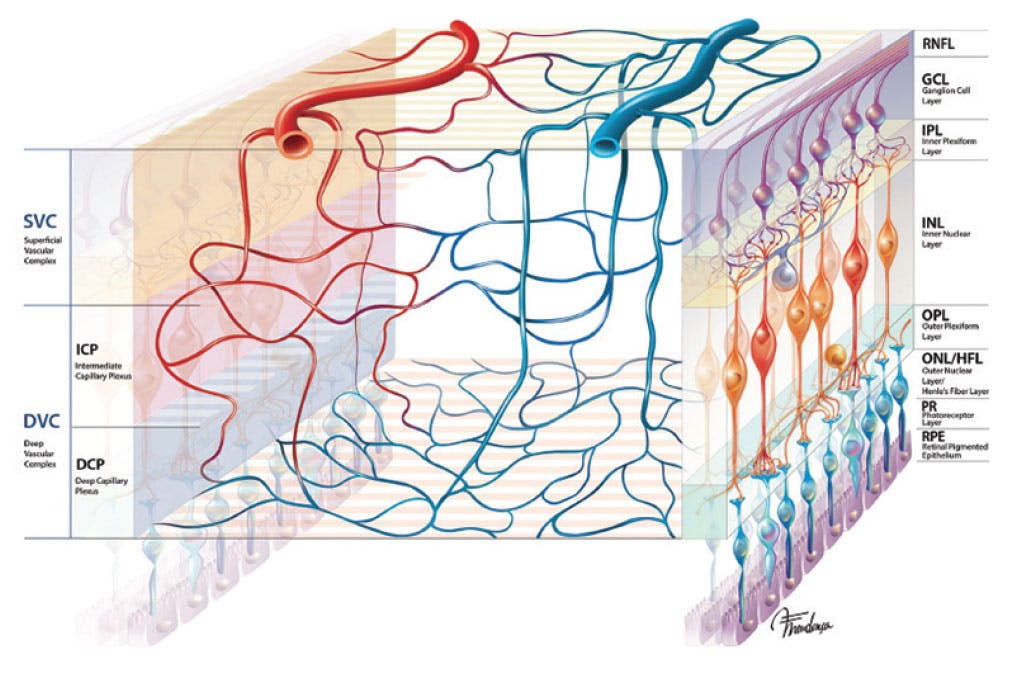
Figure 1. This schematic representation of the parafoveal vascular network demonstrates the most frequently observed connectivity patterns seen with high-resolution OCT. The superficial capillary plexus is directly supplied by the major arteries while the DCP receives its blood supply from smaller interconnected arterioles arising from the intermediate retinal capillary plexus. The DCP is the predominant level of venous outflow.2 Image courtesy of Cabral et al.
PARACENTRAL ACUTE MIDDLE MACULOPATHY
PAMM is a spectral-domain OCT (SD-OCT) finding that is characterized by a hyperreflective band at the level of the inner nuclear layer (INL) with or without extension into the adjacent inner plexiform layer (IPL) and the outer plexiform layer (OPL).3
PAMM can be focal, multifocal, or diffuse, and this pattern is best appreciated with en face OCT. These hyperreflective PAMM lesions represent acute infarction of the middle retinal layer or INL secondary to deep capillary plexus (DCP) hypoperfusion, which resolves to leave permanent INL thinning.
PAMM can be the earliest sign of macular ischemia, referred to as the ischemic cascade described in association with retinal vascular occlusion (eg, central retinal artery or vein occlusion [CRVO]).6,7
At the initial stage of macular hypoperfusion, the middle retinal layers are at the greatest risk of infarction owing to their high metabolic demand and the vulnerable nature of the DCP. With more severe forms of occlusion, deep infarction progresses anteriorly to involve the inner retinal layer.6
ACUTE MACULAR NEURORETINOPATHY
Bos and Deutman first reported AMN in 1975, and Fawzi et al further analyzed the condition using multimodal imaging in 2012.3,8 The earliest lesions seen with OCT are associated with disruption of the OPL, followed by retrograde extension through the Henle fiber layer (HFL) with associated impairment of the ellipsoid zone (EZ) and interdigitation zone (IZ).
Hyperreflective lesions resolve over time and can leave outer nuclear layer (ONL) thinning with the potential to disrupt the junction between the outer photoreceptor segment and retinal pigment epithelium (RPE). Although the etiology of AMN is debatable, most studies correlate AMN with DCP ischemia.3,4,9 Cabral et al localized AMN lesions to the center of the DCP vortices at the level of collecting venules using a complex OCT angiography analysis investigation.10
COINCIDENT PAMM AND AMN
Although PAMM and AMN are distinct entities,11 they have overlapping features. Both are associated with paracentral scotomas, and each manifests as parafoveal hyperreflective lesions on OCT and hyporeflective lesions on near-infrared reflectance (NIR). Moreover, both entities are attributed to DCP hypoperfusion.6,9,10
However, the acute lesions of PAMM characteristically appear in the INL, while AMN lesions start in the OPL. Additionally, PAMM lesions progress anteriorly and spare the outer retinal layers, while AMN lesions progress posteriorly and can cause permanent disruption of EZ and IZ.
Recently, Iovino et al reported coincident PAMM and AMN lesions in the same eye, implicating a common pathology (Figure 2).12 The authors found an association of PAMM and AMN in eyes with retinal vein occlusion (CRVO, hemi-RVO) and Purtscher-like retinopathy. With Purtscher, all three levels of retinal impairment were identified in the affected eye, including inner retinal infarction (ie, cotton-wool spots), middle retinal infarction (ie, PAMM), and outer retinal disruption (ie, AMN). Impairment of the DCP can cause infarction not only to the middle retina and INL but can also, rarely, disrupt the contiguous HFL with retrograde disruption of the outer retina. This can lead to AMN, known as angular sign of HFL hyperreflectivity (ASHH) with OCT.13
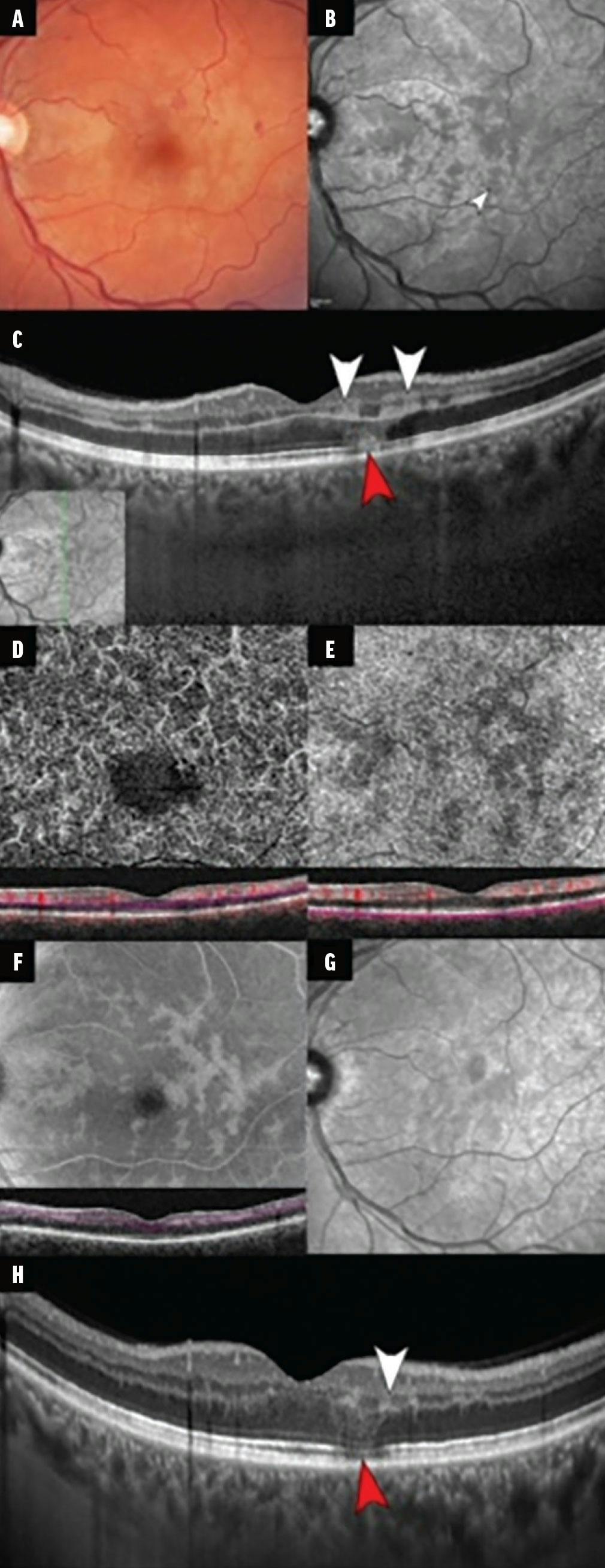
Figure 2. This patient displays coincident PAMM and AMN in an eye with CRVO. Color fundus photography shows perivenular retinal whitening in the macula with scattered retinal hemorrhages and venous dilation consistent with CRVO (A). NIR imaging shows perivenular hyporeflectivity corresponding to the PAMM lesions (B; white arrow). The vertical SD-OCT B-scan shows hyperreflective band-like lesions primarily involving the INL and extending into the adjacent IPL/OPL consistent with PAMM (C). Note the characteristic hyperreflective lesion, consistent with AMN, present in the ONL and radiating in the HFL. The NIR reflectance image indicates the location of the SD-OCT B-scan (C, inset). En face OCTA of the DCP shows multiple areas of absent decorrelation signal that colocalize with the PAMM lesions on OCT (D). The cross-sectional SD-OCT B-scan indicates the segmentation (pink lines) of the corresponding OCTA at the level of the DCP (D, inset). En face OCTA imaging of the choriocapillaris shows areas of flow signal loss presumably attributed to shadow artifacts from the overlying PAMM lesions (E). The cross-sectional SD-OCT B-scan indicates the segmentation (pink lines) of the corresponding OCTA at the level of the choriocapillaris (E, inset). Follow-up en face OCT at 1 month segmented at the level of the DCP shows attenuation of the fern-like pattern (F). The follow-up NIR image at 1 month shows decreased hyperreflectivity of the PAMM lesion (G). Follow-up eye-tracked macular OCT at 1 month shows subsequent thinning of the INL consistent with INL infarction in areas of prior PAMM lesions (H; white arrow). Although the hyperreflectivity of the AMN lesion is partially resolved, there is persistence of the EZ-IZ disruption (red arrow).12 Images courtesy of Iovino et al.
THE MISSING LINK?
The HFL is comprised of bundles of unmyelinated photoreceptor axons intermingled with outer Müller cell processes with a 1 to 1 ratio.13 It has a unique distribution within the macular area. At the foveal center, the HFL is short and vertical. In the perifoveal region, the obliqueness of the striations increases, and the HFL assumes an almost horizontal trajectory, giving rise to the typical Z-shape HFL pattern. Outside the perifovea, the obliqueness of the striation decreases, and the HFL again assumes almost a vertical pathway (Figure 3).13,14
The Müller cell bodies reside within the INL and receive their blood supply via the DCP.15 Interestingly, histopathology of hypoperfused Müller cells shows cytoplasm swelling without enlargement of intercellular spaces.16 Also, the DCP functions as the main source of blood supply to the synaptic layer of the OPL, which is connected to the contiguous HFL.17 Thus, although photoreceptors receive most of their nutritional support from the choroidal circulation, impairment of the DCP can affect the photoreceptor inner segment and/or cause Müller cell disruption within the HFL. This might explain the potential retrograde extension of AMN lesions towards outer retinal layers.18
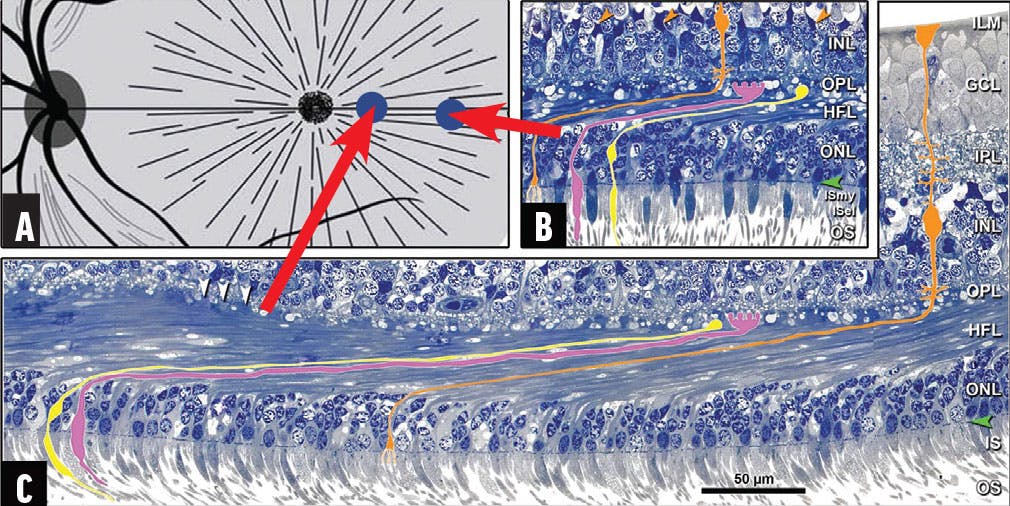
Figure 3. The en face view of Henle fibers in a normal macula shows their radial dispersion from the foveal center (A). In the perifoveal area of the central section, the Henle fibers are longitudinally oriented but short (B). A Müller cell (orange), rod (yellow), and cone (pink) photoreceptor and the Müller cell bodies (arrowheads) are shown. Close to the fovea in the central section, the Henle fibers are longitudinally oriented and long (C).14 Image adapted from Li et al.
OCTA studies show that PAMM is the result of DCP impairment,19,20 and more recently Chu et al confirmed that PAMM was associated with reduced DCP and middle capillary plexus flow signals, and occasionally superficial capillary plexus as well, while the flow reduction in AMN was limited to DCP alone.9 Furthermore, the DCP impairment in AMN may occur at the level of the capillary vortex or draining venule.10
The location of outer retinal changes associated with DCP ischemia appears to be influenced by the length and orientation of HFL.
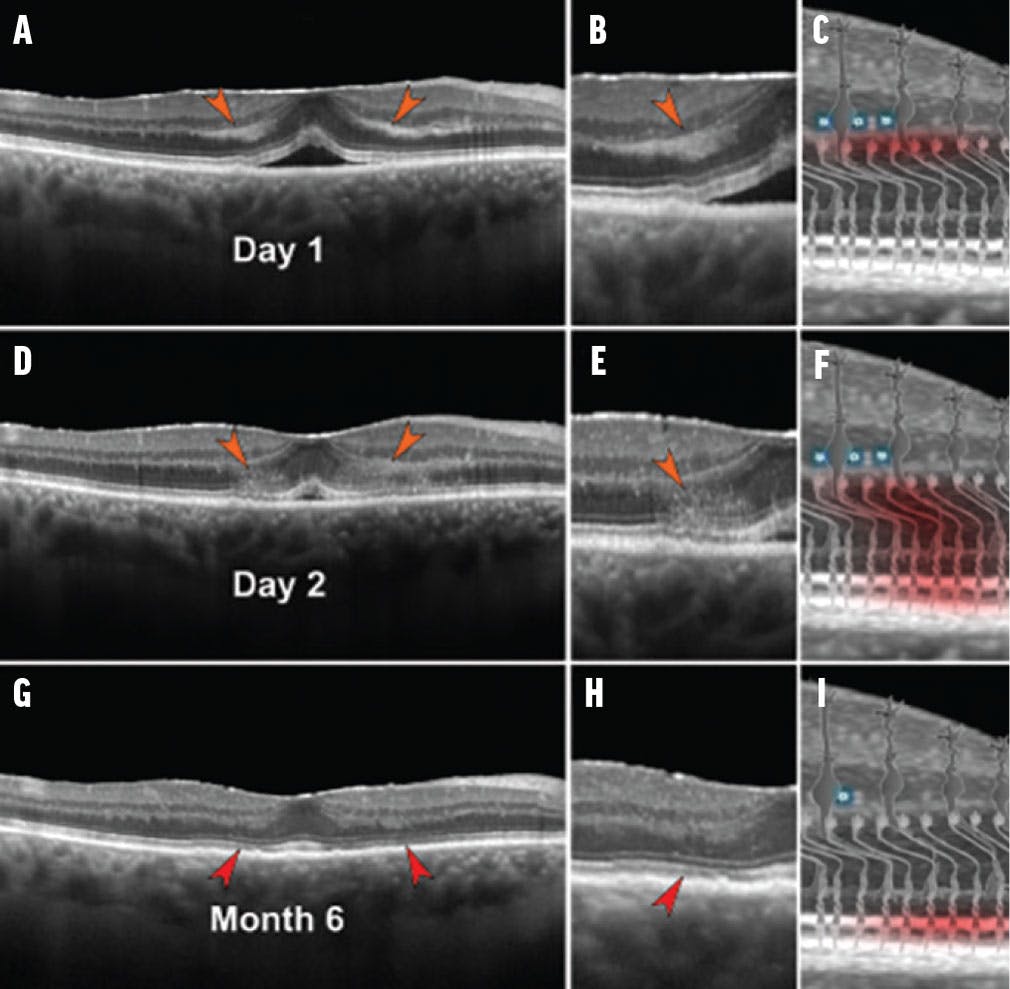
Figure 4. SD-OCT horizontal B-scan through the fovea shows hyperreflective lesions (orange arrowheads) confined to the OPL and HFL (A, B). Schematic representation of the presumed hyperacute damages in AMN, including DCP disruption and photoreceptor synapse and axon insults (C). Tracked OCT B-scan shows retrograde extension of the hyperreflective lesions to the ONL, EZ, and IZ (D; arrowheads). The angular configuration of the hyperreflective lesions is especially apparent in the temporal side of the fovea (E). Persistent DCP alteration can be observed in the schematic representation of the ASHH in AMN characterized by retrograde extension of the insult to the whole photoreceptor length (F). Tracked OCT B-scan shows resolution of ASHH and persistent OPL, HFL, and ONL thinning with EZ/IZ attenuation (G; red arrow). The OCT image was acquired 6 months after the symptom onset. A magnified view of resolved ASHH shows thinning of the OPL, HFL, and ONL and attenuation of the EZ/IZ reflectivity (H; red arrow). The schematic representation indicates resolved ASHH in AMN (I). Long-term DCP disruption can be detected but is usually more subtle on OCTA, and attenuation of the photoreceptor’s inner and outer segments is displayed.13 Image adapted from Ramtohul et al.
Ramtohul et al proposed a novel OCT biomarker indicative of acute photoreceptor disruption involving the HFL, the ASHH of macular disease.13 This sign unifies the pathoanatomy common to various disorders affecting the HFL including those that result from DCP impairment such as AMN (i.e. retrograde disruption of the HFL) and those that result from anterograde disruption of the HFL such as trauma, laser, and APMPPE (Figure 4).13
Thus, we presume that deep capillary retinal impairment can have two serious macular implications. The first and most common is PAMM, which represents INL infarction with the rare potential for anterograde progression following the predominantly vertical arrangement of the retinal capillary plexus.6 The second is AMN, which may arise as a result of OPL ischemia with retrograde disruption of the Müller cell processes and/or photoreceptor axons comprising the HFL.&
1. Campbell JP, Zhang M, Hwang TS, et al. Detailed vascular anatomy of the human retina by projection-resolved optical coherence tomography angiography. Sci Rep. 2017;7:42201.
2. Cabral D, Fradinho AC, Pereira T, et al. Macular vascular imaging and connectivity analysis using high-resolution optical coherence tomography. Transl Vis Sci Technol. 2022;11(6):2.
3. Fawzi AA, Pappuru RR, Sarraf D, et al. Acute macular neuroretinopathy: long-term insights revealed by multimodal imaging. Retina. 2012;32(8):1500-1513.
4. Sarraf D, Rahimy E, Fawzi AA, et al. Paracentral acute middle maculopathy: a new variant of acute macular neuroretinopathy associated with retinal capillary ischemia. JAMA Ophthalmol. 2013;131(10):1275-1287.
5. Long CP, Chan AX, Bakhoum CY, et al. Prevalence of subclinical retinal ischemia in patients with cardiovascular disease - a hypothesis driven study. EClinicalMedicine. 2021;33:100775.
6. Bakhoum MF, Freund KB, Dolz-Marco R, et al. Paracentral acute middle maculopathy and the ischemic cascade associated with retinal vascular occlusion. Am J Ophthalmol. 2018;195:143-153.
7. Zhao PY, Johnson MW, McDonald HR, Sarraf D. paracentral acute middle maculopathy and the ischemic cascade: toward interventional management. Am J Ophthalmol. 2022;234:15-19.
8. Bos PJ, Deutman AF. Acute macular neuroretinopathy. Am J Ophthalmol. 1975;80(4):573-584.
9. Chu S, Nesper PL, Soetikno BT, Bakri SJ, Fawzi AA. Projection-resolved OCT angiography of microvascular changes in paracentral acute middle maculopathy and acute macular neuroretinopathy. Invest Ophthalmol Vis Sci. 2018;59(7):2913-2922.
10. Cabral D, Ramtohul P, Zatreanu L, et al. Deep capillary plexus features in acute macular neuroretinopathy: novel insights based on the anatomy of Henle fiber layer. Invest Ophthalmol Vis Sci. 2022;63(13):4.
11. Rahimy E, Kuehlewein L, Sadda SR, Sarraf D. Paracentral acute middle maculopathy: What we knew then and what we know now. Retina. 2015;35(10):1921-1930.
12. Iovino C, Au A, Ramtohul P, et al. Coincident PAMM and AMN and insights into a common pathophysiology. Am J Ophthalmol. 2022;236:136-146.
13. Ramtohul P, Cabral D, Sadda S, Freund KB, Sarraf D. The OCT angular sign of Henle fiber layer (HFL) hyperreflectivity (ASHH) and the pathoanatomy of the HFL in macular disease. Prog Retin Eye Res. 2023;95:101135.
14. Li M, Huisingh C, Messinger J, et al. Histology of geographic atrophy secondary to age-related macular degeneration: a multilayer approach. Retina. 2018;38(10):1937-1953.
15. Bringmann A, Pannicke T, Grosche J, et al. Müller cells in the healthy and diseased retina. Prog Retin Eye Res. 2006;25(4):397-424.
16. Fine BS, Brucker AJ. macular edema and cystoid macular edema. Am J Ophthalmol. 1981;92(4):466-481.
17. Yu DY, Cringle SJ. Oxygen distribution and consumption within the retina in vascularised and avascular retinas and in animal models of retinal disease. Prog Retin Eye Res. 2001;20(2):175-208.
18. Pecen PE, Smith AG, Ehlers JP. Optical coherence tomography angiography of acute macular neuroretinopathy/paracentral acute middle maculopathy. JAMA Ophthalmol. 2015;133(12):1478-1480.
19. Scharf J, Freund KB, Sadda S, Sarraf D. Paracentral acute middle maculopathy and the organization of the retinal capillary plexuses. Prog Retin Eye Res. 2021;81:100884.
20. Nemiroff J, Phasukkijwatana N, Sarraf D. Optical coherence tomography angiography of deep capillary ischemia. Dev Ophthalmol. 2016;56:139-145.


