


Millions travel to high-altitude destinations each year without fully understanding the potential medical risks involved. High-altitude illnesses, including acute mountain sickness (AMS), high-altitude cerebral edema (HACE), high-altitude pulmonary edema, and high-altitude retinopathy (HAR), are associated with the hypobaric nature of high altitudes. These conditions are commonly observed at altitudes greater than 2,500 m (8,200 ft) in non-acclimatized individuals shortly after ascent and may be caused by hypobaric hypoxia-induced compensatory mechanisms to boost delivery of oxygen.1,2
HAR DEFINED
HAR was first described in 1969 by Singh et al,3 who noted increased dilatation and tortuosity of retinal vasculature, along with scattered dot-blot and flame-shaped hemorrhages, in 24 (1.3%) of 1,925 patients who were diagnosed with AMS after ascending to between 3,353 m and 5,486 m above mean sea level.3
HAR is usually asymptomatic and self-limiting, with most manifestations resolving spontaneously after descent.4 Typically, HAR occurs in individuals who ascend above 2,500 m but can occur at as low as 2,000 m.5-7 Symptomatic patients may experience unilateral or bilateral decreased vision, scotoma, and/or sudden onset of floaters after 8 to 24 hours of high-altitude exposure (see Case Example of HAR).4,8 Severe manifestations rarely occur, but isolated cases of anterior ischemic optic neuropathy, branch retinal artery occlusion, central retinal vein occlusion, cilioretinal artery occlusion, and cystoid macular edema have been reported with poor visual recovery.9,10-14
RISK AND INCIDENCE
Risk factors for HAR include rapid ascent, high maximum altitude, high baseline IOP, genetic susceptibility, and use of NSAIDs.7,15 HAR has been reported more frequently in individuals of young age, and its prevalence varies widely. McFadden et al noted retinal hemorrhages in 56% of 39 healthy individuals after a stay at 5,360 m,16 whereas Barthelmes et al reported an incidence of up to 79% of 28 climbers during a high-altitude expedition.17
PATHOPHYSIOLOGY
Various theories have been proposed to elucidate the pathogenesis of HAR. Hypobaric hypoxia experienced at a high altitude induces various compensatory mechanisms aimed to maintain oxygen delivery, and it is thought that inadequate autoregulatory response of the retinal vascular system is the primary cause of HAR.17,18 That is, hypoxia is assumed to cause increased retinal blood flow and intravenous pressure secondary to intracranial pressure, variations in hematocrit levels, extreme physical exertion, and Valsalva maneuvers during mountain climbing at high elevation. A hypoxic vasodilatation exposed to increased retinal venous pressure leads to a predisposition to intraretinal hemorrhages.9,17 Reduced IOP at high altitudes may also contribute to the progression of intraretinal hemorrhages.19 Moreover, the increase of cerebral vascular blood flow and disruption of the blood-brain barrier caused by hypoxia can lead to cerebral edema, which results in optic disc swelling.20
INVESTIGATING THE MECHANISMS
Xin et al conducted a randomized study that explored the effects of hypobaric hypoxia on the retinas of rats to investigate whether resveratrol has a protective effect on hypoxic damage.21 The study concluded that hypobaric hypoxia increased thioredoxin 1 and thioredoxin 2 expression in the retina, and resveratrol treatment significantly reversed these findings (P < .05 and P < .05, respectively). Therefore, resveratrol may be beneficial as a treatment for HAR by exerting an antioxidative role and modulating genes associated with hypoxia-induced stress; it may also regulate apoptosis-related cytokines.21
Case Example of HAR
A large preretinal hemorrhage occurred 1 day after exposure to high elevation.
By E. Anne Shepherd, MD; Naryan Sabherwal, MD; and Mathew MacCumber, MD, PhD


A 32-year-old healthy woman presented with sudden vision loss in her left eye. She saw a “gray thumb print” with her left eye that occurred in the early morning. She denied physical exertion at the time of the vision loss; however, the day before, she had been skiing on trails at an elevation of roughly 3,962 m (13,000 ft) with limited hydration because her water bottle had frozen.
The patient’s BCVA was 20/20 OD and 20/400 OS with no improvement with pinhole. She had no afferent pupillary defect, and her IOPs were 13 mm Hg OD and 11 mm Hg OS. Her motility and confrontational fields were full. Her anterior segment examination was normal.
Examination of the posterior segment demonstrated a normal right eye, while the left eye had slightly tortuous vessels, a large preretinal/sub-internal limiting membrane (ILM) hemorrhage, a superior subretinal hemorrhage, and a flame-shaped retinal hemorrhage along the inferior arcade (Figure 1). Fluorescein angiography demonstrated normal arterial and venous filling times, without evidence of leakage. No macroaneurysm was identified.
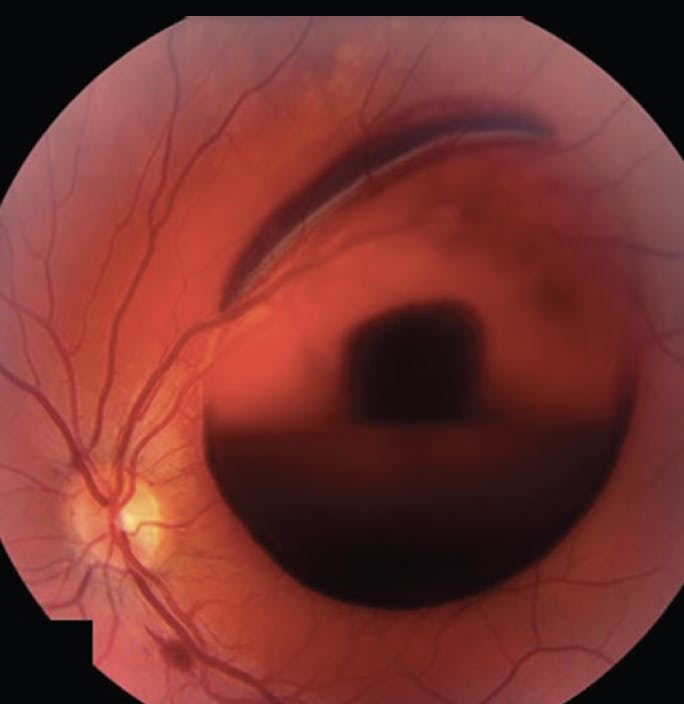
Figure 1. On fundus photography, the left eye demonstrated slight venous tortuosity, a large preretinal/sub-ILM hemorrhage, a superior subretinal hemorrhage, and a small flame-shaped hemorrhage along the inferotemporal arcade.
We decided to observe the patient closely and referred her to her primary care physician for systemic workup of blood pressure and altered coagulability, which was normal. When she returned 1 week later, her preretinal hemorrhage had mildly worsened.
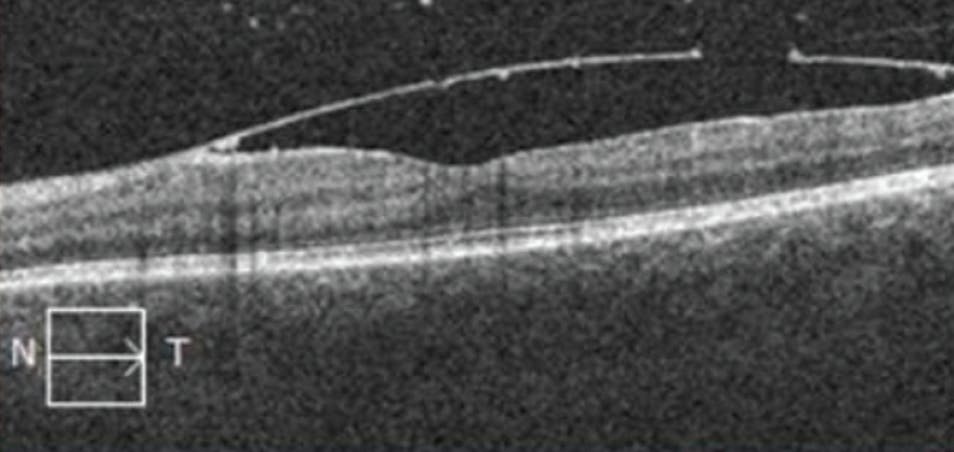
After discussion with the patient, she was treated with Nd:YAG laser of the posterior hyaloid/ILM to release the hemorrhage (Figure 2). After treatment, a break in the ILM can be seen on OCT (Figure 3). At the 1-week follow-up, the patient’s VA improved to 20/40, with further improvement to 20/30 upon resolution of mild inferior vitreous hemorrhage.
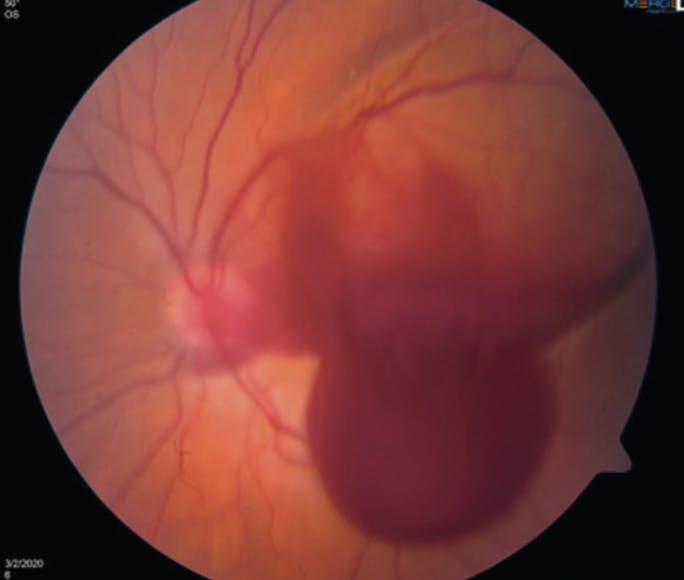
To our knowledge, our patient experienced the largest documented retinal hemorrhage due to high-altitude retinopathy occurring 1 day after returning from a high altitude. Low oxygen saturation and higher-than-usual hematocrit potentially increased her risk of HAR during and after descent.
E. Anne Shepherd, MD
Rush University Medical Center, Department of Ophthalmology, Chicago
Financial disclosure: None
Naryan Sabherwal, MD
Rush University Medical Center, Department of Ophthalmology, Chicago
Illinois Retina Associates, Chicago
Financial disclosure: None
Mathew MacCumber, MD, PhD
Rush University Medical Center, Department of Ophthalmology, Chicago
Illinois Retina Associates, Chicago
mmaccumber@illinoisretina.com
Financial disclosure: None
In 2022, Xin et al used a low-pressure oxygen cabin mimicking 5,000 m altitude to evaluate whether pyroptosis is involved in the mechanism of retinal dysfunction in rat retinas.22 Hypobaric hypoxia significantly increased the expression of proinflammatory cytokines, including interleukin-1 beta and interleukin-18, indicating that pyroptosis is involved in the pathogenesis of HAR.
A recent study looked at the molecular mechanism of HAR. Su et al used an integrated bioinformatics analysis and a hypoxia-induced cell culture to identify genes FOS, IL10, IL7R, and seven different miRNAs as candidate biomarkers of HAR, which may help explain an individual’s increased susceptibility to this condition.23
ASSESSMENT AND DIAGNOSTIC IMAGING
Patients with HAR usually have a history of ascent to a high-altitude location or even air travel with or without visual symptoms.6,24 Fundus photography may show an increase in the diameter of retinal vessels with tortuosity of arterioles and venules, along with diffuse dot-blot and flame-shaped hemorrhages, usually involving the midperiphery. Cotton-wool spots, Roth spots, vitreous hemorrhages, and papilledema may occasionally be seen as well.4,8,17,25
OCT may detect a significant increase in retina nerve fiber layer thickness in the temporal and nasal quadrants of the optic disc, along with an increase in the ganglion cell layer thickness in the superior macula. In one report, these changes were temporary and returned to baseline upon descent.26 Another study showed an increase in temporal and superior retina nerve fiber layer thickness following high-altitude exposure.27
Fluorescein angiography may show bilateral leakage of retinal vessels peripherally, favoring venules more than arterioles, and optic disc staining. These findings resolve completely after descent to baseline altitude.28 The reduction in retinal function may also be detected by multifocal electroretinography, showing reduced responses in the macula that recover with time upon descent.29
One case reported an increase in choroidal thickness (up to 530 μm) on OCT in a patient with HAR, suggesting that the hypoxia-induced increase in retinal blood flow could be associated with an increase in the choroidal blood flow and an increase in choroidal thickness.30 However, more studies are required to confirm choroidal changes in HAR.
TREATMENT AND PROGNOSIS
Although no evidence-based treatment exists for HAR and no active intervention is typically required, some reports suggest the use of steroids, nonsteroidal antiinflammatory drugs, diuretics, and supplemental oxygen, although without consistent evidence of effectiveness.31 Hyperbaric oxygen therapy has also been suggested.10
The prognosis is favorable, with patients generally regaining their full vision in the weeks after descent. Visual impairment is rare, although it may occur in severe manifestations of HAR (eg, cilioretinal artery occlusion,10 central retinal vein occlusion12). Recommendations for prevention include a slow ascent (no more than 300 m a day), allowing time for acclimatization, and immediate descent to baseline altitude if symptoms are progressing.32
A POSSIBLE SIGN OF TROUBLE
Whether HAR is related to life-threatening conditions at high altitude is still a matter of debate. Clarke et al reported retinal hemorrhages as common findings due to the acclimatization process and denied their association with impending cerebral edema.33 Other findings suggest that vasogenic cerebral edema and altered autoregulation of the cerebral blood flow may correlate with AMS and HACE.34,35 Thus, early diagnosis may alert physicians to recommend immediate descent to avoid further progression of HAR or more serious, potentially fatal high-altitude illness.36
Further studies are required to investigate the significance of HAR and whether it is a useful warning sign of potentially fatal conditions on the spectrum of high-altitude illnesses.
1. Fuehrer J, McGowan J, Huecker MR. High altitude cardiopulmonary diseases. In:StatPearls. Updated April 9, 2023. Accessed June 27, 2023. www.ncbi.nlm.nih.gov/books/NBK442011
2. West JB. English translation of nomenclature, classification, and diagnostic criteria of high altitude disease in China. High Alt Med Biol. 2010;11(2):169-172.
3. Singh I, Khanna PK, Srivastava MC, Lal M, Roy SB, Subramanyam CS. Acute mountain sickness. N Engl J Med. 2010;280(4):175-184.
4. Bhende MP, Karpe AP, Pal BP. High altitude retinopathy. Indian J Ophthalmol. 2013;61(4):176-177.
5. Mahesh SP, Mathura JRJr. Retinal hemorrhages associated with high altitude. N Engl J Med. 2010;362(16):1521-1521.
6. Nieto Estrada VH, Molano Franco D, Medina RD, Gonzalez Garay AG, Martí-Carvajal AJ, Arevalo-Rodriguez I. Interventions for preventing high altitude illness: part 1. commonly‐used classes of drugs. Cochrane Database Syst Rev. 2017;2017(6).
7. Russo A, Agard E, Blein JP, et al. [High altitude retinopathy: report of 3 cases]. J Fr Ophthalmol. 2014;37(8):629-634.
8. Shrestha A, Suwal R, Shrestha B. Vitreous hemorrhage following high-altitude retinopathy. Case Rep Ophthalmol Med. 2021;2021:7076190.
9. Mishra A, Luthra S, Baranwal VK, Shyamsunder K. Bilateral cystoid macular oedema due to high altitude exposure: an unusual clinical presentation. Med J Armed Forces India. 2013;69(4):394.
10. Gokce G, Metin S, Erdem U, et al. Late hyperbaric oxygen treatment of cilioretinal artery occlusion with nonischemic central retinal vein occlusion secondary to high altitude. High Alt Med Biol. 2014;15(1):84-88.
11. Feng X, Wang L, Wang H, Qi H, Zhang J, Wang Y. Branch retinal artery occlusion secondary to high-altitude exposure and diabetic retinopathy: a case report. BMC Ophthalmol. 2020;20(1):281.
12. Lee KM, Yoo SJ, Woo SJ. Central retinal vein occlusion following hypobaric chamber exposure. Aviat Space Environ Med. 2013;84(9):986-989.
13. Gupta A, Singh S, Ahluwalia TS, Khanna A. Retinal vein occlusion in high altitude. High Alt Med Bio. 2011;12(4):393-397.
14. Bandyopadhyay S, Singh R, Gupta V, Gupta A. Anterior ischaemic optic neuropathy at high altitude. Indian J Ophthalmol. 2002;50(4):324-325.
15. Barry PW, Pollard AJ. Altitude illness. BMJ. 2003;326(7395):915-919.
16. Mcfadden DM, Houston CS, Sutton JR, Powles ACP, Roberts RS, Gray GW. High-altitude retinopathy. JAMA. 1981;245(6):581-586.
17. Barthelmes D, Bosch MM, Merz TM, et al. Delayed appearance of high altitude retinal hemorrhages. PLoS One. 2011;6(2):e11532.
18. Mullner-Eidenbock A, Rainer G, Strenn K, Zidek T. High-altitude retinopathy and retinal vascular dysregulation. Eye (Lond). 2000;14(5):724-729.
19. Somner JEA, Morris DS, Scott KM, MacCormick IJC, Aspinall P, Dhillon B. What happens to intraocular pressure at high altitude? Invest Ophthalmol Vis Sci. 2007;48(4):1622-1626.
20. Bosch MM, Barthelmes D, Merz TM, et al. High incidence of optic disc swelling at very high altitudes. Arch Ophthalmol. 2008;126(5):644-650.
21. Xin X, Dang H, Zhao X, Wang H. Effects of hypobaric hypoxia on rat retina and protective response of resveratrol to the stress. Int J Med Sci. 2017;14(10):943-950.
22. Xin X, Yang K, Liu H, Li Y. Hypobaric hypoxia triggers pyroptosis in the retina via NLRP3 inflammasome activation. Apoptosis. 2022;27(3-4):222-232.
23. Su T, Gu C, Draga D, et al. Integrative analysis of miRNA–mRNA network in high altitude retinopathy by bioinformatics analysis. Biosci Rep. 2021;41(1).
24. Okudo AC, Babalola OE. A case of high-altitude retinopathy following long distance air travel to Abuja, Nigeria: Case report. East Afr Med J. 2022;99(4):4771-4775.
25. Petrocinio RR, Gomes ED. Lipid subhyaloid maculopathy and exposure to high altitude. Aerosp Med Hum Perform. 2016;87(10):898-900.
26. Tian X, Zhang B, Jia Y, Wang C, Li Q. Retinal changes following rapid ascent to a high-altitude environment. Eye (Lond). 2018;32(2):370-374.
27. Ascaso FJ, Nerín MA, Villén L, Morandeira JR, Cristóbal JA. Acute mountain sickness and retinal evaluation by optical coherence tomography. Eur J Ophthalmol. 2011;22(4):580-589.
28. Willmann G, Fischer MD, Schatz A, Schommer K, Gekeler F. Retinal vessel leakage at high altitude. JAMA. 2013;309(21):2210-2212.
29. Pavlidis M, Stupp T, Georgalas I, Georgiadou E, Moschos M, Thanos S. Multifocal electroretinography changes in the macula at high altitude: a report of three cases. Ophthalmologica. 2005;219(6):404-412.
30. Hirukawa-Nakayama K, Hirakarta A, Tomita K, Hiraoka T, Inoue M. Increased choroidal thickness in patient with high-altitude retinopathy. Indian J Ophthalmol. 2014;62(4):506-507.
31. Plant T, Aref-Adib G. Travelling to new heights: practical high altitude medicine. Br J Hosp Med (Lond). 2013;69(6):348-352.
32. Bezruchka S. High altitude medicine. Med Clin North Am. 1992;76(6):1481-1497.
33. Clarke C. Acute mountain sickness: medical problems associated with acute and subacute exposure to hypobaric hypoxia. Postgrad Med J. 2006;82(973):748-753.
34. Hackett PH, Yarnell PR, Hill R, Reynard K, Heit J, McCormick J. High-altitude cerebral edema evaluated with magnetic resonance imaging: clinical correlation and pathophysiology. JAMA. 1998;280(22):1920-1925.
35. Jansen GFA, Kagenaar DA, Basnyat B, Odoom JA. Basilar artery blood flow velocity and the ventilatory response to acute hypoxia in mountaineers. Respir Physiol Neurobiol. 2002;133(1-2):65-74.
36. Seth RK, Adelman RA. High-altitude retinopathy and optical coherence tomography findings. Semin Ophthalmol. 2010;25(1-2):13-15.


_1773249222.png?auto=compress,format&w=75)


