


The vitreous humor, which makes up approximately 80% of the eye, provides nutrients, maintains the eye’s shape and structure, and helps to ensure clear vision.
The eyeball weighs approximately 6.5 g to 7.5 g, and an emmetropic adult has an average axial length (AL) of 23 mm to 24 mm. The literature tends to give only approximate volumes for the vitreous body of 4 mL to 5 mL, which is imprecise.
We conducted a study to analyze anatomical differences of the vitreous body between small/hypermetropic eyes and large/myopic eyes and use this information to create a formula for calculating precise, individual vitreous volume.
THE STUDY
The study included 72 eyes of patients who had undergone MRI of the orbit or skull in the last 12 months. The reasons for this imaging were diverse, including neurological disorders such as multiple sclerosis, chronic headache, migraine, follow-up on injury or tumors, and stroke or hemorrhage within the brain. Biometric data of the eye, including measurements of the anterior chamber and the AL of the eyeball, were also analyzed.
VIVEX: A Formula to Calculate Vitreous Volume
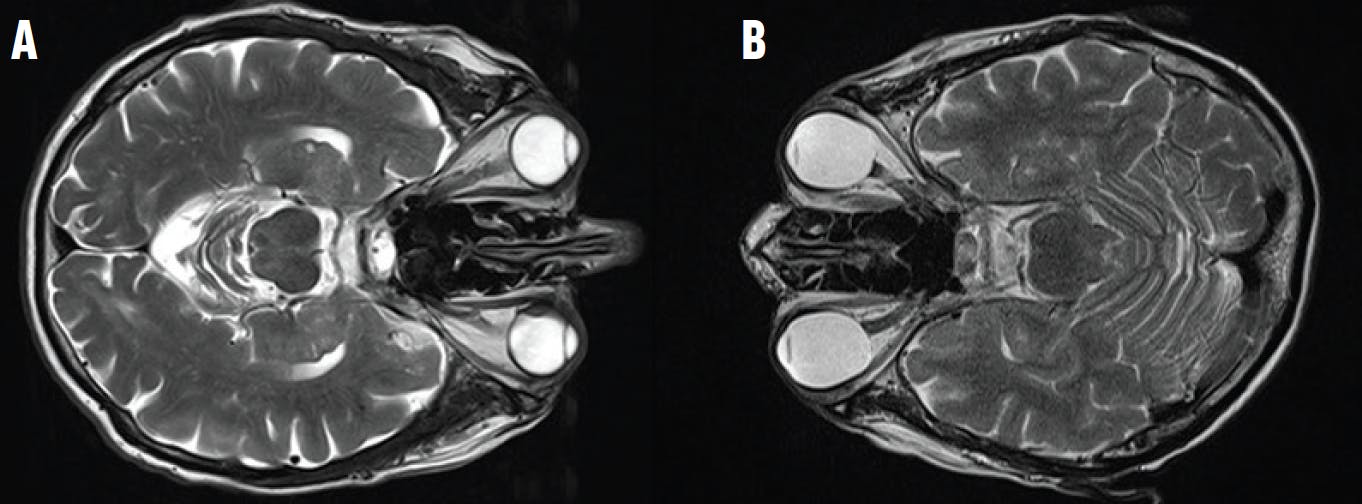
Based on the volume of a sphere with the diameter of the AL, which shows a volume of AL³ x π/6, a correction factor of 0.76 + 0.012 x (AL-24) was derived to account for the portion of the vitreous in the entire globe and the proportional increase of the vitreous for long (ie, myopic) eyes. This correction was developed based on the MRI analysis of emmetropic, myopic, and hypermetropic eyes (Figure 1).
With this newly developed formula, which we have coined vitreous volume exact (VIVEX), vitreous volume can be calculated using a known AL using the following formula:
Using this formula, we calculated a wide range of volumes from 3 mL to 10 mL with differences between emmetropic, myopic, and hypermetropic eyes (Figure 2). We also created a VIVEX-correction table to easily obtain the individual vitreous volume knowing the AL.1
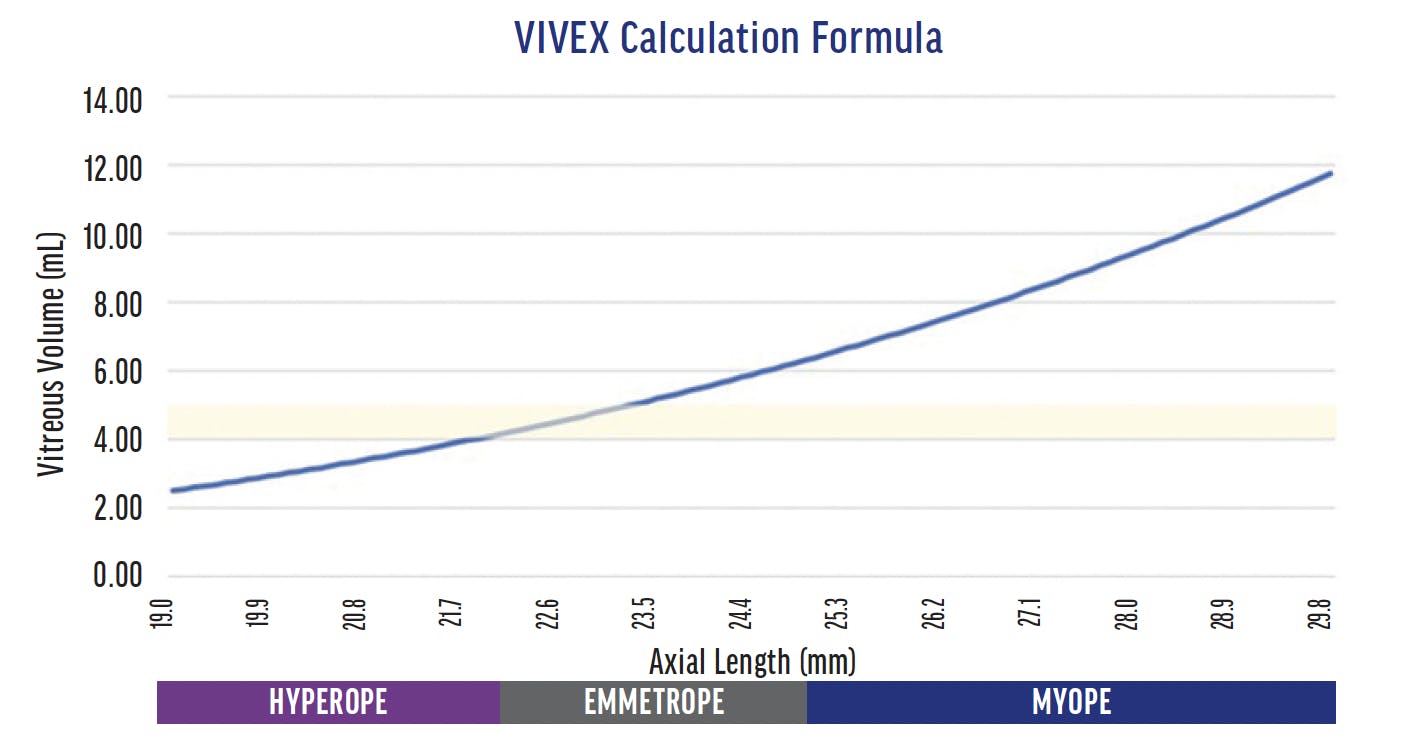
Figure 2. This diagram shows the differences in vitreous volume (range < 3 mL to > 10 mL) according to the AL of the eye calculated using the VIVEX formula.
The following examples demonstrate the variety in vitreous volume:
- An emmetropic eye with an AL of 23.4 mm had a vitreous volume of 5.05 mL.
- A highly myopic eye with a refraction of -16.25/+1.00/120 had an AL of 30.5 mm and a vitreous volume of 12.45 mL.
- A hypermetropic eye with a refraction of +7.75/+1.00/120 had an AL of 20.6 mm and a vitreous volume of 3.29 mL.
Of note, the highly myopic eye had a vitreous volume that was nearly four-times as much as the volume of the hypermetropic eye.
Implications for Dosing
Intravitreal therapies for the treatment of retinal diseases have advanced significantly in recent decades. It has become a safe and effective option for treatment of macular degeneration, diabetic retinopathy, endophthalmitis, retinal vein occlusion, and other retinal diseases. Increases in ocular diseases, higher life expectancy, and development of novel drugs are likely to drive the global intravitreal injectable market at a rapid pace.2
Anti-VEGF therapy makes up the majority of intravitreal therapeutics in retina, and the standard dosing is one-size-fits-all; thus, the same amount of drug is administered to each patient, regardless of individual anatomy. The frequency and repetition of these injections are adjusted according to the follow-up control and the clinical findings on OCT. Currently, there are no recommendations for adjusting the dose according to the vitreous volume.
However, the application of a defined substance in a specific volume leads to a certain concentration. If the intravitreal medication is planned for the standard vitreous volume of 4 mL to 5 mL, it follows that, if the actual volume of the patient’s eye is three-times that amount, the medication will dilute. Even assuming the active ingredient may still be available in sufficiently high quantities in a large vitreous volume, it remains that smaller eyes may then be overdosed. It is also well known that not all patients respond optimally and equally to the standard dose of a drug; this variability may be due to numerous individual factors.
POTENTIAL TO LOWER RISKS
Although intravitreal therapy is safe and effective, as with any procedure, there are associated risks and adverse effects. The risks of intravitreal injection include infection, endophthalmitis, uveitis, subconjunctival bleeding and vitreous hemorrhage, cataract formation, luxation of the human or intraocular lens, and increased IOP.3 In addition to these local effects, systemic adverse effects, such as cardiovascular and renal complications, have been reported, highlighting the importance of cautious use.4
Currently, it remains uncertain whether the postoperative increase of IOP has a direct correlation to the volume. However, an exact systematic investigation of anatomical factors that may have an impact on IOP could be performed by measuring the volume preoperatively; it seems logical that the addition of a standard volume of a fluid into a small eye with a lower vitreous volume would lead to more pronounced effects on IOP than would be seen in a larger eye.
Drug packet inserts cannot provide dosing recommendations for all patient populations, but rather predominantly reflect the populations studied in the pivotal trials. However, throughout medicine, it is common to adjust drug dosages according to a mass or volume. For example, there are dosage recommendations for most drugs adapted to body weight, and drugs given to children have different maximum doses than those for adults. Spreadsheets and conversion formulas exist in many subspecialities in medicine, and calculation formulas are common in pharmacology, as well.
We believe that, if the vitreous volume can be measured easily and quickly preoperatively, then large-scale, multicentered studies should follow to determine whether there are any differences in the effectiveness or adverse effect based on vitreous volume. Studies should investigate the influence on IOP increases, iris lens diaphragm displacements, and effects associated with repeat injections.
LIMITATIONS
At this stage, our findings do not have a direct impact on clinical practice, as intravitreal therapy has proven to be safe and effective. However, this experimental analysis and the development of a new calculation formula should be the starting point for more systematic clinical investigations. Research on personalized intravitreal medications and the effect of the vitreous volume should be conducted.
Studies are also required to compare the performance of one-size-fits-all dosing with individually adjusted dosing. If no adverse effects of undertreatment are noticed, such customization could be a better choice for patients with lower vitreous volumes to avoid overloading the body with pharmacological agents. Other factors may play a role; in phakic or pseudophakic eyes, there will be slight deviations of minor impact, as a natural lens is around 4.0 mm thick, while an intraocular lens is around 1.0 mm thick.
The VIVEX formula could also be used to potentially increase safety when it comes to gas or silicone oil fill.
PRECISION MEDICINE IS THE FUTURE
We believe that with this newly developed formula, it will be easy to calculate the exact vitreous volume of each patient. Future research may reveal whether matching the dosage to the volume leads to any advantages in therapy or prevention of side effects, which may in turn affect the development of future intravitreal drug therapies and recommendations.
1. Borkenstein AF, Borkenstein EM, Langenbucher A. VIVEX: A formula for calculating individual vitreous volume: a new approach towards tailored patient dosing regime in intravitreal therapy. Ophthalmol Ther. 2024 ;13(1):205-219.
2. Intravitreal (IVT) injectible market. Persistence Market Outreach. Accessed March 19, 2024. bit.ly/3TQMDEB
3. Daka Q, Špegel N, Atanasovska Velkovska M, et al. Exploring the relationship between anti-VEGF therapy and glaucoma: implications for management strategies. J Clin Med. 2023;12(14):4674.
4. Fogli S, Del Re M, Rofi E, Posarelli C, Figus M, Danesi R. Clinical pharmacology of intravitreal anti-VEGF drugs. Eye (Lond). 2018;32(6):1010-1020.


