


Myopia, a multifactorial ocular disorder, is the most common refractive error, and it’s only becoming more prevalent.1 Up to 33% of myopic eyes may progress to high myopia, defined as a refractive error greater than -6.00 D to -8.00 D and an axial length greater than 26 mm to 26.5 mm.2,3 Further, eyes with pathologic myopia experience both posterior staphyloma and axial length progression.2,3
Myopic traction maculopathy (MTM) occurs in 30% of eyes with high myopia and presents with decreased visual acuity, metamorphopsia, and central scotoma.4,5 It is caused by increased retinal stretching tangentially and posteriorly due to preretinal factors, including incomplete posterior vitreous detachment, vitreomacular traction, epiretinal membrane (ERM), and internal limiting membrane (ILM), as well as posterior factors, such as posterior staphyloma, leading to macular hole, myopic retinoschisis, and retinal detachment.2,3 Risk factors for MTM progression include longer axial length, more severe posterior staphyloma, and the absence of a dome-shaped macula.3
SURGICAL CONSIDERATIONS
As most MTM patients have a stable natural course, a follow-up approach is usually recommended.5 Nevertheless, decreased vision due to macular hole or retinal detachment, progression of macular schisis, and VA less than 20/50 are indications for surgery.6 Surgery follows the ab-externo method, including macular buckling, to serve as an iatrogenic dome-shaped maculopathy, and the ab-interno method, including pars plana vitrectomy (PPV) with membrane peeling.5 However, ILM peeling with intravitreal gas tamponade is controversial, and although macular buckling is reversible and without risk of cataract progression, it is associated with a high risk of complications, including muscle slippage and misalignment, esotropia, scleral perforation, buckle exposure, altered choroidal perfusion, and retinal pigment epithelium damage.7,8
The most widely used classification system for MTM based on OCT is the MTM Staging System, which consists of foveal morphology classification (normal foveal architecture, lamellar macular hole, full-thickness macular hole [FTMH]) and MTM staging (stage 1: inner/outer maculoschisis; stage 2: predominantly outer maculoschisis; stage 3: maculoschisis/macular detachment; stage 4: macular detachment).9 PPV with ILM peeling or ILM flap and gas tamponade has a high success rate in cases of mild maculoschisis with lamellar macular holes or FTMHs. In stages 2, 3, and 4 without a FTMH, macular buckling is typically the primary choice of surgery.10 In stages 2, 3, and 4 with a FTMH, combined macular buckling and PPV may be necessary.10
One of the biggest challenges associated with membrane peeling in these cases is the limited utility of conventional forceps. Removing the cannula and reducing IOP are common surgical tricks to grasp the membranes using conventional forceps. The case report of MTM progression described here involves successful removal of the ERM and ILM using myopic forceps and recovery of the foveal contour without a tamponade.
THE CASE
A 72-year-old man was under routine follow-up for glaucoma and high myopia for 15 years. His regular OCT scans showed myopic changes without any schitic cavity for the first 10 years (Figure 1A). His VA was 20/20 in both eyes without symptoms. Subsequent OCT scans showed increased traction with the appearance of a schitic cavity (Figure 1B). However, his VA remained 20/20 without symptoms of distortion. Over 3 years of follow-up, the schitic cavity increased with symptoms of increased distortion over the last 6 months and decreased VA of 20/60 (Figure 1C and D).
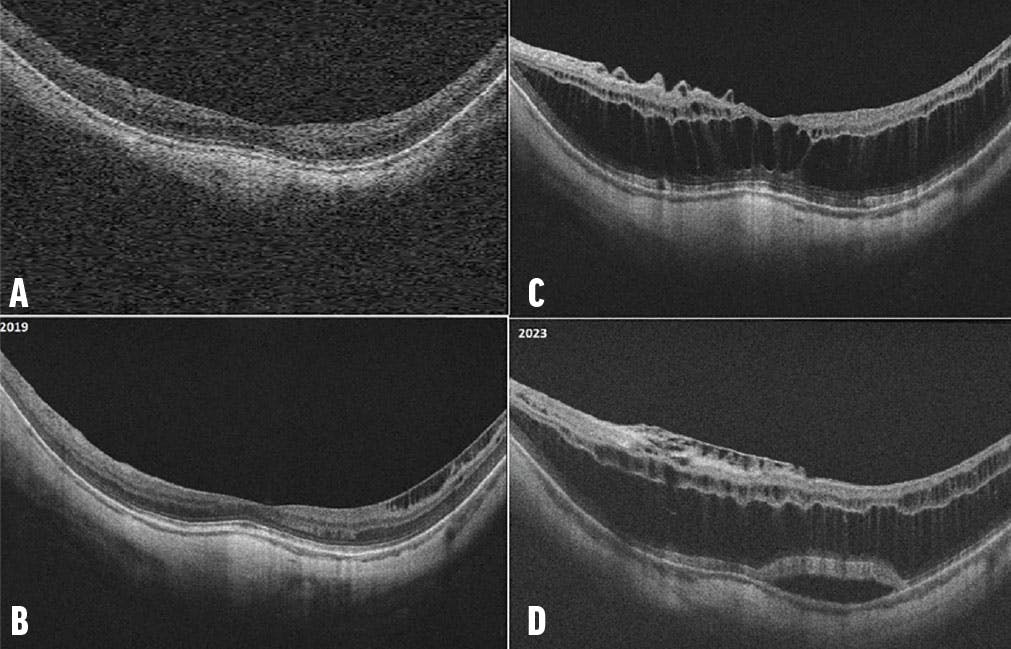
Figure 1. The OCT scan of the left eye in 2015 shows a staphyloma and a normal retinal contour (A). In 2019, the OCT shows inner retinal traction by ERM and inner retinal schisis (B). The OCT scan in 2022 shows a staphyloma, fine ERM, and outer retinal schisis (C). In 2023, the OCT shows no change in the staphyloma curvature, more traction from a thickened ERM, increased outer retinal schisis, and neurosensory detachment (D).
As his visual acuity deteriorated along with worsening macular schisis, the patient underwent PPV with ILM and ERM peeling with myopic forceps after brilliant blue G dye staining (Video and Figure 2A). The post-ILM peeling intraoperative OCT showed an immediate decrease in retinal thickness (Figure 2B).
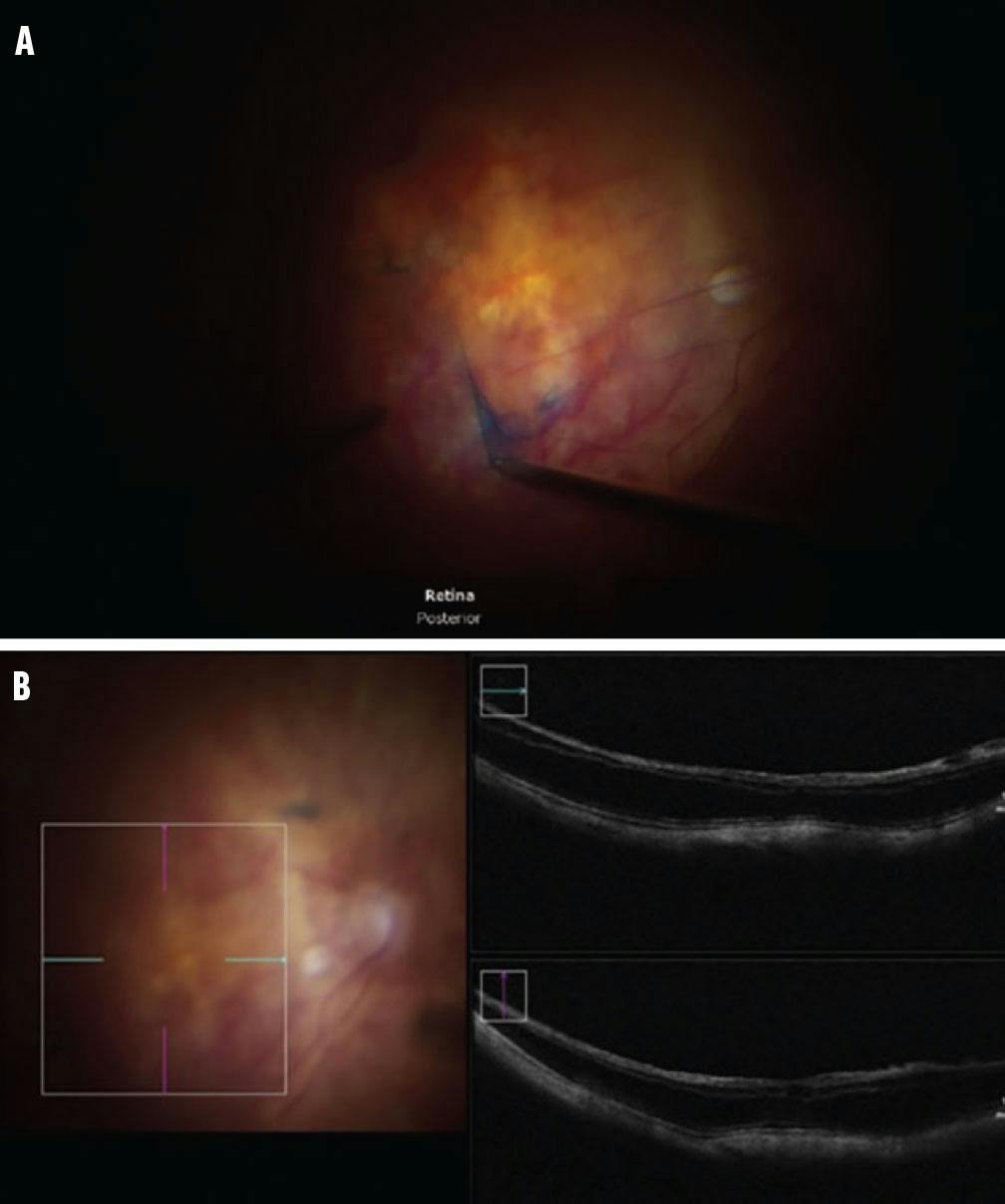
Figure 2. The patient underwent ILM peeling with brilliant blue G dye staining (A). Intraoperative OCT immediately after membrane peeling showed decreased retinal thickness (B).
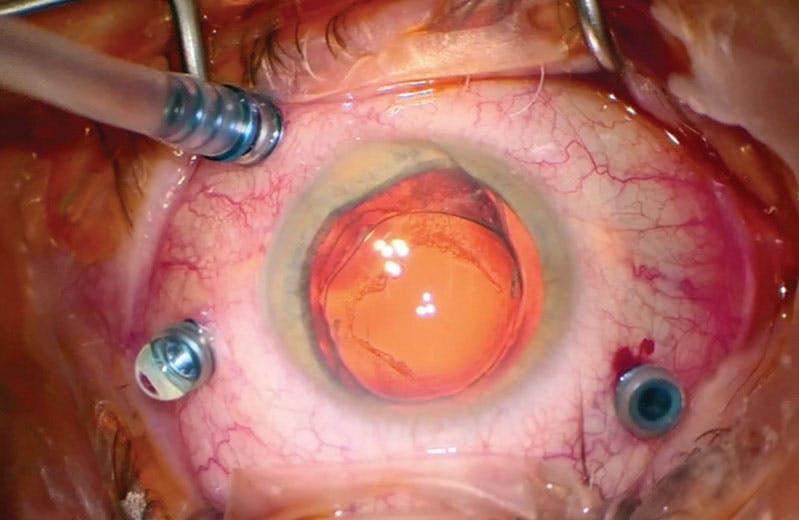
Video. Pars Plana Vitrectomy in Myopic Traction Maculopathy.
One month post-surgery, the left eye’s VA had improved to 20/40, and the follow-up OCT showed complete resolution of the macular schisis and recovery of the foveal contour (Figure 3). Overall, the patient's symptoms had significantly improved, and he continued with routine follow-up as scheduled.
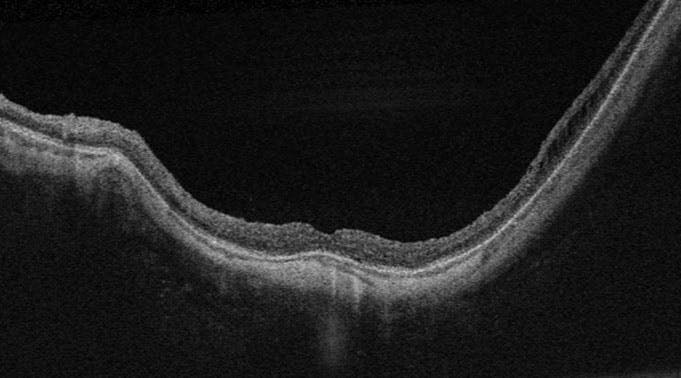
Figure 3. OCT after 1 month of follow-up shows decreased retinal thickness, significant improvement in the retinal schisis, no ERM, and complete resolution of the neurosensory detachment.
DISCUSSION
In this case, the patient’s MTM started with mild inner retinal schisis without any deterioration of visual acuity or presence of any symptoms. A follow-up approach was considered for 4 years, at which time the patient presented with decreased vision and worsening of macular schisis with a small portion of sensory layer detachment.
Based on the MTM Staging System, this case was classified as stage 2 MTM with predominantly outer macular schisis and no sign of a lamellar macular hole or FTMH. As anteroposterior traction seemed a prominent cause for the schisis progression, an ab-interno approach was taken. Because OCT did not show a lamellar macular hole or FTMH, PPV and membrane peeling without gas tamponade was performed with overall good results.
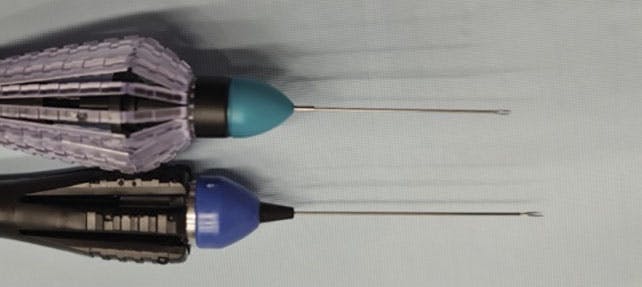
Figure 4. Myopic cutting forceps (Pinnacle 360, Bausch + Lomb) that have a longer shaft (Bottom) than routine ILM forceps (Top) were used in this procedure.
In cases of challenging macular pathology with a thin retina, peeling the ERM and ILM with complementary intraocular instruments is critical in avoiding complications and encouraging better structural and visual outcomes. Choosing myopic forceps of a suitable length is crucial in eyes with a long axial length. Myopic forceps provide additional benefit over standard forceps with an additional 5 mm of length (37 mm vs 32 mm), allowing easier access to the membranes in eyes with a posterior staphyloma (Figure 4). The Pythagorean theorem helps estimate the length of the forceps needed in myopic eyes.11 Complete resolution of the schitic cavity may take 6 to 9 months.12 With the correct choice of surgery, suitable instruments, and an uncomplicated procedure, these complex cases can achieve successful outcomes.
1. Dutheil F, Oueslati T, Delamarre L, et al. Myopia and near work: a systematic review and meta-analysis. Int J Environ Res Public Health. 2023;20(1):875.
2. Ruiz-Medrano J, Montero JA, Flores-Moreno I, Arias L, García-Layana A, Ruiz-Moreno JM. Myopic maculopathy: current status and proposal for a new classification and grading system (ATN). Prog Retin Eye Res. 2019;69:80-115.
3. Meng J, Chen Y, Cheng K, et al. Long-term progression pattern of myopic tractional maculopathy: outcomes and risk factors. Retina. 2023;43(7):1189-1197.
4. Panozzo G, Mercanti A. Optical coherence tomography findings in myopic traction maculopathy. Arch Ophthalmol. 2004;122(10):1455-1460.
5. Ng DSC, Chan LKY, Lai TYY. Myopic macular diseases: a review. Clin Exp Ophthalmol. 2023;51(3):229-242.
6. Frisina R, Gius I, Palmieri M, Finzi A, Tozzi L, Parolini B. Myopic traction maculopathy: diagnostic and management strategies. Clin Ophthalmol. 2020;14:3699-3708.
7. Sayanagi K, Hara C, Fukushima Y, Sato S, Kawasaki R, Nishida K. Three cases of macular retinal detachment exacerbated during follow-up with myopic foveoschisis around myopic choroidal neovascularization. Am J Ophthalmol Case Rep. 2023;32:101899.
8. Anderson WJ, Akduman L. Management of myopic maculopathy: a review. Turk J Ophthalmol. 2023;53(5):307-312.
9. Parolini B, Arevalo JF, Hassan T, et al. International validation of myopic traction maculopathy staging system. Ophthalmic Surg Lasers Imaging Retina. 2023;54(3):153-157.
10. Parolini B, Palmieri M, Finzi A, Frisina R. Proposal for the management of myopic traction maculopathy based on the new MTM staging system. Eur J Ophthalmol. 2021;31(6):3265-3276.
11. Teixeira A, Salaroli C, Fuganti RM, Casella AMB. The cosine law to choose the correct forcepts shaft length for macular surgery in highly myopic eyes. Retina. 2023;43(12):2166-2169.
12. Venkatesh R, Bavaharan B, Yadav NK. OCT findings in myopic traction maculopathy. A practical guide to clinical application of OCT in ophthalmology: IntechOpen; 2019.


