


AT A GLANCE
- With the advent of 3D visualization, researchers have improved the utility of intraoperative fluorescein angiography during vitreoretinal surgery.
- An optical filter with a dedicated wavelength (475 nm – 490 nm) needs to be used in the illumination light source to achieve optimal fluorescein excitation.
- Early data demonstrates both improved vision and reduced rates of postoperative vitreous hemorrhage with intraoperative fluorescein angiography-guided surgery compared with standard vitrectomy.
Intraoperative fluorescein angiography (IOFA) has transformed the way our team approaches vitrectomy. We have found that real-time 3D high-definition (3DHD) angiography accurately detects many fluorescein biomarkers observed in the clinic and provides important information for surgical decision making, which we believe improves surgical results.
IOFA has been used successfully by many researchers since its development by Steve Charles in the 1980s.1,2 However, imaging through the optical microscope without widefield viewing was limited by both resolution and two dimensionality, hindering adoption.3-6 With the advent of 3DHD visualization, Imai et al developed IOFA during digitally assisted vitreoretinal surgery and reported on the treatment of proliferative diabetic retinopathy (PDR) and retinal vein occlusion.7,8 I (L. M.) first reported on the use of a digital barrier filter; subsequently, Cardamone et al modified the method by placing the exciter filter directly into the vitrectomy system to avoid switching to an alternative light source. This type of digital barrier filter made IOFA more seamless and efficient during vitrectomy.9
Using IOFA, surgeons can observe many FA biomarkers during vitrectomy, including vascular filling times, microvascular blockage, areas of nonperfusion, microvascular leakage, inflammatory-based leakage, and retinal and choroidal neovascularization (Video).10-14
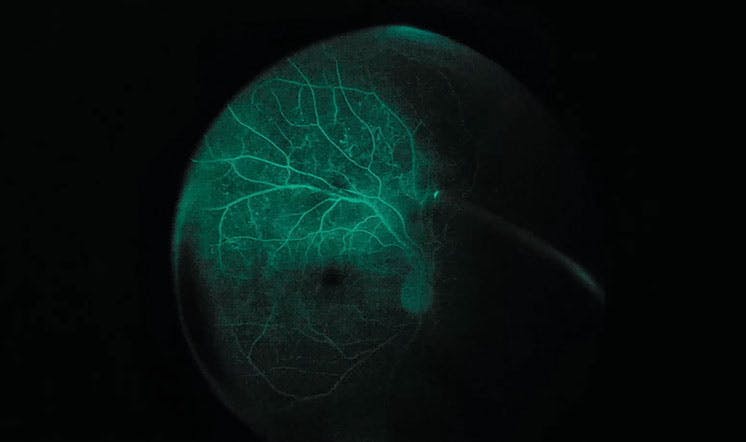
Video. The Utility of Intraoperative Fluorescein Angiography.
THE SETUP
An optical filter with a dedicated wavelength (475 nm – 490 nm) needs to be used in the illumination light source to achieve optimal fluorescein excitation. The optical exciter filter can be placed in a number of different light sources, and many different optical filters are available.15-17
Contrast enhancement is key to successful IOFA, and we determined the optimal excitation source to maximum fluorescein signal intensity. To create the best digital barrier filter recipe in the presence of a 532 laser notch filter (which can reduce the fluorescence intensity), it is important to have a high dynamic range and sensitivity camera (Figure 1).18 The digital barrier filter reduces red and blue emissions to enhance the green signal. The saturation and hue are modified to diminish the blue-green color, and the signal is enhanced with brightness and contrast to produce a grayscale image similar to that observed in office-based FA.19
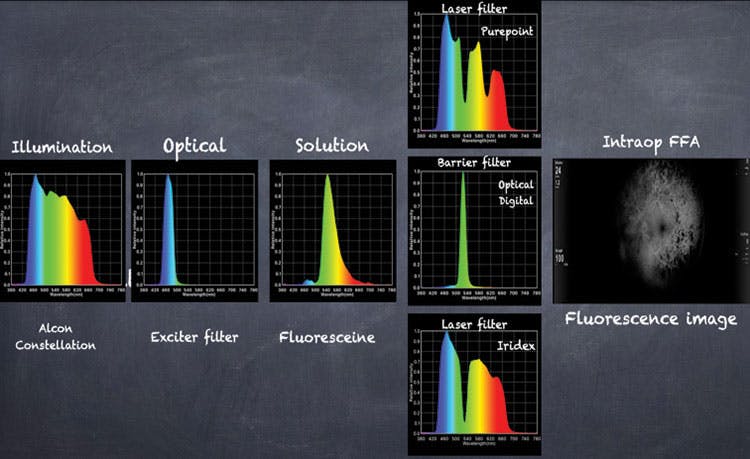
Figure 1. As demonstrated by the schematic order of achieving the digital IOFA shown here, the 532 laser notch filter can reduce the fluorescence intensity because it coincides with the wavelength emission of the fluorescein, 510 nm to 540 nm.
Initiating IOFA simply involves switching to the light source with the optical exciter filters and changing the digital surgical channel or filter. The switch back to standard visualization once IOFA is complete is equally efficient.20 We have found that dual light output with a chandelier light source and a light pipe endoilluminator produces the best signal.
SURGICAL DECISION MAKING
IOFA provides additional helpful information to guide and enhance many surgical decisions.9 A delay in vascular filling time can be observed if blood pressure is low, IOP is high, or a combination of both.21 Vascular epiretinal membranes are well visualized, and the contrast between the vascularized fluorescent vessels and a dark background is helpful to visualize the correct surgical plane to delaminate (Figure 2).22 Once delamination is complete, both areas of residual abnormal vascularities and retinal ischemia can be visualized.
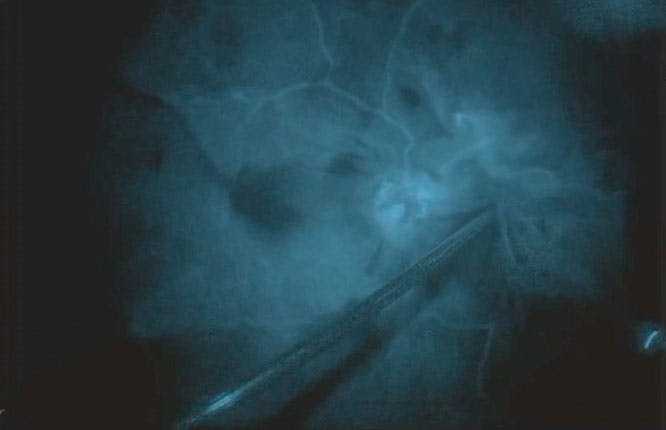
Figure 2. The patient depicted here is undergoing vitrectomy for the treatment of PDR. This image illustrates the typical IOFA view the surgeon has while delaminating the vascular epiretinal membranes using a bimanual technique.
We are currently treating these residual areas of abnormal vascular leakage with confluent laser and placing more confluent laser in the areas of peripheral ischemia, while sparing the better-perfused retina. Doing so can reduce the rate of postoperative vitreous hemorrhage, while maximizing peripheral and night vision.23 Often, media opacities such as vitreous hemorrhage or inflammation preclude sufficient visualization of fluorescein biomarkers preoperatively. In these scenarios, IOFA is helpful with diagnosis and postoperative management, in addition to guiding surgical decision making.
LACK OF TOXICITY
FA is a well-accepted and safe diagnostic aid in the clinic. In the OR, all current surgical light sources and bandpass exciter filters are above the wavelength noted to be toxic (440 nm). However, light toxicity has been reported from the straight light pipe if it is held close to the retina for longer than 15 minutes.24 The fluorescein signal significantly fades after 5 to 10 minutes, limiting the risk of phototoxicity. Although some suggest that fluorescein may enhance laser burn intensity, there are no reports of excessive laser burning with macular laser after in-clinic FA. In the OR, it is rare to place any photocoagulation burn near the macular center. Nevertheless, we recommend using a chandelier light source combined with a light pipe endoilluminator held relatively far from the retinal surface to minimize any potential light toxicity.25
EFFICACY AND POSTOPERATIVE RESULTS
We are in the process of analyzing visual acuity and rates of postoperative vitreous hemorrhage after vitrectomy with and without IOFA for PDR. Preliminary results indicate a relatively low rate of postoperative vitreous hemorrhage 1 month following vitrectomy in 21% of patients who underwent IOFA, which is in the low range of historically reported rates of 13% to 40% and is significantly lower than our group of patients who underwent vitrectomy without IOFA, more than 50% (Figure 3).26-28 This trend continued through postoperative month 2, where vitreous hemorrhage was observed in 14% of patients who underwent IOFA versus 48% without IOFA, and month 3, where vitreous hemorrhage was observed in 14% of those who underwent IOFA versus 35% of those without IOFA. In addition, postoperative visual acuity in patients when IOFA was performed was, on average, at least 3 lines better than those for whom IOFA was not performed.
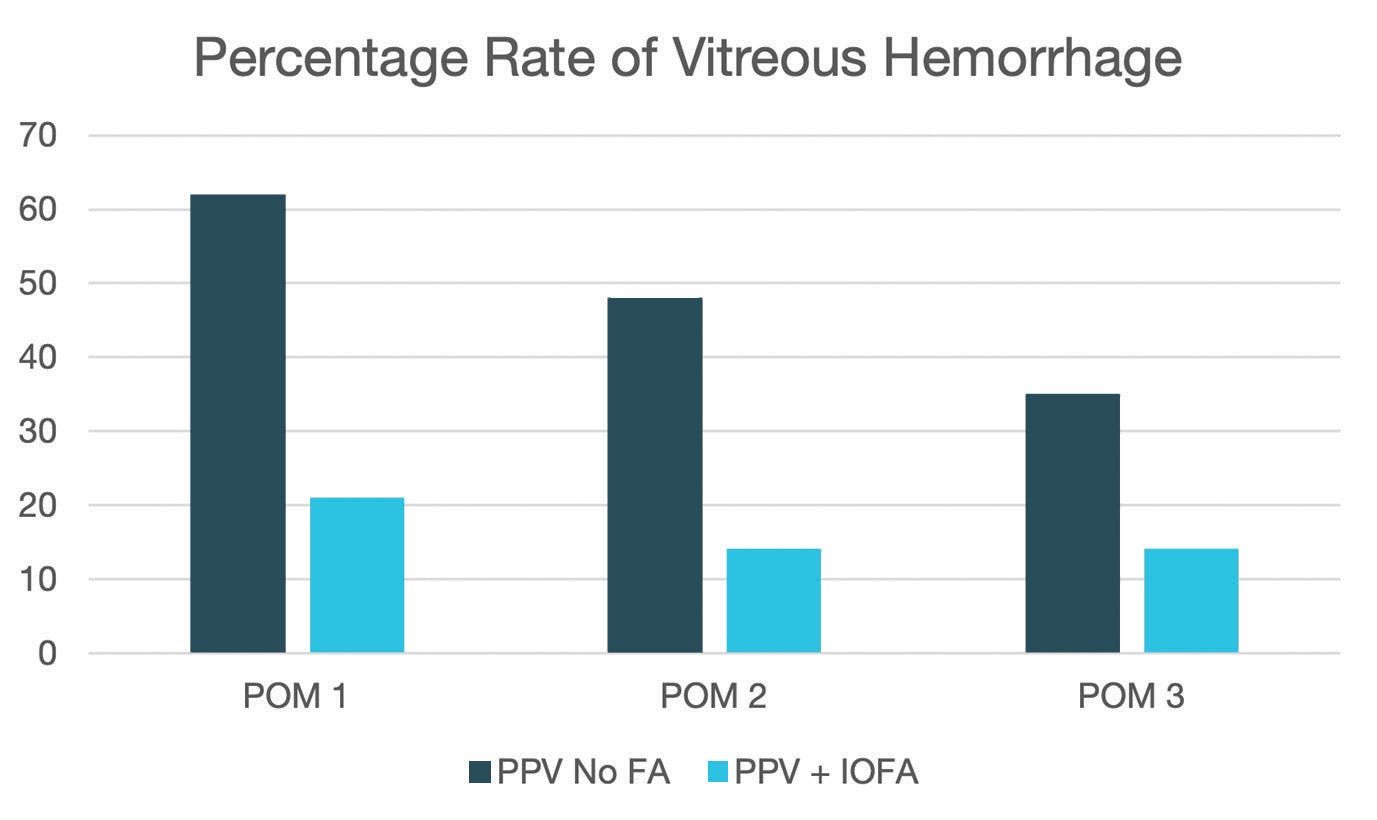
Figure 3. Our research shows that IOFA guidance during vitrectomy for patients with PDR reduces the rate of postoperative vitreous hemorrhage throughout the first 3 months of follow-up. As noted in this chart, at postoperative months 1, 2, and 3, the rate of vitreous hemorrhage was demonstrably lower in patients who underwent IOFA-guided vitrectomy versus those who didn’t (P < .05 at all points measured).
FUTURE DEVELOPMENTS
IOFA can provide important diagnostic information when preoperative media opacities limit visualization of fluorescein biomarkers and can guide surgical decision making. There have been no reports of light toxicity in more than 200 cases where IOFA was employed. However, clinicians should continue to measure postoperative safety parameters, such as vision, spectral-domain OCT, multifocal ERG, and visual fields, to objectively show that IOFA does not lead to toxicity.
Early data demonstrate both improved vision and reduced rates of postoperative vitreous hemorrhage with IOFA-guided surgery compared with standard vitrectomy. This provides significant credibility to the potential benefits of adding IOFA to the surgical armamentarium during vitrectomy. Further optimization of the optical exciter filter has been accomplished, and the improvement of the digital barrier filters will lead to improved and more useful information. Thus, we believe that IOFA is an important developing technology that can assist surgical decision making during vitrectomy and will ultimately enhance outcomes for our patients.
Acknowledgements: The authors would like to acknowledge the work of Jared Ridgeway, BS; MiaChanel Nguyen, BS; Mariam Omar, BS; Hudson Tate, BS; Brenton Bickell, BS; and Ariel Shin for data entry and analysis.
1. Charles S. Vitreous Microsurgery. Williams & Wilkins; 1981.
2. Avery RL, Hickingbotham D, Jaffe G, de Juan E Jr. Intraoperative fluorescein angioscopy in subretinal surgery. Arch Ophthalmol. 1992;110(11):1518-1519.
3. Googe JM, Bessler M, Hoskins JC, Miller JH. Intraoperative fluorescein angiography. Ophthalmology. 1993;100(8):1167-1170.
4. Horio N, Horiguchi M. Retinal blood flow analysis using intraoperative video fluorescein angiography combined with optical fiber-free intravitreal surgery system. Am J Ophthalmol. 2004;138(6):1082-1083.
5. Krueger RR, Morales RB, Smith RE, et al. New stroboscopic light source for intraoperative retinal fluorescein angiography. Arch Ophthalmol. 1994;112(3):420-422.
6. Terasaki H, Miyake Y, Awaya S. Fluorescein angiography of peripheral retina and pars plana during vitrectomy for proliferative diabetic retinopathy. Am J Ophthalmol. 1997;123(3):370-376.
7. Imai H, Tetsumoto A, Inoue S, et al. Intraoperative three-dimensional fluorescein angiography-guided pars plana vitrectomy for the treatment of proliferative diabetic retinopathy. Retina. 2023;43(2):359-362.
8. Imai H, Matsumoto A, Yamada A, et al. Intraoperative three-dimensional fluorescein angiography-guided pars plana vitrectomy for branch retinal vein occlusion. Retin Cases Brief Rep. 2022;16(6):802-805.
9. Cardamone M, Hüning G, Scarlett C, et al. Intraoperative angiography can efficiently identify biomarkers and guide surgical decision making. Retina. 2023;43(12):2177-2182.
10. Ruia S, Tripathy K. Fluorescein angiography. StatPearls; 2023.
11. Littlewood R, Mollan SP, Pepper IM, Hickman SJ. The utility of fundus fluorescein angiography in neuro-ophthalmology. Neuroophthalmology. 2019;43(4):217-234.
12. Wiley HE, Ferris FL. Nonproliferative diabetic retinopathy and diabetic macular edema. In: Ryan SJ, Sadda SR, Hinton DR, et al, eds. Retina. 5th ed. W.B. Saunders; 2013: 940-968.
13. Berlin A, Cabral D, Chen L, Ferrara D, Freund KB, Curcio CA. Histology of type 3 macular neovascularization and microvascular anomalies in treated age-related macular degeneration: A case study. Ophthalmol Sci. 2023;3(3):100280.
14. Ocular Ischemic Syndrome. EyeWiki. Accessed December 1, 2023. eyewiki.aao.org/ocular_ischemic_syndrome
15. Delori F, Ben-Sira I, Trempe C. Fluorescein angiography with an optimized filter combination. Am J Ophthalmol. 1976;82(4):559-566.
16. Spaide RF. Optimized filters for fundus autofluorescence imaging. Retina Today. 2009;4(3):79-81.
17. Hyvärinen L, Hochheimer BF. Filter systems in fluorescein angiography. Int Ophthalmol Clin. 1974;14(3):49-61.
18. Sasagawa K, Kimura A, Haruta M, Noda T, Tokuda T, Ohta J. Highly sensitive lens-free fluorescence imaging device enabled by a complementary combination of interference and absorption filters. Biomed Opt Express. 2018;9(9):4329-4344.
19. Alcon. Ngenuity 3D visualization system: clinical science compendium. Alcon. Accessed December 1, 2023. bit.ly/46Cl84I
20. McCannel CA. Optimal illumination key to safe, effective surgery. Retina Today. 2013;8(6):76-78.
21. She HC, Zhang XF, Zhang YP, Jiao X, Zhou HY. Peripheral arterial filling time and peripheral retina fluorescence features in ultra-widefield angiography. Int J Ophthalmol. 2021;14(7):1034-1040.
22. Oh KT, Lazzaro DR. Epiretinal membrane workup. Medscape. Accessed December 1, 2023. bit.ly/3N9uYUE
23. Tan SZ, Dell’ Aversana Orabona G, Robins JJ, Kumaran N, Wong R. “Delamination Plus”: a technique to reduce immediate postoperative diabetic cavity hemorrhage. Retina. 2023;43(3):520-522.
24. van Den Biesen P, Berenschot T, Verdaasdonk R, et al. Endoillumination during vitrectomy and phototoxicity thresholds. Br J Ophthalmol. 2000;84(12):1372-1375.
25. Meershoek P, KleinJan GH, van Willigen DM, et al. Multi-wavelength fluorescence imaging with a da Vinci Firefly—a technical look behind the scenes. J Robotic Surg. 2021;15:751-760.
26. Mason JO 3rd, Colagross CT, Vail R. Diabetic vitrectomy: risks prognosis, future trends. Curr Opin Ophthalmol. 2006;17(3):281-285.
27. Sima P, Zoran T. Long-term results of vitreous surgery for proliferative diabetic retinopathy. Doc Ophthalmol. 1994;87(3):223-232.
28. Yeh PT, Yang CM, Yang CH, Huang JS. Cryotherapy of the anterior retina and sclerotomy sites in diabetic vitrectomy to prevent recurrent vitreous hemorrhage: An ultrasound biomicroscopy study. Ophthalmology. 2005;112(12):2095-2102.


