


A 35-year-old man who had recently immigrated from West Africa presented to the emergency department with fever, nausea, vomiting, diarrhea, headache, and malaise. The ophthalmology service was consulted for blurry vision. The patient reported a medical history of malarial infection, and initial bloodwork showed pancytopenia with an elevated lactate level and creatinine, suggesting acute kidney injury.
INPATIENT TESTING
Given the patients demographic and medical history, he was admitted for a presumed malarial infection and was started on a broad-spectrum antibiotic and an antiviral medication for enteric fever, typhoid, and malaria. The patient underwent a blood smear, which showed schizont-stage and ring-stage parasites; a polymerase chain reaction test of his stool was positive for giardia. He denied any past ocular history, family history, and previous medication use.
On examination, the patient’s VA was 20/70 OD and 20/50 OS, and his IOP, extraocular muscles (EOM), and pupil examination findings were within normal limits. He reported no history of flashes, floaters, or sudden loss of vision. The anterior examination was unremarkable, although the dilated examination revealed scattered intraretinal and preretinal hemorrhages involving the posterior pole of each eye with peripheral areas of whitening in his right eye (Figure 1).
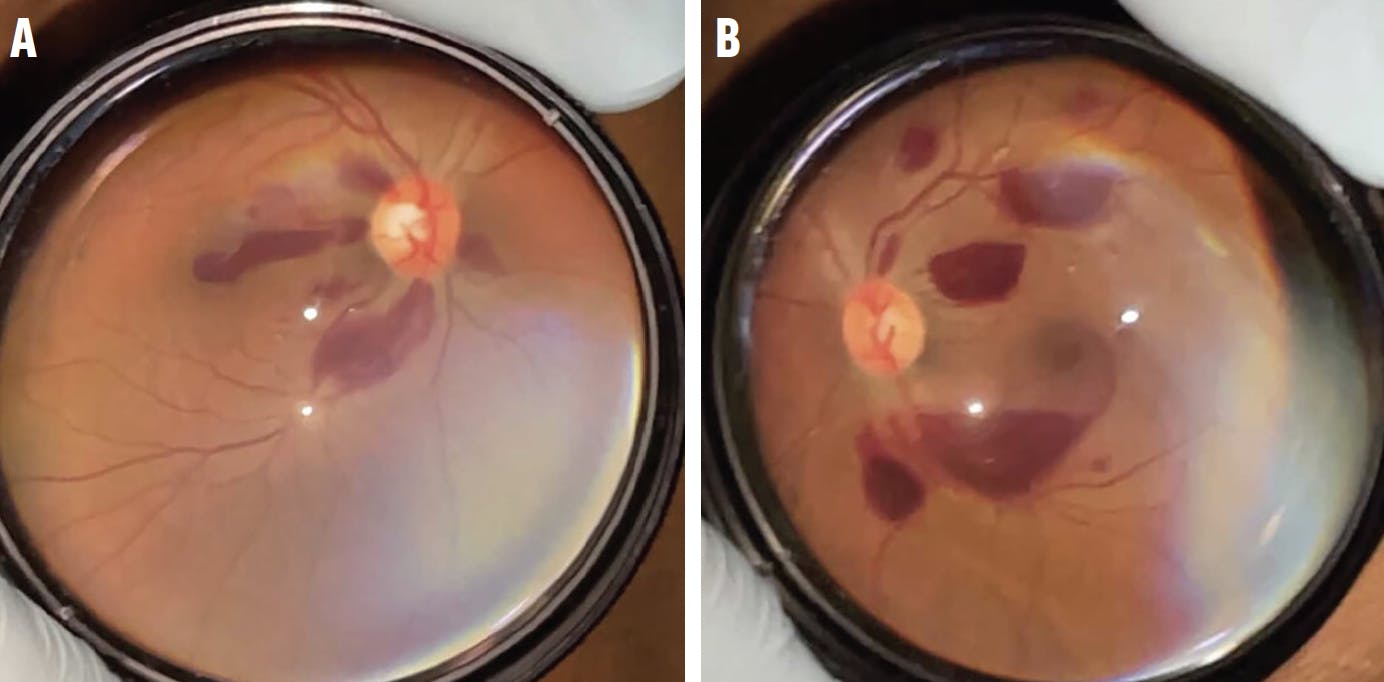
Figure 1. Dilated examination revealed scattered intraretinal and preretinal hemorrhages involving the posterior pole of the right (A) and left (B) eye.
In the setting of a known malarial infection with significant systemic symptoms, including pancytopenia, the patient was diagnosed with malarial retinopathy. No acute intervention was recommended, and treatment of the malarial infection was initiated by his primary care team.
WORSENING VISION
Seventeen days after his initial presentation, ophthalmology was consulted again because the patient reported worsening vision in his left eye for 1 day (but improvement in the right-eye vision). On examination, his BCVA was 20/20 OD and 20/400 OS. His IOP, EOM, pupils, and anterior examination findings remained within normal limits.
A dilated examination showed significant improvement in the retinal hemorrhages with continued peripheral whitening in the right eye, but there was evolution and worsening of the intraretinal and preretinal hemorrhages involving the posterior pole of the left eye with a large preretinal hemorrhage overlying the macula (Figure 2). While the patient’s malaria symptoms generally improved, his lab workup showed persistent pancytopenia resistant to transfusions.
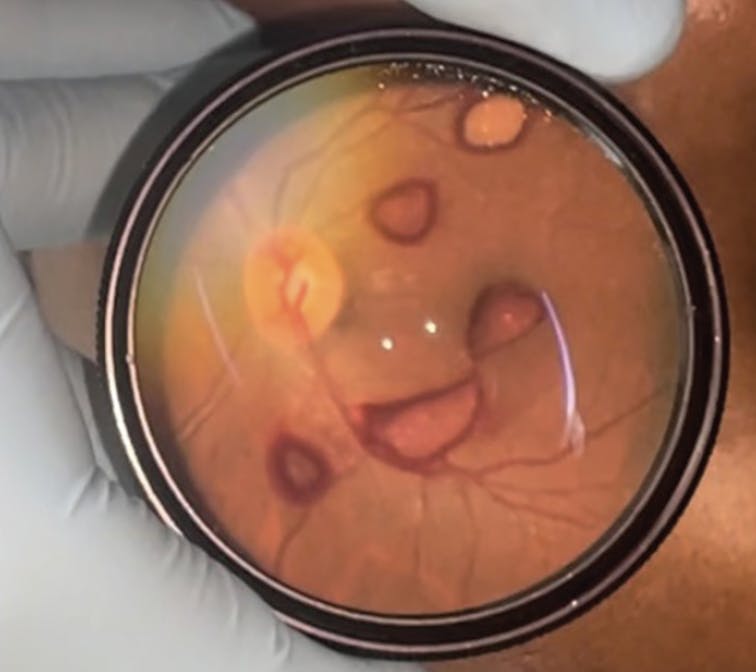
Figure 2. A dilated examination 17 days later revealed worsening of the intraretinal and preretinal hemorrhages involving the posterior pole of the left eye with a large preretinal hemorrhage overlying the macula.
BONE MARROW BIOPSY
The patient underwent a repeat blood smear that showed large blast cells, prompting a consultation with the hematology and oncology services, who recommended performing a bone marrow biopsy. The biopsy showed significantly increased cellularity in the marrow (Figure 3A and B) and positive staining for CD34 and CD117 proteins (Figure 3C), as well as myeloperoxidase. These findings confirmed a diagnosis of acute myeloid leukemia (AML) with superimposed malarial and giardia infections at the time of presentation. The patient’s fundoscopic findings were understood to be signs of leukemic retinopathy in the setting of newly diagnosed AML.

Figure 3. A bone marrow biopsy showed significantly increased cellularity in low-power field (A) and high-power field (B) in the marrow and positive staining for CD34 and CD117 proteins (C).
TREATMENT APPROACH
The patient was initiated on systemic chemotherapy and monitored with serial examinations, which showed continued improvement in his retinal findings. A repeat bone marrow biopsy confirmed the treatment effect prior to discharging the patient from the hospital. Fluorescein angiography was performed upon his discharge, which showed peripheral ischemia in each eye with small hyperfluorescent foci correlating to an area of retinal whitening in the right eye (Figure 4). The patient was continued on systemic treatment, and his vision returned to baseline.
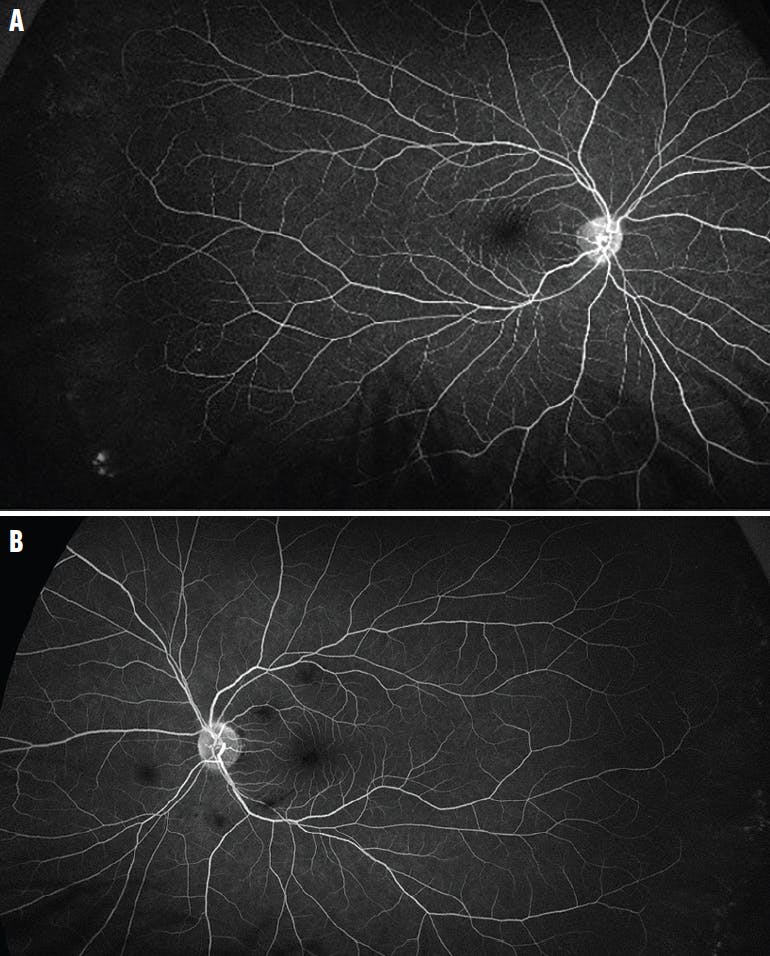
Figure 4. Fluorescein angiography performed upon the patient’s discharge from the hospital showed peripheral ischemia in the right (A) and left (B) eye with small hyperfluorescent foci correlating to an area of retinal whitening in the right eye.
LEUKEMIC RETINOPATHY
Ocular manifestations of AML can be seen in acute or chronic disease, and all parts of the eye can be affected, although retinal involvement is most common. Critically, ocular involvement is present in a third of cases at the time of presentation and serves as an indicator of poor prognosis.1 Leukemic ocular involvement can be primary, with direct infiltration of leukemic cells into ocular tissues, including the development of pseudohypopyon, subretinal or choroidal neoplastic collections, and optic nerve or vessel infiltration. More commonly, however, leukemic ophthalmic manifestations are secondary, resulting from systemic abnormalities, such as pancytopenia. Secondary findings may include retinal hemorrhages, cotton-wool spots, vascular occlusion, microaneurysms, peripheral neovascularization, and opportunistic infections.2,3
The ocular findings of leukemia are shared by various other ophthalmic pathologies such as anemia, thrombocytopenia, hyperviscosity, and several infectious or inflammatory conditions, including infectious endocarditis.4,5 As such, it is critical to remain educated on the signs and symptoms and maintain a high index of suspicion for leukemia. In this case, the patient provided a history that fit the diagnosis of malarial retinopathy, and his findings were consistent with a presentation of malarial retinopathy, specifically in an adult, which tends to be milder than its devastating presentation in children.6 It is possible that the patient’s peripheral ischemic changes were, in fact, related to the malarial infection.
Ultimately, the diagnosis of leukemic ocular involvement is made when consistent examination findings arise in the setting of a positive bone marrow biopsy, as was the case for our patient. This diagnosis is made histologically based on findings of increased marrow cellularity; staining for CD34 and CD117 indicates cellular immaturity, and other staining may help to identify cellular lineage, such as myeloperoxidase for cells of myeloid origin.7
Ophthalmic manifestations are often not individually addressed; rather, clinicians treat the underlying illness. Under the management of hematology and oncology, patients should be initiated on systemic chemotherapy and followed closely. From an ophthalmic standpoint, these patients should be managed with serial examinations, and even severe cases of leukemic retinopathy typically resolve with systemic therapy. An exception to this generalization would be neovascularization arising from complications of leukemic retinopathy, which can be treated with intravitreal injection of anti-VEGF agents.
THE GOOD NEWS
With appropriate management, ophthalmic manifestations of systemic leukemia have a favorable prognosis, with many patients maintaining functional visual acuity.
1. El Salloukh NA, Hage DG, Bashshur AZ, Kheir WJ. Early ophthalmological manifestations of acute myeloid leukemia: current perspectives. Clin Ophthalmol. 2022;16:2119-2127.
2. Vishnevskia-Dai V, Sella King S, Lekach R, Fabian ID, Zloto O. Ocular manifestations of leukemia and results of treatment with intravitreal methotrexate. Sci Rep. 2020;10(1):1994.
3. Yassin MA, Ata F, Mohamed SF, et al. Ophthalmologic manifestations as the initial presentation of chronic myeloid leukemia: a review. Surv Ophthalmol. 2022;67(2):530-543.
4. Sharma T, Grewal J, Gupta S, et al. Ophthalmic manifestations of acute leukaemias: the ophthalmologist’s role. Eye. 2004;18(7):663-672.
5. Beketova T, Mordechaev E, Murillo B, Schlesinger MD. Leukemic retinopathy: a diagnostic clue for initial detection and prognosis of leukemia. Cureus. 2023;15(12):e50587.
6. Brodeur KRN, Herculano A, Oliveira K. Clinical aspects of malarial retinopathy: a critical review. Pathog Glob Health. 2023;117(5):450-461.
7. Alexiev BA, Wang W, Ning Y, et al. Myeloid sarcomas: a histologic, immunohistochemical, and cytogenetic study. Diagn Pathol. 2007;2:42.


