


Obtaining fundus images is an important part of retinopathy of prematurity (ROP) care to document disease and monitor progression. In many settings, digital fundus imaging is the basis for effective telehealth screening and expanded access to care. In addition, multimodal imaging with fluorescein angiography (FA) and OCT can be helpful in identifying subtle pathology not visualized on the fundus examination. However, imaging the neonatal fundus can present challenges both in the OR and neonatal intensive care unit (NICU).
In this article, we describe patient factors that should be considered to optimize imaging for ROP and discuss tips and tricks for fundus photography, FA, and handheld OCT.
PATIENT FACTORS
Carefully considering patient factors is important, especially in the NICU. In the multicenter eROP study, a team of certified ophthalmic imagers and patient care providers obtained retinal images. Incomplete image sets were most commonly due to poor access to the eye, poor dilation, Bell reflex, technical difficulties with the imaging equipment, and unstable medical status of the baby.1
Adequate dilation promotes ease of imaging and improves field of view for an appropriate fundus examination. Various combinations of topical mydriatrics, including phenylephrine and cyclopentolate, are available; with attention to systemic status and vital signs, multiple rounds may be administered to ensure complete dilation.2
Infants with ROP often have comorbid respiratory issues resulting in the presence of an endotracheal tube attached to a ventilator. To improve access to the eye, the ventilator apparatus can be moved away from the patient’s eye, or the endotracheal tube can be extended with permission from the patient’s care team. This allows the imager to better access the eye to ensure high-quality fundus photographs. It is also important that the patient is suctioned adequately prior to imaging to prevent aspiration and minimize discomfort. Furthermore, it is ideal to image infants prior to feedings to minimize aspiration risk.
In the NICU setting, comfort measures such as swaddling, oral sucrose, use of a pacifier, presence of a certified child life specialist, and, if appropriate, bedside sedation may be used to help soothe the baby prior to imaging. In addition, it is imperative to have an assistant positioned opposite the imaging equipment to secure the infant.
IMAGING
Fundus Photography
Current contact-based camera systems for fundus photography in ROP include, but are not limited to, the RetCam Envision (Natus), 3Nethra Neo (Forus Health), and Phoenix Icon (Neolight). Contact-based systems can image anterior segment structures and provide color images of the posterior pole. Imaging requires the use of an eyelid speculum and coupling gel. Limitations of contact-based fundus imaging include challenges associated with ring-based imaging, which can lead to variable exposure across an image and decreased image clarity with darkly pigmented fundi, small pupils, and media opacity.3,4 The Bell reflex can be managed with the use of a pediatric scleral depressor; however, be mindful that excess scleral depression can distort fundus imaging.
Alternatively, noncontact imaging systems have been used in ROP, including the Optos ultra-widefield imaging system, which can capture up to 200° of the fundus. Use of the Optos requires holding the infant in the “flying baby” position in front of the camera while supporting the head and chest.
Fluorescein Angiography
FA is most commonly obtained using contact-based imaging modalities and is performed in the OR as part of an examination under anesthesia (Figures 1 and 2). With the increased use of anti-VEGF injections in ROP, FA can help to provide valuable information on the presence and degree of peripheral avascular retina and can guide laser treatment. It may also improve the sensitivity of diagnosis of stage 2 or worse disease.4,5
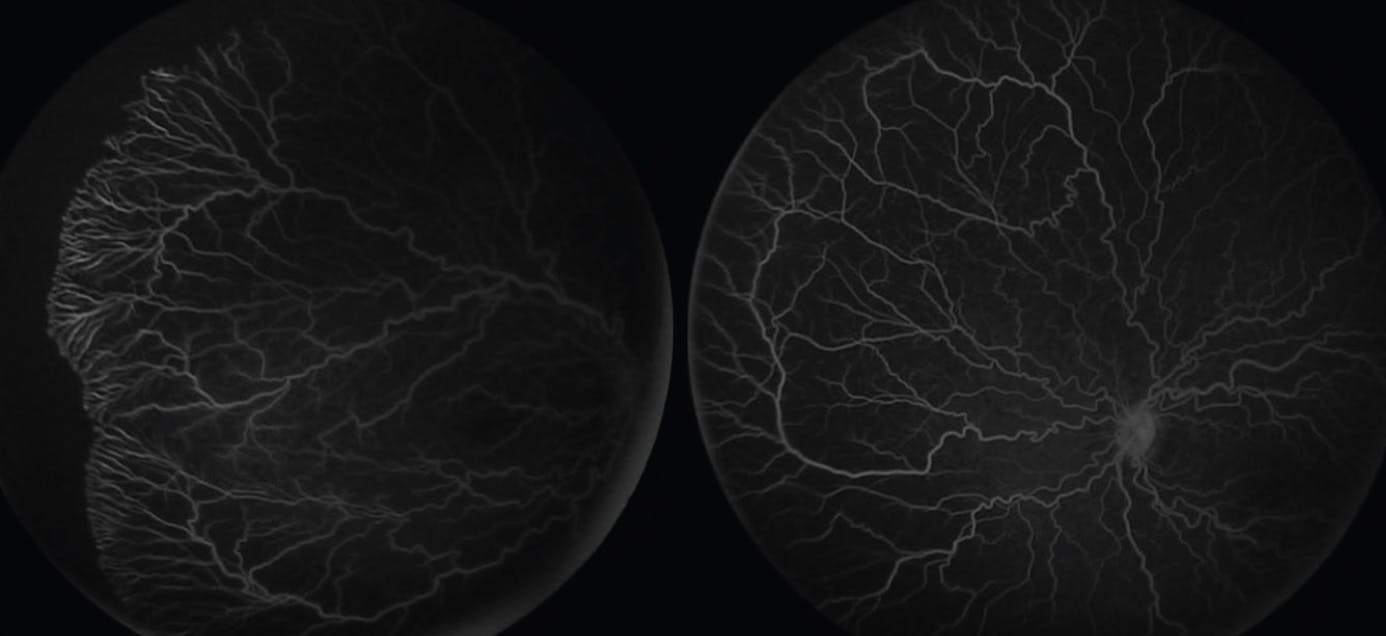
Figure 1. FA imaging shows a peripheral avascular retina and persistent vessel tortuosity following regression of disease in a neonate with severe cardiopulmonary disease.
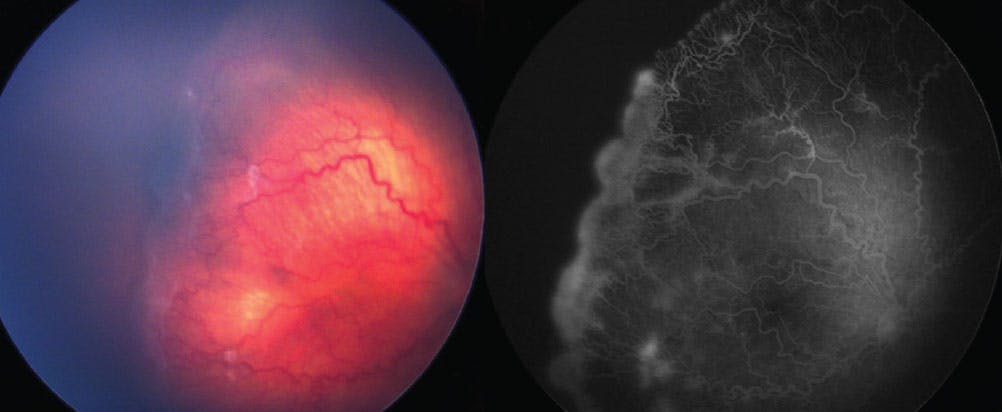
Figure 2. This side-by-side comparison shows the utility of FA alongside fundus photography in the case of type 1 ROP treated previously with bevacizumab that later developed flat neovascularization within a fibrotic ridge.
When performing FA, weight-based dosing of fluorescein dye should be calculated with a range of 5.0 mg/kg to 7.7 mg/kg. Communication with the anesthesiologist is critical regarding timing of dosing and image capture. Note that the dye should be injected as close to the intravenous catheter as possible so that the arm-to-retina timing and subsequent filling of circulation is accurate. The pressure from the imaging handpiece can impede initial flow into the choroidal and retinal vasculature; thus, the handpiece should be briefly lifted and replaced after the dye is flushed.
OCT Imaging
OCT is not currently a standard part of ROP imaging; however, OCT images can visualize the foveal pit and, in the case of preretinal hemorrhage, better assess the foveal anatomy and need for surgical intervention. Thus, OCT has great potential to supplement current ROP screening and monitoring techniques. Radial scans of the fovea can highlight foveal pit development, and peripheral scans of the temporal retina can evaluate 3D features of the ridge. OCT also has the ability to differentiate retinoschisis from retinal detachment, resulting in very different patient management.4
Prior to imaging, the reference arm of the device should be adjusted based on the age of the patient. While portable handheld OCT devices have made it possible to image preterm infants, one challenge of these examinations is maintaining immobility with the handheld device. The Heidelberg Spectralis features a Flex Module, which addresses this issue and allows for imaging of supine individuals with the device affixed to a moveable arm.6 Widefield OCT can also be used to capture far peripheral pathology and for ROP disease detection, progression, and regression.7
OCT angiography is primarily used as a research device but may have clinical utility in the near future to characterize angiographic features of the ridge in ROP.8
WHY IMAGING MATTERS
With the right tools and careful assessment, pediatric retina specialists can capture the necessary imaging to ensure proper diagnosis, management, and treatment of ROP to prevent visual impairment and blindness.
1. Karp KA, Baumritter A, Pearson DJ, et al. Training retinal imagers for retinopathy of prematurity (ROP) screening. J AAPOS. 2016;20(3):214-219.
2. Kremer LJ, Reith DM, Medlicott N, Broadbent R. Systematic review of mydriatics used for screening of retinopathy in premature infants. BMJ Paediatr Open. 2019;3(1):e000448.
3. Jayanna S, Padhi TR, Nedhina EK, Agarwal K, Jalali S. Color fundus imaging in retinopathy of prematurity screening: present and future. Indian J Ophthalmol. 2023;71(5):1777-1782.
4. Hartnett ME, Drack A, Capone A, Trese MT, Caputo G. Pediatric Retina. 3rd ed. Wolters Kluwer; 2021.
5. Klufas MA, Patel SN, Ryan MC, et al. Influence of fluorescein angiography on the diagnosis and management of retinopathy of prematurity. Ophthalmology. 2015;122(8):1601-1608.
6. Flex Module. Heidelberg Engineering. Accessed May 15, 2024. business-lounge.heidelbergengineering.com/gb/en/products/spectralis/flex-module
7. Nguyen TTP, Ni S, Khan S, et al. Advantages of widefield optical coherence tomography in the diagnosis of retinopathy of prematurity. Front Pediatr. 2021;9:797684.
8. Chen X, Imperio R, Viehland C, et al. A pilot optical coherence tomography angiography classification of retinal neovascularization in retinopathy of prematurity. Sci Rep. 2024;14:568.


