


With myriad ocular presentations in the retina space, both the budding specialist and the seasoned expert rely on a well-formulated systematic approach to arrive at the correct differential diagnosis. When you inevitably find yourself tracking down potential culprits, a few guiding principles can help keep trainees on the path to an accurate diagnosis (see Clinical Pearls for the Trainee).
CLINICAL PEARLS FOR THE TRAINEE
Pearl #1: Rule out the dangers, make a differential, and move on. In the acute setting, for the undifferentiated patient, timing and visual acuity come first. Once the cannot-miss diagnoses are ruled out, lay out the groundwork for your next steps. Basic labs will help rule out differentials and open the door to treatment escalation.
Pearl #2: Keep a mental list of your undifferentiated patients. Review the list on a regular basis and reconsider your evolving repository of cases as you continue to hone your differential diagnosis skills.
Pearl #3: Trust, but verify. In training, we find ourselves in multispecialty, tertiary-level clinics with many providers of various levels of training. We all carry the biases of our perspectives and trainings. This patient, for example, was first seen by a provider whose examination and history were nearly perfect, except for one small detail: the subtle clinical clue of the patient’s Waldenström macroglobulinemia. Integrating a complex medical history is precisely the role of the physician.
CASE PRESENTATION
A 76-year-old Hispanic man presented to our ophthalmic emergency department with 2 weeks of blurred vision in the right eye, which he described as a black spot with growing spiderwebs. A review of systems and medical history were unrevealing. His ocular history was limited to uncomplicated cataract surgery 5 years prior. An otherwise benign examination was documented during another emergency visit 6 months prior, at which point he had been diagnosed with a subconjunctival hemorrhage.
At the time of presentation, the patient’s VA was reduced to 20/60 OD, and a posterior examination revealed mild vitreous cells with unilateral optic nerve edema and small scattered white chorioretinal spots in the periphery of the affected eye. The patient was seen by the on-call retina fellow, who determined he did not have acute retinitis and would not require a tap and inject. However, a broad infectious and inflammatory differential was entertained, for which labs were ordered, and the patient was instructed to return to the clinic for further imaging.
The next day, multimodal imaging of the right eye, including color fundus imaging, fundus autofluorescence (FAF), and fluorescein angiography (FA) revealed pinpoint peripheral hypoautofluorescent spots, leakage at the disk, and early staining of small scattered subretinal lesions throughout the periphery (Figure 1). ICG angiography was normal in each eye. OCT imaging appeared to confirm a unilateral process with significant vitreous cell and vitritis, which degraded the image quality, although subtle hyperreflective outer retinal changes and normal choroidal thickness could be visualized (Figure 2).
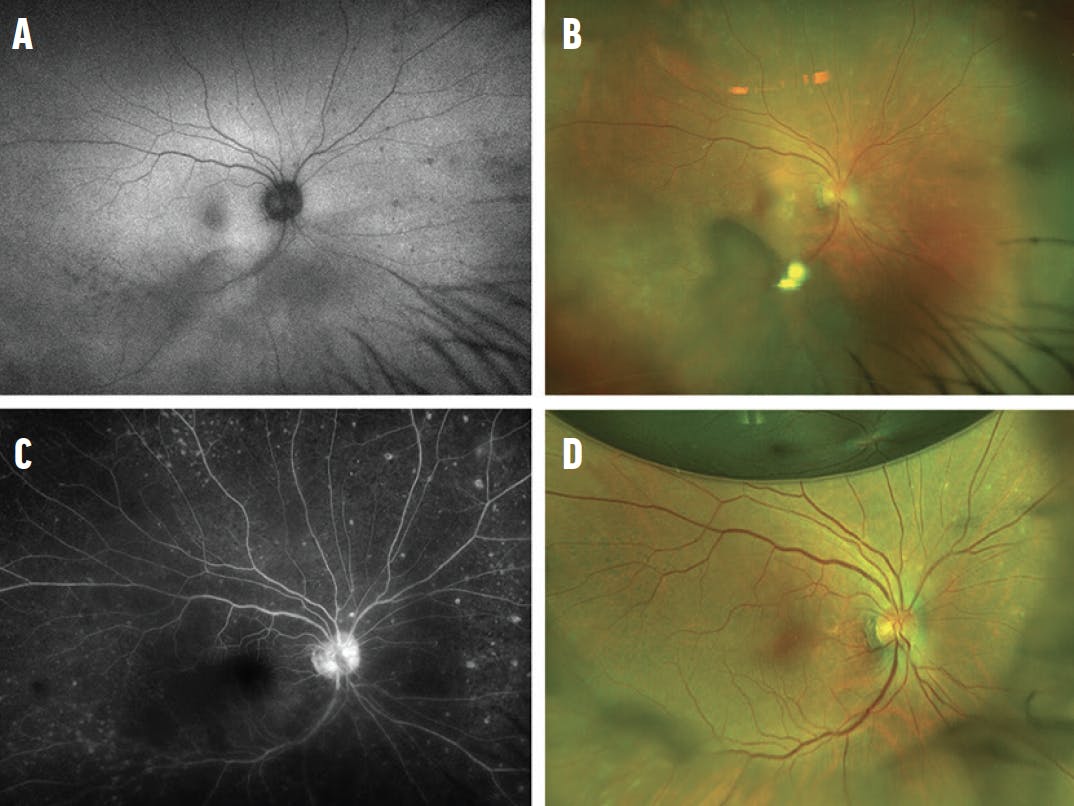
Figure 1. FAF of the right eye on day 2 revealed scattered pinpoint hypoautofluorescent spots, partially blocked by vitreous debris, in the nasal and inferotemporal periphery. Fundus pseudocolor imaging of the right eye on day 2 showed vitreous opacities and haze, blurred optic nerve margins, and pinpoint hypopigmented chorioretinal lesions in the periphery (B). The cream-colored lesion in the macula is an imaging artifact. Early-phase FA on day 2 demonstrated optic nerve staining and pinpoint staining throughout the periphery (C). Pseudocolor fundus imaging of the right eye following vitrectomy displayed mild inferior blurred disc margins and pinpoint peripheral hypopigmented chorioretinal spots (D).
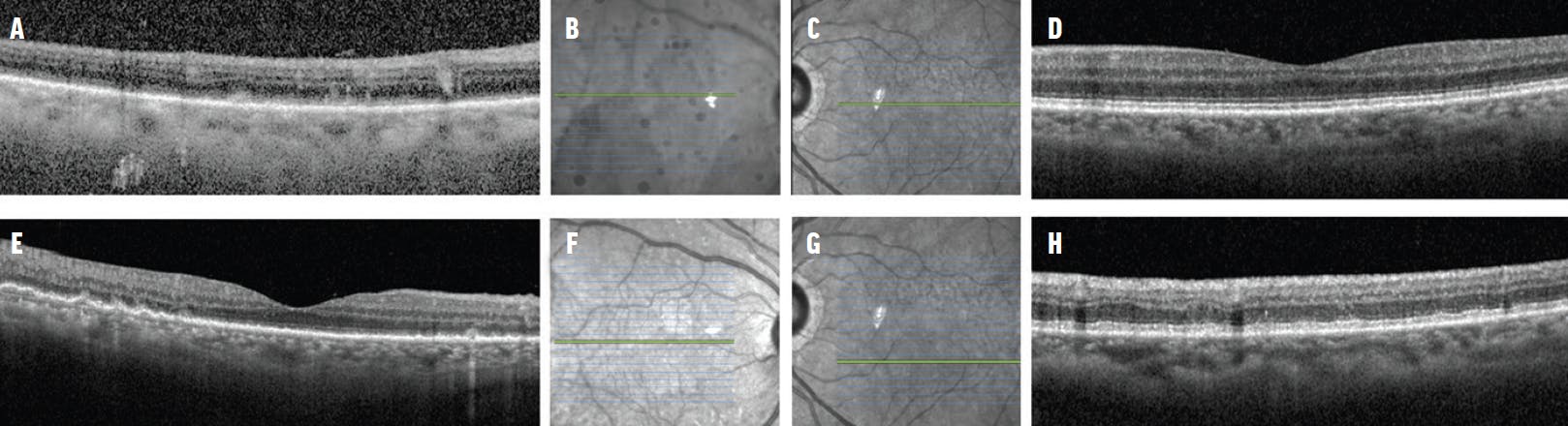
Figure 2. OCT of the right eye on presentation showed image degradation secondary to vitreous debris, subretinal deposits with possible retinal pigment epithelium thickening, and pachychoroid (A). The near-infrared image with the green cut corresponded to the OCT slab seen in panel A (B). The near-infrared image of the left eye with the green cut corresponded to the OCT slab seen in panel D (C). OCT of the left eye on presentation appeared normal (D). OCT and near-infrared imaging 19 days later showed further changes (E-H).
Further discussion with the patient revealed a remote history of a cardiac arrythmia status post-ablation, for which he was still anticoagulated, and a 2-year diagnosis of Waldenström macroglobulinemia, a rare indolent lymphoma characterized by a monoclonal gammopathy, for which he had been told he didn’t need treatment.
The patient was evaluated by a second retina fellow and the uveitis fellow on call. Both felt his presentation likely represented an infectious or idiopathic posterior uveitis; however, as labs were pending, oral steroids were deferred.
The patient returned to the clinic 3 days later reporting worsening symptoms in the right eye. On examination, his vision was unchanged, and while the right eye was stable, the left eye now showed evidence of hypopigmented peripheral subretinal lesions with corresponding pinpoint hyperautofluorescent spots on multimodal imaging (Figure 3). A white dot syndrome was deemed highest on the differential, although lymphoma remained in consideration. As bloodwork had been drawn and some of the patient’s labs were back (mildly elevated rheumatoid factor, otherwise normal CBC, CMP, ESR, and CRP, and negative RPR and ANA), the patient was started on 40 mg oral prednisone daily.
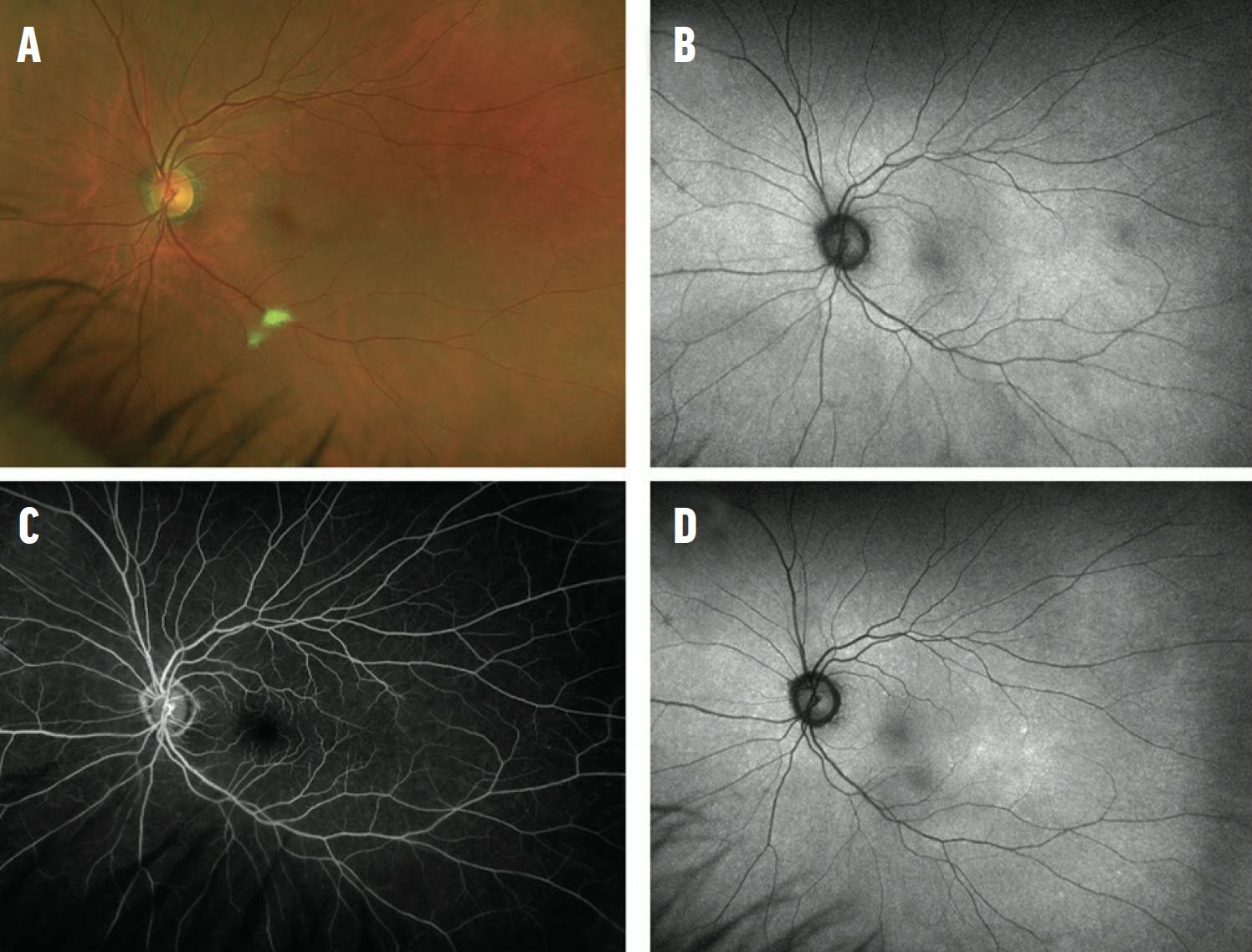
Figure 3. Fundus pseudocolor imaging and FAF of the left eye on day 2 appeared normal (A, B). Early-phase FA of the left eye on day 2 appeared normal (C). FAF of the left eye on day 5 demonstrated scattered pinpoint hyperautofluorescence mostly in the temporal macula (D).
The patient returned 5 days later as scheduled, now with decreased VA to 20/100 OD. Though he remained 20/20 OS, he was symptomatic of new floaters. At this point, both eyes had developed anterior chamber cells with fine keratic precipitates, and dense vitritis was evident in the right eye.
The patient underwent an uncomplicated vitrectomy 2 days later and noted immediate improvement in vision.
By the patient’s follow-up visit 1 week later, pathology and flow cytometry had confirmed an atypical B-cell population consistent with large B-cell lymphoma. The implications of these findings, along with the diagnosis of a primary intraocular lymphoma, were discussed with the patient, along with an ocular oncology referral.
At this point, the patient’s hematologist/oncologist joined the care team, and an outpatient brain and orbit MRI was performed. Per his oncologist, the patient reported no additional localizing symptoms and had already had a PET-CT scan 3 months prior, and no further workup was obtained.
Over the following 2 weeks, now 30 days from initial presentation, the patient was evaluated by the ocular oncology service and started on bilateral intravitreal methotrexate. He continues to receive treatment.
DISCUSSION
Primary intraocular lymphoma is most often a high-grade, non-Hodgkin, diffuse, large B-cell lymphoma, a severe disease with poor systemic prognosis due to tropism for brain involvement. A total of 15% to 25% of primary central nervous system lymphoma cases develop ocular involvement; 56% to 90% of primary intraocular lymphoma patients eventually progress to involve the central nervous system.1,2 Medical history of malignancy should raise suspicion for second malignancy.
Diagnosis of primary intraocular lymphoma is often delayed, with one series reporting a median time of 25 months from symptom onset.3 Uveitis and systemic workups are often negative, prompting a diagnosis of idiopathic uveitis, which is then treated with steroids. As patients often temporarily improve on steroids, this can further delay a definitive diagnosis, which often requires a vitreous biopsy.
There is no consensus on the treatment of primary intraocular lymphoma. When disease is limited to the eye alone, radiotherapy, intravitreal chemotherapy (ie, methotrexate), systemic chemotherapy, or combination therapy have been reported to be effective treatment modalities.4,5
1. Akpek EK, Ahmed I, Hochberg FH, et al. Intraocular-central nervous system lymphoma: clinical features, diagnosis, and outcomes. Ophthalmology. 1999;106(9):1805-1810.
2. Jahnke K, Thiel E, Abrey LE, Neuwelt EA, Korfel A. Diagnosis and management of primary intraocular lymphoma: an update. Clin Ophthalmol. 2007;1(3):247-258.
3. Cimino L, Coassin M, Chan CC, et al. Vitreoretinal lymphomas misdiagnosed as uveitis: lessons learned from a case series. Indian J Ophthalmol. 2016;64(5):369-375.
4. Berenbom A, Davila R, Lin HS, et al. Treatment outcomes for primary intraocular lymphoma: implications for external beam radiotherapy. Eye (Lond). 2007;21:1198-1201.
5. He LF, Zhang JD, Chen XX, Wei RL. Epidemiology and survival outcomes of patients with primary intraocular lymphoma: a population-based analysis. BMC Ophthalmol. 2022;22(1):486.


