


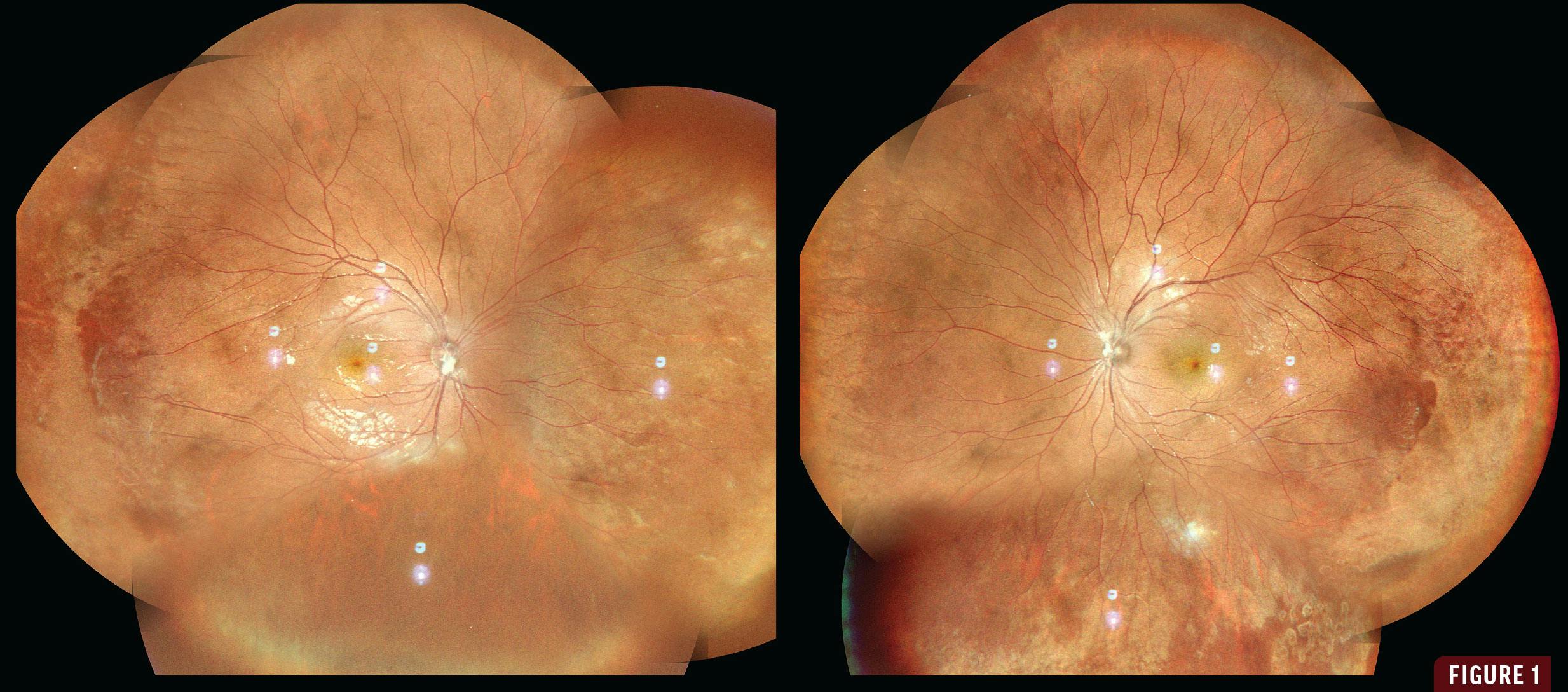
A 13-year-old boy was brought to our clinic for a routine visit. His birth history was normal, and there was no significant family history. On examination, his VA was 20/20 OU. His IOP was 20 mm Hg OD and 19 mm Hg OS. The anterior segment examination was within normal limits. Dilated fundus examination revealed avascular ischemic areas in the periphery of each eye, with a normal posterior pole (Figure 1).
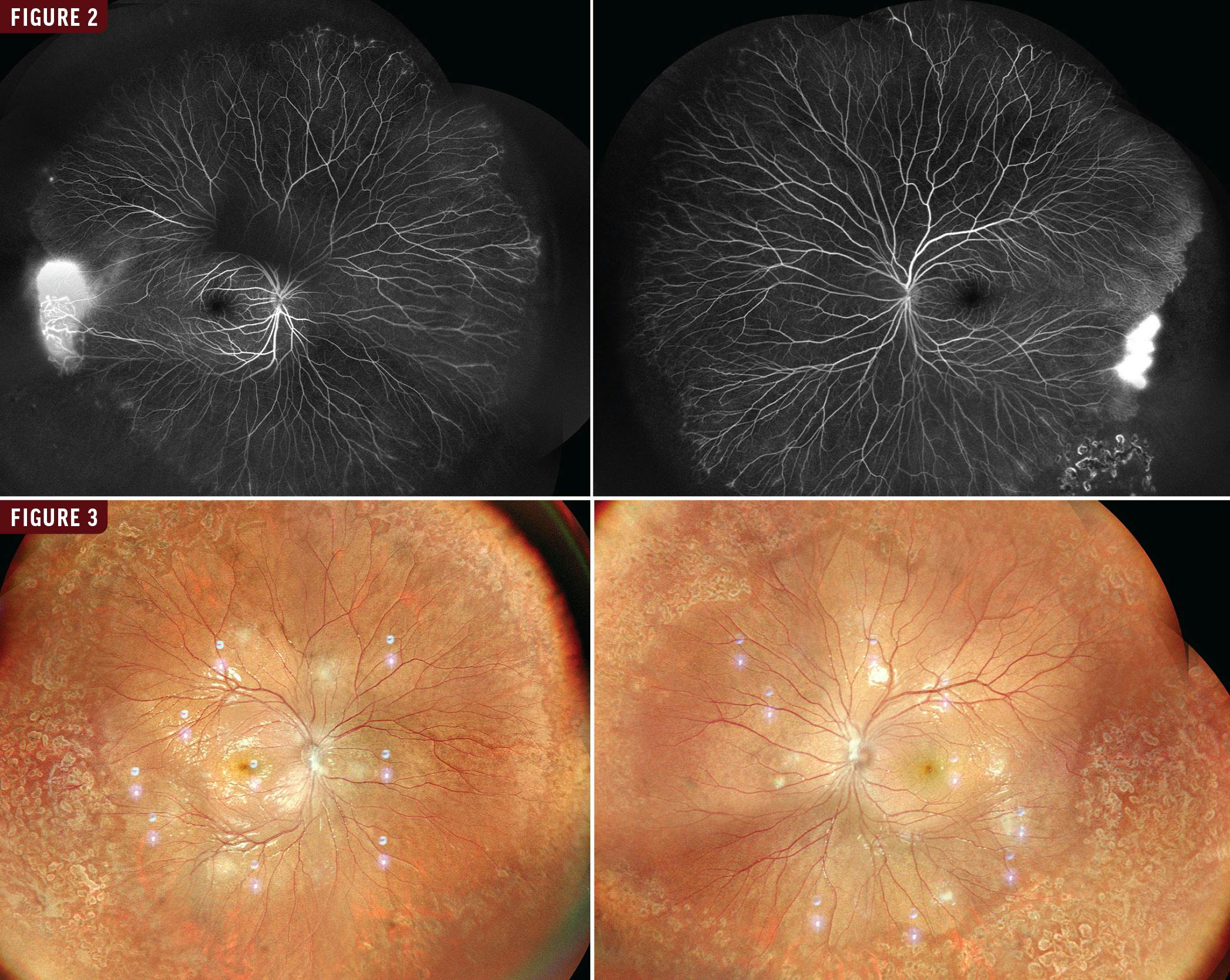
Fluorescein angiography showed 360° capillary nonperfusion in the periphery with leakage secondary to neovascular proliferations in the temporal periphery of each eye (Figure 2).
A diagnosis of stage 1 familial exudative vitreoretinopathy (FEVR) was made, and the patient was treated with laser photocoagulation. At the 1-month follow-up, each eye showed a well-lasered retinal periphery (Figure 3). The patient will be evaluated again 4 to 6 months post-treatment.
STAGING
FEVR is a hereditary vitreoretinal disorder in which there is abnormal retinal angiogenesis, resulting in incomplete peripheral retinal vascularization and retinal ischemia. A clinical classification describes five stages of FEVR1
Stage 1: avascular periphery or anomalous intraretinal vascularization
Stage 2: avascular retinal periphery with extraretinal vascularization
Stage 3: extramacular retinal detachment (RD)
Stage 4: macula-involving, subtotal RD
Stage 5: total RD
Stage 1 FEVR often goes undiagnosed due to the lack of symptoms. FEVR usually has a progressive course during childhood and may become stable after 20 years of age; however, late progression with vision-threatening complications, such as vitreous hemorrhage and RD, can occur at any age.
MANAGEMENT
Treatment protocols include observation, laser photocoagulation, and surgery (ie, vitrectomy or scleral buckling), depending on the disease stage. Long-term monitoring is required. Examination of the family members is also critical so that early intervention can be planned before complications develop.
1. Kashani AH, Learned D, Nudleman E, Drenser KA, Capone A, Trese MT. High prevalence of peripheral retinal vascular anomalies in family members of patients with familial exudative vitreoretinopathy. Ophthalmology. 2014;121(1):262-268.


