


Uveal melanoma is a rare, life-threatening malignancy that leads to systemic metastasis by 10 years in approximately 25% to 40% of patients.1,2 Until recently, prognostication has relied on nonconditional analysis, a static method that estimates survival based on the time of diagnosis. One limitation of this method is that it cannot be used to estimate the prognosis of patients who have accrued a certain number of metastasis-free years since their initial diagnosis. In contrast, conditional analysis accounts for the increased survival probability that comes with accrued years of survival and, thus, can provide patients with a better idea of future risk.
In this overview, we explore three studies that use both conditional and nonconditional analyses and discuss how these analytical methods influence disease prognostication.
METASTASIS-FREE SURVIVAL AND FUTURE RISK
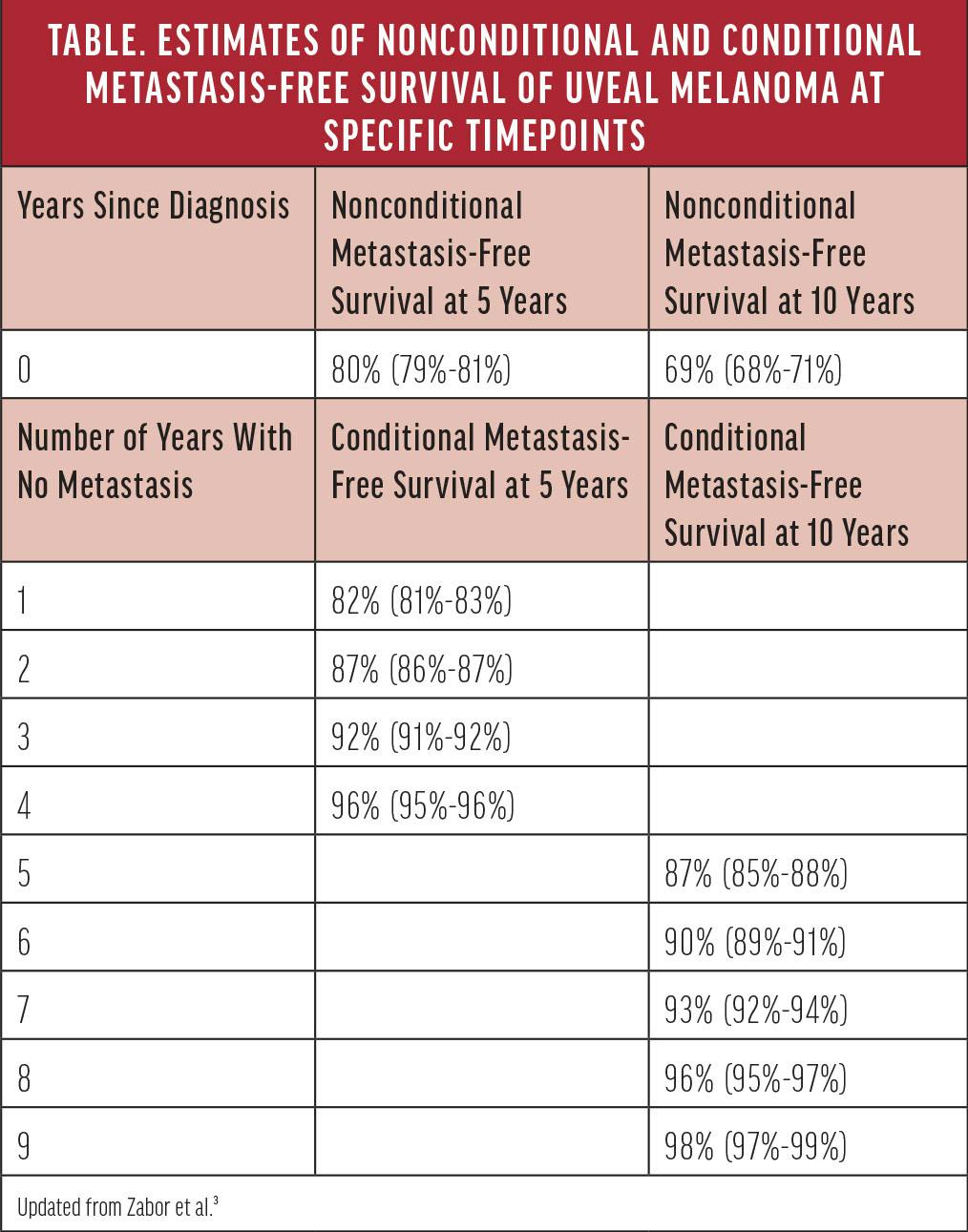
Zabor et al reported on the conditional and nonconditional metastasis-free survival of 6,863 patients with uveal melanoma 5 and 10 years after diagnosis using the online Surveillance, Epidemiology, and End Results database (Table).3 These data highlight that conditional survival estimates of uveal melanoma improve with time from primary diagnosis to provide the patient with more personalized prognostic information.
Relevance of TCGA Group
Conditional survival analysis can also be calculated for cytogenetic variations. The Cancer Genome Atlas (TCGA) serves as a four-category prognostic classification for uveal melanoma metastatic risk based on the tumor’s genetic profile. Using this classification, uveal melanoma is classified into Group A (disomy 3, disomy 8), Group B (disomy 3, 8q gain), Group C (monosomy 3, 8q gain possible), and Group D (monosomy 3, 8q gain multiple).4
Shields et al studied nonconditional and conditional metastatic rates in patients with uveal melanoma based on genetic testing in 1,001 cases over a period of 22 years (Figure 1).5 This analysis included TCGA Groups A (49%), B (14%), C (26%), and D (11%).5 The nonconditional metastatic rate (ncMR) at presentation revealed 5- and 10-year metastatic rates of 4% and 6% (Group A), 12% and 20% (Group B), 33% and 49% (Group C), and 60% and 68% (Group D), respectively.5 The conditional metastatic rate (cMR) after 2 years of metastasis-free survival yielded 5- and 10-year metastatic rates of 2% and 5% (Group A), 8% and 18% (Group B), 21% and 40% (Group C), and 38% and 50% (Group D), respectively.5 These findings further suggest that longer survival without metastasis correlates with a reduction in metastatic risk. In addition, the researchers found that this decreased risk was most prominent in TCGA Group D.5
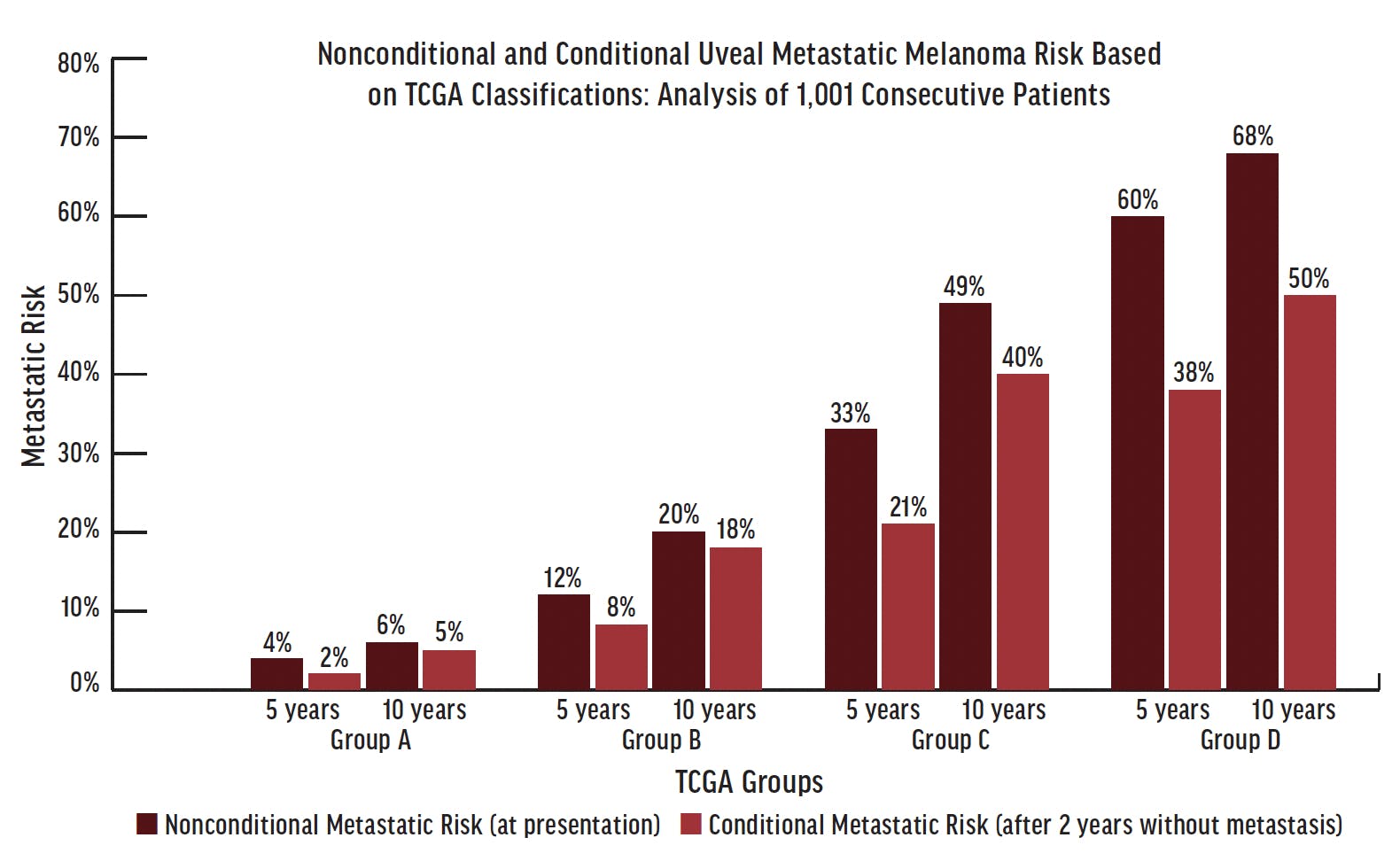
Figure 1. Comparison of cMR and ncMR of patients with uveal melanoma based on the TCGA classification system. The metastatic rate increases from Group A to Group D, but conditional survival improves when accounting for accrued years of metastasis-free survival. Adapted from Shields et al.⁵
Relevance of Patient Age
To further explore the conditional survival estimates in patients with uveal melanoma, Shields et al studied a cohort of 8,091 patients with uveal melanoma over a maximum 51-year follow-up period, specifically evaluating conditional outcomes by age.6 Patients with uveal melanoma who survived 3, 5, or 10 years without metastasis had improved probability of conditional survival compared with their initial prognosis.
At presentation, nonconditional cumulative incidence of metastasis (ncCIM) for 5-, 10-, 20-, 30-year survival was 15%, 23%, 32%, and 36%, respectively (Figure 2).6 For patients who did not develop metastasis in the first 3 years, the conditional cumulative incidence of metastasis (cCIM) for 5-, 10-, 20-, and 30-year survival sdropped to 6%, 15%, 25%, and 30%, respectively.6 The cCIM further improved in patients who remained metastasis-free at 5 years and showed even greater improvement when metastasis-free at 10 years. The cCIM fell to 13% and 18% for patients who reached 20- and 30-year survival, respectively.6
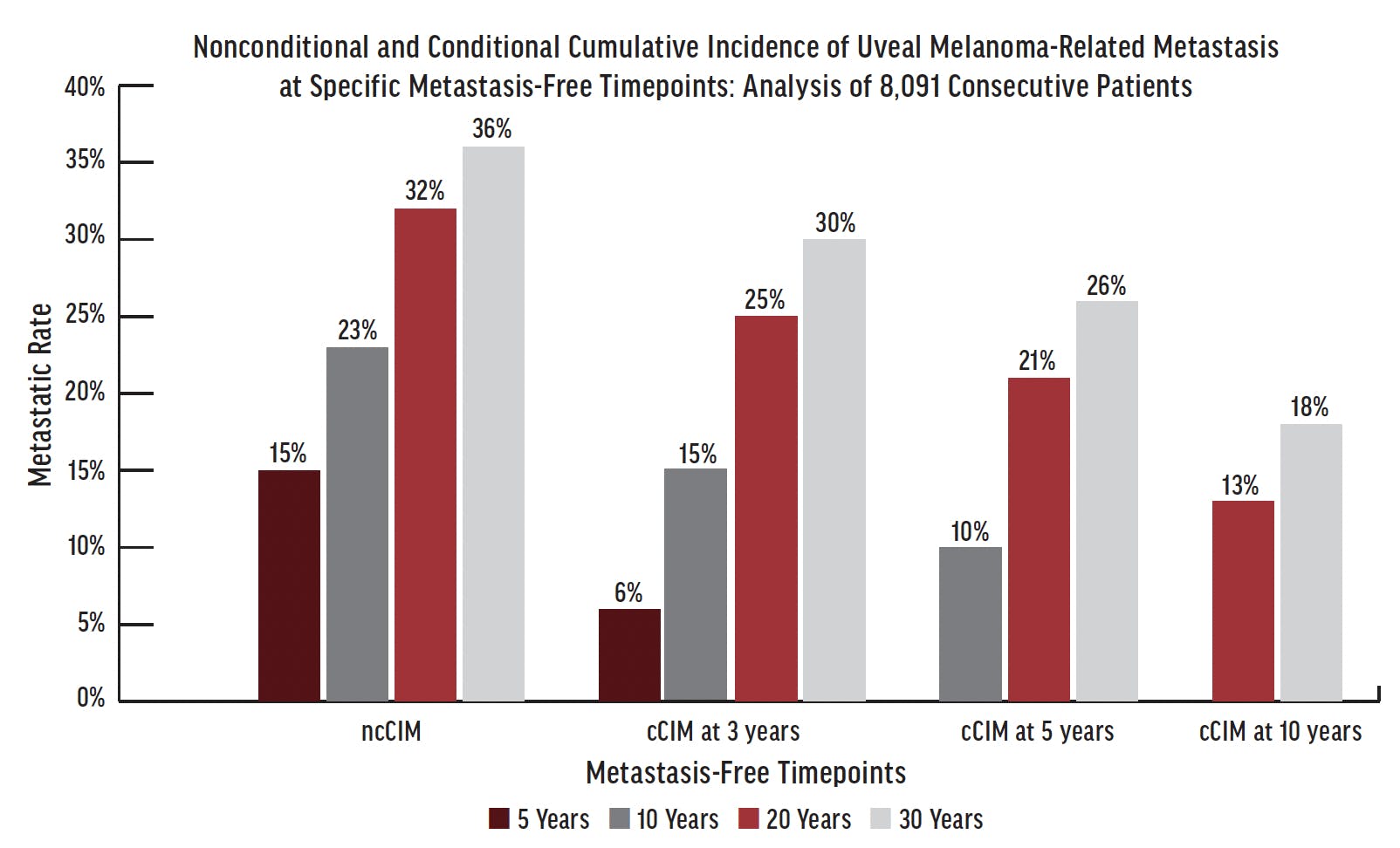
Figure 2. Comparsion of ncCIM versus cCIM at metastasis-free timepoints. The cCIM improves with accrued years of metastasis-free survival. Adapted from Shields et al.⁶
When accounting for patient age, the ncCIM revealed that the younger cohort (0-29 years of age) demonstrated significantly lower metastatic rates compared with the older cohort (80-99 years of age) with the 5-, 10-, 20-, and 30-year survival rates of 8%, 15%, and 19%, respectively, and 27% versus 21%, 29%, 29%, and 29%, respectively (P < .001).6 Although the cCIM at 1 and 2 years of metastasis-free survival showed persistent superior younger cohort survival (P < .001 and P = .001, respectively), there was no further benefit for young patients at 3 years of metastasis-free survival.6
Conditional, dynamic prediction using Kaplan-Meier estimates can enhance our ability to counsel patients based on age and accrued years of metastasis-free survival.
PAINT A MORE ACCURATE PICTURE
Using conditional analysis, survival probability can provide clinicians with a more accurate tool to estimate individual patient prognosis, allowing for a more personalized understanding of their disease state.
Authors’ note: Support provided in part by the Eye Tumor Research Foundation, Philadelphia, PA (CLS). The funders had no role in the design and conduct of the study, in the collection, analysis and interpretation of the data, or in the preparation, review and approval of the manuscript. Carol L. Shields, MD, has had full access to all the data in the study and takes responsibility for the integrity of the data.
1. Kujala E, Mäkitie T, Kivelä T. Very long-term prognosis of patients with malignant uveal melanoma. Invest Ophthalmol Vis Sci. 2003;44(11):4651-4659.
2. Shields CL, Furuta M, Thangappan A, et al. Metastasis of uveal melanoma millimeter-by-millimeter in 8033 consecutive eyes. Arch Ophthalmol. 2009;127(8):989-998.
3. Zabor EC, Radivoyevitch T, Singh AD, et al. Conditional survival in uveal melanoma. Ophthalmol Retina. 2021;5(6):536-542.
4. Jager MJ, Brouwer NJ, Esmaeli B. The cancer genome atlas project: An integrated molecular view of uveal melanoma. Ophthalmology. 2018;125(8):1139-1142.
5. Shields CL, Dockery PW, Mayro EL, et al. Conditional survival of uveal melanoma using The Cancer Genome Atlas (TCGA) classification (Simplified Version) in 1001 cases. Saudi J Ophthalmol. 2021;36(3):308-314.
6. Shields CL, Samuelson AG, Oh GJ, et al. Conditional metastasis of uveal melanoma in 8091 patients over half-century (51 years) by age group: assessing the entire population and the extremes of age. Invest Ophthalmol Vis Sci. 2023;64(10):7.


