


Von Hippel-Lindau (VHL) is an autosomal dominant neurocutaneous syndrome characterized by the growth of vascular tumors throughout the body, including the kidneys, pancreas, brain, spine, and eyes. This rare genetic mutation is found in one out of 36,000 individuals, and at least 900 cases have been reported in Canada.1,2 A key mechanism of VHL involves angiogenesis in normoxic conditions due to inactivation of the VHL protein via germline mutations of the VHL tumor suppressor gene. The inactivated VHL protein loses its ability to degrade hypoxia-inducible factors (HIF), leading to the formation of stable HIF subunits, activation of HIF-mediated transcription, and VEGF production.2-5
OCULAR TUMORS ASSOCIATED WITH VHL
Ocular manifestations affect approximately half of patients with VHL and are diagnosed at a mean age of 26 years.6,7 Retinal capillary hemangioblastomas (RCHs) are the most common, with an 80% chance after age 80.2,7,8 RCHs typically present unilaterally or bilaterally in the peripheral retina or juxtapapillary area. These lesions can lead to vision-threatening complications, such as retinal nonperfusion and exudative or tractional retinal detachments (RDs).7,9
Treatment of RCHs is indicated when the vision is compromised; otherwise, small peripheral tumors are monitored.10,11 Ablative treatment modalities, such as laser, cryotherapy, transpupillary thermotherapy, photodynamic therapy, plaque brachytherapy, and external beam radiotherapy, are employed in cases of tumor progression.2 Surgical resection may be warranted for larger tumors, and intravitreal anti-VEGF therapy may be used as an adjunctive treatment to control exudation and retinal edema.2,11 While smaller and peripheral tumors respond well to local treatment, large or juxtapapillary tumors may be refractory.11
Belzutifan (Welireg, Merck), a small-molecule HIF-2α inhibitor that effectively blocks HIF pathway activation, inhibits VEGF-driven angiogenesis and tumor progression. This novel drug is already approved for nonsurgical renal cell carcinoma, central nervous system (CNS) hemangioblastomas, and pancreatic neuro-endocrine tumors in patients with VHL.12,13 While RCHs have not been specifically identified as an indication for the initiation of belzutifan, reports are beginning to shed light on its potential benefits for patients with RCH who are also dealing with other VHL-associated tumors.14-16
In this report, we present a patient with VHL and bilateral RCHs alongside systemic tumors, whose ocular tumors responded favorably to treatment with oral belzutifan.
CASE REPORT
A 30-year-old woman with genetically confirmed VHL syndrome has been followed for 2 decades in our retina clinic due to RCHs. She established care with our institution at 11 years of age, at which time she was asymptomatic and had a VA of 20/20 OU. She was diagnosed with a peripapillary RCH in her left eye, which was initially observed.
Over the next 4 years, her vision gradually worsened to a VA of 20/100 OS secondary to tumor growth, bleeding, and exudation. Intravitreal anti-VEGF injections resulted in temporary improvement of the retinal edema. However, due to subsequent progressive tumor growth, her left eye eventually underwent plaque brachytherapy. Photodynamic therapy was also performed 1 year later. She then developed a tractional and exudative RD in her left eye, which required vitrectomy, subretinal fluid drainage, and oil tamponade. Despite these efforts, the retina redetached, and her left eye developed neovascular glaucoma, resulting in complete left visual field loss 11 years after her initial presentation.
Development of Bilateral Disease
The first RCH in the patient’s right eye was documented approximately 6 years after her initial evaluation. During this time, she presented with flashes and floaters, although her VA was 20/20 OD. A solitary tumor in the superotemporal retinal periphery was treated with focal laser ablation. After four treatment sessions, she developed a tractional and exudative RD, which warranted vitrectomy, peeling, laser, cryotherapy, and gas tamponade. The retina was successfully reattached, and she attained a postoperative VA of 20/25 OD.
The right eye remained stable for the next 5 years, at which point she developed a new RCH and associated tractional RD. She was treated with a combined buckle-vitrectomy procedure, membrane peeling, retinectomy, endolaser, and gas tamponade. Another retinal reattachment surgery was performed 8 months later, ultimately achieving anatomic reattachment and a VA of 20/60 OD.
Long-Term Follow-Up
Fifteen years after her initial presentation, the patient continued to develop multiple RCHs in the retinal periphery of her right eye. She underwent repeat laser ablation procedures, even in previously treated areas.
Wide-angle fundus photography at follow-up year 17 showed peripheral chorioretinal scarring and fibrosis, along with a focal tractional band and detachment inferiorly in the right eye (Figure 1A). Fluorescein angiography (FA) confirmed the presence of multiple perfused RCHs in the retinal periphery (Figure 1B), most of which were not visible on fundus examination. These were periodically treated with focal laser.
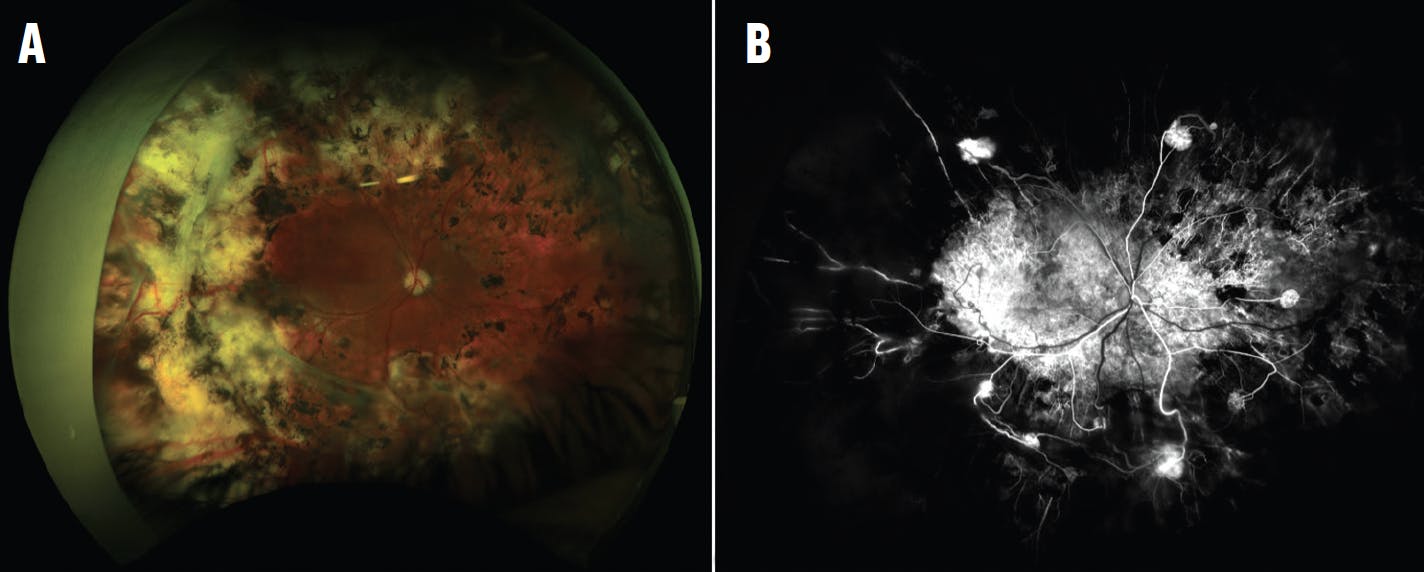
Figure 1. A wide-angle fundus photo of the right eye 17 years after initial presentation showed extensive peripheral retinal scarring after multiple retinal reattachment procedures and ablative treatment of RCHs (A). An arterial-phase FA of the right eye revealed the presence of multiple, perfused RCHs in the retinal periphery within the scarred areas of the retina (B).
At year 19 of follow-up, continued growth of the patient’s RCHs resulted in vitreous hemorrhage in the right eye, which caused her VA to decrease to 20/80 OD.
A New Treatment Approach
Throughout her disease course, this patient was managed for several VHL-associated tumors: bilateral adrenal pheochromocytomas, pancreatic neuro-endocrine tumors, CNS hemangioblastomas, intracranial meningioma, spinal intramedullary hemangioblastomas, and renal cell carcinoma. A recent abdominal MRI indicated enlargement of her right renal cell carcinoma, coinciding with the right-eye vitreous hemorrhage (Figure 2A and B).
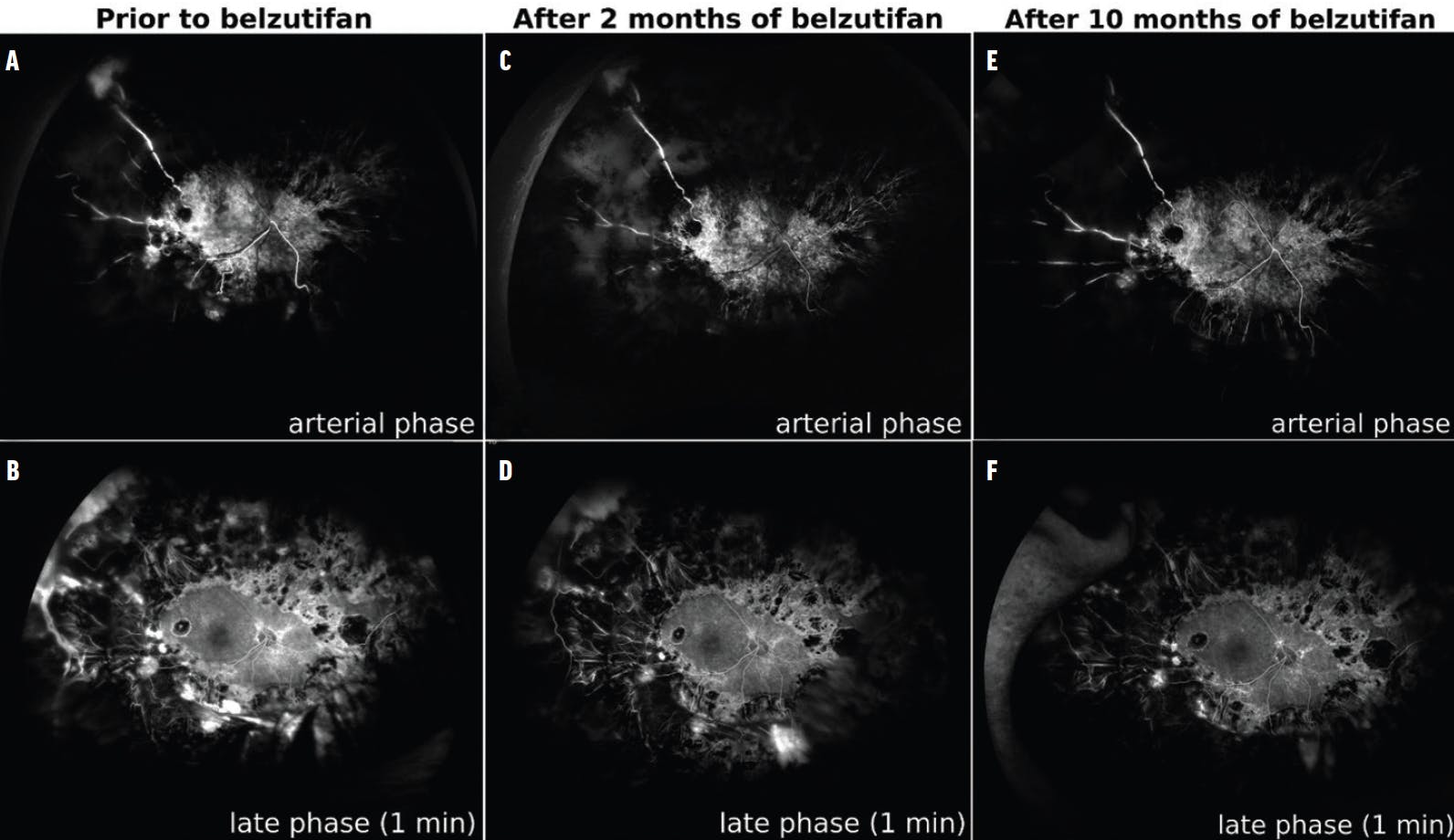
Figure 2. An arterial-phase FA prior to belzutifan initiation demonstrated hyperfluorescence of the RCHs and prominent feeder vessels (A, B). A repeat scan after 2 months of oral belzutifan showed decreased tumor hyperfluorescence and narrowing of the feeder vessels supplying the RCHs, particularly in the temporal and inferior periphery (C, D). Another scan 10 months after belzutifan initiation showed no new tumors (E, F). Note the heightened visibility of the temporal vessel in C compared with B, which can be attributed to alterations in image contrast settings. Upon thorough review of all photos, there were no newly identified tumors in the temporal periphery.
Following discussions with her medical oncologist, 120 mg oral belzutifan was initiated once daily. After 2 months of this treatment regimen, her RCHs demonstrated a favorable response (Figure 2C and D). However, she also developed symptomatic anemia, and her hemoglobin decreased to 87 mg/dL. Belzutifan was temporarily discontinued for 1 week, and she underwent infusion of two units of packed red blood cells. At present, she remains systemically stable on a reduced dose of 80 mg oral belzutifan once daily. At her latest ophthalmic examination, her VA was 20/50 OD. A follow-up FA performed 10 months after initiating belzutifan showed no new RCHs (Figure 2E and F).
DISCUSSION
Our report contributes to the growing body of evidence demonstrating the regression of RCHs following treatment with oral HIF-2α inhibitors,14-15 which has typically been initiated to address other types of VHL-associated tumors. Such reports suggest the effectiveness of oral HIF-2α inhibitors as an option for managing refractory RCHs, as was demonstrated with our patient.
Barriers to Treating RCHs With Oral Belzutifan
While CNS hemangioblastomas are listed in the current guidelines for initiation of belzutifan, RCHs are not recognized as an independent indication for oral belzutifan therapy. One anticipated barrier is the substantial cost associated with oral belzutifan treatment, especially given the prevalence of RCHs among patients with VHL. However, for patients with only one seeing eye or who develop bilateral vision-threatening RCHs, oral belzutifan may be the only hope to prevent total blindness.
While most patients who initiate treatment for alternative indications begin with a daily dose of 120 mg, some patients may need a lower dose due to adverse effects. Large-scale, comprehensive studies are warranted to investigate the minimum effective dose to treat or stabilize RCHs.
Imaging Pearls
While fundoscopy and wide-angle fundus imaging remains valuable, it was inadequate in monitoring areas of the retina that had become obscured by scarring. Periodic FA is crucial in documenting changes in tumor size and vascularity,16 especially in areas difficult to assess clinically.
HOPE AMID A LIFETIME RISK FOR TUMORS
VHL syndrome predisposes individuals to developing tumors across multiple organ systems over their lifetime. Currently, RCHs are not listed as an independent indication for initiating belzutifan therapy. Our case is a compelling example of a positive response of RCHs to oral belzutifan. Future research will provide valuable insights into the potential of oral HIF-2α inhibitors as a game-changing therapeutic option for patients with vision-threatening VHL-associated RCHs.
1. Salama Y, Albanyan S, Szybowska M, et al. Comprehensive characterization of a Canadian cohort of von Hippel‐Lindau disease patients. Clin Genet. 2019;96(5):461-467.
2. Ruppert MD, Gavin M, Mitchell KT, Peiris AN. Ocular manifestations of von Hippel-Lindau disease. Cureus. 2019;11(8):e5319.
3. Maxwell PH, Wiesener MS, Chang GW, et al. The tumour suppressor protein VHL targets hypoxia-inducible factors for oxygen-dependent proteolysis. Nature. 1999;399(6733):271-275.
4. Na X, Wu G, Ryan CK, Schoen SR, Di’Santagnese PA, Messing EM. Overproduction of vascular endothelial growth factor related to von Hippel-Lindau tumor suppressor gene mutations and hypoxia-inducible factor-1 expression in renal cell carcinomas. J Urol. 2003;170(2):588-592.
5. Iliopoulos O, Levy AP, Jiang C, Kaelin WG, Goldberg MA. Negative regulation of hypoxia-inducible genes by the von Hippel-Lindau protein. Proc Natl Acad Sci USA. 1996;93(20):10595-10599.
6. Maher ER, Yates JRW, Harries R, et al. Clinical features and natural history of von Hippel-Lindau disease. Q J Med. 1990;77(2):1151-1163.
7. Aronow ME, Wiley HE, Gaudric A, et al. Von Hippel-Lindau disease: update on pathogenesis and systemic aspects. Retina. 2019;39(12):2243-2253.
8. Wittebol‐Post D, Hes FJ, Lips CJ. The eye in von Hippel-Lindau disease. Long‐term follow‐up of screening and treatment: recommendations. J Intern Med. 1998;243(6):555-561.
9. Karimi S, Arabi A, Shahraki T, Safi S. Von Hippel-Lindau disease and the eye. J Ophthalmic Vis Res. 2020;15(1):78-94.
10. Singh AD, Nouri M, Shields CL, Shields JA, Perez N. Treatment of retinal capillary hemangioma. Ophthalmology. 2002;109(10):1799-1806.
11. Kim H, Yi JH, Kwon HJ, Lee CS, Lee SC. Therapeutic outcomes of retinal hemangioblastomas. Retina. 2014;34(12):2479-2486.
12. Choueiri TK, Bauer TM, Papadopoulos KP, et al. Inhibition of hypoxia-inducible factor-2a in renal cell carcinoma with belzutifan: a phase 1 trial and biomarker analysis. Nat Med. 2021;27(5):802-805.
13. Fallah J, Brave MH, Weinstock C, et al. FDA approval summary: belzutifan for Von Hippel-Lindau disease-associated tumors. Clin Cancer Res. 2022;28(22):4843-4848.
14. Grimes JM, Gershkovich A, Bogomolny D, Marr BP. Two cases of von Hippel-Lindau syndrome-associated retinal hemangioblastoma treated with belzutifan [published online ahead of print November 16, 2022]. Retin Cases Brief Rep.
15. Jones AA, Schloemer NJ, Wirostko WJ. Successful treatment of von Hippel-Lindau (VHL) disease-associated retinal capillary hemangioblastoma (RCH) with belzutifan in a pediatric patient [published online ahead of print July 13, 2023]. Retin Cases Brief Rep.
16. Fairbanks AM, Hoyek S, Patel NA. Systemic treatment reduces von-Hippel-Lindau–associated retinal capillary hemangioblastoma. Ophthalmology. 2023;130(5):524.


