


A dedicated ophthalmology research site independent from a clinical practice is a viable business model with the potential to yield numerous advantages for the physicians, site, patients, and research sponsors (Figure 1). The design of a retina research center in tandem with a clinic has been previously described.1 Here, we discuss the benefits of taking the next step to separate clinical practice and research.

BENEFITS TO PHYSICIANS
The most obvious benefit to working at an independent, research-only retina center may be increased efficiency and time management in conducting research that is only possible at an independent site. At such a facility, physicians can focus their attention solely on research; there are fewer patients because research visits are longer due to the number of required protocol assessments. Seeing fewer patients allows more face time with each person, and physicians have time to thoroughly understand each patient and their social milieu; thus, an independent site can be conducive to providing more holistic care. In addition, seeing fewer patients also means fewer after-hours calls and emergencies.
A research-only environment also eliminates many logistical nuances that often require personnel to manage. For example, prescriptions and refills are non-existent, as all investigational products and protocol-required medications are either provided or reimbursed by the study and dispensed by the research office. Similarly, because health insurance is not a factor at an independent research site, there is no need for credentialing, verifications, authorizations, or time spent coordinating care for patients through assistance programs. Deductibles and copays are obsolete in this setting, along with patient statements and explanation of benefits, saving significant time and effort.
In addition to these benefits, a research-only setting provides intellectual stimulation by allowing physicians to work with the latest treatments in a controlled environment. The diagnoses and treatments for enrolled patients require less decision making, as care is guided by the study protocols, and the final diagnostic eligibility decisions are made by central reading centers.
Overall, physician dissatisfaction is at an all-time high, and, consequently, they are working fewer hours and retiring at an earlier age.2,3 A large portion of this dissatisfaction can likely be explained by the rules imposed by the government/insurance complex; physicians are constantly being pressured to see more patients for less reimbursement and expend increasing resources to collect their proper compensation from insurance companies. With manageable patient volumes across an appropriate number of ongoing studies, physician compensation at an independent research site can be comparable with or even better than traditional clinical practice.
IMPROVED ACCESS FOR PATIENTS
Clinical trial participation is an incredible opportunity for most patients and is further enhanced at a site that only focuses on research. We often hear that the biggest complaint of patients today is the lack of face time with their non-research doctor, as they are often unable to ask their questions or get complete explanations of their disease and treatment; as mentioned previously, an independent research setting is a viable solution not only for physicians, but also for the patients in their care.
Because only clinical trial participants are seen at an independent research site, they benefit from a dramatically reduced wait time. At a typical clinic, patients often wait in various clinic locations to be helped by front-office staff and then seen by technicians and the physician. In contrast, patients visiting a research-only site can be welcomed upon arrival by a dedicated staff member who completes all assessments with minimal downtime. Despite the large number of assessments required for protocol visits, the duration of research visits at an independent site can be comparable with that of a typical clinic appointment in our experience, and is potentially much shorter than if a research visit were squeezed into a busy clinic day.
With shorter wait times, patients can spend more time with their physician and staff, resulting in a stronger relationship and better rapport. The patient feels they are receiving comprehensive care alongside their dedicated coordinator, rather than going through extensive protocol assessments with little explanation. Because a site dedicated to research can participate in more studies than an already busy clinic, patients also have a larger selection of studies to participate in and, thus, have better access to the latest treatments.
Lastly, financial stress is an increasing concern for patients, with constant changes and increasing costs from medical insurance. By participating in a clinical trial, uninsured or underinsured patients can receive cutting-edge treatments for a condition that may otherwise go untreated or undertreated, simply due to cost. Patients are also compensated for their time, and transportation can be provided for appointments, which further promotes compliance with treatment and yields better outcomes.
BOOST IN RESEARCH SITE PRODUCTIVITY
By shifting the focus solely to clinical research, the site itself will see a boost in efficiency, as its entire workflow becomes reoriented around the research patients, including scheduling, staffing, office layout, and equipment. Scheduling is not constrained by the physicians’ time being shared with clinic patients, and the site can have dedicated research staff, which leads to more accurate, personalized, and comprehensive care. The physical layout can be further optimized to include a space for an ETDRS vision lane, investigational product storage and preparation room, laboratory, and imaging suite (Figure 2).
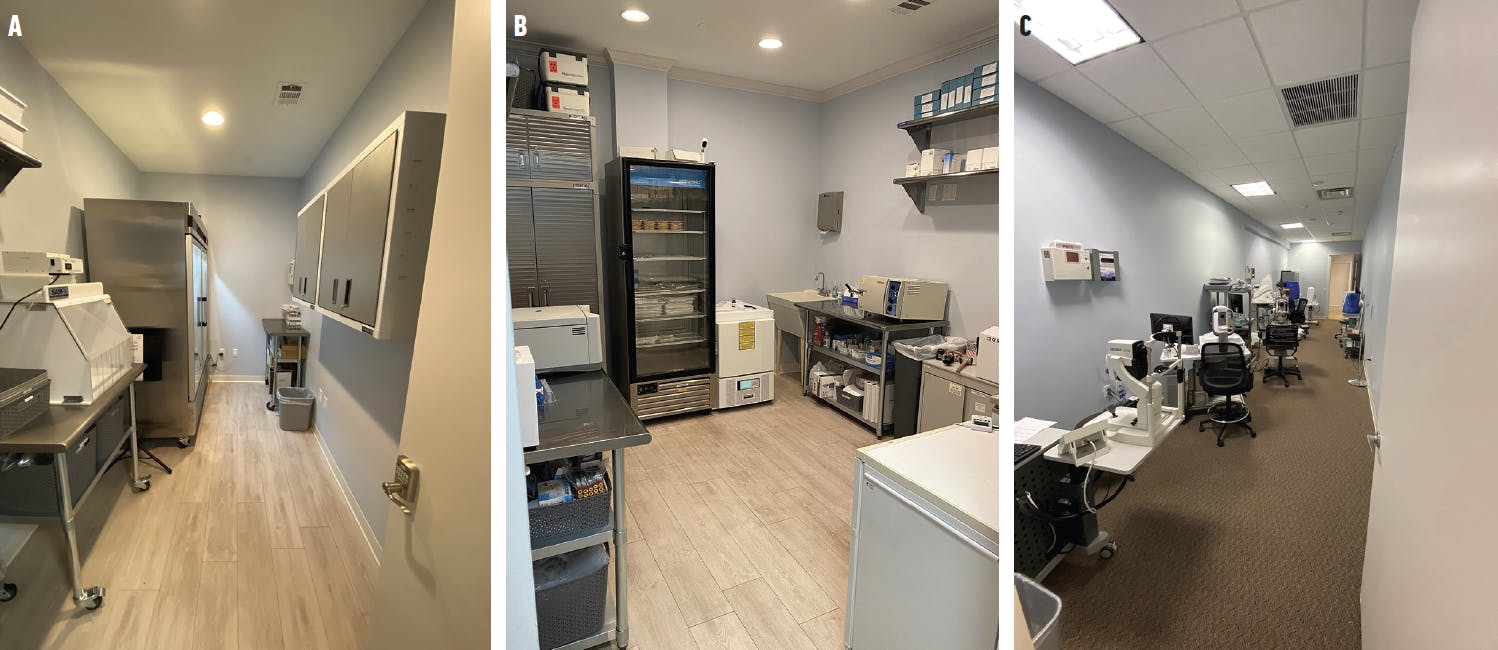
Figure 2. You can optimize the space in a research-only center by designating a separate drug storage room (A), laboratory (B), and imaging suite (C).
Another factor is that recruitment is focused entirely on patients eligible for clinical trials. This can be directed toward the entire community with direct-to-patient advertising, which, when done correctly, is quite effective. Potentially, all physicians within the community can send referrals, as there is no competition from non-research clinical physicians. Patients can enroll in a clinical trial and still maintain relationships with their other physicians; it’s worth noting that participation in a trial is not indefinite, and, thus, patients will resume routine care with their referring physicians when the trial ends. Patients may also choose to continue seeing their regular eye care provider between study appointments, as study physicians will not be managing eye conditions unrelated to the trial.
BENEFITS TO THE SPONSORS
Sponsors that conduct studies at a dedicated research site will experience key benefits across all areas of study conduct, including start-up, recruitment, enrollment, and quality of data. A dedicated research site can complete start-up and host a site initiation visit within 6 weeks of site selection, based on our experience. This is attributable to having a dedicated point of contact who can complete start-up documents, such as contracts and Institutional Review Board and Institutional Biosafety Committee submissions, concurrently, as well as experienced staff who can transfer certifications between all study vendors. Thus, sponsors do not have to spend time following up on document requests or waiting on various approvals from internal committees. An efficient start-up leads to on-time site activation and prompt participant enrollment, which allows sponsors to meet their study timelines.
Because research staff at independent sites can be trained across all areas of clinical trial conduct, they have a comprehensive understanding of protocol assessments. They can maintain certifications for all study vendors, such as those related to visual acuity, imaging, data entry, and international quality standards in which the relevant site staff are required to be certified (eg, Good Clinical Practice and Integrated Approaches to Testing and Assessment). The ability to focus solely on research can be attractive for staff, as it is intellectually stimulating and offers endless potential for growth, long-term employment, and stability.
FIRSTHAND EXPERIENCE
An independent clinical research center provides the opportunity for physicians to practice medicine with manageable schedules, proficient staff, and satisfied patients. For patients, clinical trial visits at a dedicated research site offer access to novel treatments in a friendly and professional environment; for sponsors, this setting offers confidence in the data obtained in a timely manner.
We implemented the independent research site model at the end of 2021. Our site is frequently the first one activated in many studies. The practice employs five part-time physicians, six clinical research coordinators, two imaging technicians, and a site director. Our staff have experience in more than 200 clinical trials in phase 1 to 4, enroll an average of 168 patients per year, and maintain an average of 39 ongoing studies per year. When our patients exit one study, they are usually eager to enroll in another. Our experience has demonstrated that happy physicians, patients, staff, and sponsors can generate a great work environment that is beneficial for all parties.
1. Gunderson I, Corak B, Berger BB. Designing a clinic and a research center side by side. New Retina MD. 2014;5(3):27-30.
2. Robeznieks A. Doctor shortages are here-and they’ll get worse if we don’t act fast. American Medical Association. April 13, 2022. Accessed April 9, 2024. www.ama-assn.org/practice-management/sustainability/doctor-shortages-are-here-and-they-ll-get-worse-if-we-don-t-act
3. Henry TA. Medicine’s great resignation? 1 in 5 doctors plan exit in 2 years. American Medical Association. January 18, 2022. Accessed April 9, 2024. www.ama-assn.org/practice-management/physician-health/medicine-s-great-resignation-1-5-doctors-plan-exit-2-years


