


In the differential diagnosis of bilateral optic nerve swelling, clinicians must take into consideration both papilledema and pseudopapilledema. Papilledema, a life-threatening condition, is caused by increased intracranial pressure (ICP), which is associated with ruptured aneurysms, brain tumor, encephalitis, and intraventricular hemorrhage.1 Patients who are suspicious for papilledema should undergo immediate neurological examination, MRI, and lumbar puncture.2
Pseudopapilledema consists of an anomalous elevation of the optic disc without swelling of the retinal nerve fiber layer. Pseudopapilledema can be caused by optic nerve head (ONH) drusen, congenital anomalies such as myelinated nerve fibers, vitreopapillary traction in diabetes, and optic disc infiltration by neoplastic masses.3
CASE REPORT
A 33-year-old man with obesity presented with bilateral vision loss and flashes. He noted severe head pain and pain in his frontal sinus, which he associated with prolonged inflammation after previous sinus and septum surgery. At presentation, his VA was 20/40 OD and 20/20 OS. Fundus examination revealed severe bilateral ONH swelling (Figure 1A, B, H, and I) with coexisting visual field defects (Figure 1C and J). According to the Frisen scale (papilledema grading system), he had stage 5 papilledema.4
Ultrasonography and fundus autofluorescence ruled out the possibility of optic nerve drusen. On swept-source OCT (SS-OCT), the foveal contour was unremarkable. In the right eye, we noted intraretinal hyperreflective spots near the ONH, and the nerve fiber layer was disrupted (Figure 1B and I). Fluorescein angiography confirmed bilateral optic disc swelling. On SS-OCT angiography of each eye, the typical ONH vasculature was not visible (Figure 1D-G, K-N).
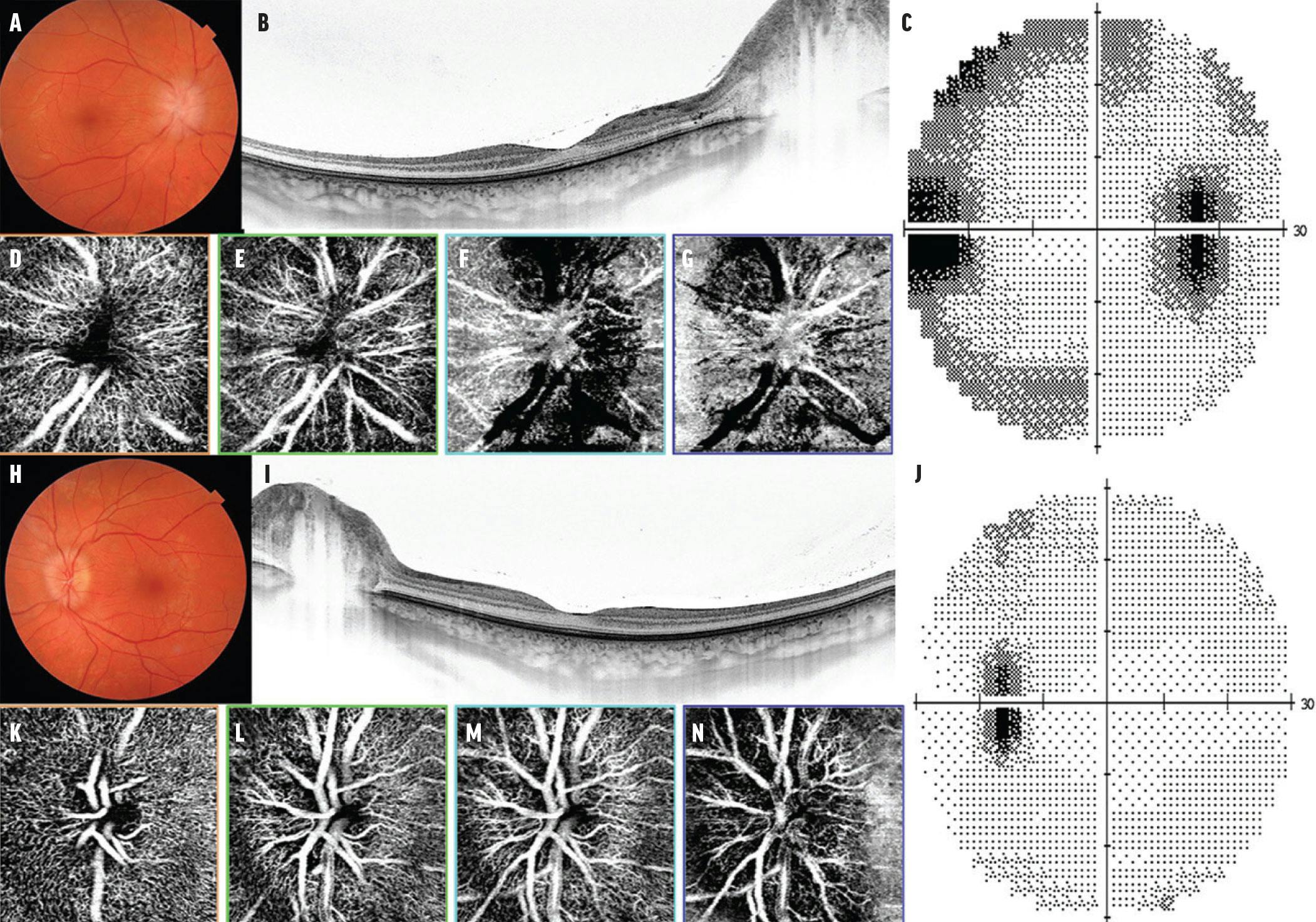
Figure 1. Multimodal imaging revealed bilateral optic disc edema in a 33-year-old man. Fundus photography of the right eye showed optic nerve edema (A). SS-OCT showed a normal foveal contour and optic disc edema (B). Near the optic disc, several hyperreflective areas were visible in the retina. The nerve fiber layer did not seem swollen. The visual fields showed defects (C). SS-OCT angiography captured the superficial retinal vessel layer (D), deep retinal vessel layer (E), avascular zone (F), and choriocapillaris (G). Fundus photography of the left eye showed optic nerve edema (H). SS-OCT showed a normal foveal contour and optic disc edema without swelling of the nerve fiber layer (I). The visual fields showed an enlarged blind spot (J). SS-OCT angiography of the left eye captured the superficial retinal vessel layer (K), deep retinal vessel layer (L), avascular zone (M), and choriocapillaris (N).
The patient explained that he would sometimes vomit while changing body position and have temporary motion aphasia and accidental diplopia, problems with distance estimation, numbness of his right leg, hyperhomocysteinemia, and hypercholesteremia. Moreover, he had been diagnosed with sleep apnea, attributed to his obesity.
The patient underwent lumbar puncture, computed tomography (CT), and MRI in the neurological unit. Increased ICP was observed without a mass in the central nervous system. On CT, an 8 mm subgaleal hemorrhage was observed. MRI confirmed signs of vein occlusion.
The first neurological diagnosis was reversible vasoconstriction syndrome, but the advised treatment didn’t result in improvement of his ophthalmic findings or systemic problems. Angiography of the central nervous system raised suspicion of autoimmune central nervous system vasculitis, a rare disease that mimics reversible vasoconstriction syndrome.
The patient was treated with mycophenolas mofetil (CellCept, Genentech/Roche), methylprednisolone (Solu-Medrol, Pfizer), acetazolamide (Diamox, Zydus Pharmaceuticals), and enoxaparinum sodium (Clexane, Sanofi). His VA improved to 20/20 OU, and the swelling and head pain decreased within 2 months of treatment (Figure 2). All other neurological symptoms also resolved.
Five years later, the patient developed a posterior subcapsular cataract, which may have been associated with the high doses of steroids he received during treatment. Phacoemulsification and multifocal IOL implantation were performed, with a resulting VA of 20/20 OU. We are continuing with immunomodulating therapy, with no further optic nerve swelling or visual field defects.
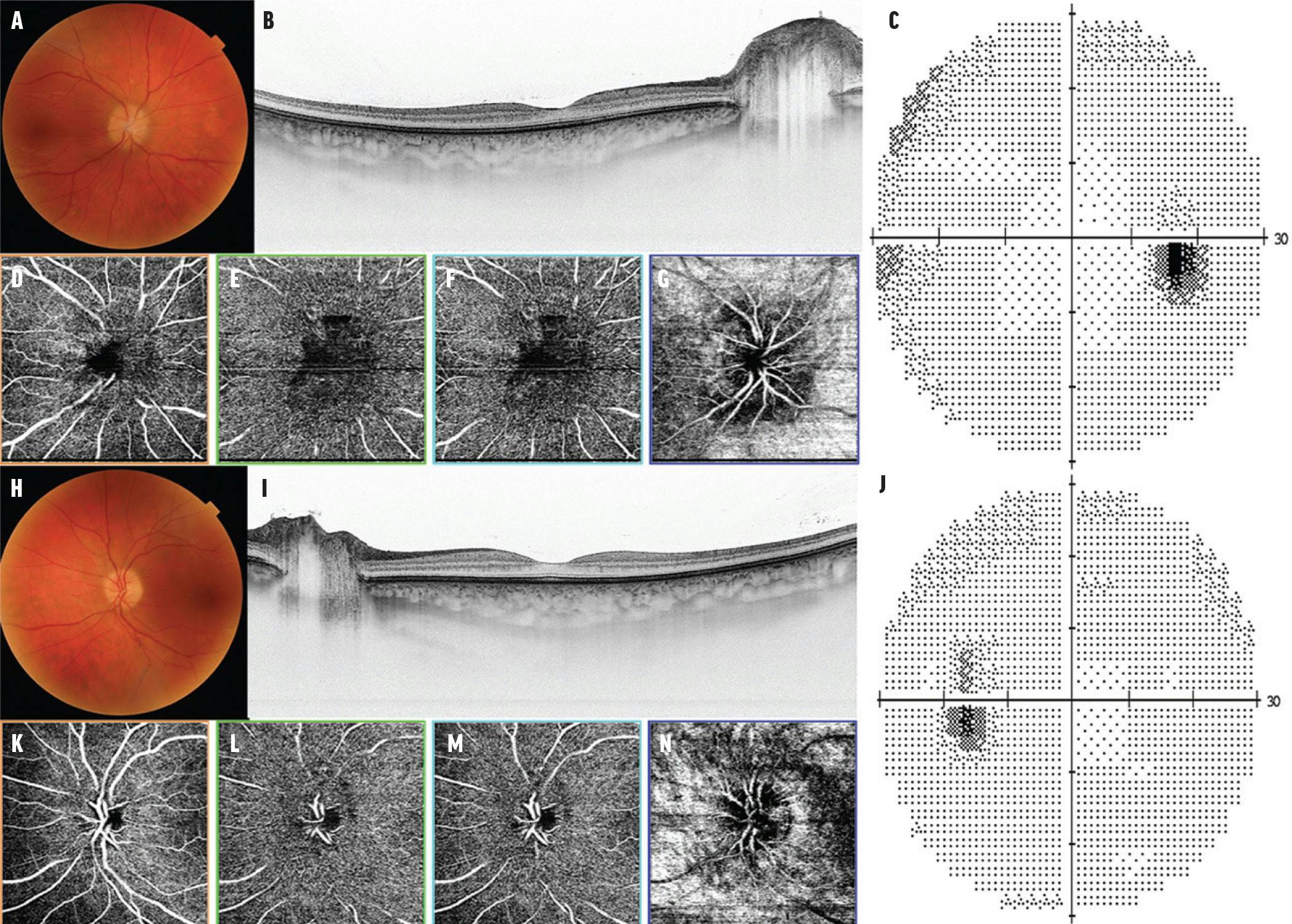
Figure 2. After treatment, fundus photography of the ONH in the right eye showed a regular contour (A). SS-OCT showed a normal foveal contour and a visible optic disc (B), and the visual fields showed no defects (C). SS-OCT angiography captured the superficial retinal vessel layer (D), deep retinal vessel layer (E), avascular zone (F), and choriocapillaris (G). In the left eye, the fundus was normal (H), SS-OCT showed a normal foveal contour and a visible optic disc (I), and the visual fields were normal (J). SS-OCT angiography showed the superficial retinal vessel layer (K), deep retinal vessel layer (L), avascular zone (M), and choriocapillaris (N).
DISCUSSION
Primary central nervous system vasculitis is a rare, life-threatening autoimmune disease of unknown etiology. A total of 2.4 cases per million people are reported each year.5 There is a range of possible symptoms, including headache, neurological deficits, weight loss, and fever. Few case reports of ocular involvement have been published in the literature to date. Ocular symptoms can include decreased visual acuity, visual field loss, branch retinal vein occlusion, and unilateral or bilateral optic neuritis with or without retinal hemorrhage.6-10 Due to the non-specificity of symptoms, the workup can be complex; multimodal imaging may be necessary to document ocular involvement and improvement with treatment.
1. Iijima K, Shimizu K, Ichibe Y. A study of the causes of bilateral optic disc swelling in Japanese patients. Clin Ophthalmol. 2014;8:1269-1274.
2. Friedman DI, Liu GT, Digre KB. Revised diagnostic criteria for the pseudotumor cerebri syndrome in adults and children. Neurology. 2013;81(13):1159-1165.
3. Miller NR, Newman NJ, Biousse V, Kerrisson J. Walsh and Hoyt’s Clinical Neuro-Ophthalmology. Sixth edition. Philadelphia: Lippincott Williams & Wilkins, 2004.
4. Friesen L. Swelling of the optic nerve head: a staging scheme. J Neurol Neurosurg Psychiatry. 1982;45(1):13-18.
5. Calabrese LH, Duna GF, Lie JT. Vasculitis in the central nervous system. Arthritis Rheum. 1997;40(7):1189-1201.
6. Jellinger K. Giant cell granulomatous angiitis of the central nervous system. J Neurol. 1977;215(3):175-190.
7. Rao NM, Prasad PS, Flippen CC 2nd, et al. Primary angiitis of the central nervous system presenting as unilateral optic neuritis. Neuroophthalmol. 2014;34(4):380-385.
8. Benson CE, Knezevic A, Lynch SC. Primary central nervous system vasculitis with optic nerve involvement. J Neuroophthalmol. 2016;36(2):174-177.
9. Susac JO, Calabrese LH, Baylin E, et al. Branch retinal artery occlusions as the presenting feature of primary central nervous system vasculitis. Clin Exp Rheumatol. 2004;22(6 Suppl 36):S70-S74.
10. Hassan AS, Trobe JD, McKeever PE, Gebarski SS. Linear magnetic resonance enhancement and optic neuropathy in primary angiitis of the central nervous system. J Neuroophthalmol. 2003;23(2):127-131.


