



AT A GLANCE
- Recent studies suggest that the implantation of multifocal IOLs in patients with AMD may not be as strict a contraindication as previously thought.
- Although accommodating IOLs may provide some additional magnification for near vision, patients with advanced AMD may not see any benefit.
- There are many specialty IOLs, such as implantable telescopic lens systems and macular lenses, available for patients with late-stage AMD.
Traditional wisdom has long held that premium IOL technologies are contraindicated for patients with AMD due to a lack of effectiveness and the potential for further compromise to visual quality. However, new IOL technologies offer patients with AMD myriad options to optimize their postoperative vision without some of the disadvantages associated with multifocal IOLs (MFIOLs).
With the emergence of these new options, we must reevaluate our assumptions about IOL selection in patients with AMD (Figure). Here, we provide a summary of each IOL technology in the context of patients with macular disease.
TORIC MONOFOCALS
Although considered premium lenses, toric monofocal IOLs simply offer patients the added benefit of cylindrical correction in addition to the spherical correction offered by traditional monofocals without sacrificing contrast sensitivity. If cataract surgery can offer possible visual improvement, the use of a toric monofocal IOL in a patient with AMD and regular astigmatism would be reasonably expected to improve the patient’s vision without any deleterious effect on the overall quality of vision.
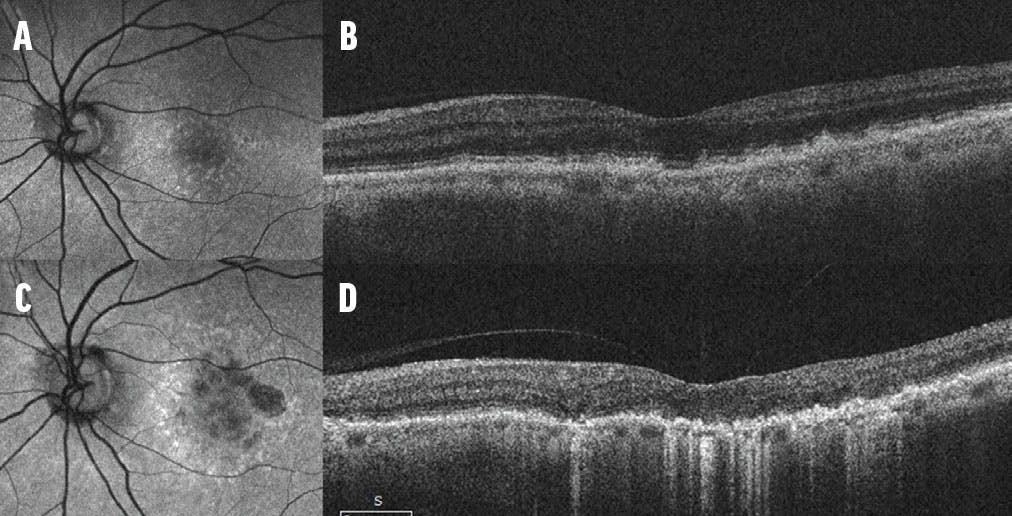
Figure. This patient’s fundus autofluorescence documented intermediate dry AMD (A), and the OCT demonstrated multiple drusen (B). The patient progressed to patchy geographic atrophy with photoreceptor loss 8 years later (C), and OCT showed photoreceptor loss and increased transmission of the OCT beam (D). As this case demonstrates, progression from intermediate AMD to geographic atrophy may be faster than expected; thus, surgeons should be cautious when considering implanting an MFIOL in patients with intermediate AMD.
MULTIFOCAL IOLS
MFIOLs offer patients the opportunity to achieve functional vision at multiple focal lengths and can be an excellent option for patients seeking spectacle independence. MFIOLs come in varying designs, including diffractive, refractive, bifocal, trifocal, and hybrid.
Diffractive MFIOLs—such as the Acrysof ReSTOR (Alcon), the Tecnis Symfony (Johnson & Johnson Vision), and the Clareon Panoptix (Alcon)—feature concentric rings that create diffractive wave patterns that focus light on two or more unique focal points, allowing patients to achieve multifocality; however, by nature of the design, as light rays pass through the lens’ multiple diffracting surfaces, contrast sensitivity is reduced and the incidence of glare and halos is increased.1
In patients with AMD, contrast sensitivity is affected early in the disease course, even in patients with preserved visual acuity, leading to significantly diminished vision-related quality of life. This early loss of contrast sensitivity may explain patients’ subjective reports of visual impairment in the setting of good visual acuity.2 It has been long held that the reduced contrast sensitivity in AMD in addition to further loss of contrast sensitivity from a MFIOL could potentially lead to an overall decline in patients’ functional vision. However, Gayton et al demonstrated favorable preliminary results with the implantation of the Acrysof ReSTOR in patients with mild and moderate macular disease, including AMD, using a magnification strategy targeting a spherical equivalent of -2.00 D, yielding a 5.20 D near add and reported improvement of near UCVA in 90% of eyes and distance BCVA in 70% of eyes.3 Importantly, however, the authors do not quantify the staging of AMD. Kaymak et al found that AMD patients’ level of contrast adaptation was not different from that of healthy subjects,4 indicating that the implantation of MFIOLs in patients with AMD may not be as strict a contraindication as previously thought.
Ultimately, the implantation of MFIOLs in patients with AMD is not yet ready for widespread implementation. Although early data suggest that there may not be as clear cut a contraindication as once thought, these early studies included patients with early to intermediate AMD and fail to consider disease progression. As patients progress to more advanced forms of AMD and contrast sensitivity worsens, their visual quality with MFIOLs may dramatically decline. As a result, the use of MFIOLs in patients with AMD should continue to be approached with extreme caution.
EXTENDED DEPTH-OF-FOCUS IOLS
IOLs with extended depth-of-focus (EDOF), such as the AcrySof IQ Vivity (Alcon), create a single elongated focal point to enhance the depth of focus and range of vision. This can provide a higher level of near and intermediate vision than traditional monofocal IOLs, while avoiding some of the negative aspects of MFIOLs such as glare and halos. The literature is conflicting regarding contrast sensitivity with EDOF lenses; several studies demonstrate no significant difference in contrast sensitivity compared with monofocal lenses, and at least one study demonstrates a decrease in contrast sensitivity. However, when compared with MFIOLs, EDOF lenses result in significantly less degradation of contrast sensitivity.1,5
Furthermore, EDOF IOLs, unlike MFIOLs, demonstrate no difference in visual field sensitivity on standard automated perimetry.5,6 These early data suggest that EDOF lenses could potentially offer visual benefit to select early to intermediate AMD patients.
UNIQUE DESIGNS
Accommodating IOLs use the eye’s own ciliary muscle contractions to change the IOL shape, thereby altering the IOL’s refractive power without diminishing contrast sensitivity and providing the quality of vision expected from monofocal IOLs. Although these lenses may provide some additional magnification for near vision, patients with advanced AMD requiring high-powered magnification may not see any benefit to the relatively small accommodative power these lenses can provide.
The Light Adjustable Lens (LAL; RxSight) is a monofocal three-piece lens made from a silicone that can change shape with UV light treatments to adjust refractive power postoperatively. The LAL can provide clear vision at any desired focal length but does not provide multiple zones of vision simultaneously. The LAL provides patients the opportunity to try different combinations of refractive power postoperatively to optimize their refractive target and can be adjusted up to three times. Compared with patients with a monofocal IOL, LAL patients were 50% more likely to have unaided VA of 20/20 at the 6-month follow-up.7 The LAL is relatively contraindicated in macular disease due to concerns regarding exposing an already damaged macula to UV treatment.
Both the LAL and accommodating IOLs have the potential to give patients both near and distance vision; however, there is a lack of data on the use of these lenses in patients with AMD.
IMPLANTABLE MAGNIFICATION DEVICES
There are many specialty IOLs available for patients with low vision, including those with late-stage AMD. Implantable telescopic lens systems and macular lenses have the potential to augment or even replace more traditional external low vision aids, which, although helpful, carry limitations such as restriction of the visual field, the need for continued head motion during use, and cosmetic drawbacks.8
The IOL for Visually Impaired People System (Soleko) is a combination of a biconcave high-minus-power IOL placed in the capsular bag and a biconvex high-plus-power IOL placed in the anterior chamber, which, with the help of the cornea, creates a 1.3x magnification for distance. The lens is effective and well tolerated without interference with peripheral or binocular vision.8
The IOL-AMD (London Eye Hospital Pharma) also uses the principle of the Galilean telescope with the cornea to produce 1.25x to 1.3x magnification with consequent visual field reduction of approximately 30%. The device involves the implantation of one high-negative and one high-positive soft hydrophobic IOL injected into the capsular bag and the ciliary sulcus.8
The Lipschitz Macular Implant (OptoLight Vision Technology) and the sulcus-implanted Lipschitz Macular Implant (OptoLight Vision Technology) are technologies that incorporate two miniature mirrors in a Cassegrain telescope configuration to create magnified central images up to 2.5x while maintaining normal peripheral vision through the peripheral portion of the lens.9
The Fresnel Prism IOL (Fresnel Prism and Lens Co) is a polymethyl methacrylate nonfoldable lens made for implantation into the capsular bag with the purpose of optical displacement of the central scotoma caused by AMD; essentially, it is a nonsurgical option to achieve the desired effect of macular translocation surgery without the associated risks. In a series of three patients with advanced AMD, all patients reported displacement of the scotoma peripheral to their central field of vision and noted that the scotoma had become less bothersome.9
The Scharioth Macular Lens (Medicontur) is a single-piece, add-on lens that can be placed in the ciliary sulcus at the time of cataract surgery or years later. It is designed to improve near vision with reduced reading distance with 2x magnification without altering peripheral vision.8
The Implantable Miniature Telescope (IMT, Samsara Vision) is FDA approved, with a second-generation iteration, the Smaller-Incision New-Generation IMT (SING IMT, Samsara Vision), under investigation in the CONCERTO study (it received a CE mark for the European Union in 2020).10 This device, designed for patients with late-stage AMD, provides 2.7x magnification of central vision, which is projected onto undamaged portions of the macula.11
These are only a handful of the innovative specialty lenses available to assist late-stage AMD patients who have exhausted their options to improve functional vision. In combination with low vision rehabilitation and training, these lenses are potentially useful options and are likely underused. Good candidates for these IOLs include patients with good cognitive function and high motivation, as postoperative training to properly use and become accustomed to the device can take up to a year.
Each of these devices has specific ocular requirements, and, importantly, some can result in difficult fundoscopic examination, making monitoring disease progression more challenging. Currently, clinical results for these devices are limited and based on small numbers of patients with short follow-up; nevertheless, they offer promising and exciting new avenues for patients with late-stage AMD.
THINK OUTSIDE THE BOX
The emergence of new IOL technologies promises patients ever-greater options to optimize postoperative visual quality. While AMD patients have historically not been considered good candidates for premium lenses, data suggest that this may not be a hard and fast rule.
While early data suggest EDOF lenses may be an emerging option for early to intermediate AMD patients, extreme caution should still be taken if considering implanting a MFIOL in this patient population.
Specialty implantable miniature telescopes and macular lenses may hold promise for select patients with late-stage AMD, although more data is needed before widespread use is achieved. Individual patient considerations must always be taken into account with the use of any premium IOL in patients with AMD. Stage of disease, state of the fellow eye, age, visual needs, and lifestyle considerations all vary from patient to patient, and each patient’s unique situation requires careful consideration when selecting an IOL.
More large-scale data is required to assess the performance of these new technologies in the setting of AMD; however, the continued emergence of new and improved IOLs offers hope to many patients.
1. Hong ASY, Ang BCH, Dorairaj E, Dorairaj S. Premium intraocular lenses in glaucoma-a systematic review. Bioengineering (Basel). 2023;10(9):993.
2. Vingopoulos F, Bannerman A, Zhou P, et al. Towards the validation of quantitative contrast sensitivity as a clinical endpoint: correlations with vision-related quality of life in bilateral AMD [published online ahead of print October 19, 2023]. Br J Ophthalmol.
3. Gayton JL, Mackool RJ, Ernest PH, Seabolt RA, Dumont S. Implantation of multifocal intraocular lenses using a magnification strategy in cataractous eyes with age-related macular degeneration. J Cataract Refract Surg. 2012;38(3):415-418.
4. Kaymak H, Neller K, Graff B, et al. Contrast adaptation in pseudophakic patients with macular disorders. Curr Eye Res. 2024;49(2):207-213.
5. Takahashi M, Yamashiro C, Yoshimoto T, et al. Influence of extended depth of focus intraocular lenses on visual field sensitivity. PLoS One. 2020;15(9):e0237728.
6. Lee J, Mori Y, Nejima R, Minami K, Miyata K. Influence of implantations of extended depth-of-focus on standard automated perimetry. Sci Rep. 2020;10(1):20153.
7. Summary of safety and effectiveness data (SSED). Light Adjustable Lens (LAL)/Light Delivery Device (LDD). FDA. Accessed March 26, 2023. www.accessdata.fda.gov/cdrh_docs/pdf16/P160055B.pdf
8. Borkenstein AF, Borkenstein EM, Augustin AJ. Implantable vision-enhancing devices and postoperative rehabilitation in advanced age-related macular degeneration. Eye (Lond). 2023;37(4):597-606.
9. Grzybowski A, Wasinska-Borowiec W, Alio JL, Amat-Peral P, Tabernero J. Intraocular lenses in age-related macular degeneration. Graefes Arch Clin Exp Ophthalmol. 2017;255(9):1687-1696.
10. Multicenter clinical study of the SING-IMT in patients with late-stage AMD (CONCERTO). Accessed April 22, 2024. clinicaltrials.gov/study/NCT05438732
11. Advantages of SING IMT. Samara Vision. Accessed April 22, 2024. singimt.samsaravision.com/en/sing-imt


_1773249222.png?auto=compress,format&w=75)


