


Retina surgeons certainly understand that any type of investing involves risk, as does any surgical procedure or medical therapy. How much risk to take on when investing is not a simple question for anyone to answer—it’s even more complicated when the portfolio is owned by a married couple, where each spouse has their own thoughts and emotions regarding investing.
One process that can help retina specialists, whether married or not, better understand their investment risk tolerance is called prospect theory. This theory explains how people make financial decisions when faced with risk. It’s based on the idea that people tend to avoid losses, even when other factors are equal, and that their risk tolerance is influenced by how they react to situations in which they gain or lose money.
THE RISK TOLERANCE PROCESS
The Wall Street Journal once asked Harry Markowitz, a Nobel Prize-winning economist, how he invests his own money. He replied: “I visualized my grief if the stock market went way up and I wasn’t in it or if it went way down and I was completely in it. My intention was to minimize my future regret. So, I split my contributions 50/50 between bonds and equities.”1
A risk tolerance process based in prospect theory begins by quantifying the amount of downside risk you can handle over a short period, such as 6 months. This is done by using a sliding bar to determine the amount you are willing to lose for a chance to gain a different amount. For example, would you be willing to risk an 8% loss for the chance to potentially gain 14%? The system will further clarify by turning the example into a dollar amount; would you be willing to risk an $80,000 loss for the chance to potentially gain $140,000? The most influential part of the exercise is when an investor’s current investments are stress-tested to determine whether the asset allocation mix matches the risk tolerance and financial goals. For a jointly owned portfolio, this process is implemented for each spouse/owner. Too often, the results are not aligned, and reallocation is necessary.
Investors typically will tolerate additional risk when markets are rising and become overly risk-averse when markets begin to fall. Measuring risk tolerance during a bull market generally results in scores that are significantly higher than when risk tolerance is measured after a market crash. Prospect theory is particularly useful for financial advisors who need to work around this bias to reveal a more accurate reflection of each investor’s true risk tolerance.
A LOOK AT PORTFOLIO RISK SCORES: SPRING 2020
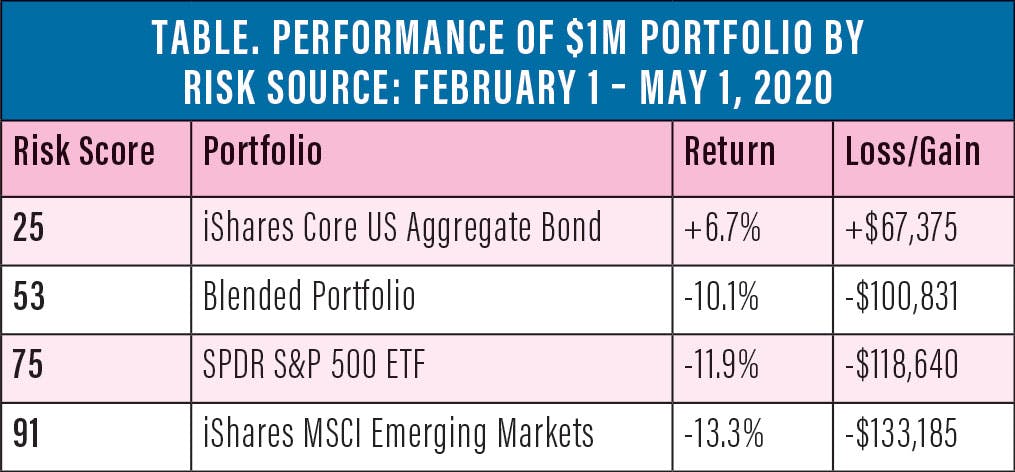
During the market pullback caused by the onset of the COVID-19 pandemic in 2020, portfolios with higher risk scores lost more of their value. The Table quantifies the difference between portfolios that generate various risk scores (between 1 and 100, with 100 meaning the most risk). It’s crucial to comprehend the amount of risk, in actual dollar terms, that you are currently taking on in your investment portfolio. Understanding how portfolio risk can affect actual investment losses can help you when setting target allocations so that you don’t overestimate your emotional ability to deal with losses in poor market conditions.
UNDERSTANDING RISK IN YOUR PORTFOLIO
Increasing risk tolerance due to fear of missing out is often where investors go wrong. A frequently overlooked approach to investing is winning by not losing. Limiting the downside generally enhances the odds of a successful outcome over a defined period, as illustrated in these investment statements:
- A 10% loss requires an 11% subsequent return to recover your initial investment.
- A 20% loss requires a 25% return to break even.
- A 50% loss requires a 100% return to recover your initial capital.
Consider the following example: An investor places $100,000 into a growth stock that subsequently declines 50%; the investor now has a $50,000 position. The growth stock would have to double in price (100% return) for the value to return to $100,000.
High-quality bonds, Treasury Bills, certificates of deposit, and money market funds are all vehicles that investors can use to limit the downside risk. Maintaining discipline and resisting the urge to take excessive risk by chasing returns will help prevent you from experiencing the whipsaw effect (ie, a price movement that is in the opposite direction of your intended outcome) when markets correct.
The investments you find boring may be the most rewarding when you need them most. They can also be used as a source of assets to fund the purchase of stocks when rebalancing after a market sell-off.
HOW AGE AFFECTS RISK TOLERANCE
As physicians approach retirement, the effect of risk on their investment portfolios becomes increasingly significant. A key consideration during this stage is the need to protect accumulated wealth and ensure a reliable income stream for retirement. As investors age, their risk tolerance often decreases, primarily because they have less time to recover from potential market downturns. This shift in risk tolerance is crucial, as a substantial market downturn just before or during retirement can have a detrimental effect on the overall portfolio value.
To mitigate the effect of market volatility, investors nearing retirement often transition to a more conservative investment strategy. This typically involves reducing exposure to high-risk assets, such as stocks, and increasing allocations to more stable, income-generating assets, such as bonds. Diversification becomes even more critical during this phase, as a well-diversified portfolio can cushion the effect of market fluctuations. Some investors also consider incorporating alternative investments, such as real estate, to provide additional stability and income during retirement. Regular portfolio reviews and adjustments to align with changing risk tolerance and retirement goals are essential to effectively navigate this transition.
RISK AND THE ROLE OF YOUR ADVISOR
One of the most important value-added services an investment advisor can provide is ensuring that reason and discipline prevail over emotions, such as fear and regret. Investors should work with an advisor who understands that risk tolerance evolves over time and realizes that it is not enough to simply rebalance based on an initial risk assessment. Throughout the years of a relationship with an investor, the ideal advisor should periodically evaluate risk scores and match portfolios to the results.
1. Zweig J. What Harry Markowitz meant. Wall Street Journal. October 2, 2017. Accessed October 7, 2024. bit.ly/3YhExFS
SPECIAL OFFER: Mr. Mandell and OJM Group partners are pleased to announce the 2024 publication of our newest book, Wealth Strategies for Today’s Physician: A Multi-Media Playbook. The Playbook’s innovative format features more than 90 links to videos and podcast episodes to enhance important financial topics for physicians. To receive a free print copy or ebook download, text RETINA to 844-418-1212 or visit www.ojmbookstore.com and enter promotional code RETINA at checkout.
OJM Group, LLC. (“OJM”) is an SEC registered investment adviser with its principal place of business in the State of Ohio. SEC registration does not constitute an endorsement of OJM by the SEC nor does it indicate that OJM has attained a particular level of skill or ability. OJM and its representatives are in compliance with the current notice filing and registration requirements imposed upon registered investment advisers by those states in which OJM maintains clients. OJM may only transact business in those states in which it is registered or qualifies for an exemption or exclusion from registration requirements. For information pertaining to the registration status of OJM, please contact OJM or refer to the Investment Adviser Public Disclosure website www.adviserinfo.sec.gov.
For additional information about OJM, including fees and services, send for our disclosure brochure as set forth on Form ADV using the contact information herein. Please read the disclosure statement carefully before you invest or send money.
This article contains general information that is not suitable for everyone. The information contained herein should not be construed as personalized legal or tax advice or as a recommendation of any particular security or strategy. There is no guarantee that the views and opinions expressed in this article will be appropriate for your particular circumstances. Tax law changes frequently, accordingly information presented herein is subject to change without notice. You should seek professional tax and legal advice before implementing any strategy discussed herein.


