


AMD is a retinal disease involving the progressive loss of photoreceptors, choriocapillaris, and retinal pigment epithelium (RPE).1 Drusen deposits, hypertransmission observed via OCT, and changes in RPE pigmentation are often used to classify stages of early and intermediate AMD that can suggest an increased risk of photoreceptor deterioration.2,3 Geographic atrophy (GA) is associated with significant RPE atrophy and photoreceptor loss.3 Ongoing research aims to develop treatments administered earlier to patients with AMD with the goal of preserving visual function.
A traditional metric to assess GA is the lesion area and its changes over time, usually with fundus autofluorescence.1 However, this metric cannot be used to assess patients at earlier stages of AMD, potentially indicating a gap in longitudinal disease biomarkers.4 While drusen and RPE pigmentary changes can be biomarkers of disease, they may not be the first detectable changes in AMD formation; therefore, other biomarkers to identify and predict early and intermediate AMD progression to GA are needed.5 For example, photoreceptor health may play a significant role in AMD and is a potentially valuable predictor of disease progression.
Evidence suggests that features such as the ellipsoid zone (EZ) are reflections of photoreceptor health and may serve as a biomarker and endpoint for AMD and GA in both clinical trials and clinical practice.5
ELLIPSOID ZONE INTEGRITY
Photoreceptors are highly metabolically active cells with substantial energy demands.6 To meet these requirements, photoreceptors contain an abundance of mitochondria to produce sufficient adenosine triphosphate.2 In healthy eyes, mitochondria account for approximately 80% of the cellular volume in cones and approximately 55% of the cellular volume in rods.7 These mitochondria reproducibly reflect light on OCT imaging, resulting in the appearance of a consistent bright band.7,8 Several such hyperreflective bands can be identified on OCT images of the retina (Figure 1A). The EZ, seen as the second band, comprises the outer portion of photoreceptor inner segments that appear on scans due to the dense collection of mitochondria localized to that region.8,9
EZ imaging analyses on OCT may capture and quantify photoreceptor degradation through measurable changes.9,10 This may include patterns of disorder, such as discontinuity in the band, reduction in the distance between the EZ and RPE band, EZ thinning, and decreased reflectivity/brightness (Figure 1B). Common quantifiable EZ measurements by OCT include analysis of EZ-RPE thickness and EZ reflectivity.11
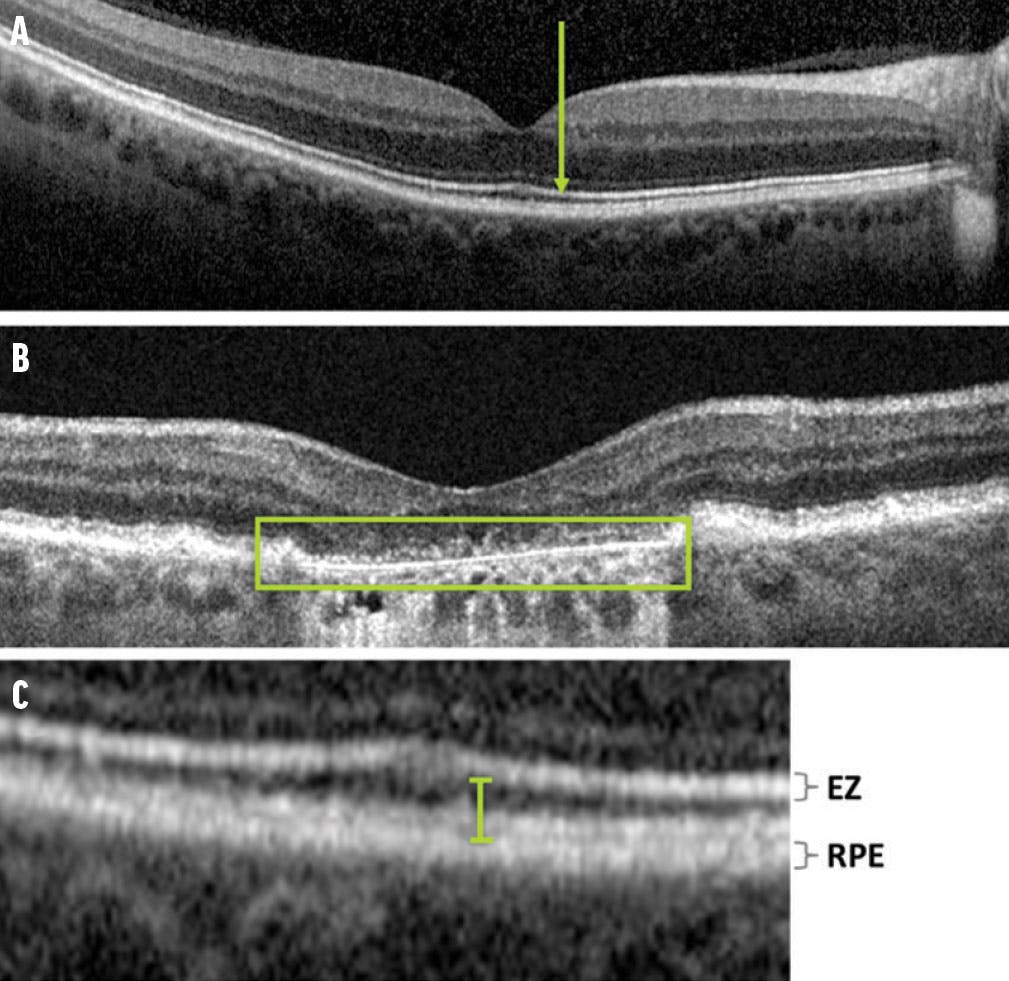
Figure 1. In a healthy retina with identifiable hyperreflective bands (A), the EZ (arrow) represents the outer portion of the inner segments of retinal photoreceptors containing large amounts of mitochondria, owing to the band’s high reflectivity. In an eye with GA (B), there is total outer retinal and RPE loss in the retina. EZ-RPE thickness (C) spans the outer segments of photoreceptors and across the interdigitation zone (band directly above the RPE).
EZ: A BIOMARKER AND PREDICTOR OF DISEASE PROGRESSION
The prevailing feature of GA is the presence of sharply demarcated atrophic lesions due to loss of photoreceptors and RPE. Photoreceptor loss may both precede and predict the progression of AMD, including GA, before other overt signs appear.4,12,13 In GA, areas of photoreceptor loss outside of GA lesions have been associated with lesion growth and disease advancement.10 Quantification of EZ metrics as a related measure of photoreceptor/outer segment loss may serve as biomarkers of AMD and forecast progression.
EZ attenuation (photoreceptor degradation and/or loss), as measured by a reduction in the distance between the EZ and RPE, is a key metric of EZ integrity and, thus, photoreceptor health. Partial EZ attenuation (photoreceptor degradation) and total EZ attenuation (photoreceptor loss) describe the measured thickness between the EZ and RPE layers via OCT (EZ-RPE thickness). Normal EZ-RPE thickness is 40 μm to 50 μm (Figure 1C).14 Total EZ attenuation represents complete loss of the EZ on OCT B-scan (Figure 2).12 Partial EZ attenuation represents a significant decrease in the EZ-RPE thickness, defined as ≤ 20 μm, and has been found to represent significant pathologic/functional consequence in multiple retinal diseases.12 Both partial and total EZ attenuation are significantly associated with GA progression, consistent with extensive photoreceptor loss.15 Studies have found that baseline measurements of partial and total EZ attenuation are significantly higher in AMD patients who later develop GA and that those patients have larger rates of GA lesion growth.12,16,17
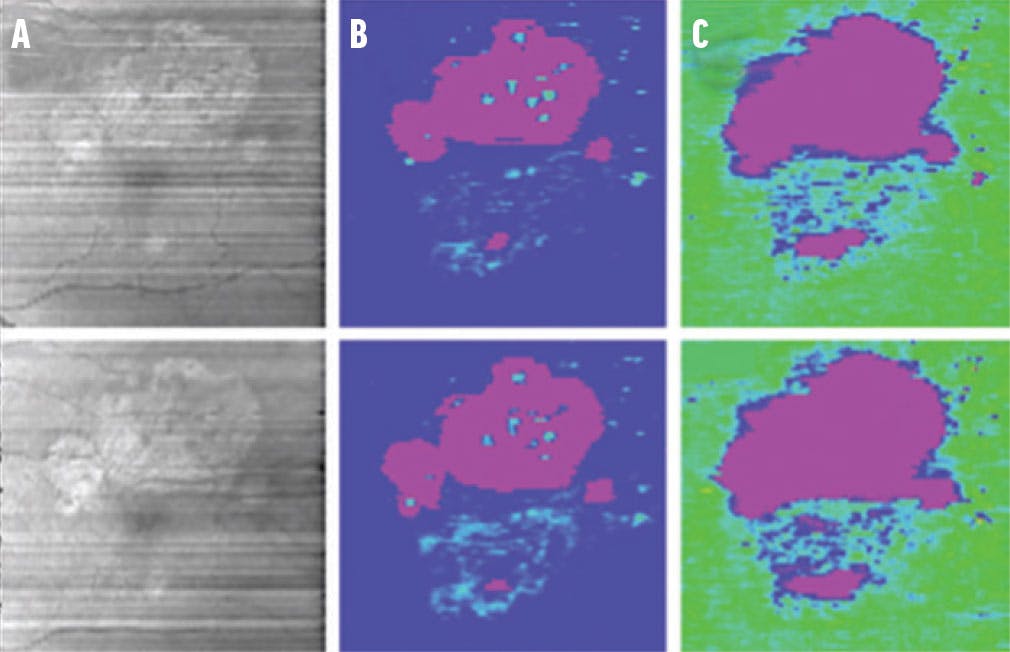
Figure 2. Longitudinal EZ integrity mapping (en face OCT) at two points 6 months apart (top and bottom, respectively) demonstrates focal areas of progressive loss (A). Note the sub-RPE compartment (B) with total RPE loss and associated GA (pink) and drusen (green). The EZ integrity map (C) demonstrates areas of normal EZ integrity (green), partial EZ attenuation (blue), and total EZ attenuation (pink).
Several studies have demonstrated the use of relative EZ reflectivity (rEZR) as a biomarker for AMD stages. Across all stages of AMD, rEZR is significantly diminished compared with age-matched controls, and changes in intensity have been associated with functional changes in visual acuity.2,18,19 Furthermore, decreases in rEZR correlate with AMD advancement.5,8 In intermediate AMD, the presence of high-risk factors for disease progression and photoreceptor loss, such as large drusen, reticular pseudodrusen, and pigmentation abnormalities, have been significantly associated with reduced rEZR.2,3,5
Changes in the visual acuity of patients with AMD have been associated with EZ disruption, and BCVA is negatively correlated with total EZ attenuation in patients with AMD.2,20 One analysis demonstrated that EZ-RPE thickness features were linked not only to visual acuity, but also to the risk of future loss.21 One study in wet AMD observed a treatment-associated significant decrease in total EZ attenuation, indicating recovery of the EZ in places of prior loss.20 Collective research supports the potential of EZ metrics as biomarkers and predictors of AMD progression.
THE VALUE OF EZ ANALYSIS IN CLINICAL TRIALS
There is an unmet need for new, reliable, and objective endpoints in AMD clinical trials. Historical primary endpoints, such as GA lesion growth rate, potentially capture only one aspect of the disease. Incorporating EZ metrics into clinical trials may aid in better capturing the entirety of the disease, both as key endpoints and as potential inclusion/exclusion criteria.
Implementation of EZ-related endpoints has already demonstrated value in AMD clinical trials. For example, the phase 2 ReCLAIM-2 clinical trial for elamipretide (Stealth BioTherapeutics) demonstrated the use of EZ attenuation as a prespecified endpoint.22 Elamipretide treatment reduced total EZ attenuation by 43% and partial EZ attenuation by 47% over 48 weeks compared with placebo as a prespecified secondary endpoint.22 Furthermore, higher partial and total EZ attenuation at baseline were found to be predictors of GA growth rates.19 When observing visual outcomes, a significant correlation was established between change in low-luminance BCVA and change in total EZ attenuation at week 48.22,23
Analyses from other GA trials have also revealed important observations regarding EZ metrics. In a post-hoc analysis of the FILLY trial of pegcetacoplan (Syfovre, Apellis), areas of EZ attenuation were significantly reduced in treated eyes compared with sham.24 A pooled post-hoc analysis of the GATHER1 and GATHER2 trials of avacincaptad pegol (Izervay, Astellas) demonstrated similar results, reporting a 55% reduction in partial EZ loss.25 Additional analysis from the phase 2 ARCHER trial of ANX007 (Annexon Biosciences) showed significant reduction in progressive total EZ attenuation through 12 months (29% reduction in progression vs sham).26 These clinical trial findings further support the evolving relation of EZ metrics as reflections of photoreceptor health and how changes in the EZ affect functional outcomes in patients.
FUTURE DIRECTIONS
As our understanding of GA and AMD continue to grow, greater efforts are being put into the development of reliable biomarkers and objective predictors of AMD progression. Evidence is accumulating to support the longitudinal utility of EZ integrity assessment toward these goals.
Applications for future research and design of clinical trials are actively evolving. In 2023, the FDA confirmed total EZ attenuation as an approvable endpoint in dry AMD studies.27 The two phase 3 trials investigating elamipretide, ReNEW and ReGAIN, will use EZ attenuation as a primary endpoint.28,29 Prior to this, Neurotech Pharmaceuticals reported positive data for the prespecified primary endpoint of EZ area loss in two phase 3 randomized controlled studies of revakinagene taroretcel (NT-501), a ciliary neurotropic factor-producing surgical implant, for the treatment of macular telangiectasia type 2.30
With EZ attenuation as an approvable endpoint, future trials may better capture the features of early disease pathogenesis and better assess critical structure-function relationships—those between photoreceptor integrity and changes in visual function.
Researchers are also working on the diagnosis and prognostication of earlier stages of AMD. Changes in photoreceptor health may precede and predict more overt signs of AMD; thus, earlier indications of the disease may improve disease monitoring, enhance personalized care delivery, and improve clinical outcomes. Collectively, research supports the use of EZ metrics as predictors of AMD progression and the recent approval of EZ-related endpoints in clinical trials for AMD.
1. Fleckenstein M, Mitchell P, Freund KB, et al. The progression of geographic atrophy secondary to age-related macular degeneration. Ophthalmology. 2018;125(3):369-390.
2. Gin TJ, Wu Z, Chew SKH, Guymer RH, Luu CD. Quantitative analysis of the ellipsoid zone intensity in phenotypic variations of intermediate age-related macular degeneration. Invest Opthalmol Vis Sci. 2017;58(4):2079-2086.
3. Wong JHC, Ma JYW, Jobling AI, et al. Exploring the pathogenesis of age-related macular degeneration: A review of the interplay between retinal pigment epithelium dysfunction and the innate immune system. Front Neurosci. 2022;16:1009599.
4. Schaal KB, Rosenfeld PJ, Gregori G, Yehoshua Z, Feuer WJ. Anatomic clinical trial endpoints for nonexudative age-related macular degeneration. Ophthalmology. 2016;123(5):1060-1079.
5. Saßmannshausen M, Behning C, Isselmann B, et al. Relative ellipsoid zone reflectivity and its association with disease severity in age-related macular degeneration: a MACUSTAR study report. Sci Rep. 2022;12(1):14933.
6. Kooragayala K, Gotoh N, Cogliati T, et al. Quantification of oxygen consumption in retina ex vivo demonstrates limited reserve capacity of photoreceptor mitochondria. Invest Ophthalmol Vis Sci. 2015;56(13):8428-8436.
7. Litts KM, Zhang Y, Freund KB, Curcio CA. Optical coherence tomography and histology of age-related macular degeneration support mitochondria as reflectivity sources. Retina. 2018;38(3):445-461.
8. Thiele S, Isselmann B, Pfau M, et al. Validation of an automated quantification of relative ellipsoid zone reflectivity on spectral domain-optical coherence tomography images. Transl Vis Sci Technol. 2020;9(11):17.
9. Tao LW, Wu Z, Guymer RH, Luu CD. Ellipsoid zone on optical coherence tomography: a review. Clin Exp Ophthalmol. 2016;44(5):422-430.
10. Pfau M, von der Emde L, de Sisternes L, et al. Progression of photoreceptor degeneration in geographic atrophy secondary to age-related macular degeneration. JAMA Ophthalmol. 2020;138(10):1026-1034.
11. Lee KE, Heitkotter H, Carroll J. Challenges associated with ellipsoid zone intensity measurements using optical coherence tomography. Transl Vis Sci Technol. 2021;10(12):27.
12. Sarici K, Abraham JR, Sevgi DD, et al. Risk classification for progression to subfoveal geographic atrophy in dry age-related macular degeneration using machine learning-enabled outer retinal feature extraction. Ophthalmic Surg Lasers Imaging Retina. 2022;53(1):31-39.
13. Toprak I, Yaylalı V, Yildirim C. Early deterioration in ellipsoid zone in eyes with non-neovascular age-related macular degeneration. Int Ophthalmol. 2017;37(4):801-806.
14. Arepalli S, Srivastava SK, Hu M, et al. Assessment of inner and outer retinal layer metrics on the Cirrus HD-OCT platform in normal eyes. PLoS ONE. 2018;13(10):e0203324.
15. Itoh Y, Vasanji A, Ehlers JP. Volumetric ellipsoid zone mapping for enhanced visualisation of outer retinal integrity with optical coherence tomography. Br J Ophthalmol. 2016;100(3):295-299.
16. Amine R, Yordi S, Cetin H, et al. Baseline characterization of advanced ellipsoid zone integrity features in the GATHER1 phase 2/3 clinical trial for AMD with geographic atrophy. Invest Ophthalmol Vis Sci. 2023;64(8):2265.
17. Whitmore VE, Kalra G, Cetin H, et al. Impact of baseline quantitative ellipsoid zone integrity on geographic atrophy expansion in the ReCLAIM-2 clinical trial. Invest Ophthalmol Vis Sci. 2023;64(8):2264.
18. Wu Z, Ayton LN, Guymer RH, Luu CD. Second reflective band intensity in age-related macular degeneration. Ophthalmology. 2013;120(6):1307-1308.e1.
19. Wu Z, Ayton LN, Guymer RH, Luu CD. Relationship between the second reflective band on optical coherence tomography and multifocal electroretinography in age-related macular degeneration. Invest Ophthalmol Vis Sci. 2013;54(4):2800-2806.
20. Ehlers JP, Zahid R, Kaiser PK, et al. Longitudinal assessment of ellipsoid zone integrity, subretinal hyperreflective material, and subretinal pigment epithelium disease in neovascular age-related macular degeneration. Ophthalmol Retina. 2021;5(12):1204-1213.
21. Yordi S, Cakir Y, Kalra G, et al. Ellipsoid zone integrity and visual function in dry age-related macular degeneration. J Pers Med. 2024;14(5):543.
22. Heier JS. ReCLAIM-2 study topline result: elamipretide safety and efficacy in geographic atrophy. Presented at: Clinical Trials at the Summit; May 2022; Incline Village, NV.
23. Lally D, Abbruscato A, Yordi S, et al. Elamipretide-mediated visual function improvements are associated with ellipsoid zone integrity in patients with geographic atrophy. Invest Ophthalmol Vis Sci. 2023;64(8):2261.
24. Riedl S, Vogl WD, Mai J, et al. The effect of pegcetacoplan treatment on photoreceptor maintenance in geographic atrophy monitored by artificial intelligence-based OCT analysis. Ophthalmol Retina. 2022;6(11):1009-1018.
25. Ehlers JP. Ellipsoid zone integrity preservation and characterization of ellipsoid zone integrity features in the GATHER 1 phase 2/3 study and the GATHER 2 phase 3 study. Presented at: American Society of Retina Specialists Annual Meeting; July 28, 2023; Seattle, WA.
26. Boyer DS. Protection against vision loss by ANX007: results from the phase 2 ARCHER clinical trial. Invest Ophthalmol Vis Sci. 2024;65(7):2791.
27. Stealth BioTherapeutics announces positive end-of-phase 2 meeting with FDA on the development of elamipretide in patients with dry age-related macular degeneration [press release]. Stealth BioTherapeutics. June 12, 2023. Accessed September 6, 2024. bit.ly/3PTawZE
28. Phase 3 study of efficacy, safety and pharmacokinetics of subcutaneous injections of elamipretide in subjects with dry age-related macular degeneration (dry AMD) (ReNEW). Accessed May 1, 2024. clinicaltrials.gov/study/NCT06373731
29. Phase 3 study of efficacy, safety and pharmacokinetics of subcutaneous injections of elamipretide in subjects with dry age-related macular degeneration (dry AMD) (ReGAIN). Submitted and under review for publication to www.clinicaltrials.gov.
30. Neurotech Pharmaceuticals, Inc. announces positive phase 3 topline results for NT-501 implant in macular telangiectasia type 2 [press release]. Neurotech Pharmaceuticals. November 2, 2022. Accessed September 6, 2024. bit.ly/3PTaH7g


