



Inferior rhegmatogenous retinal detachments (RRDs) pose unique challenges, especially for fellows and early-career attendings. The complexities of managing these cases span from deciding the necessity and timing of surgery to determining the most appropriate surgical approach and follow-up care. Here, I present key considerations and strategies to aid in the management of this intricate condition.
PEARL NO. 1: OBTAINING THE DIAGNOSIS
A thorough history and examination are crucial for accurately diagnosing an inferior RRD. Scleral depression plays a pivotal role in identifying causative retinal breaks, holes, and other underlying pathology, such as lattice degeneration and proliferative vitreoretinopathy (PVR). If no breaks or holes are detected, consider the possibility of a serous RD. Positioning the patient supine or laterally for a few minutes may help reveal fluid shifts typical of serous RDs (Figure 1). B-scan ultrasound can also aid in the diagnosis by detecting masses that might be obscured by the RD or choroidal thickening, such as in cases of posterior scleritis-related serous RD.
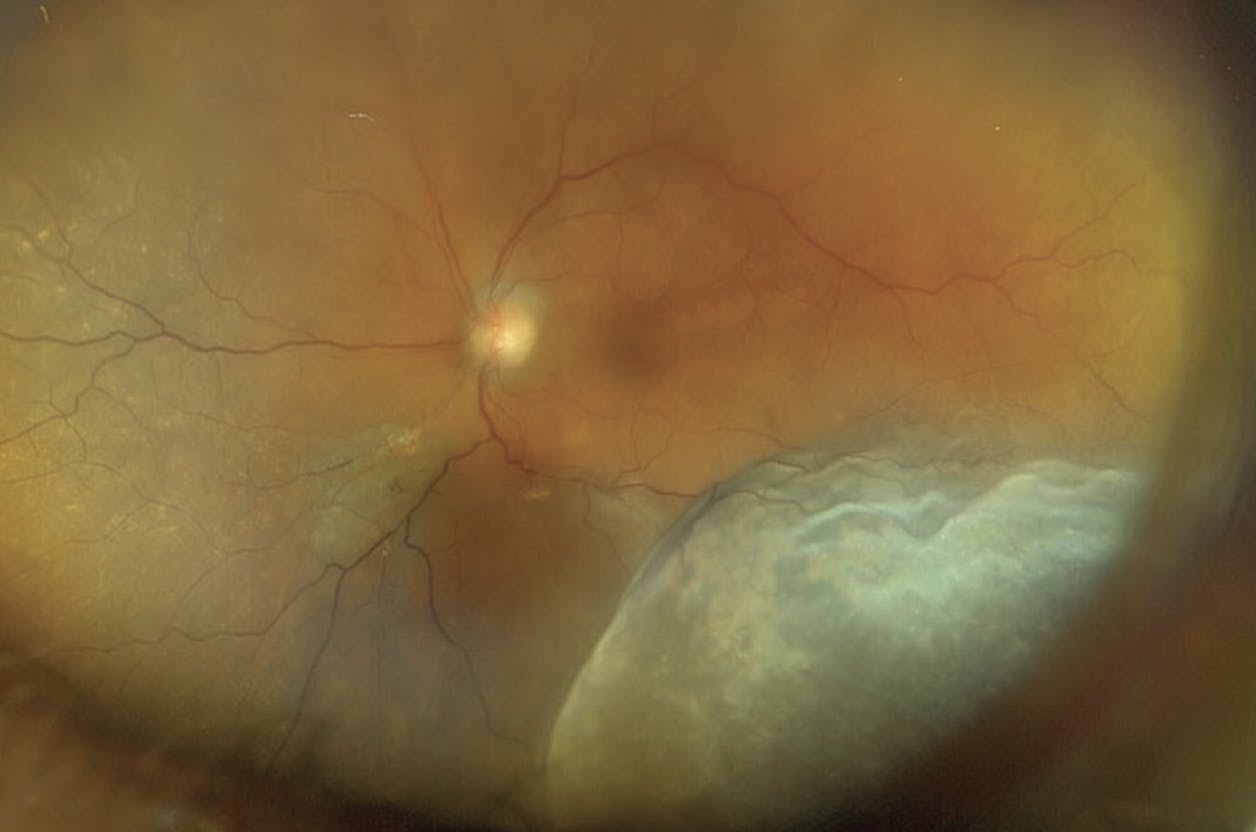
Figure 1. The fluid shifted during examination of this posterior scleritis-related inferior serous RD.
PEARL NO. 2: DECIDING ON SURGERY
Not all inferior RRD cases require surgical intervention. Inferior RRDs with chronic features, such as a partial or complete demarcation line, can often be monitored with less than a 10% risk of progression (Figure 2).1,2 Similarly, detachments distant from the macula may be managed with laser demarcation followed by close observation. Surgical intervention should be considered for symptomatic, large inferior RRDs, especially those associated with giant retinal tears, macula-off detachments, or signs of progression.
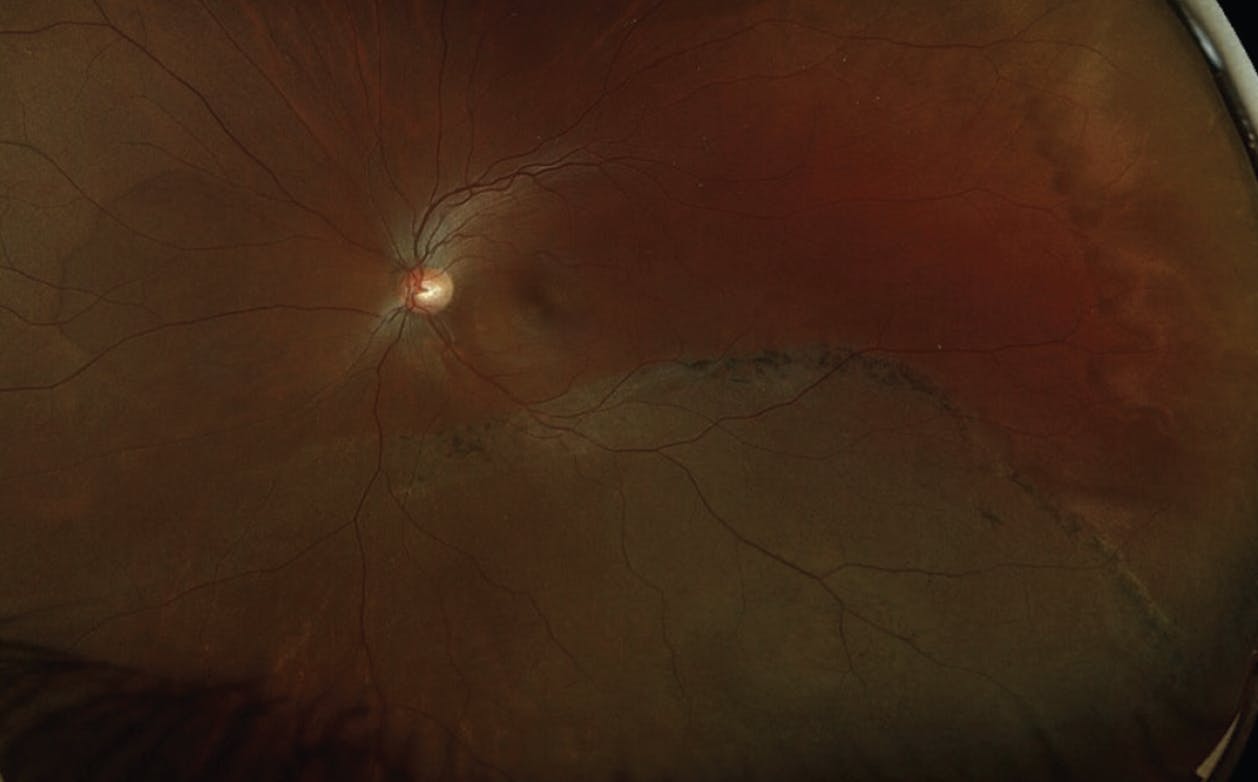
Decisions regarding surgery, including scleral buckling, vitrectomy, or a combination of both, should be based on patient-specific factors and intraocular conditions. As with all medical decisions, the patient’s health, age, line of work, and lifestyle all need to be considered. For example, patients who cannot maintain positioning after surgery or who frequently travel may benefit more from scleral buckling. Consider other ocular factors, such as the presence of vitreous hemorrhage, status of the sclera, status of the lens (phakic vs pseudophakic), and identification of breaks.
In general, inferior RRDs in phakic patients with non-giant retinal tears and minimal PVR can be managed with scleral buckling with or without drainage. Patients with pseudophakia, vitreous hemorrhage, or giant retinal tears are typically managed with vitrectomy. Combined scleral buckle/vitrectomy is particularly useful in cases of PVR but can also be employed for all RDs, depending on surgeon preference.
PEARL NO. 3: PINPOINTING SURGICAL TIMING
There is no consensus on the ideal timeframe for inferior RRD surgery, with progression generally occurring more slowly compared with superior RRDs due to gravitational effects.3 This slower progression contributes to a higher rate of chronicity in inferior RRDs. Surgical timing should take into account patient health, symptom duration, macular involvement, progression, and associated giant retinal tears.
Typically, an inferior detachment threatening the fovea with recent symptoms (1 to 2 days) warrants prompt surgical intervention. Conversely, asymptomatic RRDs or those with symptom onset exceeding 1 week but not threatening the macula may not require immediate intervention. In cases of delayed surgery, provide the patient with an Amsler grid to monitor for progression, and schedule surgery sooner if significant progression is detected.
PEARL NO. 4: MANAGING SUBRETINAL FLUID
Persistent postoperative subretinal fluid can occur, with incidence rates varying significantly (up to 83%) at 1 month depending on the procedure.4,5 This fluid can remain for an extended period of time, with reports of up to 30 months following scleral buckle surgery without drainage.5 Patience is essential, but vigilance is required to identify progression, which could indicate new breaks, breakthrough of previously treated breaks, or inadequate treatment. Serial OCTs are crucial for monitoring. If fluid worsens, carefully examine for missed or new breaks and consider reoperation. Peripheral OCTs directed at areas of concern can be used to evaluate if subretinal fluid tracts to a potential break.
1. Cohen SM. Natural history of asymptomatic clinical retinal detachments. Am J Ophthalmol. 2005;139(5):777-779.
2. Sengillo JD, Smiddy WE, Lin B, Shoji MK, Townsend J, Yannuzzi NA, Flynn HW Jr. Asymptomatic rhegmatogenous retinal detachments: outcomes in patients without initial surgical intervention. Ophthalmol Retina. 2023;7(3):215-220.
3. Li YM, Fang W, Jin XH, Li JK, Zhai J, Feng LG. Risk factors related to chronic rhegmatogenous retinal detachment. Int J Ophthalmol. 2012;5(1):92-96.
4. Kim JM, Lee EJ, Cho GE, Bae K, Lee JY, Han G, Kang SW. Delayed absorption of subretinal fluid after retinal reattachment surgery and associated choroidal features. Korean J Ophthalmol. 2017;31(5):402-411.
5. Fu Y, Chen S, Gu ZH, Zhang YL, Li LY, Yang N. Natural history of persistent subretinal fluid following the successful repair of rhegmatogenous retinal detachment. Int J Ophthalmol. 2020;13(10):1621-1628.


