




Surgical retina fellows face a steep learning curve in the first summer of their fellowship program. The annual Mass Eye and Ear Vitrectomy Course is designed to help fellows get up to speed on core surgical principles and techniques. The course, founded by John Loewenstein, MD, and Demetrios Vavvas, MD, PhD, gained increased recognition with the addition of Dean Eliott, MD, as an honorary founder and the third course director in 2012 and John B. Miller, MD, 4 years later. The 14th annual meeting, held July 12 – 13, 2024, in Boston, was led by current course directors Dr. Miller; Elizabeth Rossin, MD, PhD; and Nimesh A. Patel, MD. Each year, the course trains upwards of 60 retina fellows from across the country. It is perhaps best known for its incredible faculty, who are notable for their high character and surgical skills, combined with a nearly one-to-one faculty-to-fellow ratio.
KNOWLEDGE IS POWER
Day one consisted of talks on foundational surgical concepts. The first session focused on primary retinal detachment repair with talks on pneumatic retinopexy by Yewlin Chee, MD; scleral buckling by Lucy H. Young, MD, PhD; and vitrectomy by Thanos Papakostas, MD. The retinal detachment section concluded with the signature case panel led by Donald J. D’Amico, MD, and featuring panelists Maria H. Berrocal, MD; Steve Charles, MD; John W. Kitchens, MD; and William F. Mieler, MD.
After a lunch with views of the Boston and Cambridge skyline, the fellows shifted to more complex retinal detachment management topics, such as diabetic retinal detachments by Dr. Berrocal, proliferative vitreoretinopathy by Dr. Eliott, and trauma by Dr. Rossin. The day continued with rapid-fire talks covering the fundamentals of surgical retina, including epiretinal membranes by Katherine E. Talcott, MD; endophthalmitis by Luis J. Haddock, MD; surgical uveitis by Kareem Moussa, MD; secondary IOLs by Dr. Kitchens; and pediatric retina by Eric D. Nudleman, MD, PhD.
Other highlights included an introduction to PFO by Stanley Chang, MD, who initially described the technique, lively question-and-answer sessions, and the Founder’s Lecture on vitrectomy fluidics and instrumentation by Dr. Charles. The audience was captivated by Dr. Charles’ in-depth discussion of the intricacies of fluidics, as well as his quip that his retirement plan would be “asystole.”
Robert B. Bhisitkul, MD, PhD, provided an introduction to ergonomics, emphasizing that macular pucker surgery is one of the highest precision surgeries that exists in all of medicine. He discussed each contributor to ergonomics (the chair, the scope height, each muscle group) and ended by reminding fellows to “keep the cornea clear—not just the patient’s, but also your own!”
The day concluded with a reception, an event sponsored by YoungMD Connect, and a faculty dinner.
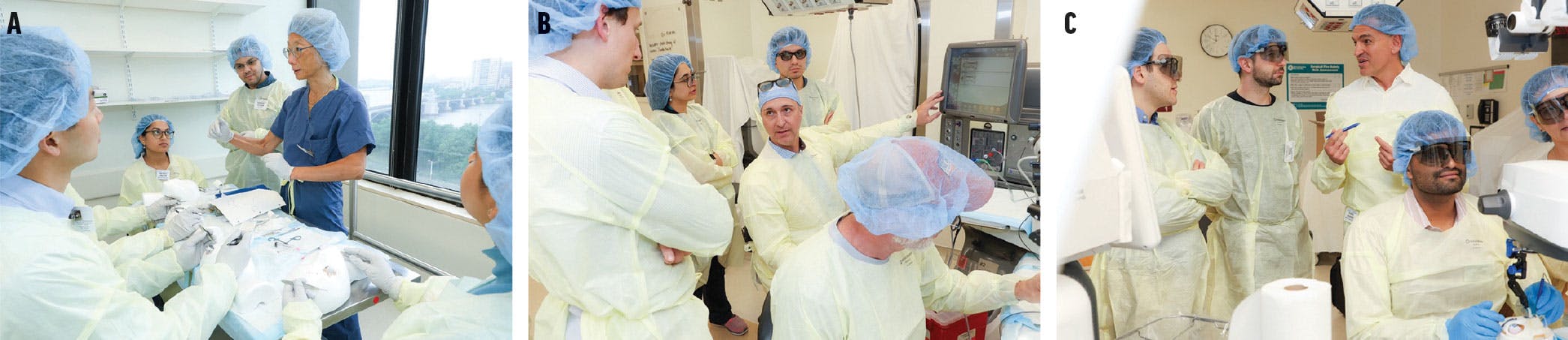
Figure 1. Dr. Young led a wet lab on scleral buckling (A), Dr. Houston shared vitrectomy techniques (B), and Dr. Rezende discussed Alcon’s NGenuity 3D heads-up display system (C). Image courtesy of Kevin Caldwell Photography.
PRACTICE MAKES PERFECT
The hands-on teaching day took place at Mass Eye and Ear. This action-packed second day focused on putting newly learned principles into action with a wet lab, simulators, injection practice, surgical video case discussions, and small-group career mentoring (Figure 1).
The wet lab, held in the Mass Eye and Ear ORs, featured stations on vitrectomy, membrane peeling, intraocular foreign body removal, and scleral buckling on porcine eyes. Dry lab stations showcased the latest equipment from Alcon, DORC, Oculus Surgical, Bausch + Lomb, MIRA, and Proficient Surgical. The fellows then practiced with various injectables, including the triamcinolone acetonide injectable suspension (Xipere, Bausch + Lomb), 0.18 mg and 0.19 mg fluocinolone acetonide intravitreal implants (Yutiq and Iluvien, Alimera Sciences), and the dexamethasone intravitreal implant (Ozurdex, Abbvie), and surgical simulators, such as EyeSi (Haag-Streit), Johnson & Johnson Vision’s Virtual Reality Demo, and the Genentech surgical simulator. These sessions were complemented by surgical videos with faculty and focused small-group career mentoring.
Interspersed between the labs were panel discussions featuring faculty from around the country. Dr. Kitchens moderated a panel on IOLs with Dr. Talcott; Durga S. Borkar, MD, MMCi; S.K. Steven Houston III, MD; Miin Roh, MD; and Archana T. Seethala, MD, reminding fellows that secondary IOLs can be a major practice builder. The panelists also shared their lens and technique preferences. Dr. Papakostas then moderated a panel on proliferative vitreoretinopathy, retinectomies, and instruments with Xi Chen, MD, PhD; Yannek Leiderman, MD, PhD; Cynthia X. Qian, MD; Flavio A. Rezende, MD, PhD; and Francis Wu, MD. Lastly, Rishi P. Singh, MD, moderated a panel on macular holes, internal limiting membrane peeling, and instruments with Ivana K. Kim, MD; Sandra R. Montezuma, MD; Patrick R. Oellers, MD; Aleksandra Rachitskaya, MD; and Nadia K. Waheed, MD, MPH.
The preparation and understanding that is essential to achieve excellent surgical outcomes was emphasized through in-depth case discussions accompanied by surgical videos.
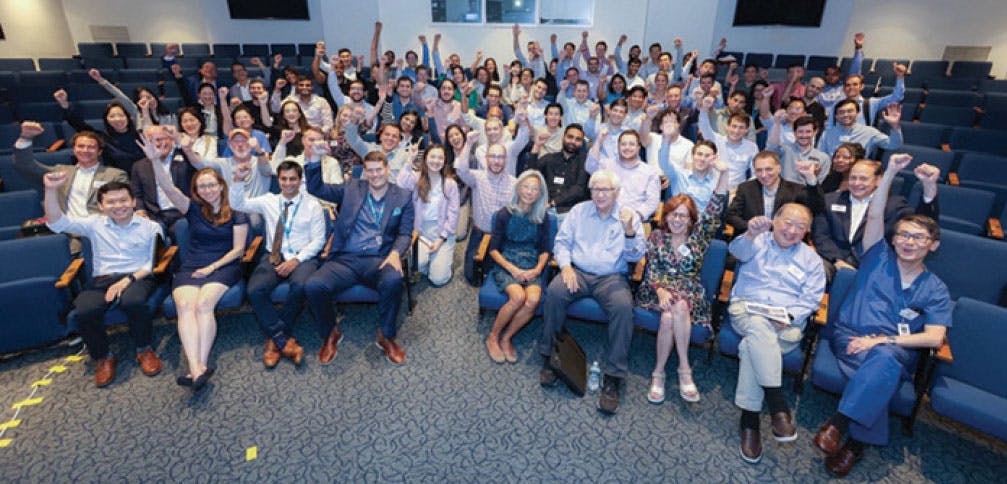
Figure 2. A group photo featuring the participating fellows and faculty. Image courtesy of Kevin Caldwell Photography.
BEYOND THE OR
The meeting provided career mentoring through small-group discussions that shared actionable tips. In keeping with the theme of career success, the closing lecture of the course was “Top 10 Things to Keep Your Attending AND YOU Happy” by Ronald C. Gentile, MD.
In addition to the education, the vitreoretinal surgery fellowship class of 2026 had numerous opportunities to connect in small-group settings or one-on-one with leaders and each other (Figure 2). The relationships formed will help foster collaborations and provide a network to discuss challenging cases in the future.
The fellows left feeling prepared with foundational knowledge and skills to help them embark on their next challenge of vitreoretinal surgical fellowship training! Mark your calendars for the 15th Annual Mass Eye and Ear Vitrectomy Course, scheduled for July 11 – 12, 2025, in Boston.


_1773249222.png?auto=compress,format&w=75)


