



The panel discussions are a hallmark of the annual Aspen Retinal Detachment Society (ARDS) meeting. During the 52nd ARDS meeting, held March 2 – 6, 2024, in Snowmass Village, Colorado, we hosted three fantastic panels that focused on imaging and treating complex disease, the latest approaches to vitreoretinal surgery, and managing rare conditions. I hope you enjoy this recap and join us March 1 – 5, 2025, for the 53rd ARDS meeting for more exceptional education and skiing.
– Timothy G. Murray, MD, MBA
PANEL 1: TREATING GEOGRAPHIC ATROPHY
The first panel was moderated by Timothy G. Murray, MD, MBA, and included Maura Di Nicola, MD; Giovanni Staurenghi, MD; K. Bailey Freund, MD; and Daniel F. Martin, MD (Figure 1). The conversation began with the treatment of choroidal neovascularization (CNV) in the setting of geographic atrophy (GA). Some argued that treating the CNV with anti-VEGF therapy is unnecessary, while others believed it can be beneficial, particularly if there are signs of progression or hemorrhage at the margins of the GA lesions. The decision to treat depends on individual factors, including lesion location, visual acuity, and new symptoms such as metamorphopsia. The panelists agreed that there is no one-size-fits-all approach; instead, the decision is made on a case-by-case basis.

Figure 1. During the first panel (from left to right), Drs. Martin, Di Nicola, Murray, Freund, and Staurenghi discussed imaging and treating complex retinal disease.
Image courtesy of Kevin Caldwell Photography
The panel then discussed the case of an 89-year-old patient with a VA of 5/200 OD due to GA and 20/200 OS due to GA with an underlying type 1 macular neovascularization (MNV). There was a debate about treating the MNV; it is thought that MNV could be protective in GA, given that MNV might be under the only viable photoreceptors and retinal pigment epithelium (RPE). Drs. Di Nicola, Martin, and Freund argued that, because it was silent, observation may be best. Drs. Murray and Staurenghi were concerned that it could worsen and eventually lead to vision loss due to fluid leakage and recommended anti-VEGF injection.
The discussion then turned to treating GA itself. Drs. Di Nicola and Martin explained that complement inhibitors should be offered to certain patients with GA without MNV at baseline who meet the criteria of the OAKS, DERBY, and GATHER trials. Dr. Di Nicola highlighted the importance of carefully explaining to patients that these medications will not improve vision but might slow GA progression. Dr. Martin acknowledged the potential for preserving photoreceptors with the available GA treatments, although he believes the treatment burden, cost, and risks outweigh the benefits for most patients. He emphasized the importance of informed decision making and the need for further research to better understand the long-term effects of GA therapy.
PANEL 2: VITREORETINAL SURGERY
The second panel, moderated by Donald J. D’Amico, MD, and including Justis P. Ehlers, MD; Barbara Parolini, MD; and Basil K. Williams Jr, MD, focused on cutting-edge surgery (Figure 2). They started with the current treatments for macular holes and agreed that the initial surgery of choice for uncomplicated cases should be vitrectomy with internal limiting membrane (ILM) peeling because it increases the closure rate to more than 90%.1 Dr. D’Amico then discussed the work done by Zofia A. Nawrocka, MD, PhD, on large holes, which showed that an inverted flap technique was better than standard ILM peeling.2 The panelists then touched on complications of the inverted flap technique, such as flap dislocation, failure of hole closure, and formation of a cauliflower configuration. The panel discussed the case of a patient with myopic foveoschisis and a VA of 20/30. Dr. Parolini recommended a macular buckle given the possibility of progression with worsening vision. However, Drs. Ehlers, D’Amico, and Murray recommended close observation given the lack of symptoms and good vision.
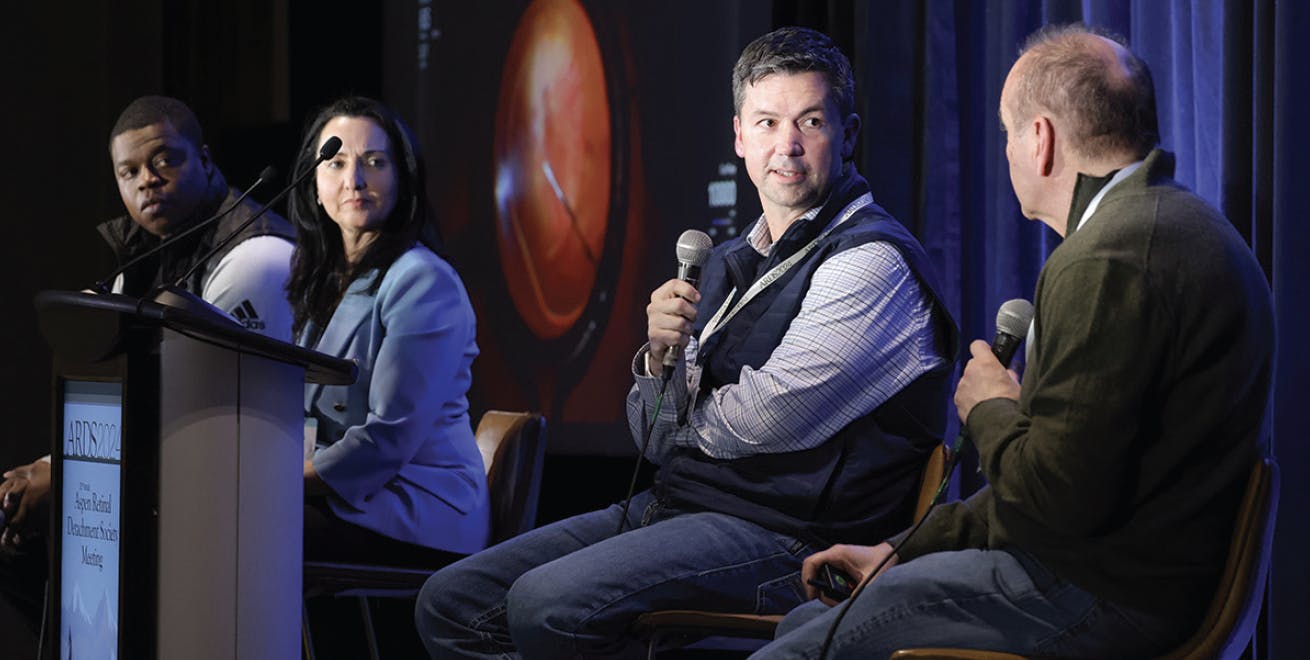
Figure 2. The second panel focused on surgical considerations and included (from left to right) Drs. Williams, Parolini, Ehlers, and D’Amico.
Image courtesy of Kevin Caldwell Photography
The panel also discussed vitrectomy for symptomatic vitreous opacities (SVOs). Some surgeons do not recommend vitrectomy due to the lack of objective assessment and potential risks associated with surgery. Others weigh the risks against the potential benefits for patients experiencing significant functional impairment. Factors favoring surgery include significant visual dysfunction, longer duration of symptoms, the presence of a posterior vitreous detachment, and pseudophakia. However, the lack of a standardized, objective method to measure SVO severity and the effect on vision make decision making a challenge.
PANEL 3: RARE RETINAL DISEASES
Moderated by Dr. D’Amico, the final panel included Dean Eliott, MD, and Drs. Di Nicola, Martin, and Staurenghi. The group discussed unique retinal conditions and offered management advice. They started with acute retinal necrosis. The standard of care involves a combination of intravitreal foscarnet and oral acyclovir to prevent spread to the other eye. Systemic therapy should continue for at least 12 weeks, but lifelong antiviral therapy might be necessary, especially if the patient had an unfavorable outcome with the first eye.
The panel then discussed a case of retinoblastoma in a 4-year-old boy. The patient presented with unilateral anterior chamber nodular material on the iris and vitritis. The B-scan showed noncalcified lesions, and a biopsy confirmed the diagnosis. The key message was to keep retinoblastoma in the differential diagnosis when evaluating children with uveitis.
Next, the panel discussed a patient who presented with profound bilateral vision loss with a normal eye examination. The panelists highlighted the importance of considering cancer-associated retinopathy (CAR) and melanoma-associated retinopathy (MAR) when the severity of vision loss does not match the clinical examination. To diagnose CAR and MAR, visual field testing, imaging, and serological testing for CAR antibodies are essential, along with oncology evaluation and a PET scan. While systemic steroids have been used, there is growing interest in local therapies. Recent case reports suggest that an intravitreal dexamethasone implant (Ozurdex, Abbvie) can be an effective treatment approach.3
Dr. D’Amico then showed a picture of an enucleated eye of a patient with bilateral diffuse uveal melanocytic proliferation (BDUMP). The patient initially presented with severe angle-closure glaucoma and iris bulging that did not respond to medical or surgical treatment. BDUMP is often associated with highly malignant tumors, and, despite the benign nature of the ocular tumor, patients with BDUMP have a poor prognosis due to the underlying systemic cancer.
The group also discussed distinguishing congenital hypertrophy of the RPE (CHRPE), which may indicate Gardner syndrome and require a gastrointestinal evaluation, from other pigmented lesions, such as bear tracks, which do not necessitate further testing. CHRPE lesions appear torpedo-shaped on examination, are excavated on OCT, have high near-infrared reflectance, and lack autofluorescence.
Dr. D’Amico also shared a case of choroidal metastases, in which the patient presented with occasional flashing lights and scotomas. The panelists discussed the role of OCT in the diagnosis, noting that the imaging tool often reveals a choroidal mass with a lumpy appearance, which might be associated with subretinal fluid. Breast cancer is the most common primary tumor that metastasizes to the choroid in women, while lung cancer is more common in men.
The final case was a 54-year-old man with recent vision loss who presented with retinal hemorrhages, exudates, and disc edema. The patient was diagnosed with malignant hypertension and referred to the emergency department. The primary treatment goal is to gradually lower blood pressure to prevent complications. Some experts also recommend intravitreal anti-VEGF therapy to reduce the risk of scarring and neovascularization.
These panels highlight the diversity of opinions, even within a field of experts, and the insights derived from an extended discussion of imaging, diagnosis, and treatment of complex conditions.
1. Tadayoni R, Gaudric A, Haouchine B, Massin P. Relationship between macular hole size and the potential benefit of internal limiting membrane peeling. Br J Ophthalmol. 2006;90(10):1239-1241.
2. Michalewska Z, Michalewski J, Adelman RA, Nawrocki J. Inverted internal limiting membrane flap technique for large macular holes. Ophthalmology. 2010;117(10):2018-2025.
3. Kim MS, Hong HK, Park KH, Woo SJ. Intravitreal dexamethasone implant with plasma autoantibody monitoring for cancer-associated retinopathy. Korean J Ophthalmol. 2019;33(3):298-300.
REGISTER NOW!
53rd Annual ARDS Meeting
March 1 – 5, 2025
Snowmass Village, Colorado


_1784132761.jpg?auto=compress,format&w=75)


