






Uveal melanoma is a rare intraocular tumor that most often arises from the choroid. The most common treatment modality for this malignancy is plaque radiotherapy,1,2 which involves delivery of focal radiation to the tumor using radionucleotides, such as iodine-125, ruthenium-106, cobalt-60, iridium-192, and cesium-131.3 In a meta-analysis of 14 cohorts (n = 21,263), the 5-year median local tumor control following plaque radiotherapy for uveal melanoma was excellent (94%).4
The surgical technique of plaque radiotherapy involves suturing a template device with precisely placed radioactive material onto the sclera to deliver radiation through the sclera to target the entire melanoma, with the apex dose of 70 Gy delivered to the area of greatest thickness. This requires accurate positioning of the plaque onto the surface of the eye, centered over the intraocular melanoma and covering all tumor margins. The plaque is secured with partial-thickness 5-0 nylon scleral sutures, as plaque displacement could potentially lead to poor delivery of radiation to the tumor. Additionally, if placement of the sutures is too deep or too shallow, especially in cases of a thin sclera, ocular complications such as scleral perforation with vitreous leakage, retinal detachment, choroidal or vitreous hemorrhage, endophthalmitis, or ultimate extraocular extension may occur.5,6 Due to these risks, biologic tissue adhesive (ie, tissue/fibrin glue) has been proposed as a potential mode of assistance for plaque application in eyes with a thin sclera.5,6
Herein, we detail a case report using the technique of tissue glue-assisted plaque radiotherapy.
CASE REPORT
A 77-year-old White man was found to have a choroidal nevus in his left eye measuring 8 mm x 8 mm in base and 2.8 mm in thickness on ultrasonography that demonstrated growth into melanoma after 11 years of follow-up. The choroidal melanoma was located superotemporally, measuring 12 mm in base (Figure 1A) and 5.7 mm in thickness with no evidence of extrascleral extension (Figure 1B).

Local plaque radiotherapy with an 18-mm iodine-125 round plaque was advised. At the time of surgery, there was notable intraoperative scleral thinning evidenced by a bluish hue underlying the uveal tissue involving two quadrants (Figure 2A). Due to the risks of placing scleral sutures in such thin tissue, we decided to use tissue glue-assisted plaque securement (Tisseel [Fibrin Sealant], Baxter). One 5-0 nylon partial-thickness scleral suture was cautiously placed (Figure 2B), and glue was applied over the entire plaque rim, including both suture holes. The Tenon fascia and then the conjunctiva were both carefully pulled over the glue for closure (Figure 2C) with the melanoma apex dose delivered at 70 Gy over 102 hours.
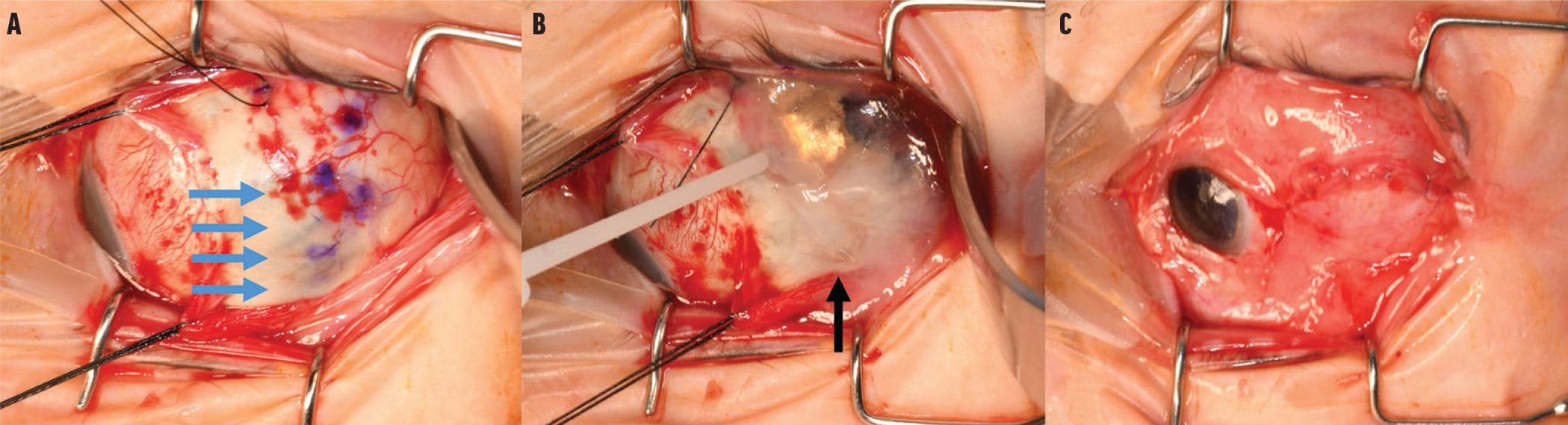
Figure 2. During surgery, scleral thinning (A, blue arrows) was noted; therefore, one suture was placed, and the remainder of the plaque was sealed with tissue glue to all margins covering both suture holes (B, black arrow). Closure of the overlying Tenon fascia and conjunctiva was performed (C).
At the time of plaque removal, the device was secure and in place and could be safely peeled off the sclera. Eight months later, the radiation seed-induced local choroidal atrophy was in an ideal position, another sign of accurate plaque placement (Figure 3A), and the tumor demonstrated regression in thickness to 4.4 mm (Figure 3B).
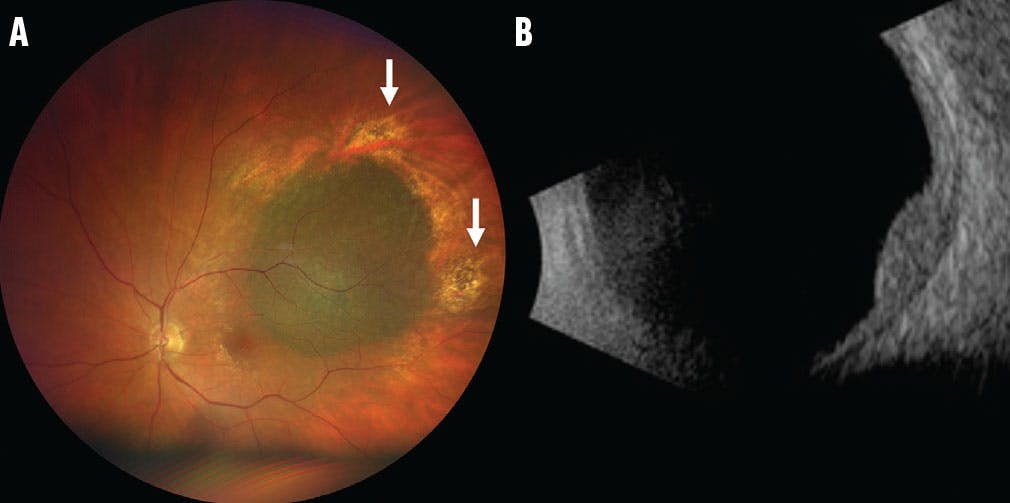
Figure 3. At the 8-month follow-up visit, the melanoma demonstrated regression, and choroidal atrophy at the site of the radiation seeds confirmed accurate placement (A, white arrows). Tumor thickness was reduced to 4.4 mm (B).
THE USE OF TISSUE GLUE IN OPHTHALMIC PROCEDURES
Tissue glue is commonly used in eyelid and adnexal surgeries, conjunctival autograft with amniotic membrane transplantation, conjunctival closure in strabismus surgery, conjunctival port-closure in vitreoretinal and cataract surgery, corneal perforation, keratoplasty, corneal limbal stem cell transplantation, epikeratophakia, temporary keratoprosthesis, keratorefractive procedures, and as a substitute for sutures in trabeculoplasty and placement of drainage devices in glaucoma.7-20 By using tissue glue, surgeons can avoid suture-related complications.
TISSUE GLUE-ASSISTED PLAQUE RADIOTHERAPY IN THE LITERATURE
In 2016, Zloto et al assessed the use of fibrin glue as an adhesive and urokinase as a dissolvent for tissue glue in the setting of plaque placement in six porcine eyes.6 In this ex-vivo animal model, the feasibility of this technique and the glue adhesion strength were assessed and compared with a sutured plaque.6 The tissue glue-assisted plaques were held tightly in place with post-placement stability over 5 days and could be removed with a force similar to that required with the suturing technique. The removal of each plaque in this study used saline and urokinase, with saline having no effect on the glue dissolvent and drops of urokinase having an immediate dissolving effect. However, the authors stated that the plaque-glue complex could be retrieved easily by gently grasping it along with side-to-side movement, with no damage to the underlying globe.6
In 2023, our team reported on tissue glue-assisted plaque radiotherapy in six patients with choroidal melanoma who demonstrated intraoperative scleral thinning.5 The tissue glue was applied over the plaque rim and suture holes. Precaution was taken to prevent fibrin glue from entering under the plaque to avoid lifting it off the sclera and reducing the apical radiation dose. In these six cases, the tumor apex dose was 70 Gy with a mean dose rate of 63.6 cGy/hour over a mean duration of 117.6 hours. Complete closure of the conjunctiva was achieved in each case.5 At plaque removal, accurate plaque position was confirmed with no shifting, and the device was removed by lifting the glue and device off the globe without the need for urokinase. No glue-associated complications were noted.5
A NOVEL AND SAFER OPTION
Plaque radiotherapy is a primary treatment for uveal melanoma. In eyes with a thin sclera, fibrin tissue glue can serve as a novel alternative to sutures for a potentially safer surgical approach.
Carol L. Shields, MD, has had full access to all the information in the study and takes responsibility for the integrity of the information provided. Support provided in part by the Jerry A. Shields MD Eye Cancer Fund, Philadelphia, and the Eye Tumor Research Foundation, Philadelphia. The funders had no role in the design and conduct of the study, in the collection, analysis, and interpretation of the data, and in the preparation, review, or approval of the manuscript.
1. Shields CL, Kaliki S, Furuta M, et al. Clinical spectrum and prognosis of uveal melanoma based on age at presentation in 8033 cases. Retina. 2012;32(7):1363-1372.
2. Semeniuk O, Yu E, Rivard MJ. Current and emerging radiotherapy options for uveal melanoma. Cancers. 2024;16(5):1074.
3. American Brachytherapy Society Ophthalmic Oncology Task Force. The American Brachytherapy Society consensus guidelines for plaque brachytherapy of uveal melanoma and retinoblastoma. Brachytherapy. 2014;13(1):1-14.
4. Buonanno F, Conson M, de Almeida Ribeiro C, et al. Local tumor control and treatment related toxicity after plaque brachytherapy for uveal melanoma: A systematic review and a data pooled analysis. Radiother Oncol J Eur Soc Ther Radiol Oncol. 2022;166:15-25.
5. Agrawal KU, Kalafatis NE, Singla K, et al. Tissue glue adhesion for plaque radiotherapy of uveal melanoma in humans: an initial experience. Ocul Oncol Pathol. 2023;9(1-2):62-65.
6. Zloto O, Vishnevskia-Dai V, Moisseiev J, et al. A biological tissue adhesive and dissolvent system for intraocular tumor plaque brachytherapy. Ophthalmic Surg Lasers Imaging Retina. 2016;47(2):163-170.
7. Steinkogler FJ. The use of fibrin sealant in lid surgery. In: Schlag G, Redl H, eds. Fibrin Sealant in Operative Medicine. Springer; 1986:85-87.
8. Kucukerdonmez C, Karalezli A, Akova YA, et al. Amniotic membrane transplantation using fibrin glue in pterygium surgery: a comparative randomised clinical trial. Eye Lond Engl. 2010;24(4):558-566.
9. Pan HW, Zhong JX, Jing CX. Comparison of fibrin glue versus suture for conjunctival autografting in pterygium surgery: a meta-analysis. Ophthalmology. 2011;118(6):1049-1054.
10. Basmak H, Gursoy H, Cakmak Aİ, et al. Tissue adhesives as an alternative for conjunctival closure in strabismus surgeries. Strabismus. 2011;19(2):59-62.
11. Zauberman H, Hemo I. Use of fibrin glue in ocular surgery. Ophthalmic Surg. 1988;19(2):132-133.
12. Sharma A, Sharma N, Basu S, et al. Tissue adhesives for the management of corneal perforations and challenging corneal conditions. Clin Ophthalmol. 2023;17:209-223.
13. Rosenthal AR, Egbert PR, Harbury C, et al. Use of platelet-fibrinogen-thrombin mixture to seal experimental penetrating corneal wounds. Von Graefes Arch Clin Exp Ophthalmol. 1978;207(2):111-115.
14. Duarte MCB, Kim T. Sutureless lamellar keratoplasty: A modified approach for fibrin glue application. Cornea. 2007;26(9):1127-1128.
15. Pfister RR, Sommers CI. Fibrin sealant in corneal stem cell transplantation. Cornea. 2005;24(5):593-598.
16. Rostron CK, Sandford-Smith JH, Morton DB. Experimental epikeratophakia using tissue lathed at room temperature. Br J Ophthalmol. 1988;72(5):354-360.
17. Uhlig CE, Gerding H. Fibrin sealing improves stability of corneal prostheses during vitreoretinal procedures. Retina. 2003;23(2):209-214.
18. Yeh DL, Bushley DM, Kim T. Treatment of traumatic LASIK flap dislocation and epithelial ingrowth with fibrin glue. Am J Ophthalmol. 2006;141(5):960-962.
19. Välimäki J. Fibrin glue for preventing immediate postoperative hypotony following glaucoma drainage implant surgery. Acta Ophthalmol Scand. 2006;84(3):372-374.
20. Panda A, Kumar S, Kumar A, Bansal R, Bhartiya S. Fibrin glue in ophthalmology. Indian J Ophthalmol. 2009;57(5):371-379.


