


While screening for retinal conditions with a commercial fundus camera is beneficial, the currently available portable handheld fundus cameras (HFCs) are expensive. A mobile fundus camera (MFC) may be useful for mass screening to detect early lesions, especially in remote areas. We conducted a study to assess the quality of retinal images captured with various MFC systems. The secondary objectives were to assess the usability of the images and evaluate any potential safety issues associated with the light emission. Here’s what we found.
THE STUDY: LIGHTS, CAMERA, ACTION
In this cross-sectional study, 10 ophthalmologists were trained to use a commercial HFC and eight different MFC systems to capture fundus photographs of schematic eyes, after which the systems were compared. The MFC systems tested were comprised of a lens connected to a smartphone using a specially designed adjustable holding tube and a commercial locking interface. To standardize the lighting, the camera was operated in video mode using the flashlight. The study included different combinations of smartphone (Apple iPhone 12 and Samsung S21) and connecting lens (oDocs 20D, oDocs 30D, Volk 20D, and Volk 28D).
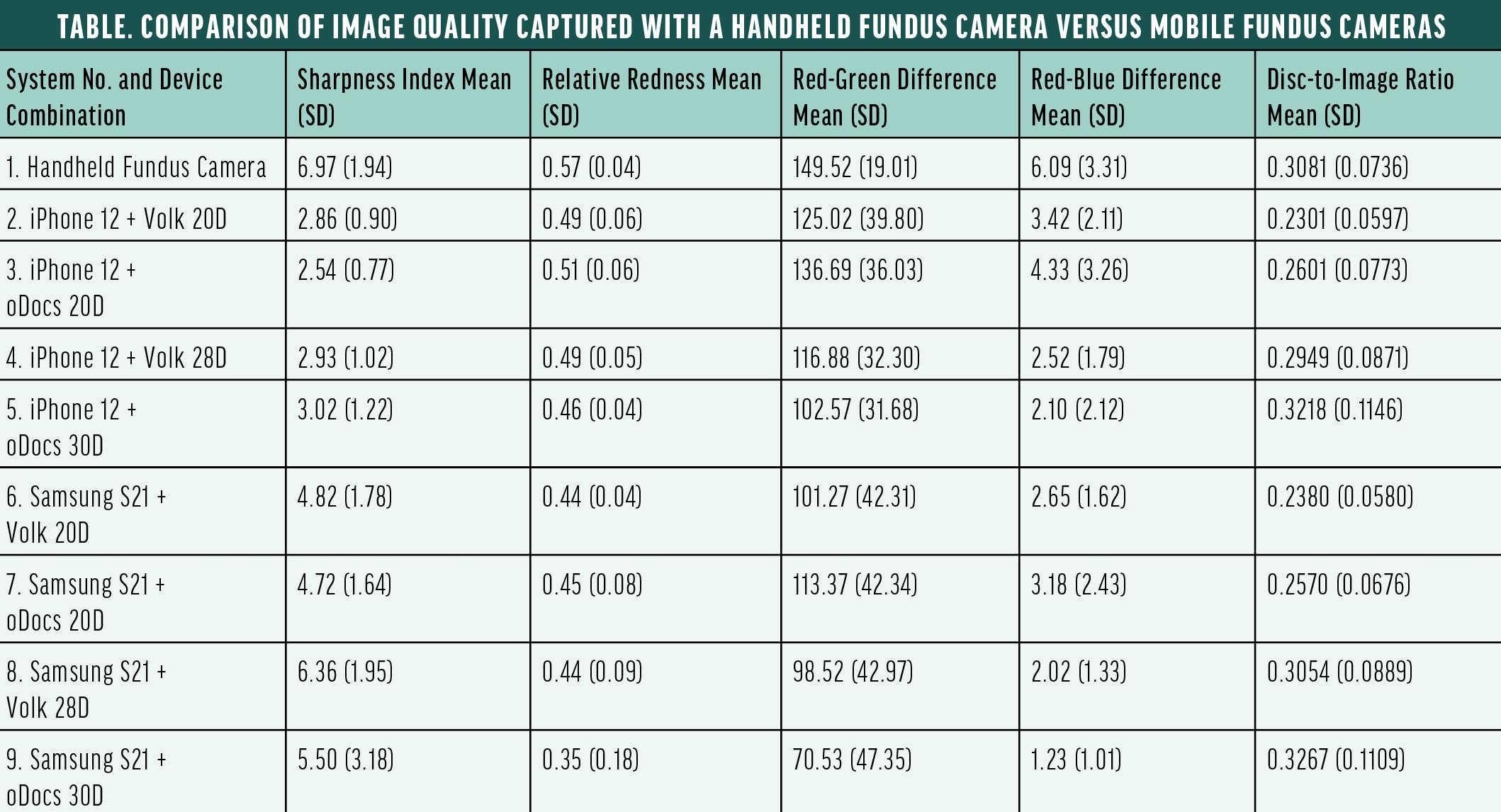
Each ophthalmologist evaluated the MFC using the Usability Experience Questionnaire (UEQ),1 which measures attractiveness, perspicuity, efficiency, dependability, stimulation, and novelty using 26 questions. Image quality was evaluated without processing based on five quality metrics: relative redness, red-green difference, red-blue difference, sharpness index (SI), and disc-to-image ratio (Table). These metrics were calculated from the retinal areas in the photographs.2-4 We used SI to measure the sharpness of an image by calculating the differences between adjacent pixels, with higher values indicating greater contrast.
THE FINDINGS
For each device, we summarized the five quality parameters with the overall mean and standard deviation. The independent effects of the operating system (iOS vs Android) and connecting lens were evaluated using a multiple regression model. The key quality value was sharpness, which was plotted against the relative value of each prime color. The metric of the best device for each parameter was compared with that of the HFC. Inter-participant differences were analyzed using the Conover post-hoc test.
Differences Between Devices
We excluded 12 images due to poor quality of the flashlight reflex; the remaining 348 images were evaluated using the five quality metrics mentioned earlier.
Each MFC system had a lower SI value than the HFC; however, the SI values for four MFC systems were closer to those of the HFC than all other devices, indicating better sharpness with the Samsung S21, although they had poorer color discrimination than the iPhone 12 (P < .05). The effect of the connecting lens (ie, oDocs vs Volk) was not significant. The SI of device 8 (Samsung S21 + Volk 28D) and all color indices of device 3 (iPhone 12 + oDocs 20D) were close to that of the HFC (Figure 1). Consequently, the combination of the Samsung S21 with the Volk 28D provided the best SI (91.2% of HFC), and the iPhone 12 with the oDocs 20D provided the best color discrimination (71.1% to 91.6% of HFC). The quality parameters were found to be consistent among the devices tested (Figure 2), indicating good reliability.
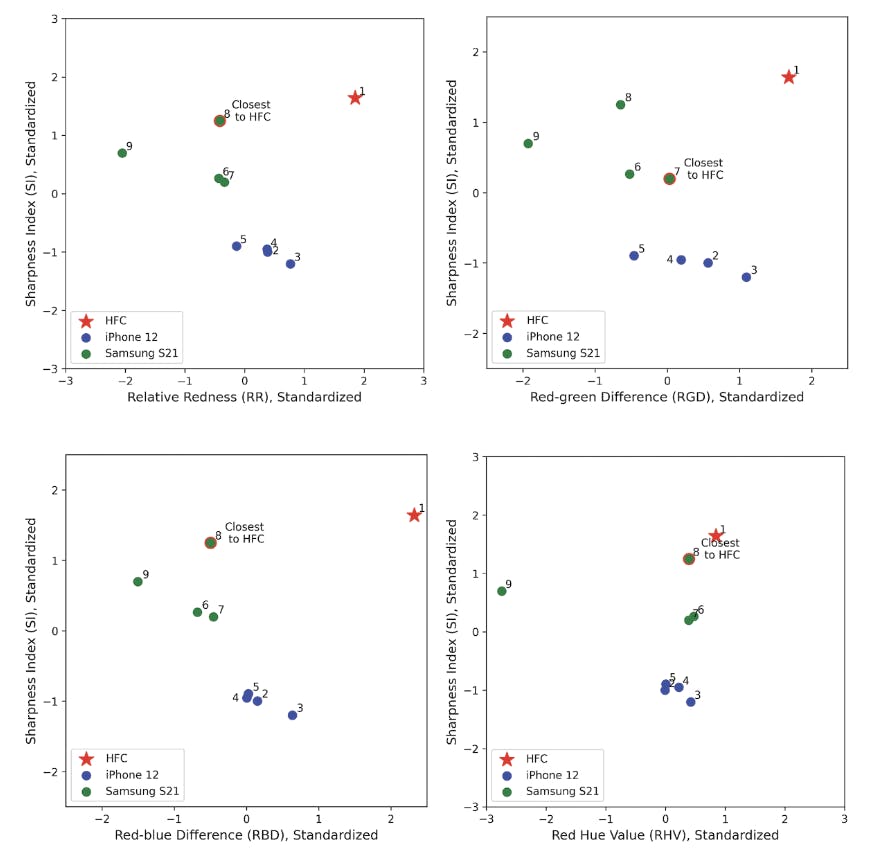
Figure 1. Interaction plots of the SI, relative redness, and disc-to-image ratio, which represent clarity, color, and scale, respectively. The Samsung S21 + Volk 20D MFC system was closest to the HFC in the SI versus relative redness versus disc-to-image ratio, SI versus relative redness, and SI versus disc-to-image ratio plots.
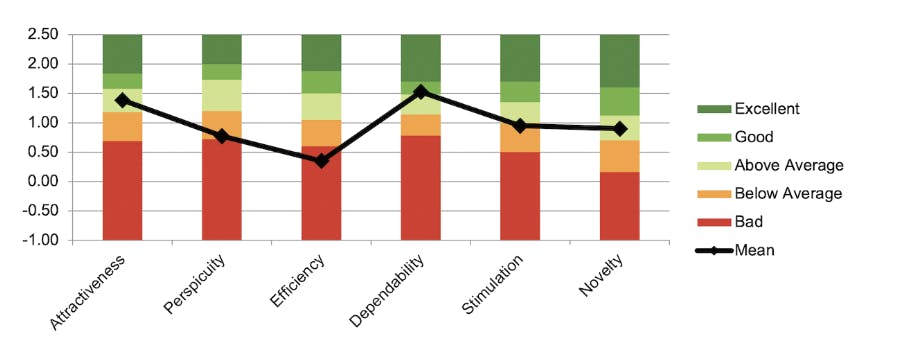
Figure 2. The overall UEQ for the MFCs showed unsatisfactory scores for perceived efficiency and perspicuity.
Safety
For both the iPhone 12 and Samsung S21, the light safety parameters for photochemical and thermal hazards were below the limits defined in the ISO 15004-2 Ophthalmic Instruments Fundamental Requirements and Test Methods Part 2: Light Hazard Protection.5 In addition, our results were in line with those of a previous study that used a smartphone for fundoscopy.6
UEQ Assessment
The UEQ scores in this study showed mixed results. The ophthalmologists were satisfied with attractiveness, dependability, stimulation, and novelty but were unsatisfied with efficiency and perspicuity. The system was perceived as inefficient because the users had to connect and disconnect the smartphones using different connecting lenses throughout the assessment period; this issue was resolved when only the optimal combination was used. Regarding perspicuity, the reviewers rarely operated HFCs before this study, and the MFC was new to all participants, who required an extensive explanation before use. Jansen et al reported that image quality was not affected by shorter time spent in training6; Gosheva et al reported no significant effects on users’ learning with the use of a mobile device.7
RESULTS POINT TO GOOD CLINICAL UTILITY
Our results suggest use of an MFC system is safe and effective for retinal screening. Based on the SI criteria, the Samsung S21 with the Volk 28D lens was closest to the HFC and should therefore be considered for further development, especially for primary care providers.
1. Schrepp M. User experience questionnaire handbook. 2023. www.ueq-online.org/Material/Handbook.pdf
2. Otero C, García-Porta N, Tabernero J, Pardhan S. Comparison of different smartphone cameras to evaluate conjunctival hyperaemia in normal subjects. Sci Rep. 2019;9(1):1339.
3. Amparo F, Wang H, Emami-Naeini P, Karimian P, Dana R. The ocular redness index: a novel automated method for measuring ocular injection. Invest Ophthalmol Vis Sci. 2013;54(7):4821-4826.
4. Papas EB. Key factors in the subjective and objective assessment of conjunctival erythema. Invest Ophthalmol Vis Sci. 2000;41(3):687-691.
5. Ophthalmic Instruments—Fundamental Requirements and Test Methods Part 2: Light Hazard Protection. 1st ed. International Standard; 2007. Reviewed 2019.
6. Jansen LG, Shah P, Wabbels B, Holz FG, Finger RP, Wintergerst MWM. Learning curve evaluation upskilling retinal imaging using smartphones. Sci Rep. 2021;11(1):12691.
7. Gosheva M, Klameth C, Norrenberg L, et al. Quality and learning curve of handheld versus stand-alone non-mydriatic cameras. Clin Ophthalmol. 2017;11:1601-1606.


