



While patients are the most important part of any retina practice, today, they often feel as though their physicians do not spend enough quality time with them. In our busy, high-volume retina practice with 20 locations and 14 specialists, maximizing efficiency enables us to increase the amount of time each doctor can spend face-to-face with patients. This quality time makes a huge difference in their satisfaction and compliance with their treatments. My mindset is that if every aspect of the clinic is efficient enough, then I can spend the most possible direct time with the patient and build camaraderie—even on our busiest days.
THE 1-MINUTE RULE
Each of our physicians and staff members is tasked with performing their job as efficiently as possible. To be a great doctor, I need my staff to be great at what they do as well. To support this team effort, we operate by a “1-minute rule,” which states that if we waste even 1 minute per patient due to small inefficiencies, it has a cumulative effect. For example, if we see a total of 60 patients, then that extra hour added to the clinic day is felt acutely by patients, doctors, and staff alike. It can mean the difference between finishing a busy day at 5:30 PM instead of 6:30 PM or later. More importantly, keeping this rule in mind can allow patients to enjoy short wait times and quality time with their doctor, instead of getting frustrated with long waiting periods.
HARNESS THE POWER OF TECHNOLOGY
Many factors contribute to building efficiency in the clinic, including our technology. Our practice management system, electronic health record (EHR), OCT, and widefield imaging system must be high-quality and reliable to help our staff manage the patient flow effectively. If any of this technology is slow, difficult to learn, or frequently out of service, it is impossible for staff to accomplish their daily goals efficiently. This is why identifying quality products that are well-supported is crucial for busy clinics.
The following sections elaborate on how effective use of imaging technology, especially OCT, can boost your clinic efficiency and enhance your facetime with patients.
DEFINE YOUR PROTOCOL
Create protocols to maximize the best qualities of your staff with the most useful features of the technology so that each step—check-in, workup, imaging, physician data review, patient examination, physician-patient discussion, and, ultimately, treatment—is streamlined and effective.
OCT has become central to the diagnosis and management of retinal disease and offers an apt illustration for how we practice our 1-minute rule by following a simple, straightforward protocol (Figures 1 and 2). For example, we order the scans ahead of time based on the diagnosis, symptoms, or information provided from previous evaluations. Of course, it is important to ensure our protocol is fully compliant with billing and coding guidelines. Our staff performs the OCT scan before the patient even sees their doctor. Acquiring the OCT image in advance not only helps with patient flow, but it also allows for review of the OCT image along with the patient’s history before I walk into the examination room. Armed with that information, I can typically narrow down my thought process and have an idea of the differential diagnosis, which allows me to focus more on the examination.
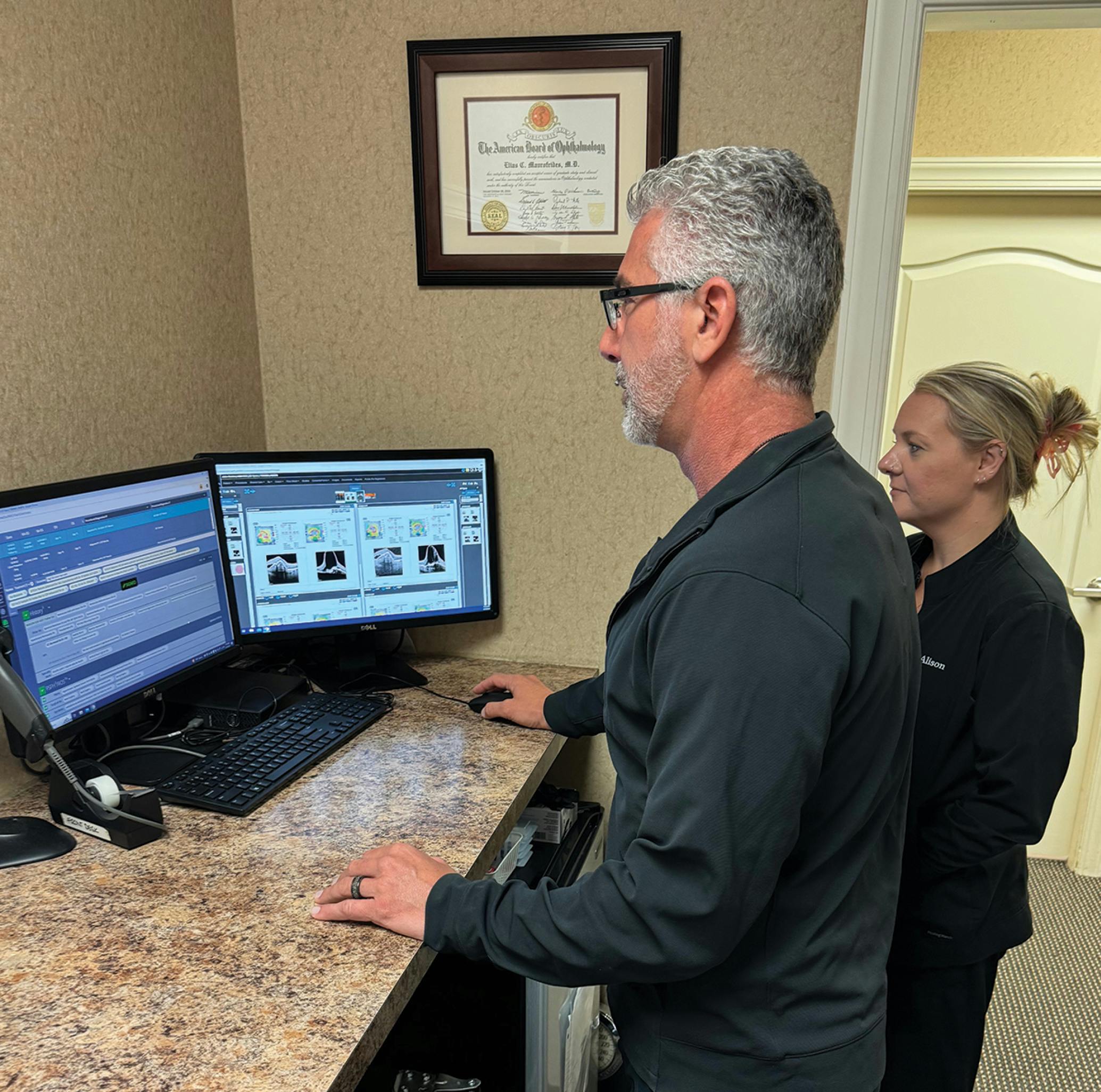
Figure 1. Dr. Mavrofrides reviews the patient’s clinical information and OCT images at the technician’s station prior to seeing the patient.
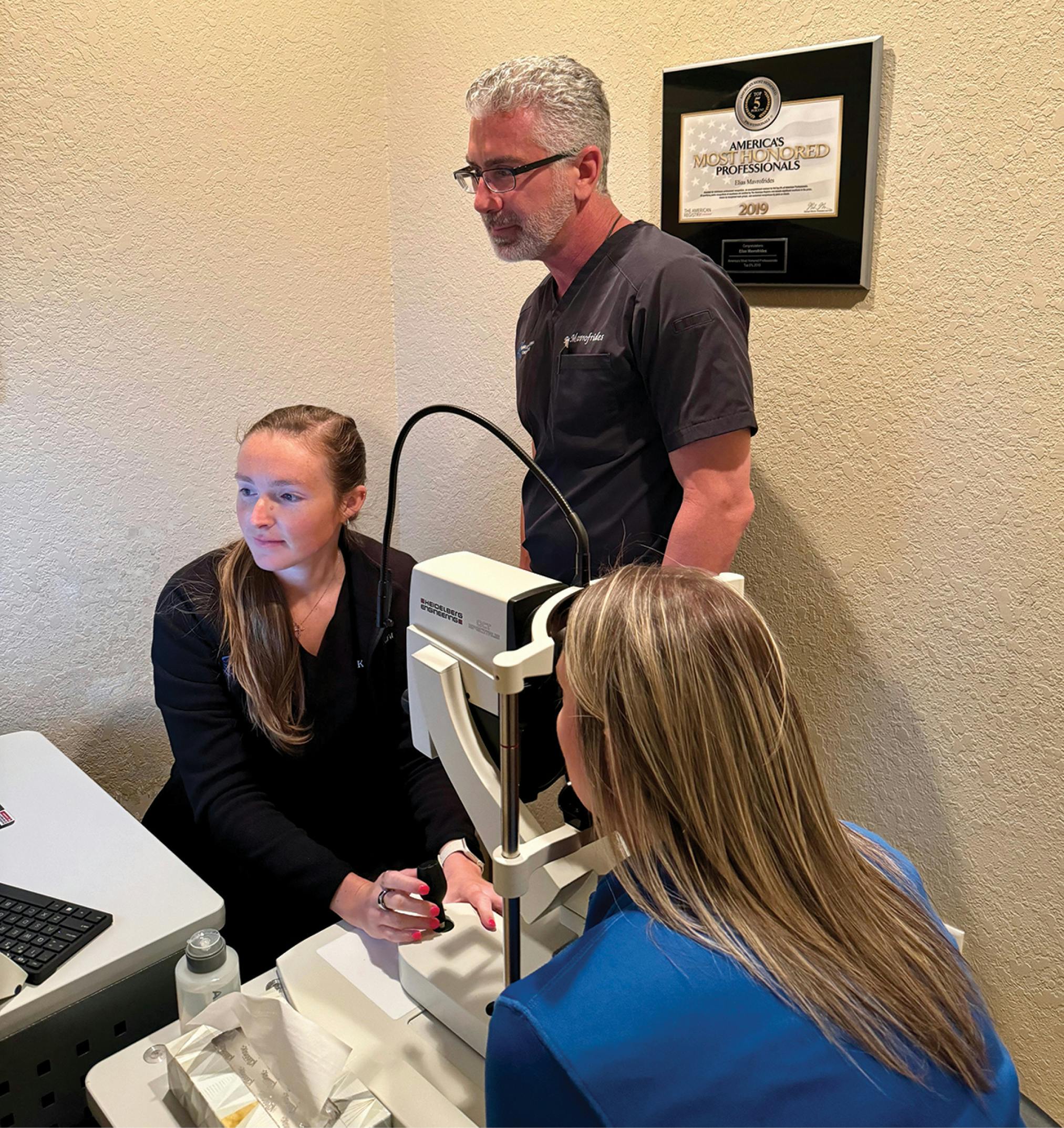
In our practice, all assistants, regardless of which doctor they work with, are cross trained to obtain OCT images using the fast macular scan setting (Spectralis, Heidelberg Engineering). This scan protocol is easy for the patient to tolerate and quick for the technician to perform, yielding excellent images applicable to most of my patients. I can easily visualize the macular contour and retinal layers, especially the photoreceptor layer, as well as the vitreous and vitreoretinal interface. For patients with more occult pathology, our imaging technicians can do a more detailed dense-volume or radial scan. My staff is also trained to do extra scans for patients with certain diagnoses, such as impending macular holes. In other cases, I may decide I need additional scans after examining the patient and reviewing the macular scans. My technicians can efficiently obtain these extra scans while I see another patient, such that we don’t disrupt the clinic flow.
ENHANCE PATIENT EDUCATION
Another key to a well-run clinic is detailed, efficient patient education. OCT imaging plays a key role in simplifying patient education. When I am describing to patients what I see and what that means for their condition, I show them their OCT images and discuss my treatment plan. A picture truly is worth a thousand words, helping to build their confidence in the diagnosis and in me as their provider. This is especially important with new patients as I work to build their trust. For established patients, our OCT platform allows us to easily cycle through scans from previous visits to track what is happening over time. These images are extremely valuable for helping patients understand how their condition may be changing from visit to visit.
Many retina treatments, such as lasers or injections, can create significant anxiety for patients, and asymptomatic patients may not understand why I am telling them they need another injection. I tell patients that I can’t wait until their vision gets worse to do something and that my goal is to try to catch the problem before they notice it. Showing patients their imaging results, including OCT, can make a huge difference in their compliance in cases where they have not yet noticed a change in their vision.
INVEST IN IMAGING
From a business perspective, our imaging technologies are true workhorses that must reliably perform a vast number of scans. This is an under-recognized, vitally important factor for maintaining efficiency. We image more than 100,000 patients—or 200,000 eyes—a year across the practice. A single office with one OCT device will scan more than 15,000 patients—30,000 eyes—per year. Busy practices require reliable, top-notch technology with equally top-notch hardware that gives us the confidence that it will perform as expected each time. It is an investment that pays dividends.
TREAT-AND-EXTEND
There are many different intravitreal medications available now for the treatment of various retinal conditions, and our goal is to provide the best visual outcomes with the fewest injections necessary. Monthly injections are not well-tolerated by most patients, and, in many cases, they are an unnecessarily excessive treatment. As-needed treatment protocols decrease treatment burden but can be associated with suboptimal outcomes if changes are not caught right away.
Therefore, my partners and I typically recommend a treat-and-extend protocol with high-quality OCT imaging to help ensure good visual outcomes. It is crucial for me to be able to see even a small recurrence of edema so that I can address it right away and adjust the treatment interval accordingly. Effective OCT imaging also helps me decide whether I should try new therapeutic options, rather than simply adjusting a treatment interval. With this approach, comparing OCT images over time allows me to determine whether changing medications truly leads to a better treatment response.
WORK SMARTER
The 1-minute rule holds my staff accountable for how smoothly our day runs (and when it ends). We are all invested in taking the best possible care of our patients, but we also want to finish the workday on time. I emphasize to my staff that they are an integral part of this process, which helps them understand that working efficiently allows us to not only end the day on time, but also reduce patient wait times—a source of stress for everyone in the clinic.
Efficiency is not simply about being faster; rather, it is about making the best possible use of your time, which can be enhanced by streamlining your imaging protocols. Time spent face-to-face connecting with and caring for patients should always be top of mind, and prioritizing this time with them makes all the difference.


