




AT A GLANCE
- Experts have developed a consensus framework for OCT angiography (OCTA) nomenclature.
- The structure consists of generic terms (ie, OCTA signal), adjective terms (ie, absence/presence and increased/decreased), and descriptive/etiologic terms (ie, due to shadowing/decreased perfusion/artifacts).
- While the proposed terms are tailored to retinal vascular diseases, ongoing efforts aim to extend this nomenclature to other conditions.
OCT angiography (OCTA) has become a transformative tool in retinal imaging, offering unparalleled insights into retinal vasculature and disease pathologies. However, the lack of standardized terminology has posed challenges for consistent communication in clinical and research settings. Additionally, many terms commonly used to describe pathological changes on OCTA fail to accurately reflect the underlying physical principles of the technology.
To address these issues, a consensus framework for OCTA nomenclature was developed using a modified Delphi method. This initiative involved retinal imaging specialists with extensive expertise in the field, basic researchers specializing in retinal pathology, and biomechanical engineers actively engaged in the development of OCTA devices and modules. The collaborative initiative included four prominent retina societies: the European Society of Retina Specialists (Euretina), Japanese Retina and Vitreous Society (JRVS), American Society of Retina Specialists (ASRS), and International Retinal Imaging Society (IntRIS).1,2
The framework initially focuses on retinal vascular diseases (RVD), and it is currently being expanded to encompass a broader range of retinal and macular diseases.
WHY STANDARDIZED TERMINOLOGY MATTERS
OCTA’s rapid adoption has exposed inconsistencies in how findings are described. Terms such as flow void and flux, adapted from other modalities, do not align with the unique principles of OCTA, which relies on motion contrast rather than direct flow measurement. OCTA’s signal detection is inherently binary, identifying the presence or absence of motion contrast, rather than providing a quantitative measure of flow. Using terms such as flow implies a level of quantification OCTA does not deliver. Terminology should accurately reflect the underlying principles of a modality. Just as we use reflectivity to describe changes on OCT or fluorescence to describe findings on fluorescence angiography, OCTA requires terminology that is precise and consistent with its technical basis. Without a standardized nomenclature, comparisons across studies are challenging, and communication among professionals remains ambiguous.
THE PROCESS OF REACHING CONSENSUS
The initial effort began with a comprehensive survey distributed to Euretina, JRVS, and ASRS members, which did not reach a consensus.1 Subsequently, a modified Delphi process was conducted, involving experts in the field. Despite this rigorous approach, consensus on OCTA nomenclature remained elusive.2 What became evident, however, was that achieving consensus required the development of a new framework that accurately reflects the physical principles of OCTA, rather than simply endorsing the terms frequently used in previous literature. Thus, the final effort began with the formation of an executive committee and an expert panel. The executive committee oversaw literature reviews, survey design, and data analysis, while the expert panel, consisting of seven specialists in OCTA technology, retinal diseases, and imaging physics, provided iterative feedback and refinement. A literature review focusing on OCTA and RVD identified 159 relevant terms from 58 studies. This review, together with the initial results of the two prior efforts, formed the basis for the subsequent surveys.3
The first survey ranked and selected preferred terms based on expert feedback. In subsequent surveys, these terms were applied to OCTA images to evaluate their accuracy and suitability. After each round, the executive committee and the expert panel refined the framework through discussions, ensuring its applicability to both clinical and research contexts. The iterative surveys adhered to a structured classification system to define levels of consensus:
- Accepted: Median ≥ 6, no strict interquartile range (IQR) criteria
- Considerable Consensus: Median 6 to 7, IQR ≤ 3
- Strong Consensus: Median ≥ 8, IQR ≤ 2
- Refined Strong Consensus: Median ≥ 8, IQR ≤ 2, with ≥ 70% responses in the 8 to 10 range
After several rounds of refinement, the final framework was distributed via a survey to IntRIS members. They were asked to apply the framework to describe a series of provided OCTA examples (Figure 1).
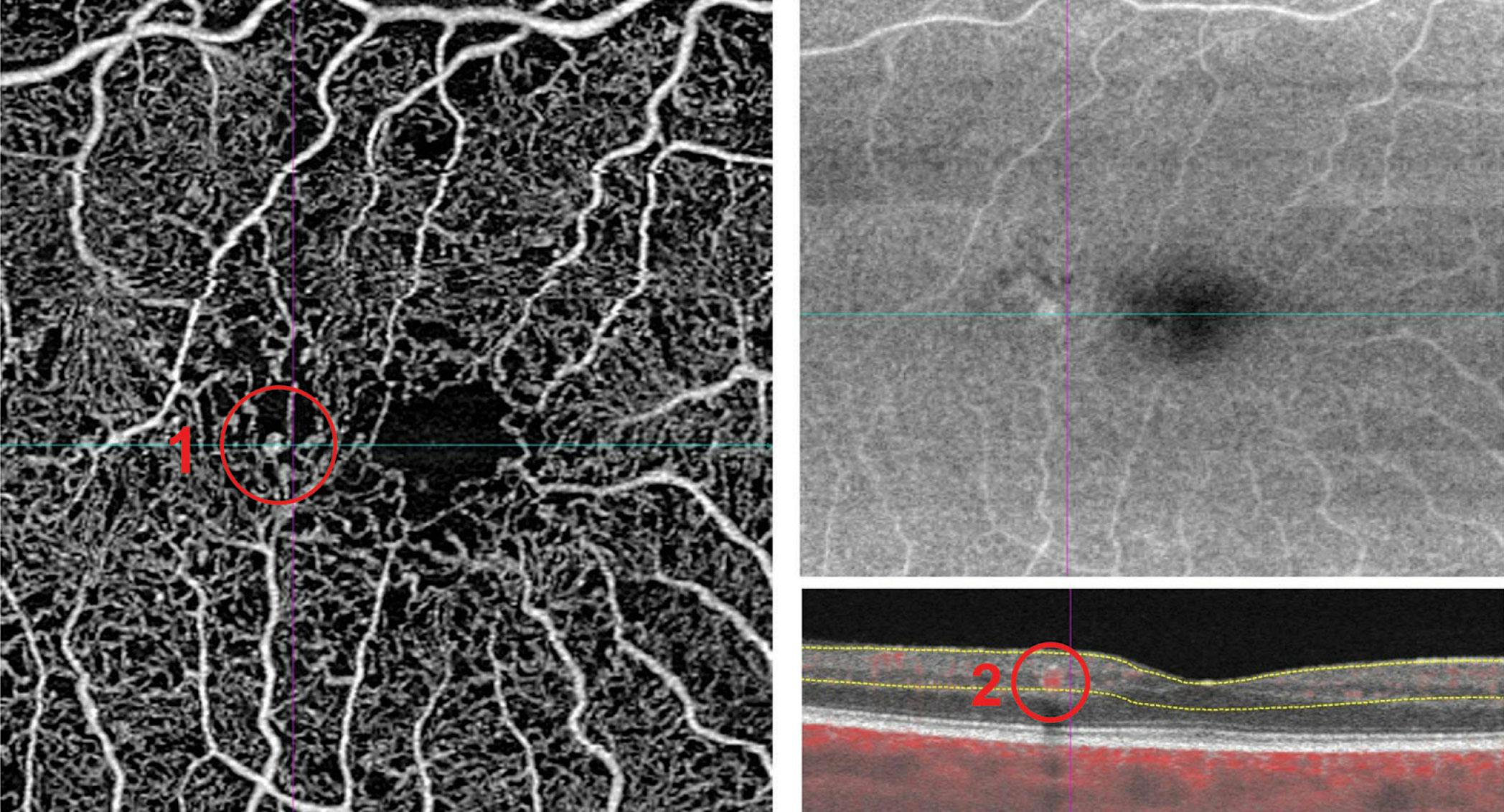
Figure 1. This is the first OCTA image that experts were asked to describe using the proposed nomenclature framework. They were also asked how comfortable they felt using the proposed nomenclature. Descriptions of the marked area (red 1 and 2) include: “The OCTA images reveal a 6 mm x 6 mm macular SCP en face slab with a focal increase in OCTA signal, indicative of a microaneurysm”; “The OCTA B-scan shows an abnormal OCTA signal extension intraretinally, likely at the boundary between the inner nuclear layer and the outer plexiform layer, consistent with a microaneurysm originating from vascular abnormalities”; and “Increased OCTA signal consistent with a microaneurysm.”
KEY FINDINGS
The final framework introduces a three-tiered structure:
- Generic Terms: OCTA signal achieved refined strong consensus (median: 8, IQR: 8 to 9, 75.8% agreement). This term provides a versatile and universally applicable descriptor independent of OCTA module and mechanism to generate motion contrast.
- Adjective Terms: Descriptors such as absence/presence and increased/decreased were preferred for their clarity, achieving refined strong consensus (median: 8, IQR: 8 to 9, 76.6% agreement).
- Descriptive/Etiologic Terms: Categories (nonexhaustive) such as due to shadowing, due to decreased perfusion, and due to artifacts describe the potential underlying origin of the signal and achieved strong consensus (median: 8, IQR: 7 to 9), offering specificity for differentiating signal alterations.
The use of terms within these three categories should be complemented by a detailed description of the scan, including the scan type (eg, en face, OCTA B-scan), scan size (eg, 3 mm x 3 mm, 6 mm x 6 mm), slab (eg, superficial capillary plexus [SCP], deep capillary plexus [DCP], middle capillary plexus [MCP], choriocapillaris, or specific segmentation boundaries used to generate the slab), and any other relevant technical details (eg, swept-source or spectral-domain OCT).The level of detail naturally varies depending on the context but is particularly crucial in scientific settings to ensure clarity, reproducibility, and consistency in reporting (Figure 2).
Utility in Clinical Practice: The framework achieved a median score of 8 (IQR: 7 to 9), with 67.4% of responses in the 8 to 10 range. This underscores its utility in improving interdisciplinary communication and diagnostic accuracy in clinical settings.
Utility in Research: For research applications, the framework was rated highly with a median score of 8.5 (IQR: 8 to 9) and 78% agreement in the top range, emphasizing its value in enhancing reproducibility and facilitating multicenter studies.
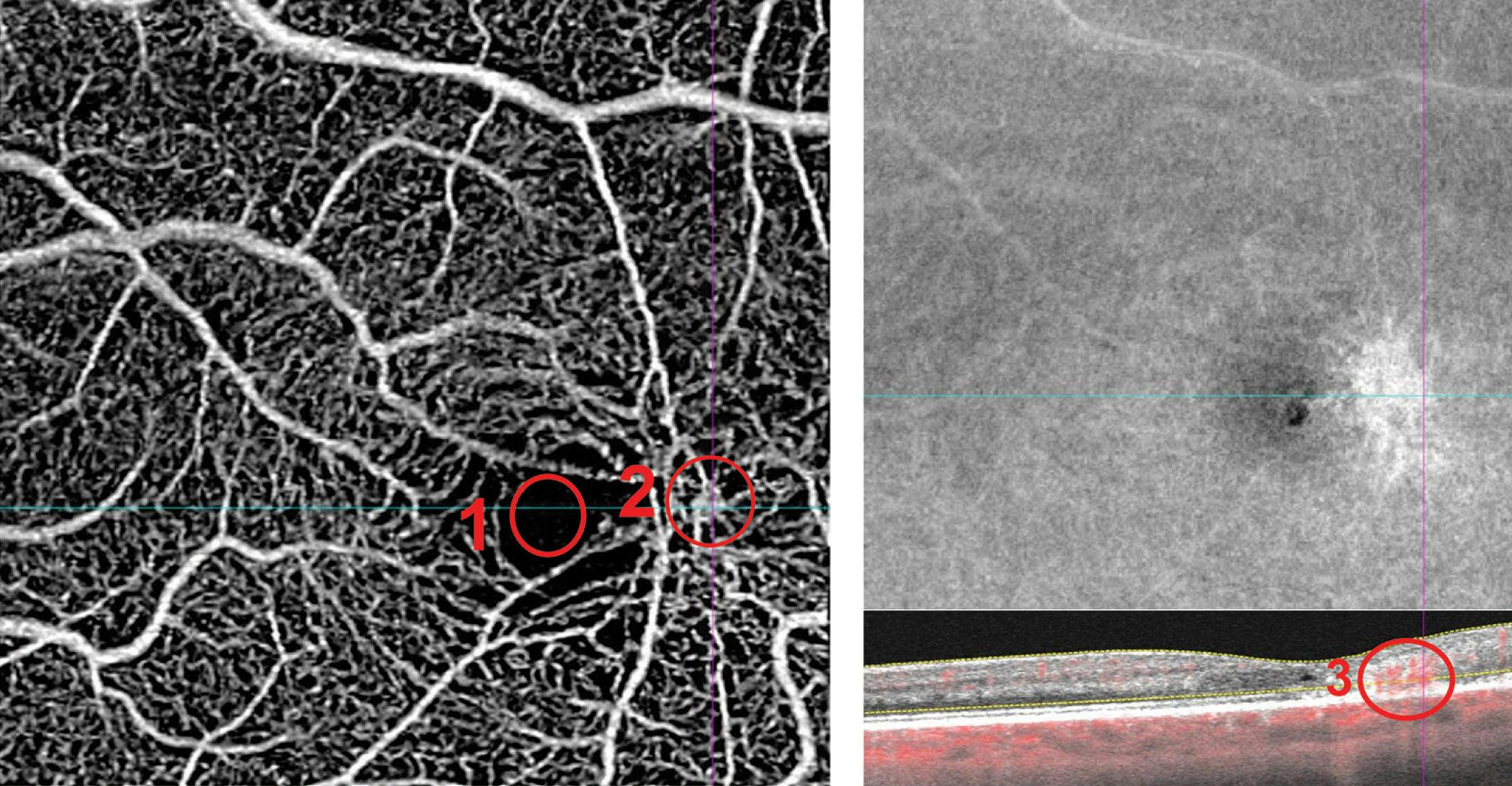
Figure 2. Experts were asked to describe three key changes observed in these OCTA images, applying the standardized terms from the new framework. The first observation (red 1) highlights the 6 mm x 6 mm en face SCP slab displaying a decreased OCTA signal due to nonperfusion at the foveal avascular zone (FAZ). The FAZ boundaries are irregular, with temporal dragging and distortion of the perifoveal capillaries, indicative of vascular disruption. A different feature (red 2) reveals a focal increase in OCTA signal temporal to the FAZ on the SCP en face slab. This finding suggests vascular remodeling or neovascularization, characterized by a cluster of tangled vessels, increased vascular density, and capillary distortion. Finally (red 3), the OCTA B-scan shows a focal area of increased OCTA signal in the outer retina. This signal is localized at the boundary of the MCP and DCP and colocalizes with a hyperreflective lesion at the structural en face scan, suggestive of intraretinal neovascularization and/or chorioretinal anastomosis seen in macular telangiectasia type 2.
EXPANDING APPLICATIONS
While the proposed terms are tailored to RVD, ongoing efforts aim to extend this nomenclature to other conditions, such as AMD and macular dystrophies, so the framework can be used irrespective of underlying disease. As OCTA technology evolves, new terms may be integrated into the framework to address emerging imaging challenges.
HURDLES TO OVERCOME
Advancing OCTA technology brings new complexities, such as distinguishing between retinal layers like the choriocapillaris and inner choroid. Future refinements will address these challenges, ensuring that the nomenclature remains robust and adaptable to technological innovations.
The new framework provides clinicians with an accurate, flexible, and adaptive system to describe OCTA images using standardized terminology. The consensus nomenclature marks a critical step forward in retinal imaging. By providing a standardized language for describing OCTA findings, it empowers clinicians and researchers to fully leverage this transformative technology, while paving the way for expanded applications in other retinal conditions.
Acknowledgment: This article was prepared with the assistance of OpenAI’s ChatGPT, version January 2024. The AI model was used solely for grammar review and improvement of phrasing, based on author-provided text and guidelines.
1. Munk MR, Kashani AH, Tadayoni R, et al. Standardization of OCT angiography nomenclature in retinal vascular diseases: first survey results. Ophthalmol Retina. 2021;5(10):981-990.
2. Munk MR, Kashani AH, Tadayoni R, et al. Recommendations for OCT angiography reporting in retinal vascular disease: a Delphi approach by international experts. Ophthalmol Retina. 2022;6(9):753-61.
3. Munk MR, Turgut F, Faes L, et al; on behalf of the International Retinal Imaging Society Research Group. Standardization of optical coherence tomography angiography nomenclature in retinal vascular diseases: consensus-based recommendations Ophthalmol Retina. 2025 Jan 31:S2468-6530(25)00047-8.


_1784132761.jpg?auto=compress,format&w=75)


