


Bascom Palmer Eye Institute’s Angiogenesis, Exudation, and Degeneration meeting, held February 8, was packed with clinical pearls, research findings, and robust discussions of both. International speakers shared on retinal imaging, AMD therapies, considerations for treating diabetic eye disease, and more. Here, we summarize key talks from the meeting.
OCT SPOTLIGHT
The meeting kicked off with an OCT session, during which K. Bailey Freund, MD, and James G. Fujimoto, MD, discussed high-resolution OCT. Dr. Freund noted that scrutinizing high-resolution OCT over time may allow researchers to fill gaps in our understanding of AMD disease progression. He gave the example of a potential alternative biologic pathway for drusen formation, which he supported with high-resolution OCT images. Dr. Fujimoto further explained how high-resolution OCT better defines outer retinal features, allowing researchers to investigate Bruch membrane/retinal pigment epithelium (RPE) complex changes in aging versus AMD.
Alessandro Berni, MD, and Nadia K. Waheed, MD, MPH, explored OCT angiography (OCTA), including updated guidelines for imaging the choriocapillaris and a new variable interscan time analysis, which is a measure that can help researchers assess choriocapillaris flow changes in AMD.
To wrap up the session, Seung-Young Yu, MD, presented on the changes in drusen parameters in a Korean patient cohort. She noted that Asian patients typically have a thicker choroid, which might have a protective effect.
IMAGING DRY AMD
Giovanni Staurenghi, MD, began the next session with a comprehensive look at the differential diagnosis of macular atrophy (Figure). Using OCTA, ICG angiography, color fundus imaging, medical history, and genetic testing, clinicians can differentiate geographic atrophy (GA) from many other conditions, such as Stargardt, adult-onset foveomacular vitelliform dystrophy, and toxic maculopathies.
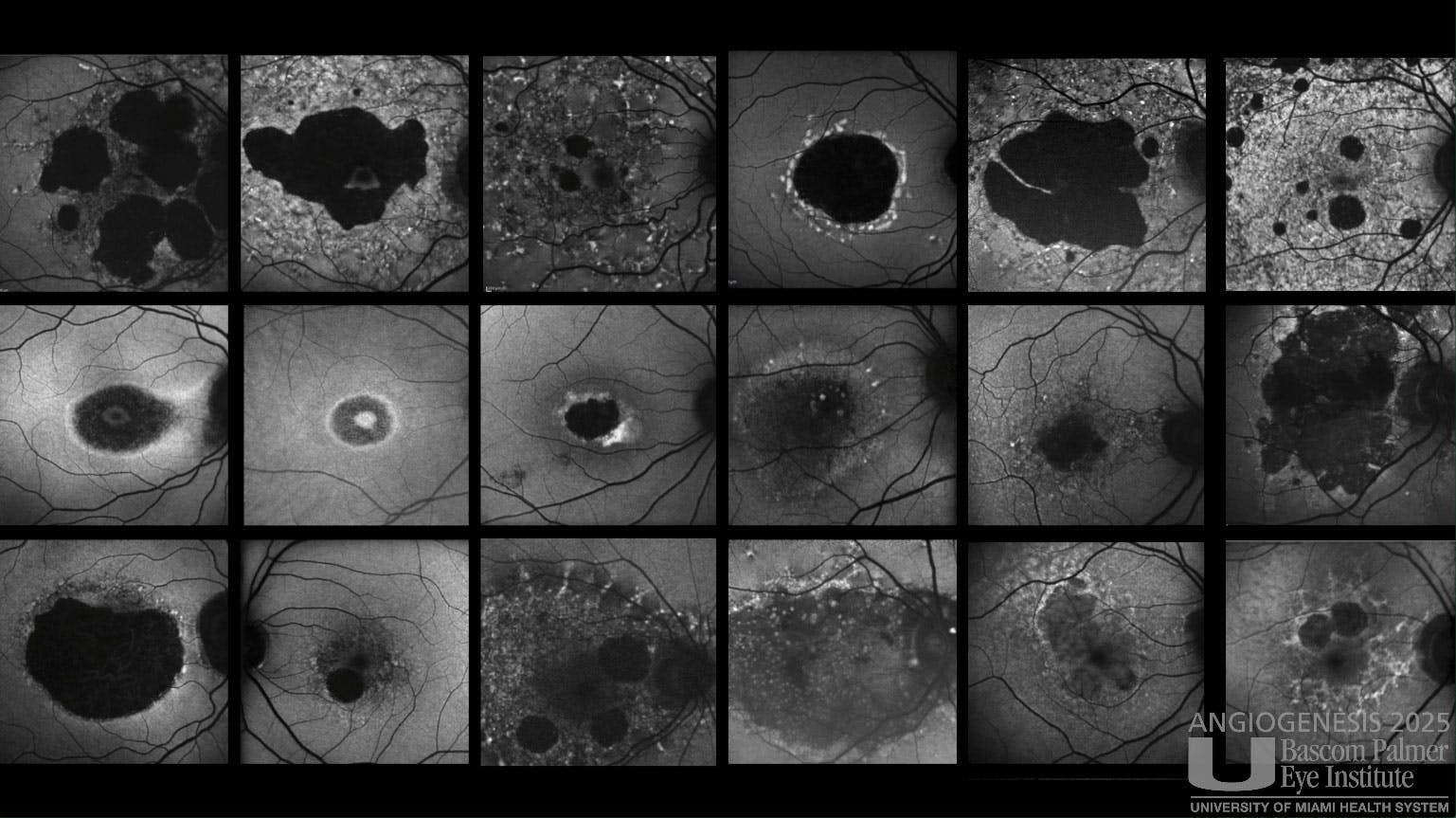
Figure. Dr. Staurenghi shared imaging pearls to help the audience properly diagnose macular atrophy beyond GA, including Stargardt, Doyne honeycomb retinal dystrophy, mitochondrial diseases, psedoxanthoma elasticum, and toxic maculopathies.
Ursula Schmidt-Erfurth, MD, discussed AI-based biomarkers for GA progression, noting that Al tools allow real-time visualization of disease activity and progression on OCT imaging. AI also shows that ellipsoid zone (EZ) change is an important biomarker for functional gain and decline.
Peter Kaiser, MD, also lectured on EZ attenuation, sharing data from the Optical Coherence Tomography to Function Delphi study. He explained how consensus was reached for the use of total EZ attenuation as a suitable standalone clinical trial endpoint. Partial EZ attenuation is also a suitable endpoint, but work is ongoing to define a standardized threshold value, Dr. Kaiser added.
Hasenin Al-khersan, MD, and his team are working on an automated algorithm to accurately segment GA lesions in the clinic using OCT, particularly in eyes with concurrent wet AMD. While the algorithm performed well, accuracy fell in cases of atrophy with multiple small atrophic islands. More research is needed to better understand the utility of deep-learning tools in cases with combined wet AMD and GA, Dr. Al-khersan concluded.
Monika Fleckenstein, MD, discussed how GA lesion location affects patients’ vision-related quality of life. Her study found that low-luminescence visual acuity was the key factor for patients, as were lesions in the inner lower and inner left subfields of the better-seeing eye. Understanding these effects on patients is critical for informed decision making when it comes to treatment, she concluded.
TREATING DRY AMD
Eleonora M. Lad, MD, discussed the effect ANX007 (Annexon) has on the central EZ and visual function in the phase 2 ARCHER study. ARCHER’s primary endpoint was change in GA lesion growth, which was not statistically significant. ANX007 treatment, however, did reduce EZ loss across the macula and offer statistically significant protection from vision loss.
David S. Boyer, MD, then presented results from the SAGA study of oral gildeuretinol (Alkeus) in patients with GA secondary to AMD. SAGA’s primary endpoint—mean rate of growth in GA area from baseline to 24 months—did not reach statistical significance. However, there was a trend toward functional benefit in BCVA at month 24.
Charles C. Wykoff, MD, shared the results of the phase 2 GOLDEN study looking into the efficacy and safety of IONIS-FB-LRx (Sefaxersen, Ionis) in GA. The primary endpoint was rate of GA growth, with outcomes failing to indicate a statistically significant reduction in GA area growth.
Glenn J. Jaffe, MD, closed out the session with a summary of imaging biomarkers in the LIGHTSITE III trial of the Valeda Light Delivery System (Lumithera). The trial met its primary endpoint of improved visual acuity, with better results over time. Photobiomodulation reduced incident GA by 73% and GA lesion growth, conversion of incomplete to complete RPE and outer retinal atrophy, incident incomplete RPE and outer retinal atrophy, drusen volume, and EZ loss compared with sham.
COMPLEMENT INHIBITION IN PRACTICE
Nathan C. Steinle, MD, covered the effects of AREDS vitamins on GA, which were analyzed in the OAKS and DERBY studies. The primary endpoints were overall GA growth and GA growth toward the fovea. The analysis showed 13 µm and 34 µm greater overall GA growth and GA growth toward the fovea, respectively, with vitamins. This outcome was seen regardless of GA lesion location or pegcetacoplan (Syfovre, Apellis) use, emphasizing the need for a prospective study to assess the effect of AREDS vitamins on GA growth.
Mathew MacCumber, MD, then presented on real-world practice patterns and adverse events of pegcetacoplan and avacincaptad pegol (Izervay, Astellas) for GA. His report noted an increase in the use of both drugs over time, with few to no adverse events and good safety results. Pegcetacoplan, specifically, was associated with stable visual acuity and IOP across injections.
IMAGING AND TREATING WET AMD AND DME
Shifting gears to wet AMD and diabetic macular edema (DME), David M. Brown, MD, addressed the question, “Why do some eyes require more frequent injections?” The answer has to do with anti-VEGF half-lives and drug clearance, he said. To extend drug clearance, researchers need to increase the molar blockade, block additional targets, or increase the molecular weight. For example, tarcocimab (Kodiak) has a human ocular half-life of 20 days, which is three times longer than faricimab (Vabysmo, Genentech/Roche), he noted.
Usha Chakravarthy, MD, PhD, shared data on ISTH0036 (Isarna Therapeutics), an antisense-blocking TGF-ß2 under investigation for DME and wet AMD. It’s showing promise in phase 2 trials as monotherapy and may be used in combination with anti-VEGF therapy.
Michael Singer, MD, presented interim phase 2 data for a novel subcutaneous therapy for DME and AMD, migaldendranib (Ashvattha Therapeutics), which is an anti-angiogenic receptor tyrosine kinase inhibitor. The potentially at-home therapy has been safe and well tolerated, with a greater-than 69% reduction in the need for supplemental anti-VEGF therapy at 9 months, he explained.
Promising 52-week data from the phase 2 LUNA trial of ixo-vec (Adverum) was presented by Dr. Wykoff. The gene therapy reduced treatment burden by 88% and 92% at 6E10 and 2E11 doses, respectively, he explained.
4D-150 (4DMT) is moving into phase 3 trials this year, following positive 52-week data from the phase 2b PRISM trial in wet AMD, according to Dante Pieramici, MD. In the trial, treatment with 4D-150 led to an 83% reduction in treatment burden for recently diagnosed AMD patients.
Jeffrey S. Heier, MD, and Anat Loewenstein, MD, discussed home OCT (Notal Vision). Dr. Heier shared findings from the visualization study showing that the at-home device was able to capture hyporeflective spaces on OCT, and the system’s efficacy and safety led to FDA marketing authorization. According to Dr. Loewenstein, the AI estimation of hyporeflective space volume had good agreement with the graders, which was similar to the agreement between graders.
DIABETIC EYE DISEASE AND RETINAL VASCULAR DISEASE
Veeral Sheth, MD, MBA, presented 1-year results of the phase 4 ELEVATUM trial, which evaluated the safety and efficacy of faricimab in underrepresented patients with DME. Hispanic/Latino patients with DME had worse BCVA, central subfield thickness (CST), and diabetic retinopathy (DR) at baseline compared with Black/African American patients. However, they also experienced the most robust responses to treatment with faricimab; at week 56, 41.5% achieved a greater than 2-step improvement in Diabetic Retinopathy Severity Scale (DRSS) score compared with 17.6% of Black/African American patients. Among the other important findings gleaned from this trial, the investigators noted a high treatment completion rate of 87%, challenging stereotypes that underrepresented patients are more difficult to recruit and follow throughout a clinical trial.
Diana V. Do, MD, presented results from the PHOTON trial of 2 mg aflibercept (Eylea, Regeneron) versus 8 mg aflibercept (Eylea HD, Regeneron). Among patients who met the criteria for shortening the treatment interval (approximately 10%), 8 mg aflibercept provided greater anatomic benefits compared with 2 mg, as well as similar functional and anatomic benefits between the two doses in patients who maintained their dosing intervals through week 48.
A study presented by Jennifer K. Sun, MD, showed that older age is significantly associated with reduced gains in visual acuity and CST improvement from anti-VEGF therapy, as well as a higher proportion of weak treatment responses. These results may help clinicians set expectations for treatment outcomes with older patients, Dr. Sun said.
David Eichenbaum, MD, presented a fellow-eye analysis of the port delivery system (PDS; Susvimo, Genentech/Roche) versus standard anti-VEGF injection. The results showed that eyes treated with the PDS had comparable visual outcomes with fellow injection-treated eyes; however, greater reduction in CST was observed in PDS-treated eyes. In addition, a higher proportion of eyes treated with the PDS achieved a greater-than 2-step DRSS score (50.2% vs 31.7% at week 112), while a higher proportion of fellow eyes experienced worsening DR severity by greater than 2 steps.
Investigational Bl 764524 (Boehringer Ingelheim) may have the potential to treat ischemia related to diabetic eye disease, according to Quan Dong Nguyen, MD, MSc. He explained that the drug works by binding to Sema3A antibodies, which are linked to the development of retinal nonperfusion in DR. The phase 1/2a HORNBILL trial demonstrated a favorable safety profile, as well as potential for a disease-modifying effect based on exploratory efficacy data.
Arshad M. Khanani, MD, MA, discussed 1-year results of the phase 2 ALTITUDE trial evaluating ABBV-RGX-314 (Abbvie/Regenxbio). The results showed a tolerable safety profile at each dose. In addition, treatment was associated with improvements in disease severity and an 89% reduction in vision-threatening events in patients with nonproliferative DR (NPDR) at dose level two. Of the 24 patients with NPDR who were treated at dose level two, none experienced a greater-than 2-step worsening in DRSS score.
Allen C. Ho, MD, shared 126-week data on MCO-010 (Nanoscope), a mutation-agnostic optogenetic intravitreal therapy for patients with retinitis pigmentosa. This therapy uses multi-characteristic opsins to target retinal neurons to become sensitive to light, thus supplementing the activity of remaining functional photoreceptors. The data showed a favorable safety profile and a clinically meaningful BCVA improvement of 15 ETDRS letters.
Thomas A. Albini, MD, presented on revakinagene taroretcel (NT-501, Neurotech), a cell therapy in development to produce sustained levels of ciliary neurotrophic factor. In the study, 65 explanted devices (implant durations of 0.5 to 14.6 years) in participants with retinal degenerative disease were evaluated for ciliary neurotrophic factor production. The investigators found that the devices remained bioactive comparable with a pre-implant NT-501 control sample.
DATA AND PEARLS ALL DAY
The meeting wrapped up late in the evening, but the audience and panel members remained engaged throughout. Everyone walked away feeling better informed and with a fresh take on the many therapies new to practice and churning through the pipeline. We look forward to next year’s Angiogenesis, Exudation, and Degeneration meeting!


