


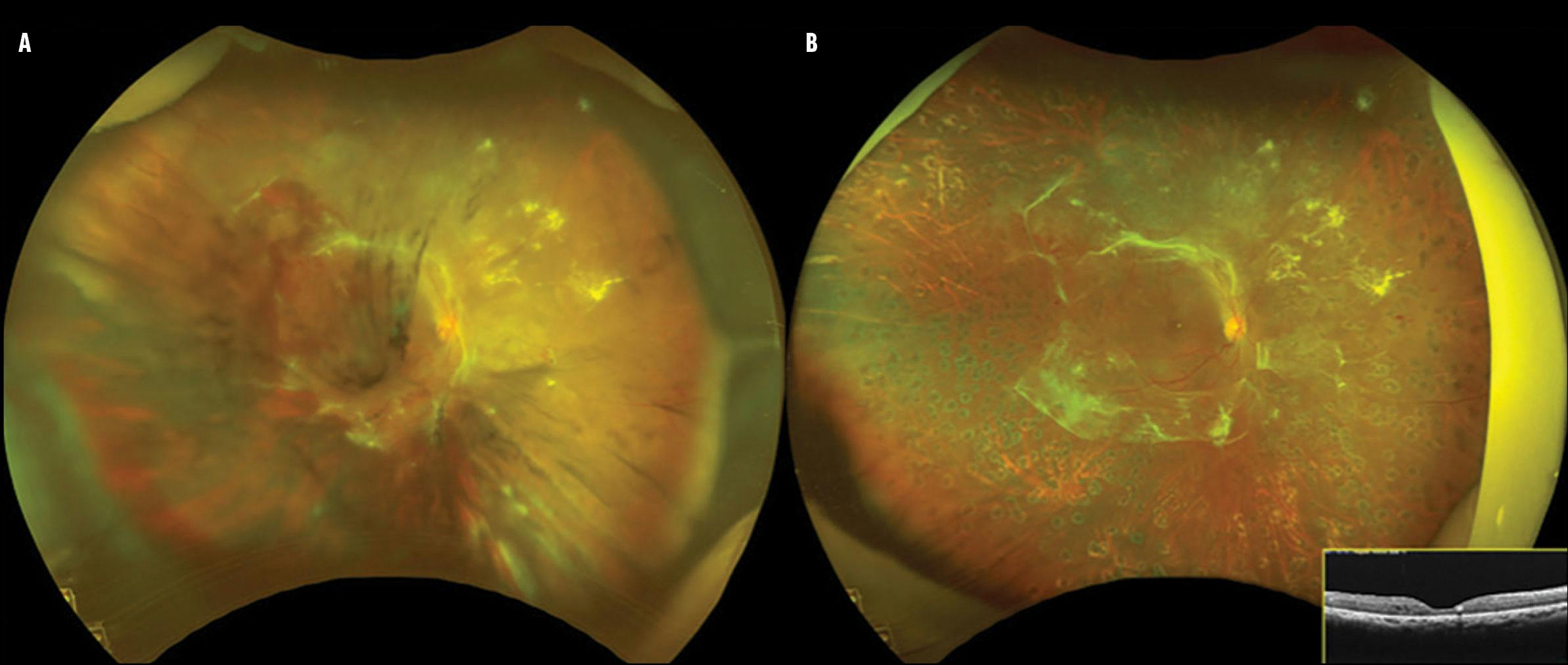
A 59-year-old woman presented with vision loss in each eye. She had a 20-year history of type 2 diabetes, and her BCVA was 20/500 OD and light perception OS. She complained of recent vision loss in her right eye. On initial examination, her right eye showed a tractional retinal detachment (TRD) with a ring-shaped fibrovascular membrane and vitreous hemorrhage due to proliferative diabetic retinopathy (Figure 1A).
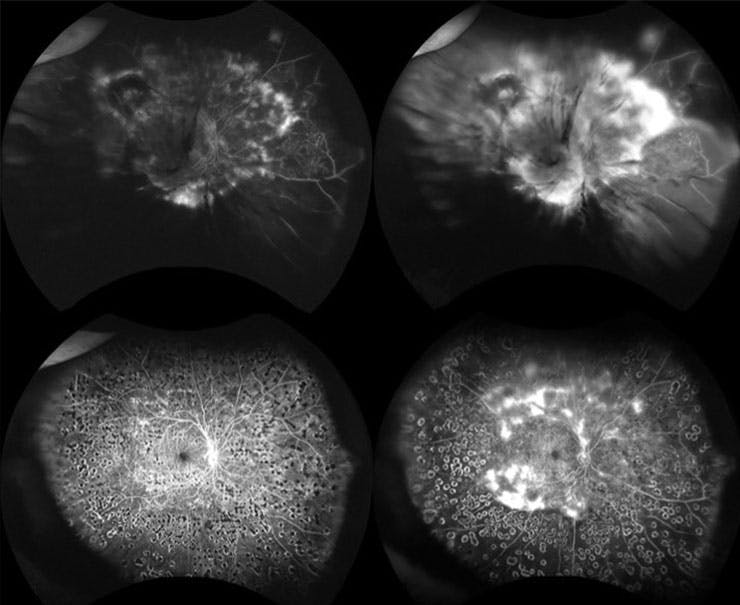
Widefield fluorescein angiography (FA) showed peripheral retinal nonperfusion and extensive leakage from retinal neovascularization (Figure 2, top row).
SURGICAL MANAGEMENT
Given the risk of progression, we performed a 25-gauge vitrectomy in the right eye. The core vitrectomy was followed by peripheral vitreous shaving and segmentation and delamination of the fibrovascular membrane along the vascular arcade.
During the surgery, we carefully released the traction by performing a limited membranectomy with a vitreous cutter while minimizing membrane dissection and avoiding iatrogenic breaks. We intentionally left some membranes intact without removal.
We also conducted brilliant blue G-assisted internal limiting membrane peeling and then released the anteroposterior traction from the equator to the periphery in the superior, inferior, and temporal areas, leaving the nasal fibrovascular membranes intact. At the end of the surgery, we applied panretinal photocoagulation up to the far periphery.
OUTCOMES
Six months after surgery, the patient’s retina was attached, and her vision had recovered to 20/40 OD (Figure 1B). Some leakage remained in the postoperative FA (Figure 2, bottom row); however, no postoperative vitreous hemorrhage or membrane reproliferation occurred. The optic disc was well perfused without appearing pale.
A GOOD OPTION FOR HIGH-RISK PATIENTS
Indications for limited membranectomy include eyes with mature fibrovascular membranes and TRD without a rhegmatogenous component, eyes without posterior vitreous detachment or with partial posterior vitreous detachment, and high-risk monocular eyes for which avoiding intraoperative complications is paramount, as was the case for this patient. Long-term anatomic and visual outcomes should be explored in future studies.


