



An 82-year-old man with a medical history of hypertension and hyperlipidemia but no significant ocular history was referred to our clinic for persistent vitreous floaters in the right eye. Here’s what we found.
EXAMINATION
The patient’s VA was 20/40 OD and 20/25 OS. His IOP was within normal limits, and no relative afferent pupillary defect was noted. Anterior segment examination showed 2+ nuclear sclerosis cataracts in each eye. Dilated fundus examination of the right eye showed prominent vitreous opacities; the left eye was normal (Figure 1).
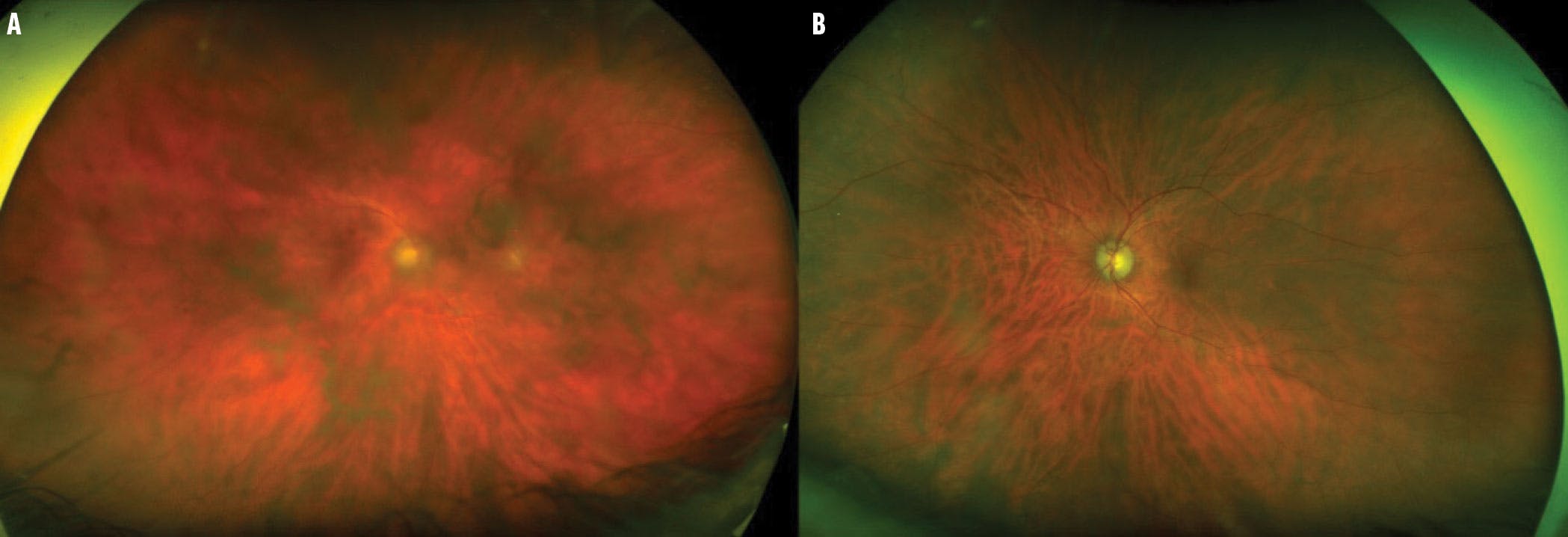
Figure 1. Ultra-widefield fundus photography of the right eye (A) shows prominent vitreous opacities compared with the normal left eye (B).
Given the lack of hypopyon and significant anterior chamber reaction, suspicion for an underlying infectious process was low. The vitreous opacities were presumed to be secondary to either an old vitreous hemorrhage or a lymphoproliferative process. Observation was recommended to see if the opacities resolved with time.
At the 3-month follow-up, the vitreous opacities had worsened. The patient underwent an uncomplicated diagnostic pars plana vitrectomy (PPV). Histopathology results of the vitreous sample did not show neoplastic cells, and no organisms were identified. The sample was also negative for MYD88 mutation. It did, however, demonstrate amorphous eosinophilic material that stained with Congo red, revealing the characteristic red-green birefringence of amyloidosis (Figure 2).
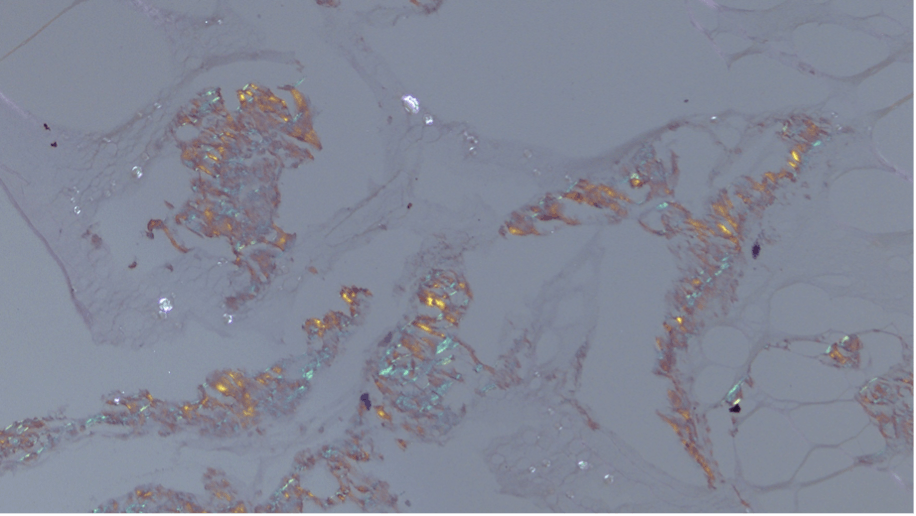
Figure 2. Congo red staining of the vitreous sample shows the characteristic red-green birefringence of amyloidosis.
The patient subsequently underwent genetic testing, which showed a missense mutation in the transthyretin gene consistent with familial systemic amyloidosis. Late-phase ICG showed characteristic hyperfluorescent spots along the choroidal vessels, and OCT showed needle-shaped deposits on the retina (Figure 3).
One year post-PPV, there was some recurrence of the amyloid opacities. The patient’s course was complicated by neovascular glaucoma requiring a series of three intravitreal anti-VEGF injections.
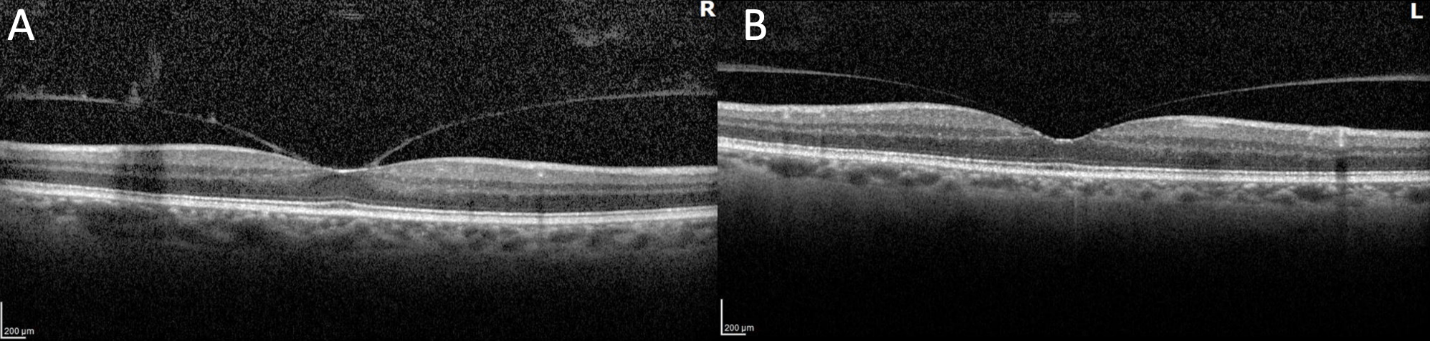
Figure 3. OCT of the right eye (A) shows the characteristic needle-shaped deposits on the retina compared with the normal left eye (B).
DISCUSSION
Amyloidosis encompasses a diverse group of disorders characterized by the deposition of amyloid in various parts of the body.1 Involvement of the eye and/or ocular adnexal structures is not a feature of all amyloidosis cases, but when it does occur, the resulting clinical phenotypes are highly variable. Extraocular manifestations can vary from waxy eyelid papules to infiltration of the extraocular muscles and orbital adnexa, which can lead to progressive proptosis, ptosis, and restrictive ophthalmoplegia. Recurrent atraumatic subconjunctival hemorrhages, conjunctival nodules, glaucoma, and a scalloped pupil are among the anterior segment findings that have been described.1,2
Among the posterior segment findings, vitreous opacities are the most common. Vitreous amyloidosis is typically bilateral and asymmetrical. The opacities can be debilitating and, in some cases, can cause severe vision loss.3 They recur in up to 20% of cases following PPV, which is thought to be secondary to intraocular amyloid production by the retinal pigment epithelium. Luckily, PPV allows for almost complete visual acuity recovery in these patients. One study reported an improvement in VA from 20/100 preoperatively to 20/20 postoperatively among 31 eyes with vitreous amyloidosis following PPV.4 Another study found that BCVA improved to 20/25 or better for all 14 study patients following PPV.5
Diagnosing ocular amyloidosis requires a high degree of suspicion. Although PPV remains the standard to confirm vitreous involvement, several imaging features have been described that can aid clinicians in these cases. Choroidal amyloid angiopathy, which appears as hyperfluorescent streaks on late-phase ICG, has been described in several studies.6,7 At least 10 minutes of staining are required to demonstrate these findings, with maximal staining seen around 12.5 minutes.6 On OCT, needle-shaped deposits, presumably depicting amyloid deposition on the retina, have been described, which can persist even after PPV.8
Glaucoma is a major cause of vision loss in patients with amyloidosis. In many cases, the glaucoma is very difficult to control, often requiring multiple medications and/or multiple surgeries. The risk of glaucoma increases after PPV, with up to 74% of patients developing elevated IOP postoperatively.4 Vitrectomy is thought to cause both diffusion of amyloid fibrils into the trabecular meshwork and IOP elevation. One study compared the incidence of glaucoma among eyes that underwent complete PPV versus incomplete vitrectomy and found that 75% of patients in the complete vitrectomy group developed glaucoma over a mean follow-up of 8 years compared with 25% of patients in the incomplete vitrectomy group over a mean follow-up of 28.5 years.9 The authors hypothesized that the residual vitreous in incomplete PPV may act as a filter that retains mutant amyloid protein and promotes its deposits in the vitreous itself, decreasing and delaying amyloid deposition in the trabecular meshwork. Incomplete vitrectomy is also associated with reduced damage of the trabecular meshwork, explaining the less frequent and delayed progression to glaucoma.
RARE BUT CONSEQUENTIAL
Amyloidosis is a rare cause of vitreous opacities and requires a high degree of clinical suspicion. Imaging modalities such as ICG and OCT can aid in making the diagnosis. These patients can have serious organ involvement and require lifelong monitoring of their IOP, especially after PPV.
1. Mathew R, Zeppieri M. Ocular Amyloidosis. In: StatPearls. StatPearls Publishing; 2025.
2. Beirão JM, Malheiro J, Lemos C, Beirão I, Costa P, Torres P. Ophthalmological manifestations in hereditary transthyretin (ATTR V30M) carriers: a review of 513 cases. Amyloid. 2015;22(2):117-122.
3. Reynolds MM, Veverka KK, Gertz MA, et al. Ocular manifestations of familial transthyretin amyloidosis. Am J Ophthalmol. 2017;183:156-162.
4. Kakihara S, Hirano T, Imai A, Miyahara T, Murata T. Small gauge vitrectomy for vitreous amyloidosis and subsequent management of secondary glaucoma in patients with hereditary transthyretin amyloidosis. Sci Rep. 2020;10(1):5574.
5. Koga T, Ando E, Hirata A, et al. Vitreous opacities and outcome of vitreous surgery in patients with familial amyloidotic polyneuropathy. Am J Ophthalmol. 2003;135(2):188-193.
6. Mano F, Yonekawa Y, Kakihara S, et al. Choroidal amyloid deposition: a multicenter study of amyloid lesions identified in late indocyanine green angiography. Retina. 2022;42(10):1989-1994.
7. Attia S, Kahloun R, Mbarek S, et al. Indocyanine green angiography findings in patients with nonfamilial amyloidosis. J Ophthalmic Inflamm Infect. 2012;2(4):199-203.
8. Tasiopoulou A, Ong D, Lightman S. Characteristic needle-shaped pattern seen on OCT in a patient with ocular amyloidosis. Ophthalmol Retina. 2021;5(1):99-101.
9. Beirão NM, Matos ME, Meneres MJ, Beirão IM, Costa PP, Torres PA. Vitreous surgery impact in glaucoma development in liver transplanted familial amyloidosis ATTR V30M Portuguese patients. Amyloid. 2012;19(3):146-151.


