




AT A GLANCE
- Several biomarkers have been implicated in geographic atrophy (GA) prediction and prognosis, including reticular pseudodrusen, hyperreflective foci, thickness loss of specific retinal bands, drusen volume, and hyporeflective cores within drusen.
- However, current biomarkers do not fully account for the high variability observed in the progression of atrophic lesions.
- The authors have developed a predictive model based on the phenotypic elementary lesions of intermediate AMD associated with GA.
Geographic atrophy (GA) is characterized by the complete loss of photoreceptors, retinal pigment epithelium (RPE), and choriocapillaris. This condition profoundly affects the quality of life of patients and their families.1-3
Although fundus autofluorescence has historically been regarded as the standard imaging modality for GA assessment and progression, OCT has gained increasing importance.4-7 OCT surpasses the 2D en face visualization provided by fundus autofluorescence and color fundus photography, offering both 2D and 3D high-resolution imaging. OCT B-scans deliver a cross-sectional view of the retina, enabling precise visualization of the retinal layers and the choroid.8 This technology allows the identification of early biomarkers of GA development and precursor lesions of atrophy, precise delineation of atrophic lesion borders, assessment of the severity of cellular loss, and detection of nascent neovascular lesions that may further complicate atrophy.6,9-17
NOVEL OCT BIOMARKERS
These advantages have expanded the use of OCT for evaluating GA, driving the development of a consensus OCT definition for atrophy. This OCT definition, termed complete outer retina and RPE atrophy, characterizes atrophy as a region of photoreceptor degeneration and RPE disruption, accompanied by underlying choroidal hypertransmission measuring at least 250 µm in diameter.7
Recent studies have focused on developing predictive models using OCT to estimate GA progression. Several biomarkers have been implicated in GA prediction and prognosis, including reticular pseudodrusen, hyperreflective foci, the thickness loss of specific retinal bands (outer nuclear layer, outer retinal bands, RPE plus inner/outer segments of photoreceptors), drusen volume (> 0.03 mm3), and hyporeflective cores within drusen.13,18-21 Among factors involved in GA lesion expansion, the choriocapillaris impairment assessed on OCT angiography (OCTA) was demonstrated to be greater at the front of lesion expansion, with a direct correlation between choriocapillaris flow deficits and growth rate.16,22 Choroidal vascularity index has also demonstrated a strict association with the GA growth rate, further corroborating the undeniable role of choroidal microvasculature.23
DIGGING DEEPER INTO THE OCT
These biomarkers underscore the potential of OCT in identifying early indicators of GA susceptibility and progression. However, they do not fully account for the high variability observed in the progression of atrophic lesions. To address this, our group recently developed a predictive model based on the phenotypic elementary lesions of intermediate AMD (iAMD) associated with GA development and progression (Figure 1). These lesions were represented by drusen, reticular pseudodrusen or subretinal drusenoid deposits, drusenoid pigment epithelium detachment, and the presence of an avascular thin double-layer sign (DLS).14
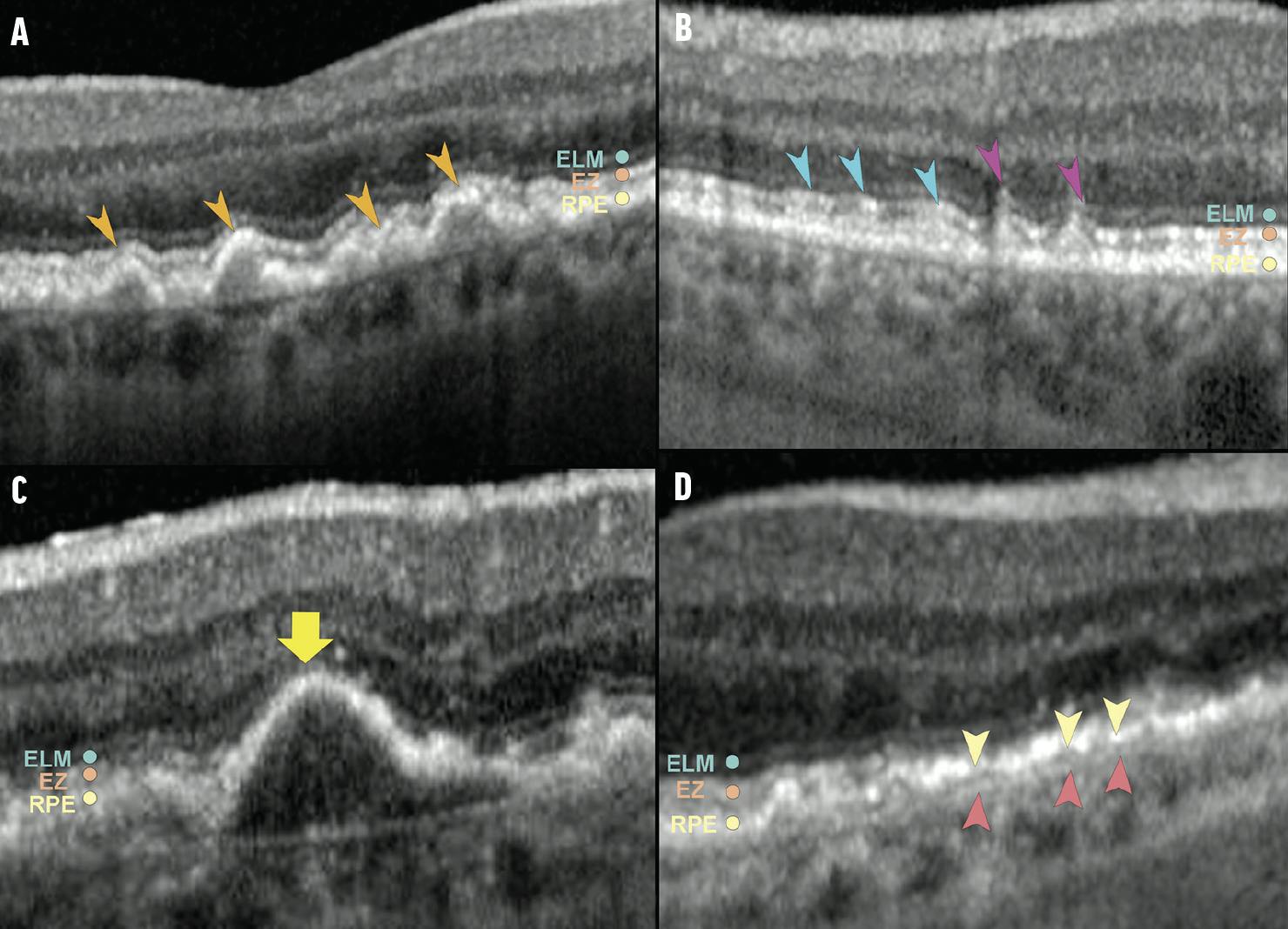
Figure 1. Phenotypic elementary lesions seen in iAMD. Drusen (A, arrowheads) can be appreciated as RPE+basal lamina elevations measuring > 125 µm. Reticular pseudodrusen or subretinal drusenoid deposits appear as subretinal flat hyperreflective deposits (B, blue arrowheads) or conical well-defined deposits (purple arrowheads). Drusenoid pigment epithelium detachment is defined as an RPE mound elevation measuring at least 350 mm in the horizontal diameter (C, arrow). DLS appears as a thin hyporeflective separation between RPE+basal lamina (D, yellow arrowheads) and Bruch membrane (red arrowheads).
The presence of a thin hyporeflective band between the RPE, its basal lamina, and Bruch membrane, without evidence of a neovascular signal on OCTA, represents the OCT signature for thick basal lamina deposits (BLamD), as recently confirmed by histopathology.24 However, this signature needs to be distinguished from neovascular DLS, which is characterized by a greater vertical thickness and a multilaminar reflective interior, indicative of neovascular tissue (Figure 2). An accurate distinction between these two entities was performed using OCTA in our series. The identification of a DLS signature for thick BLamD represented the primary baseline predictor of GA progression. Moreover, eyes with DLS presented a faster development of atrophy (1.26 years vs 2.15 years for controls) and larger lesion size at different points compared with controls.14

Figure 2. A thick DLS presents an interior multilayered reflectivity (A, hypo: purple arrowhead; midreflective: yellow arrowhead) that can reflect the presence of a neovascular tissue. A thin DLS demonstrates a single hyporeflective band between the RPE and Bruch membrane (B).
The association between thick BLamD and rapidly evolving GA is further corroborated by previous studies that demonstrate an obvious RPE-basal lamina-Bruch membrane splitting on OCT B-scan in aggressive forms of GA, such as the diffuse-trickling phenotype and extensive macular atrophy with pseudodrusen-like appearance.25,26 Possible pathogenic explanations for the more aggressive behavior observed in eyes with thick BLamD included the disrupted metabolic support, increased oxidative stress, and chronic inflammation. Specifically, thick and continuous BLamD create a physical separation between the RPE and choriocapillaris, impairing nutrient and oxygen exchange, which results in RPE ischemia and dysfunction.27 Another possible mechanism resides in the retention of lipoproteins and other macromolecules within the thickened BLamD, leading to a prolonged exposure to these substances, thereby increasing oxidative stress and chronic inflammation.28
WATCH FOR A THIN DLS
Thick BLamD, identifiable on OCT as a thin DLS, should be recognized as a critical prognostic predictor in eyes with AMD, leading to earlier development of atrophic lesions and a faster progression rate. Expanding the phenotypic characterization of OCT predictors can help explain the variability in GA progression and support the development of more accurate predictive models and deep-learning algorithms to aid clinical decision making and advance the management of dry AMD. While OCT is increasingly recognized as a critical imaging modality for studying GA, its full potential and implications should be better emphasized, particularly within future clinical trials and GA management.
1. Sarks JP, Sarks SH, Killingsworth MC. Evolution of geographic atrophy of the retinal pigment epithelium. Eye (Lond). 1988;2(Pt 5):552-577.
2. Li M, Huisingh C, Messinger J, et al. Histology of geographic atrophy secondary to age-related macular degeneration: A Multilayer Approach. Retina. 2018;38(10):1937-1953.
3. Querques G, Amblard JC, Andrao A, et al. Expert consensus on geographic atrophy in the EU: a call for urgent policy action. Ophthalmol Ther. 2024;13(4):867-881.
4. Holz FG, Bindewald-Wittich A, Fleckenstein M, et al. Progression of geographic atrophy and impact of fundus autofluorescence patterns in age-related macular degeneration. Am J Ophthalmol. 2007;143(3):463-472.
5. Holz FG, Sadda SR, Staurenghi G, et al. Imaging protocols in clinical studies in advanced age-related macular degeneration: recommendations from classification of atrophy consensus meetings. Ophthalmology. 2017;124(4):464-478.
6. Guymer RH, Rosenfeld PJ, Curcio CA, et al. Incomplete retinal pigment epithelial and outer retinal atrophy in age-related macular degeneration: classification of atrophy meeting report 4. Ophthalmology. 2020;127(3):394-409.
7. Sadda SR, Guymer R, Holz FG, et al. Consensus definition for atrophy associated with age-related macular degeneration on OCT: classification of atrophy report 3. Ophthalmology. 2018;125(4):537-48.
8. Sadda SR, Chakravarthy U, Birch DG, et al. Clinical endpoints for the study of geographic atrophy secondary to age-related macular degeneration. Retina. 2016;36(10):1806-1822.
9. Sacconi R, Sarraf D, Sadda SR, et al. Nascent geographic atrophy as a predictor of type 3 macular neovascularization development. Ophthalmol Retina. 2023;7(7):586-592.
10. Schaal KB, Gregori G, Rosenfeld PJ. En face optical coherence tomography imaging for the detection of nascent geographic atrophy. Am J Ophthalmol. 2017;174:145-154.
11. Shi Y, Yang J, Feuer W, et al. Persistent hypertransmission defects on en face oct imaging as a stand-alone precursor for the future formation of geographic atrophy. Ophthalmol Retina. 2021;5(12):1214-1225.
12. Wu Z, Ayton LN, Luu CD, Guymer RH. Microperimetry of nascent geographic atrophy in age-related macular degeneration. Invest Ophthalmol Vis Sci. 2014;56(1):115-121.
13. Schmidt-Erfurth U, Waldstein SM, Klimscha S, et al. Prediction of individual disease conversion in early AMD using artificial intelligence. Invest Ophthalmol Vis Sci. 2018;59(8):3199-3208.
14. Fragiotta S, Dysli C, Parravano M, et al. Phenotypic characterization of predictors for development and progression of geographic atrophy using optical coherence tomography. Retina. 2024;44(7):1232-1241.
15. Querques G, Capuano V, Frascio P, et al. Wedge-shaped subretinal hyporeflectivity in geographic atrophy. Retina. 2015;35(9):1735-1742.
16. Sacconi R, Corbelli E, Borrelli E, et al. Choriocapillaris flow impairment could predict the enlargement of geographic atrophy lesion. Br J Ophthalmol. 2021;105(1):97-102.
17. Dolz-Marco R, Balaratnasingam C, Messinger JD, et al. The border of macular atrophy in age-related macular degeneration: a clinicopathologic correlation. Am J Ophthalmol. 2018;193:166-177.
18. Nassisi M, Lei J, Abdelfattah NS, et al. OCT risk factors for development of late age-related macular degeneration in the fellow eyes of patients enrolled in the HARBOR study. Ophthalmology. 2019;126(12):1667-1674.
19. Lei J, Balasubramanian S, Abdelfattah NS, et al. Proposal of a simple optical coherence tomography-based scoring system for progression of age-related macular degeneration. Graefes Arch Clin Exp Ophthalmol. 2017;255(8):1551-1558.
20. Vogl WD, Bogunovic H, Waldstein SM, et al. Spatio-temporal alterations in retinal and choroidal layers in the progression of age-related macular degeneration (AMD) in optical coherence tomography. Sci Rep. 2021;11(1):5743.
21. Agrón E, Domalpally A, Cukras CA, et al. Reticular pseudodrusen: the third macular risk feature for progression to late age-related macular degeneration: age-related eye disease study 2 report 30. Ophthalmology. 2022;129(10):1107-1119.
22. Nassisi M, Baghdasaryan E, Borrelli E, et al. Choriocapillaris flow impairment surrounding geographic atrophy correlates with disease progression. PLoS One. 2019;14(2):e0212563.
23. Sacconi R, Battista M, Borrelli E, et al. Choroidal vascularity index is associated with geographic atrophy progression. Retina. 2022;42(2):381-387.
24. Sura AA, Chen L, Messinger JD, et al. Measuring the contributions of basal laminar deposit and bruch’s membrane in age-related macular degeneration. Invest Ophthalmol Vis Sci. 2020;61(13):19.
25. Fleckenstein M, Schmitz-Valckenberg S, Lindner M, et al. The “diffuse-trickling” fundus autofluorescence phenotype in geographic atrophy. Invest Ophthalmol Vis Sci. 2014;55(5):2911-2920.
26. Fragiotta S, Parravano M, Sacconi R, et al. A common finding in foveal-sparing extensive macular atrophy with pseudodrusen implicates basal laminar deposits. Retina. 2022;42(7):1319-1329.
27. Sarks S, Cherepanoff S, Killingsworth M, Sarks J. Relationship of basal laminar deposit and membranous debris to the clinical presentation of early age-related macular degeneration. Invest Ophthalmol Vis Sci. 2007;48(3):968-977.
28. Curcio CA. Soft drusen in age-related macular degeneration: biology and targeting via the oil spill strategies. Invest Ophthalmol Vis Sci. 2018;59(4):AMD160-AMD81.


