



Recent advances in surgical techniques, particularly the continuous refinement of small-gauge, sutureless vitrectomy approaches, have significantly increased the safety and efficacy of internal limiting membrane (ILM) peeling. Wide-angle viewing systems provide enhanced visibility during the procedure, while macular lenses enable detailed visualization when managing epiretinal membranes (ERMs) and ILMs.
The intricate nature of retinal surgery has always posed significant challenges to retina surgeons. ILM peeling stands out as a critical intervention for conditions such as idiopathic macular holes, vitreomacular traction, and ERM, among others. Certain indications remain controversial, such as diabetic macular edema and primary retinal detachments. Recent advances in surgical techniques and technologies have ushered in a new era of retina peeling, promising better outcomes and fewer complications.
The following three complex surgical cases illustrate useful tips and techniques for ERM and ILM peeling.
CASE NO. 1: PSEUDOMACULAR HOLES
The surgical maneuvers for managing pseudomacular holes can vary based on the specific case, diagnosis, consistency, and tissues involved. When using forceps during retinal surgery (Video 1), it is crucial to hold them halfway open initially to avoid asymmetrical contact with the retina and unintended damage. When peeling the ILM, surgeons should use slow horizontal movements in a clockwise or counterclockwise direction to minimize complications that can arise from vertical traction (Figure). In some cases, loosening the ILM tissue may be challenging because it may be adherent and tense. Closing the forceps’ blades symmetrically, ensuring they remain equidistant to secure a proper grip, potentially offers the retina further protection from trauma. After membrane peeling, surgeons may consider employing a gentle, rhythmic motion with a 25-gauge backflush cannula to clear small hemorrhages from the macular region, particularly in cases with resistant ILM.
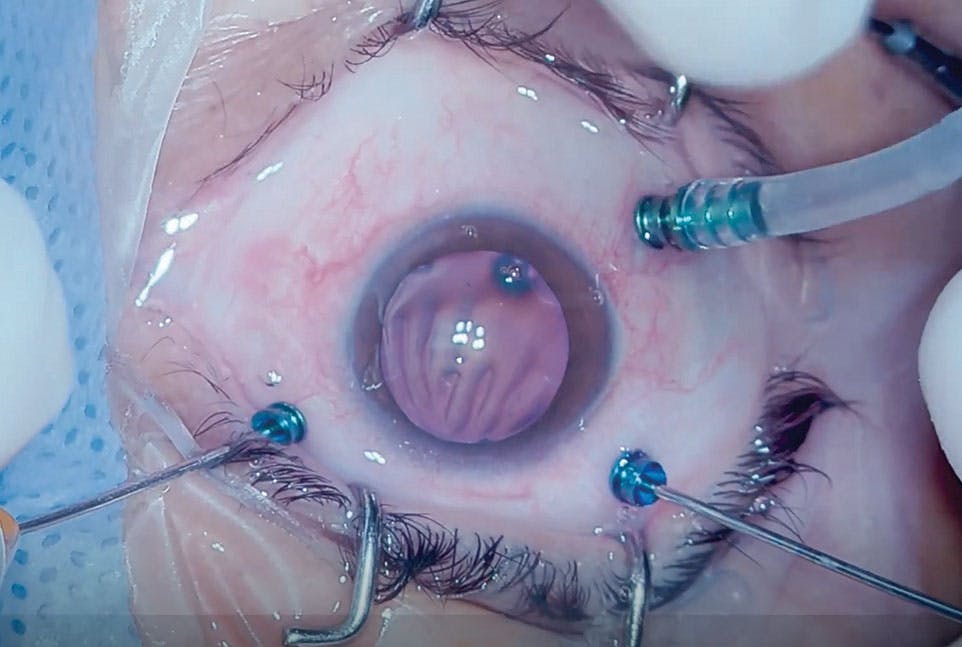
Video 1. Optimal Timing for ERM Surgery in Patients With Pseudomacular Holes.
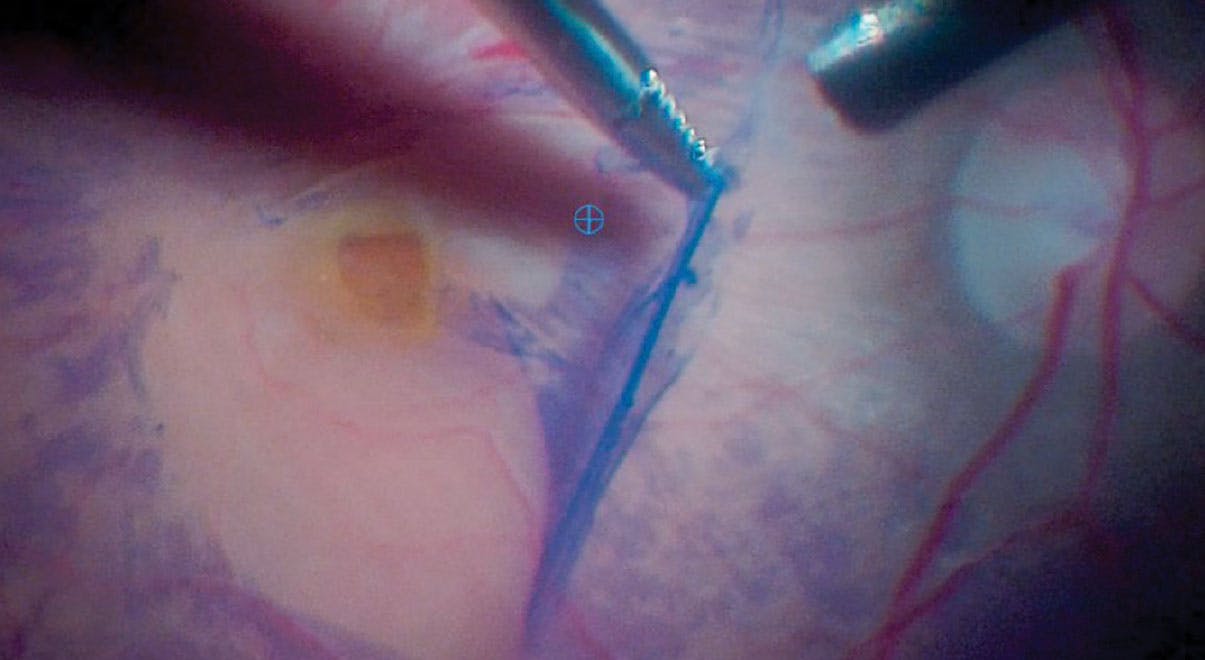
Figure. A 25-gauge serrated forceps was used to peel the ILM. The membrane was removed carefully in a counterclockwise direction with a horizontal pull to minimize complications.
CASE NO. 2: RETINITIS PIGMENTOSA
When managing a case of retinitis pigmentosa (RP), I used two different forceps to manipulate the epiretinal tissues and the ILM (Video 2): a 23-gauge endgrip ILM forceps and a serrated 25-gauge forceps. I began the approach with the 23-gauge forceps, which was tilted almost parallel to the retina. To further avoid touching the retina, an edge was created by lifting the ILM, potentially causing less harm than reaching the retina vertically. As the ILM was so adherent that only parts of it could be grabbed, I used the 25-gauge forceps to grab the ILM in a pinch maneuver (opened only halfway).
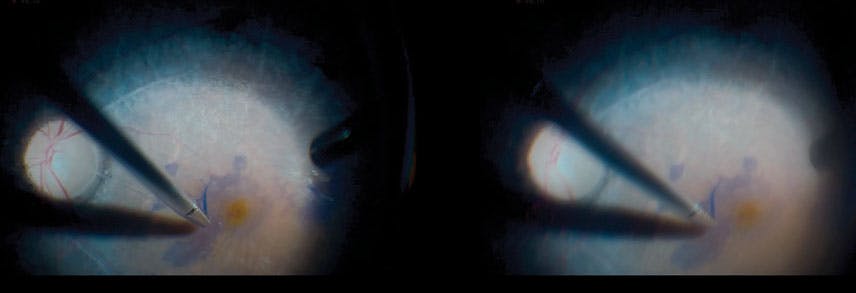
Video 2. Complex Membrane Peeling for Vitreomacular Traction in Retinitis Pigmentosa.
Of note, the ILM measurement itself does not typically differ between patients with RP and those without the condition; however, the retinal thickness and structural integrity can be different in patients with RP due to the degenerative nature of the disease. Thus, in patients with RP, the outer retinal layers are often thinner, and there can be more pronounced thinning of the photoreceptor outer segments and the retinal pigment epithelium. These changes can be observed using imaging techniques, such as OCT.
CASE NO. 3: SEVERE DIABETIC RETINOPATHY WITH RETINAL DETACHMENTS
Tissue characteristics, such as resistance and thickness, make management of diabetic retinopathy cases increasingly reliant on the surgeon’s skill. Proper force application and consideration of vectors and directions are essential to accurately target specific tissues. In the context of diabetic retinopathy, fibrovascular tissue peeling must be conducted with utmost care and delicacy.
When managing a patient with severe diabetic retinopathy and retinal detachments (Video 3), I used 25-gauge serrated forceps, which provides excellent grip on both the ILM and some ERM, allowing the use of gentle and controlled movements. Rushing the procedure or applying excessive force can lead to tearing of the membrane, potentially causing hemorrhage and other complications.
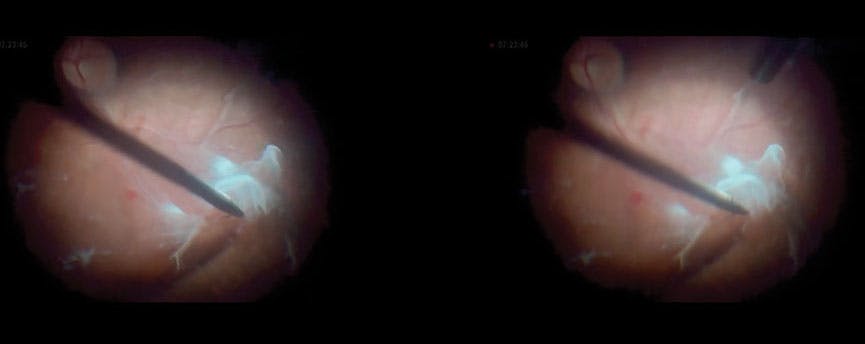
Video 3. Fibrovascular Tissue and ILM Peel for Severe Diabetic Retinopathy With Retinal Detachment.
This technique involves securing the fibrovascular tissue and employing horizontal movements, which allows the forceps to engage the membrane with minimal traction. Some ERMs may not be stained with brilliant blue G (the dye that was used in this procedure). As a result, when the ILM is peeled horizontally, it also removes the unstained ERM, achieving a double peel. By removing both membranes from the macular area, this technique effectively relieves traction.
PEELING STRATEGIES AND FUTURE OUTCOMES
The field of retinal surgery is constantly advancing, thanks to ongoing research into bioengineered materials and robotic-assisted procedures. These innovations promise greater precision, reduced human error, and an expanded range of treatable conditions. However, ensuring safety during vitreoretinal surgery requires more than just advanced visualization systems and lenses. It demands the surgeon’s tactile sensitivity to feel the membrane through the forceps. The skills, tips, and tricks discussed here can help surgeons make precise movements and determine the direction and force needed without damaging the delicate tissues involved. Ultimately, this blend of technology and human expertise allows for the most successful surgical outcomes.


