


The 53rd annual Aspen Retinal Detachment Society (ARDS) meeting, held March 1 – 5, 2025, in Snowmass Village, Colorado, included several wonderful talks that focused on the management of complex surgical cases. Here, one of our top-notch fellows summarizes five key lectures on epiretinal membranes (ERMs) and macular holes. I hope you enjoy this recap and join us February 28 – March 4, 2026, for the 54th ARDS meeting for more education and mountaintop views.
– Timothy G. Murray, MD, MBA
During the 53rd annual ARDS meeting, experts from around the world discussed the pathophysiology and management of ERMs and macular holes. Mrinali P. Gupta, MD; Lejla Vajzovic, MD; Mario R. Romano, MD, PhD; and John T. Thompson, MD, each shared their unique insights (Figure).
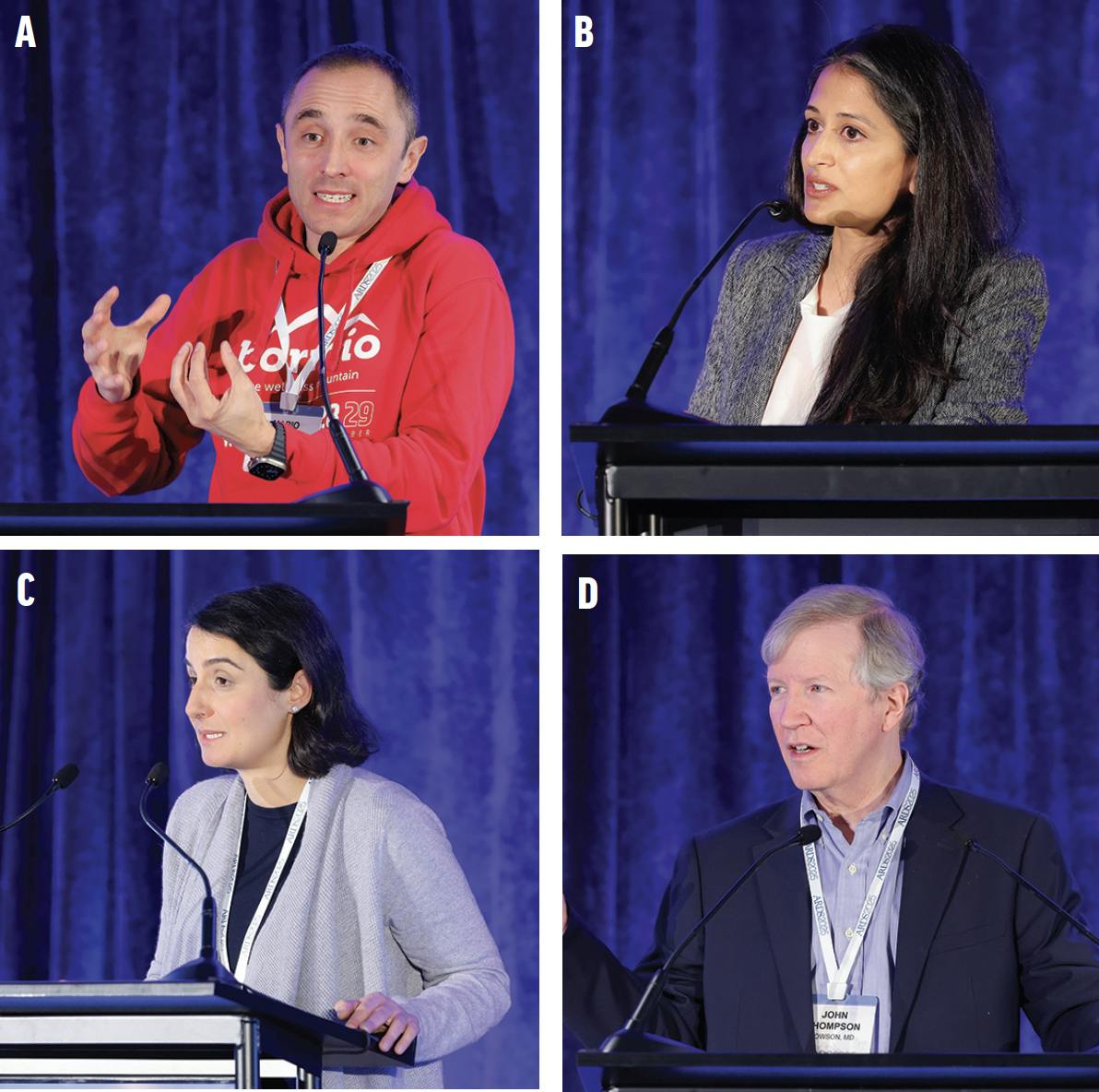
Figure. Drs. Romano (A), Gupta (B), Vajzovic (C), and Thompson (D) each added their expertise to the discussion of ERMs and macular holes during the ARDS meeting.
()Images courtesy of Kevin Caldwell Photography)
EPIRETINAL MEMBRANES
ERMs exert tractional forces when attached to the retina, leading to gliosis and a decline in visual function. Dr. Romano discussed the management of ERMs and focused on the importance of early detection because a decline in visual function precedes overt structural damage, and the surgical challenges only increase as the ERMs become more advanced.
Dr. Romano described the intraretinal damage from internal limiting membrane (ILM) peeling, and emphasized its importance in using a centripetal peeling technique to minimize this damage. On lamellar holes, his studies revealed that epiretinal proliferation is present in 70% of the cases and results from intraretinal glial activation rather than tractional forces. These membranes do not exhibit significant traction and rarely progress to full-thickness macular holes, he said.
Dr. Gupta’s talk on ERMs focused on those that form after retinal detachment (RD) repair. Although recurrent RD and proliferative vitreoretinopathy are often the primary concerns for surgeons, ERM and cystoid macular edema are frequent complications that can severely affect postoperative visual outcomes. The incidence of ERMs after RD repair, which varies widely with rates ranging from 8% to 58%, depends on the methodology and follow-up duration. She noted that while mild ERMs are common, significant ERMs that require surgical intervention occur in only a small percentage of cases, typically ranging from 1% to 8%.1
Dr. Gupta also explored the surgical factors that influence ERM formation, including the number of laser spots used during the procedure. Studies show that more than 750 laser spots increases the risk of ERM development, even after adjusting for baseline factors such as detachment severity.2
Dr. Gupta reviewed studies on drainage retinotomies and PFO, highlighting their effect on ERM rates. In some studies, drainage retinotomies were associated with increased risk of ERMs, particularly in cases that required larger retinotomies. Interestingly, the PRO study found no significant difference in ERM rates between drainage retinotomy and PFO, suggesting the surgical technique itself may not be as important as other factors such as retinal health.3
MACULAR HOLES
In a second talk, Dr. Gupta reviewed complex macular holes, focusing on cases that failed previous repairs. While traditional macular hole surgery techniques remain effective for most cases, more advanced strategies are required for refractory and recurrent holes. She recognized the growing role of medical management of these holes. Dr. Gupta explained that the first step in managing complex macular holes is to categorize them by size, with smaller holes typically requiring different approaches than larger ones. The presence or absence of the ILM also plays a crucial role in determining the surgical strategy.
Dr. Gupta mentioned several ILM flap techniques, amniotic membrane graft (AMG), and autologous retinal transplantation (ART) before focusing on the “viscostretch” technique, developed by Donald J. D’Amico, MD, in 2020. This technique involves using cohesive viscoelastic to release retinal pigment epithelium adhesions and increase retinal elasticity; early data showed a 65% closure rate from a multi-center retrospective study of 20 eyes. Dr. Gupta recommended ILM peeling as an effective approach for holes under 500 µm and additional techniques for those up to 650 µm, after which ILM flaps, AMG, or ART should be considered.
Dr. Vajzovic’s presentation focused on additional techniques for refractory or recurrent macular holes. She outlined her technique for smaller holes, emphasizing the benefits of platelet rich plasma (PRP), which serves as a biological adhesive to stabilize the ILM flaps and prevent displacement. She noted that PRP is particularly useful for optic pit macular holes, where the adhesive properties offer enhanced stability during the procedure. Subretinal balanced salt solution injections are also part of her approach to macular hole closure. Her approach is highly individualized, with the goal of closing the hole the first time to avoid the need for subsequent surgeries.
Dr. Vajzovic then discussed larger macular holes, which often require ART and AMG. ART has shown promise in promoting anatomic closure, although functional outcomes remain unpredictable.4 She addressed the technical challenges of ART, particularly the difficulty in harvesting the retinal tissue and ensuring proper graft orientation. Despite these challenges, ART can be effective in some cases, particularly when there is no residual ILM. In cases where the hole is too large for ART, she recommends AMG as an alternative.
Dr. Vajzovic’s approach emphasizes an aggressive first-time repair strategy, especially for larger macular holes, with the goal of maximizing anatomic closure and visual recovery.
Finally, Dr. Thompson delivered the 43rd annual Taylor Smith & Victor Curtin lecture on the natural history and treatment of lamellar macular holes and pseudoholes. He began by acknowledging the confusion in the literature surrounding classification. He discussed the publication of a consensus definition that categorized lamellar macular holes and pseudoholes into three distinct types based on OCT findings.5 The classifications include the following:
- lamellar macular holes, characterized by foveal cavitation with undermined edges;
- macular pseudoholes, marked by a center-sparing ERM and a steepened foveal profile; and
- ERM foveoschisis, defined by contractile ERMs and foveoschisis at the Henle fiber layer.
Dr. Thompson emphasized that many lamellar macular holes remain stable and do not require treatment, as visual acuity typically remains stable. However, some patients experience progressive visual acuity loss, necessitating vitrectomy. He reviewed studies that demonstrated postoperative visual improvements in these patients, with VA improvements ranging from 20/63 to 20/43 in one study.6 Dr. Thompson recommended vitrectomy for symptomatic patients with significant vision loss, noting that OCT findings play a crucial role in determining which patients are most likely to benefit from surgery. For foveoschisis cases, sparing the ILM around the fovea and short-term tamponade can reduce macular hole formation. Although surgical outcomes are often positive, visual acuity improvements tend to be modest.
COMPREHENSIVE EDUCATION
These presentations provided a comprehensive exploration of complex macular holes, ERMs, and lamellar macular holes. The speakers emphasized the importance of tailored, patient-specific approaches, using advanced surgical techniques, and careful postoperative management to optimize anatomic and visual outcomes.
1. Popovic MM, Berinstein JM, Franco J, et al. Epiretinal membrane formation following rhegmatogenous retinal detachment repair: a retrospective cohort study. Ophthalmologica. 2024:1-9.
2. Cakir B, Peacker BL, Zeng R, et al. Extensive endolaser during vitrectomy for primary rhegmatogenous retinal detachment is associated with epiretinal membrane formation. Ophthalmic Surg Lasers Imaging Retina. 2024;55(6):326-333.
3. Starr MR, Ryan EH, Yonekawa Y. Primary retinal detachment outcomes study: summary of reports number 1 to number 18. Curr Opin Ophthalmol. 2023;34(3):211-217.
4. Moysidis SN, Koulisis N, Adrean SD, et al. Autologous retinal transplantation for primary and refractory macular holes and macular hole retinal detachments: the global consortium. Ophthalmology. 2021;128(5):672-685.
5. Hubschman JP, Govetto A, Spaide RF, et al. Optical coherence tomography-based consensus definition for lamellar macular hole. Br J Ophthalmol. 2020;104(12):1741-1747.
6. Chehaibou I, Tadayoni R, Hubschman J-P, et al. natural history and surgical outcomes of lamellar macular holes. Ophthalmol Retina. 2024;8(3):210-222.


