


Traumatic macular hole (TMH) usually occurs secondary to blunt trauma in young patients. Its pathophysiology includes vitreoretinal disruption, tangential traction, and structural retinal damage.1 In up to 39% of patients, spontaneous closure may occur; however, in persistent cases, the standard treatment is vitrectomy with internal limiting membrane (ILM) peeling.2,3
For large or persistent holes, techniques such as the inverted ILM flap have shown higher anatomic closure rates by facilitating glial cell migration over the defect.4 In complex situations, the double inverted flap technique has been proposed, which involves inserting two ILM flaps into the hole and creating a double scaffold that promotes cell proliferation and tissue reorganization to achieve closure.
The following case describes the use of this technique in a patient with refractory TMH.
CASE REPORT
A 36-year-old woman presented with TMH in the left eye following a car accident. Initial treatment included vitrectomy with ILM peeling 1 month after the event; however, the hole closure was incomplete with poor anatomic and functional outcomes (Figure 1A). Her initial VA was 20/100, and a full-thickness MH (FTMH) with elevated edges and intraretinal cysts was documented via OCT, with a basal diameter of 1,152 µm (Figure 1B).
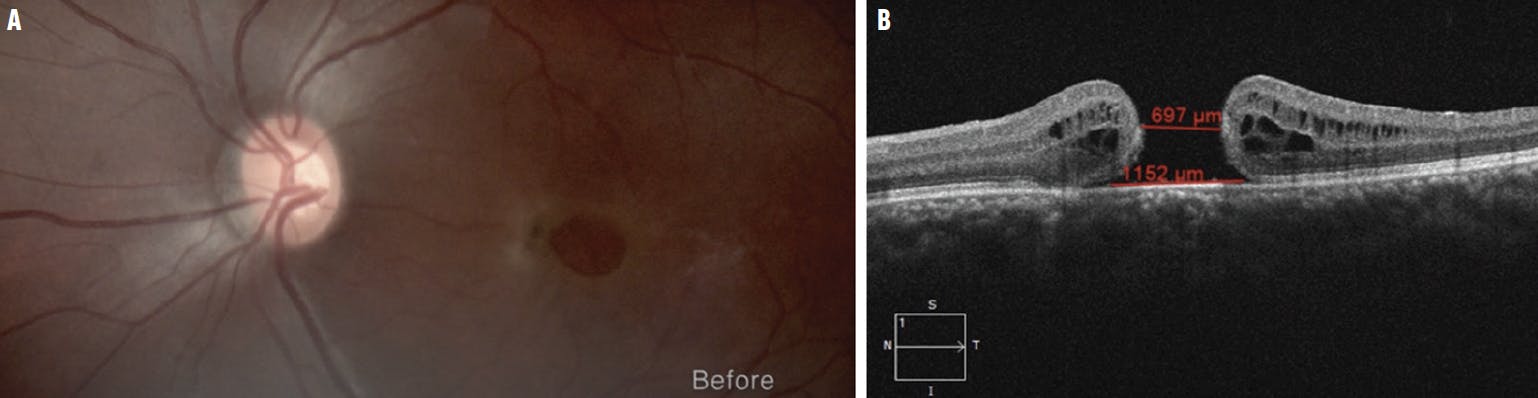
Figure 1. The FTMH is still evident after the first procedure with vitrectomy and ILM peeling (A). OCT shows the FTMH, elevated edges, and intraretinal cysts (B).
During the second procedure, triamcinolone was injected to visualize residual vitreous and complete the vitrectomy. Brilliant blue staining revealed a small area of previously peeled ILM and residual ILM tissue. ILM peeling was extended, leaving two long peripheral remnants to serve as scaffolding. The edges of the FTMH were stimulated using a Charles cannula, and heavy liquid was used to help insert both ILM remnants into the hole. This was followed by fluid-air exchange and SF6 gas injection (Figure 2).
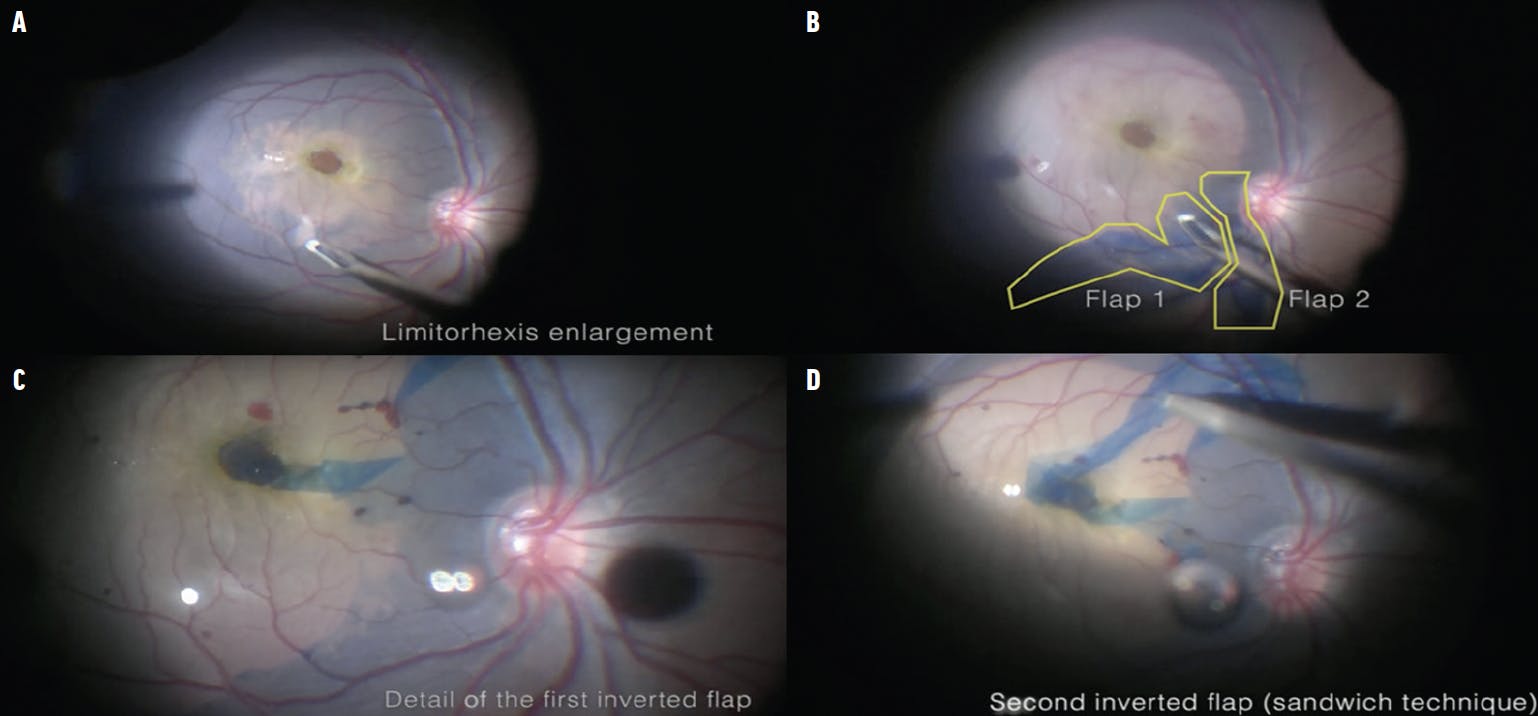
Figure 2. The initial ILM peeling area is enlarged using retinal forceps, creating two ILM remnants to serve as a scaffold for hole closure (A, B). The edges of the MH are stimulated with a Charles cannula, liquid is injected, and the first inverted flap is placed inside the hole (C). The second flap is placed over the first, followed by a fluid-air exchange and injection of SF6 gas (D).
One month later, the patient’s VA improved to 20/50, and complete hole closure was documented (Figure 3).
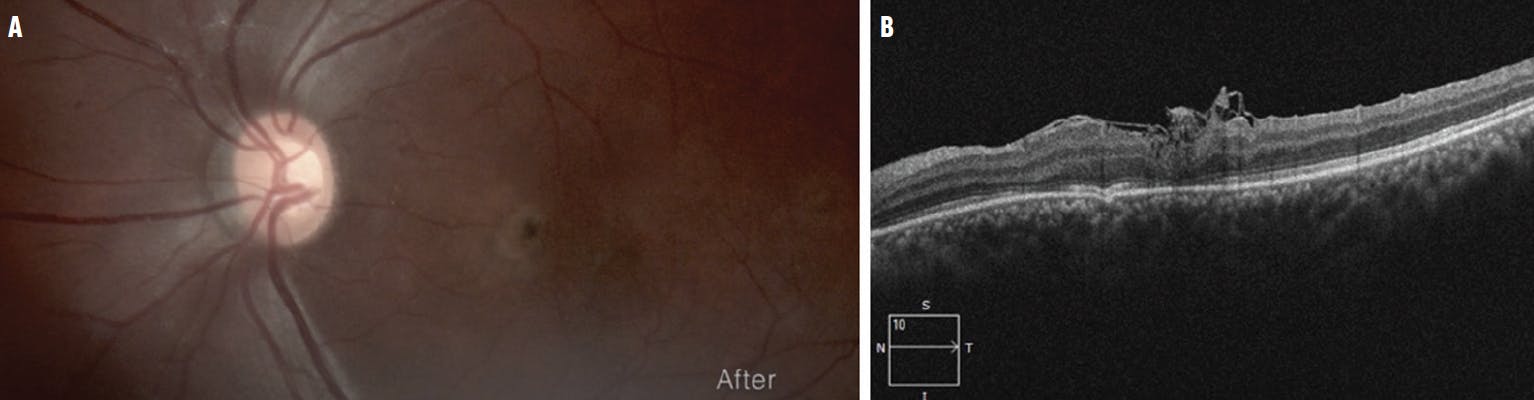
Figure 3. Complete hole closure is noted after the second surgery with a double ILM flap and fluid-air exchange (A). OCT confirms closure of the TMH with ellipsoid zone restoration (B).
DISCUSSION
The double inverted flap technique may offer a new solution for large persistent TMH. Unlike conventional ILM peeling (which relies on passive approximation of the hole edges) and the traditional inverted flap technique (which covers the hole with a single ILM flap), this method inserts two flaps into the defect to provide dual support for cell proliferation and neurosensory tissue regeneration.
From a pathophysiological standpoint, TMH involves vitreoretinal traction, ILM rupture, and loss of neurosensory retinal structure.1 In this context, successful closure and functional recovery depend on the elimination of tractional forces on the macula, glial cell proliferation (particularly Müller cells) into the hole, and the release of neurotrophic factors such as basic fibroblast growth factor (bFGF), which helps inhibit neuronal and photoreceptor cell apoptosis.5
With ILM peeling, the membrane is removed to reduce retinal traction, but in large or persistent holes, this strategy may not achieve anatomic closure. With the inverted flap technique, a single ILM fragment is placed over the hole to serve as a substrate for gliosis. The double inverted flap technique builds on the mechanism described by Michalewska et al in 2010 and involves the insertion of two ILM flaps into the defect to create a double-layer structure that provides a more robust scaffold for cell proliferation.4 This promotes Müller cell migration into the hole, facilitates retinal fiber reorganization and neurosensory layer regeneration, and induces greater bFGF release.6 Combined with edge stimulation using a Charles cannula to remove adhesions, this technique supports retinal repair and creates a favorable environment for photoreceptor reorganization, improving the foveal contour and enhancing retinal remodeling.
Alternatively, the use of human amniotic membrane grafts has been proposed for persistent hole closure. This technique has shown an anatomic closure rate of 94%, but its effectiveness in restoring visual acuity is limited, at 66%.7 This is due to the non-neurosensory nature of the graft, which does not foster a suitable environment for gliosis or efficient photoreceptor reorganization. Fortunately, the double inverted flap technique offers advantages in accessibility and cost and minimizes the risks associated with external graft rejection or complications. As a whole, it creates a better environment for complete anatomic closure of TMH due to the presence of more cells within the hole and the dual scaffolding that facilitates cell migration. This active repair process enables significant functional recovery, allowing patients to experience visual improvements.
TIME WILL TELL
The double inverted ILM flap technique represents a potential alternative for the treatment of refractory TMH. Inserting two ILM flaps into the defect creates a double scaffold structure that promotes cell proliferation, particularly of Müller cells, and neurosensory tissue reorganization. This mechanism enhances anatomic hole closure and facilitates functional recovery by providing an optimal environment for retinal repair and photoreceptor reorganization.
Furthermore, by using autologous tissue, the technique offers benefits in terms of accessibility and cost. While the initial outcomes in this case suggest the technique may be effective, prospective studies are needed to evaluate its long-term effectiveness and its potential inclusion among therapeutic options for complex cases.
1. Budoff G, Bhagat N, Zarbin MA. Traumatic macular hole: diagnosis, natural history, and management. J Ophthalmol. 2019;2019:5837832.
2. Lee SM, Lee JW, Lee JE, et al. Efficacy of inverted inner limiting membrane flap technique for macular holes of ≤400 μm: a systematic review and meta-analysis. PLoS One. 2024;19(4):e0302481.
3. Zhou Q, Feng H, Lv H, Fu Z, Xue Y, Ye H. Vitrectomy vs spontaneous closure for traumatic macular hole: a systematic review and meta-analysis. Front Med (Lausanne). 2021;8:735968.
4. Michalewska Z, Michalewski J, Adelman RA, Nawrocki J. Inverted internal limiting membrane flap technique for large macular holes. Ophthalmology. 2010;117(10):2018-2025.
5. Ghoraba H, Rittiphairoj T, Akhavanrezayat A, et al. Pars plana vitrectomy with internal limiting membrane flap versus pars plana vitrectomy with conventional internal limiting membrane peeling for large macular hole. Cochrane Database Syst Rev. 2023;8(8):CD015031.
6. Shiode Y, Morizane Y, Matoba R, et al. The role of inverted internal limiting membrane flap in macular hole closure. Invest Ophthalmol Vis Sci. 2017;58(11):4847-4855.
7. Zhang H, Li Y, Chen G, Han F, Jiang W. Human amniotic membrane graft for refractory macular hole: a single-arm meta-analysis and systematic review. J Fr Ophtalmol. 2023;46(3):276-286.


