


The reasons for drug claim denials are endless. Starting with a clean claim will increase the probability of streamlined reimbursement. Here are a few factors that can contribute to accurate coding and billing and prompt payment.
CHOOSE THE APPROPRIATE CPT OR CATEGORY III CODE
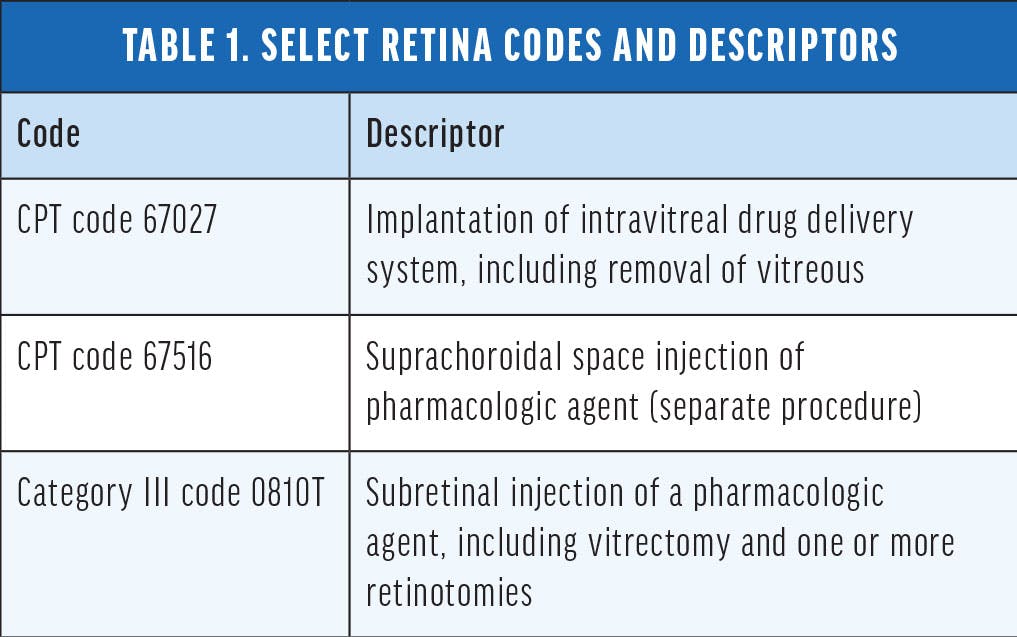
When providing treatment, there are multiple procedural codes to consider. A frequently used injection code is CPT code 67028, intravitreal injection of a pharmacologic agent (separate procedure), when treating with anti-VEGF or dual inhibitors for AMD, diabetic retinopathy, and macular edema following retinal vein occlusion, and complement inhibitors to treat geographic atrophy. Additional codes to consider are provided in Table 1.
VERIFY THE HCPCS CODE AND UNITS
Identify the appropriate HCPCS code for the medication used. New treatments are initially billed with not otherwise classified (NOC) HCPCS codes until a permanent code is assigned. When billing with an NOC code, report the medication name, dosage, and invoice amount in item 19 of the claim form. Without this information, the claim may be denied. Once a permanent HCPCS code is assigned, the descriptor will provide the name of the drug and the dosage amount that equates to 1 unit. For example:
- HCPCS code J2781, injection, pegcetacoplan (Syfovre, Apellis), intravitreal, 1 mg: 15 mg are administered, 15 units are billed.
- HCPCS code J2777, injection, faricimab-svoa (Vabysmo, Genentech/Roche), 0.1 mg: 6 mg are administered, 60 units are billed.
- HCPCS code Q5147, injection, aflibercept-ayyh (Pavblu, Amgen), biosimilar, 1 mg: 2 mg are administered, 2 units are billed.
REPORT THE CORRECT NDC
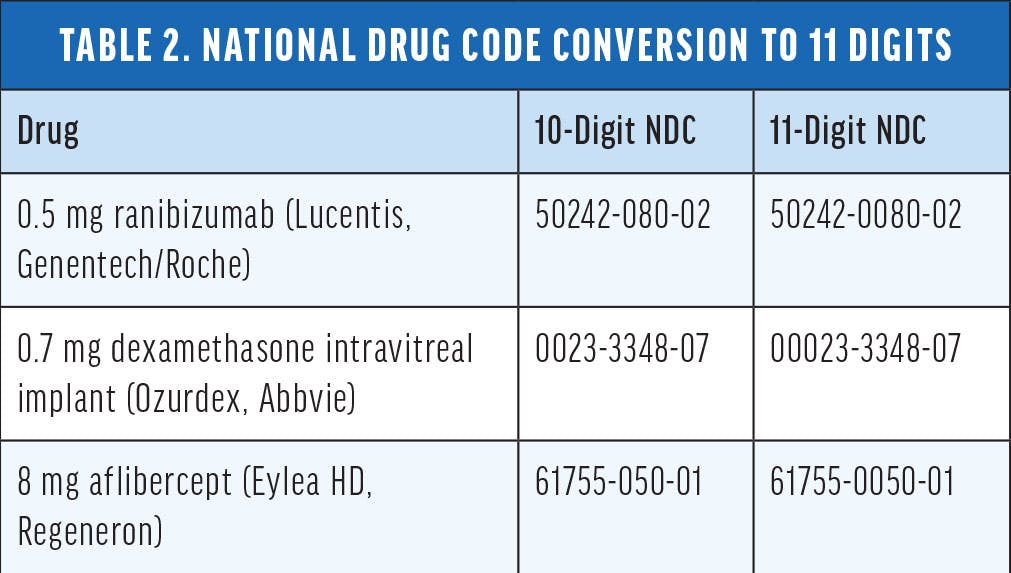
The national drug code (NDC) is essential for accurate claims. However, to be recognized by payers, it must be converted from a 10-digit to an 11-digit, 5-4-2 sequence. This means a zero must be placed where appropriate to achieve the correct claim submission format (Table 2).
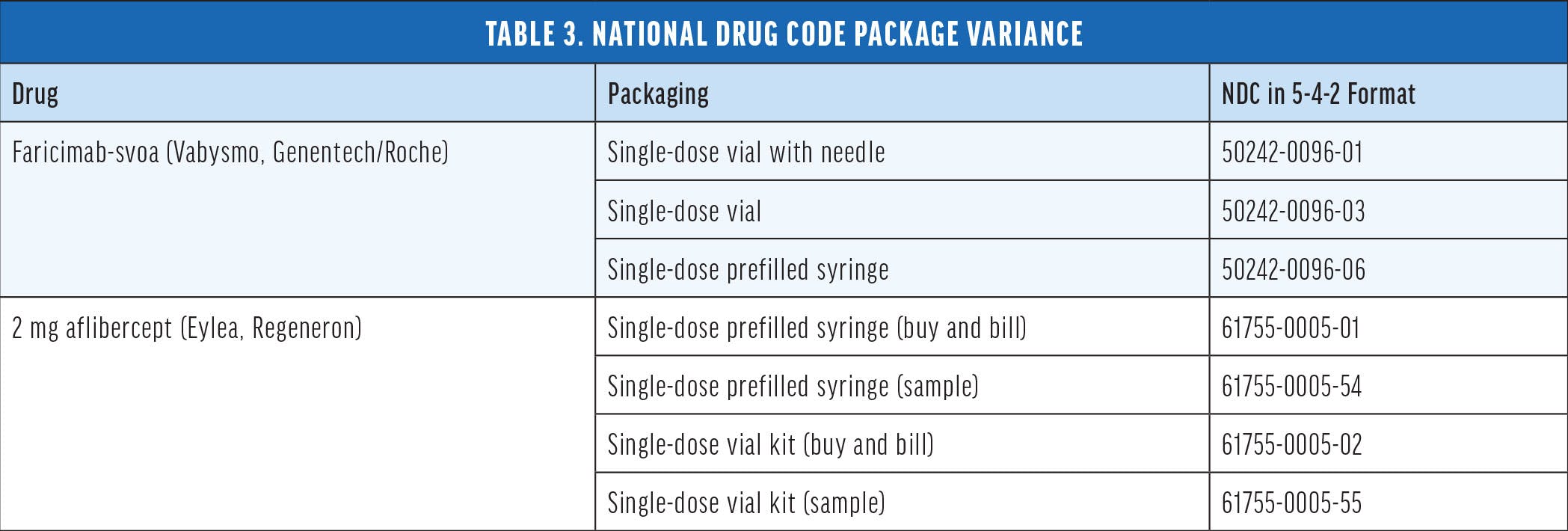
Drug packaging may have different NDC numbers. Single-use versus multidose vials and liquid versus powder vials also have different NDC numbers on the packaging. It is crucial to report the correct NDC for the type of drug used (Table 3).
The NDC is reported on the CMS-1500 and EDI equivalent in item 24a proceed by the N4 qualifier.
USE THE ACCURATE UNIT OF MEASURE
Following the appropriate NDC on the claim in item 24a should be the unit of measure, which reports the volume of the drug injected. Most retina drugs are provided in liquid form and are reported with the volume in milliliters. For example, 2 mg/0.05 mL aflibercept (Eylea, Regeneron) would be reported as ML0.05.
For powder-filled vials of medications that are reconstituted (eg, verteporfin [Visudyne, Bausch + Lomb]), report the number of vials used in units. For example, if one vial was used, report as UN1.
Find More Retina Today Coding Articles Here:
Decoding the Nuances of Injectable Antibiotics in Retina
How to Implement the –JZ Modifier
Why Was My Intravitreal Injection Claim Denied?
FOLLOW THE FDA LABEL
Each drug has indications and frequency limitations, and following these guidelines will ensure the claims are paid. Off-label use is consistently denied by payers unless they have a published policy with expanded diagnosis coverage or unique frequency limitations.
APPEND THE -JZ OR -JW MODIFIER
Append the -JZ or -JW modifier to the HCPCS code as appropriate. Modifier -JZ should be reported when the wastage is less than 1 unit, as defined by the HCPCS code descriptor, and/or if considered overfill. Retina drugs are frequently reported with modifier -JZ. Modifier -JW, on the other hand, should be appended to the HCPCS code when the wastage is 1 unit or greater (eg, triamcinolone acetonide [Triesence, Harrow]).
LEARN MORE
To confirm the FDA indications, billing units, and whether to report the -JZ or -JW modifier, access the AAO’s Table of Common Retina Drugs at aao.org/retinapm. Additional billing guidance can be reviewed at aao.org/injection.


_1773249222.png?auto=compress,format&w=75)


