





AT A GLANCE
- Nutritional supplementation represents a potential adjunctive approach to treating inherited retinal disease, although limitations in bioavailability, study design, and long-term clinical validation remain.
- Vitamin A, docosahexaenoic acid, lutein, zeaxanthin, N-acetylcysteine, tauroursodeoxycholic acid, curcumin, and saffron have all been studied for their potential therapeutic effect.
- Precision medicine tailored to specific genetic profiles could help identify candidates more likely to benefit from specific supplements.
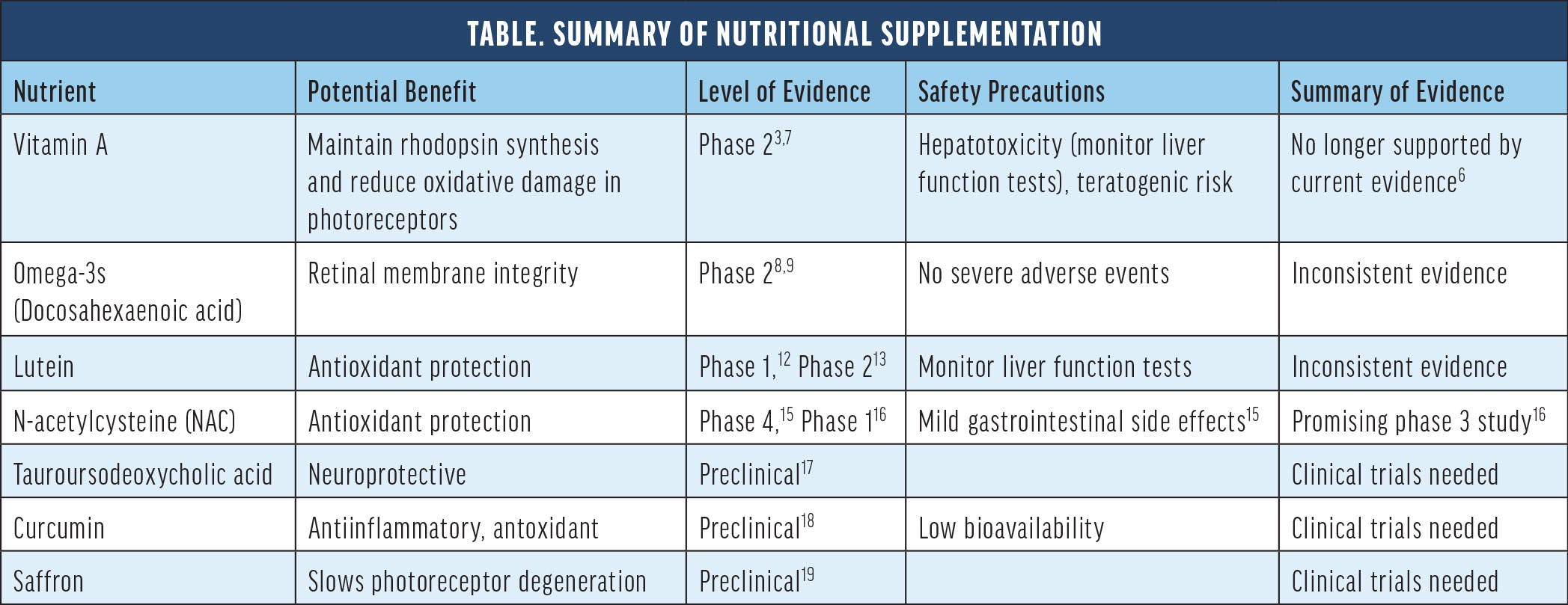
Inherited retinal diseases (IRDs) are characterized by degeneration of photoreceptors, leading to irreversible vision loss starting from birth to even late middle age.1 Nutritional supplementation has been used to potentially diminish progression of many IRDs. In this article, we provide an overview of the current evidence supporting various nutritional supplementation for IRDs (Table).
VITAMIN A SUPPLEMENTATION IN RP
Vitamin A is crucial for the visual cycle, serving as an essential component of the visual pigment rhodopsin. In its active form as 11-cis retinal, vitamin A is integral for phototransduction. It also supports the structural integrity of photoreceptors and the retinal pigment epithelium (Figure).2 Given vitamin A's fundamental role in vision, a randomized controlled trial involving 601 patients with retinitis pigmentosa (RP) demonstrated that 15,000 IU/day of vitamin A palmitate led to a slower annual decline in 30-Hz cone flicker electroretinography (ERG) amplitude loss. The vitamin A group experienced a 6.2% loss compared with 7.5% in the control group (P = .01), without significant differences in visual field or acuity outcomes.3
A more recent analysis found no evidence that high-dose vitamin A slowed overall disease progression, highlighting methodological limitations in previous studies. Importantly, a subgroup analysis revealed a potential benefit for patients with RHO-related RP, with an approximately 6.1% slower progression per year. However, after correction for multiple comparisons, this effect did not reach statistical significance. This suggests that the effects of vitamin A supplementation may depend on specific genetic subtypes, highlighting the need for personalized approaches. Furthermore, clinicians must carefully consider the potential toxicity risks associated with high-dose vitamin A, such as hepatotoxicity and teratogenicity. Its use should be approached cautiously, especially among women of childbearing age.4
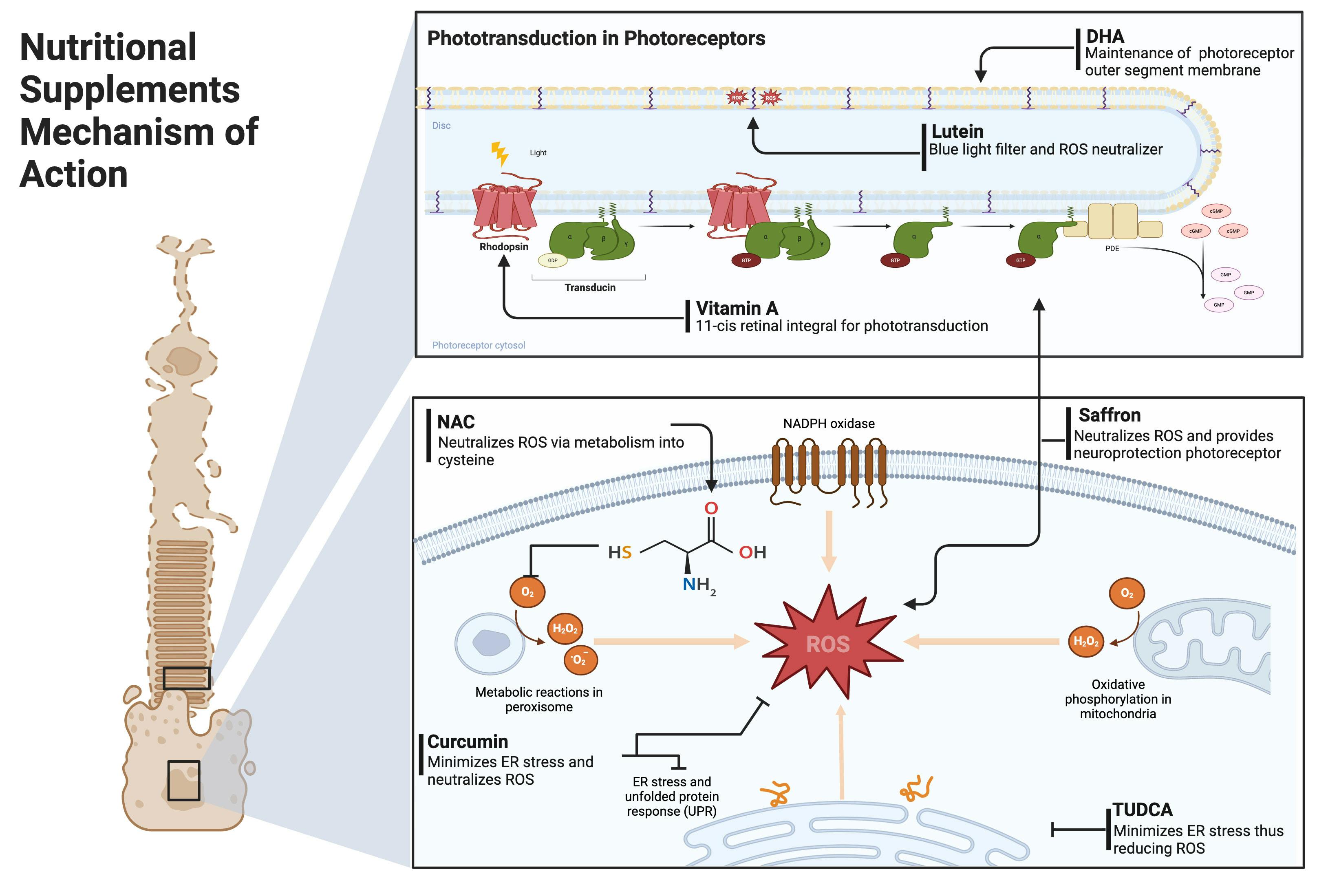
Figure. This image summarizes the proposed mechanisms by which vitamin A, omega-3 fatty acids, and other nutraceuticals may exert neuroprotective and antioxidant effects in IRDs. Image created in BioRender. Morales P. 2025. https://BioRender.com/muapy0p
THE NEUROPROTECTIVE ROLE OF OMEGA-3 FATTY ACIDS
Docosahexaenoic acid (DHA) is a long-chain polyunsaturated fatty acid of the omega‐3 family that is vital for the maintenance of retinal photoreceptor outer segment membranes. This structural role facilitates phototransduction. The results of DHA supplementation trials in RP have been inconsistent.5-7 For instance, the 4-year randomized controlled DHAX trial did not show statistically significant results, although it demonstrated a trend, suggesting slightly delayed progression in X-linked RP. While DHA did not reduce rod or cone decline in ERG, a subsequent DHAX analysis demonstrated it may slow progression in final dark-adapted thresholds and visual field sensitivity parameters.8,9
DECREASING THE OXIDATIVE PROCESS IN IRDS
Oxidative stress is a widely recognized contributor to retinal degeneration, with the accumulation of reactive oxygen species leading to photoreceptor damage and progressive vision loss. Considering this, antioxidant therapies have been investigated extensively as potential means to mitigate oxidative injury and preserve retinal function.10
Carotenoid: Natural Blue Light Filter
Carotenoids such as lutein and zeaxanthin have received considerable attention due to their propensity to accumulate in the macula, where they filter high-energy blue light and neutralize reactive oxygen species.11 In a 4-year randomized controlled trial, 240 patients with RP were assigned to receive either 12 mg lutein plus 15,000 IU/day vitamin A or placebo plus 15,000 IU/day vitamin A. The primary outcome, measured by the Humphrey visual field 30-2 test, showed no significant difference between the groups. However, a secondary measure using the 60-4 grid revealed a significantly slower decline in the lutein group (26.6 dB/year) compared with controls (34.1 dB/year; P = .05), with a greater effect in patients with higher serum lutein and increased macular pigment optical density. No significant differences were observed in ERG or visual acuity outcomes.12
Another trial focused solely on lutein supplementation. This crossover study randomly assigned 45 patients to receive either placebo then lutein or lutein then placebo over 48 weeks. Results showed a small but statistically significant improvement in log retinal area of visual field (0.018 [95% CI, 0.001-0.036], P = .04). However, the study was limited by a small sample size.13
Glutathione Precursors and Oxidative Stress Modulation
N-acetylcysteine (NAC) functions as a free radical scavenger and is metabolized into cysteine, which is essential for producing glutathione, a critical element of the body’s intrinsic antioxidant defense system.14
The FIGHT-RP1 trial evaluated the safety and efficacy of oral NAC at escalating doses (600 mg to 1,800 mg twice a day) over 24 weeks. Supplementation resulted in statistically significant improvements in BCVA across all dose groups, with the 1,800 mg cohort also showing significant gains in macular sensitivity. However, no significant structural preservation was observed in ellipsoid zone width, suggesting that NAC did not halt anatomic photoreceptor loss over the study period.15 Given these promising findings, a phase 3 study is enrolling 438 patients. If the preliminary analyses at 21 months indicate benefit in the NAC group, placebo patients will be transitioned to active treatment.16
The Role of TUDCA
In addition to conventional antioxidants, emerging nutraceuticals are being studied for their neuroprotective potential. Tauroursodeoxycholic acid (TUDCA) has shown promise in experimental studies by inhibiting apoptosis, reducing oxidative stress, suppressing endoplasmic reticulum stress, and exerting antiinflammatory and antiangiogenic effects. Animal models receiving TUDCA demonstrated structural and functional preservation of the retina. Despite promising findings, no clinical trials are being conducted to validate TUDCA’s therapeutic potential.17
Promising Plant-Based Compounds
Curcumin, a compound derived from turmeric, has demonstrated potent antiinflammatory and antioxidant properties in preclinical retina models. It acts as a free radical scavenger and enhances the activity of antioxidant enzymes. Curcumin's antiinflammatory effects are mediated through the downregulation of proinflammatory cytokines, as well as the inhibition of the NF-κB signaling pathway. Despite these promising effects, its clinical utility is limited by challenges related to its low bioavailability.18
Fernandez-Sanchez et al demonstrated that saffron and its active compounds, safranal and crocetin, slow photoreceptor cell degeneration and improve ERG responses in P23H retina models.19 Furthermore, when combined with photobiomodulation, saffron was initially thought to show synergistic effects that reduced photoreceptor apoptosis and mitigated the upregulation of Müller cells gliosis.20 However, a recent analysis suggests photobiomodulation and saffron may not enhance their individual neuroprotective properties and could potentially have antagonistic interactions. This combined treatment showed only limited benefits in reducing early neuroinflammation in retina models.21
MORE RESOURCES

Foundation Fighting Blindness provides important educational resources for you and your patients, including disease state education, genetic testing, and clinical trials.
CLINICAL TAKEAWAYS
Nutritional supplementation is a potential adjunctive approach, although limitations in bioavilability, study design, and long-term clinical validation remain key challenges. Until robust evidence demonstrates clear benefits, nutritional supplementation continues to function as a placebo rather than an established therapeutic co-adjuvant.
1. Rattner A, Sun H, Nathans J. Molecular genetics of human retinal disease. Ann Rev Genetics. 1999;33(33):89-131.
2. Miyazono S, Isayama T, Delori FC, Makino CL. Vitamin A activates rhodopsin and sensitizes it to ultraviolet light. Vis Neurosci. 2011;28(6):485-497.
3. Berson EL, Rosner B, Sandberg MA, et al. A randomized trial of vitamin A and vitamin E supplementation for retinitis pigmentosa. Arch Ophthalmol. 1993;111(6):761-772.
4. Comander J, Weigel DiFranco C, Sanderson K, et al. Natural history of retinitis pigmentosa based on genotype, vitamin A/E supplementation, and an electroretinogram biomarker. JCI Insight. 8(15):e167546.
5. Olivares-González L, Salom D, González-García E, et al. NUTRARET: Effect of 2-year nutraceutical supplementation on redox status and visual function of patients with retinitis pigmentosa: a randomized, double-blind, placebo-controlled trial. Front Nutr. 2022;9:847910.
6. SanGiovanni JP, Chew EY. The role of omega-3 long-chain polyunsaturated fatty acids in health and disease of the retina. Prog Retin Eye Res. 2005;24(1):87-138.
7. Schwartz SG, Wang X, Chavis P, Kuriyan AE, Abariga SA. Vitamin A and fish oils for preventing the progression of retinitis pigmentosa. Cochrane Database Syst Rev. 2020;6(6):CD008428.
8. Hoffman DR, Hughbanks-Wheaton DK, Pearson NS, et al. Four-year placebo-controlled trial of docosahexaenoic acid in X-linked retinitis pigmentosa (DHAX trial): a randomized clinical trial. JAMA Ophthalmol. 2014;132(7):866-873.
9. Hoffman DR, Locke KG, Wheaton DH, Fish GE, Spencer R, Birch DG. A randomized, placebo-controlled clinical trial of docosahexaenoic acid supplementation for X-linked retinitis pigmentosa. Am J Ophthalmol. 2004;137(4):704-718.
10. Campochiaro PA, Mir TA. The mechanism of cone cell death in Retinitis Pigmentosa. Prog Retinal Eye Res. 2018;62:24-37.
11. Landrum JT, Bone RA. Lutein, Zeaxanthin, and the Macular Pigment. Arch Biochem Biophys. 2001;385(1):28-40.
12. Berson EL, Rosner B, Sandberg MA, et al. Clinical trial of lutein in patients with retinitis pigmentosa receiving vitamin A. Arch Ophthalmol. 2010;128(4):403-411.
13. Bahrami H, Melia M, Dagnelie G. Lutein supplementation in retinitis pigmentosa: PC-based vision assessment in a randomized double-masked placebo-controlled clinical trial [NCT00029289]. BMC Ophthalmol. 2006;6:23.
14. Dilger RN, Baker DH. Oral N-acetyl-L-cysteine is a safe and effective precursor of cysteine. J Anim Sci. 2007;85(7):1712-1718.
15. Campochiaro PA, Iftikhar M, Hafiz G, et al. Oral N-acetylcysteine improves cone function in retinitis pigmentosa patients in phase I trial. J Clin Invest. 130(3):1527-1541.
16. Johns Hopkins University. NAC Attack, A phase III, multicenter, randomized, parallel, double masked, placebo-controlled study evaluating the efficacy and safety of oral n-acetylcysteine in patients with retinitis pigmentosa. clinicaltrials.gov/study/NCT05537220. Accessed February 8, 2025.
17. Li J, Huang Z, Jin Y, et al. Neuroprotective effect of tauroursodeoxycholic acid (TUDCA) on in vitro and in vivo models of retinal disorders: a systematic review. Curr Neuropharmacol. 2024;22(8):1374-1390.
18. Chandrasekaran PR, Madanagopalan VG. Role of curcumin in retinal diseases—a review. Graefes Arch Clin Exp Ophthalmol. 2022;260(5):1457-1473.
19. Fernández-Sánchez L, Lax P, Esquiva G, Martín-Nieto J, Pinilla I, Cuenca N. Safranal, a saffron constituent, attenuates retinal degeneration in P23H rats. PLoS One. 2012;7(8):e43074.
20. Marco FD, Romeo S, Nandasena C, et al. The time course of action of two neuroprotectants, dietary saffron and photobiomodulation, assessed in the rat retina. Am J Neurodegener Dis. 2013;2(3):208-220.
21. Di Paolo M. Sequential PBM–saffron treatment in an animal model of retinal degeneration. Medicina (Kaunas). 2021;57(10):1059.


