



AT A GLANCE
- Achromatopisa, inherited in an autosomal recessive pattern, occurs in approximately one in 30,000 to 50,000 births.
- The most common genetic mutations responsible for achromatopisa are in the CNGB3 and CNGA3 genes.
- Care aims to reduce symptom burden, such as reduce photophobia; accurate refraction can optimize visual acuity, and low vision aids are necessary.
Achromatopisa, an inherited retinal disease characterized by loss of cone function, is inherited in an autosomal recessive pattern and occurs in about one in 30,000 to 50,000 births.1 Common symptoms include color blindness, decreased visual acuity, pendular nystagmus, central scotoma, eccentric fixation, and photophobia.2,3 Hyperopia is common among patients with achromatopsia.3
This condition is characterized by variable expressivity depending on the amount of residual cone function.1 Patients with complete (typical) achromatopsia have a more severe phenotype due to a total lack of function of all three types of cones and typically present at around 6 months of age with nystagmus and photophobia.3 VA is generally worse than 20/200. Patients with incomplete (atypical) achromatopsia have a less severe phenotype due to the presence of varying degrees of functioning cones, with VA as good as 20/80, mild or absent photophobia and nystagmus, and partially intact color discrimination.3
Signs of disease on fundoscopic examination are frequently absent, although possible findings include vessel attenuation, alteration of the foveal reflex, and retinal pigment epithelium (RPE) mottling. RPE atrophy may develop in early to late adulthood (Figure).3 Although historically thought to be a stationary disease, recent long-term data has illustrated a progressive decline in visual function and macular integrity in many patients with achromatopsia.2
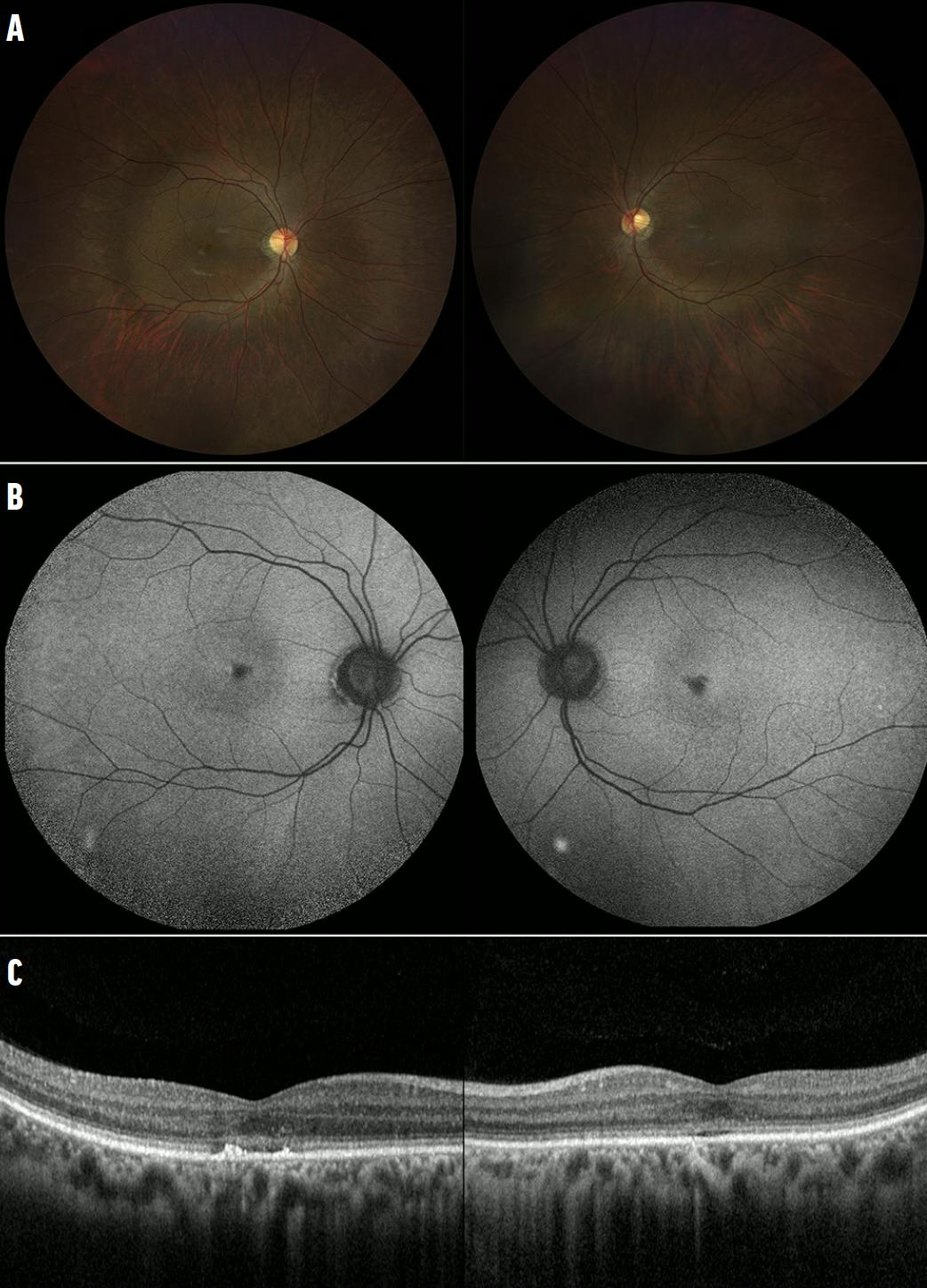
Figure. A 37-year-old man presented with progressive vision loss in each eye since early childhood due to achromatopsia. Fundus photography (A) was unremarkable other than macular RPE mottling in each eye. Fundus autofluorescence (B) demonstrated mild foveal hypoautofluorescence, and OCT (C) demonstrated mild subfoveal RPE atrophy in each eye. Images courtesy of Byron L. Lam, MD.
DIAGNOSTIC PEARLS
Important components in the diagnosis of achromatopsia include family history, nystagmus examination, color vision assessment, and visual acuity testing. Additional diagnostic tests include OCT, electroretinography (ERG), visual fields, and microperimetry.
Full-field ERG classically demonstrates diminished or absent photopic responses with normal or only slightly reduced scotopic responses. However, due to the limited number of photoreceptors within the fovea, full-field ERG may be normal in up to 75% of patients. Therefore, multifocal ERG, which allows for isolated evaluation of macular function, is generally more accurate.4,5
Typical findings on OCT include macular thinning, disruption of the ellipsoid zone, and macular RPE atrophy.6 Of patients with achromatopsia, 85% have some degree of photoreceptor disruption.4 Foveal hypoplasia, another common finding, has been hypothesized to represent a gene-specific feature in patients with CNGA3, CNGB3, or ATF6 mutations, although this association is not well-established.2,3,7 Fundus autofluorescence demonstrates varying degrees of macular hypoautofluorescence or ring-shaped hyperautofluorescence.8
Color vision testing may be helpful in identifying patients’ specific phenotypes, and patients demonstrate abnormalities in all axes. Note that testing may be unreliable if patients use color-object associations or differentiate colors based on their brightness using undamaged photoreceptors.1
Visual field testing may demonstrate small central scotomas with careful testing, although poor fixation can limit reliability.3 Microperimetry generally demonstrates reduced macular sensitivity and may be more sensitive than standard visual field testing.2
GENETIC TESTING
Achromatopsia is an autosomal recessive condition exhibiting genetic heterogeneity. The most common mutations are in the CNGB3 (50% to 70%) and CNGA3 (approximately 25%) genes. CNGB3 mutations are the most frequent disease-causing mutations in patients of European descent, while CNGA3 mutations are more common in those of Asian and middle Eastern descent.9,10 Other reported disease-causing mutations include those in ATF6 (2%), GNAT2 (less than 2%), PDE6C (less than 2%), and PDE6H (0.3%).2,11
There do not appear to be direct associations between specific gene mutations and phenotype. Mutations on the same gene can cause either incomplete or complete forms of the disease. Genetic testing can be useful for prognostic information, identifying carriers, and establishing a prenatal diagnosis. Testing is highly sensitive and specific when the aforementioned genes are included and can be used to confirm the disease, as it demonstrates 100% penetrance.12 Given the small number of causative genes and the clear phenotype associated with the disease, targeted genetic testing rather than whole exome or whole genome sequencing may be appropriate. A small minority of patients (less than 10%) demonstrate no known genetic mutation in the presence of a clear clinical diagnosis.13
MANAGEMENT AND COMPLICATIONS
Management for patients with achromatopsia aims to reduce symptom burden. Accurate refraction is important to optimize visual acuity, and low vision aids are necessary to assist patients at home and in public. Due to the debilitating photophobia characteristic of the disease, patients may prefer to avoid light exposure using dark or special filter glasses, tinted contact lenses, and visors.3
Low vision aids such as magnifiers, occupational assistance, and preferential seating at the front of the classroom and away from windows should be provided, as appropriate.3 Because the limitations imposed by the disease can cause significant psychological and social distress, patients and families should have access to resources to cope.
CLINICAL PIPELINE
Achromatopsia represents an ideal target disease for gene therapy given the well-defined genetic associations and the presence of residual non-functioning cone photoreceptors, and several trials are underway.13
In 2007, an AAV vector was used to transduce a mouse model with GNAT2 with a resultant increase in ERG responses to 80% of the normal range, serving as proof of principle for AAV-mediated gene therapy in achromatopsia.14 Since then, gene therapy has been successfully used in animals with achromatopsia caused by other genetic mutations including CNGA3 and CNGB3, leading to a Fast Track designation by the FDA.15,16
AAV-CNGB3 (MeiraGTx UK) was studied in a phase 1/2 trial (NCT03001310) that involved the subretinal delivery of an AAV8 vector with CNGB3 in 23 participants. In the trial, favorable responses were recorded in several efficacy assessments including photo-aversion (11 of 20 patients), color vision (six of 23), and vision-related quality-of-life questionnaires (21 of 23).17 The program has stalled since being acquired by Janssen in 2023.18
MORE RESOURCES

Foundation Fighting Blindness provides important educational resources for you and your patients, including disease state education, genetic testing, and clinical trial updates.
An ongoing phase 1/2 trial investigating subretinal delivery of AAV8.hCNGA3 (STZ Eyetrial) for achromatopsia in 13 patients has shown good interim safety and efficacy outcomes.19 In an early phase 1 trial (NCT04041232), investigators are also evaluating the potential role of supplementing glycerol phenylbutyrate, a fatty acid compound that facilitates protein folding, in patients with achromatopsia caused by mutations in ATF6.13
FOCUS ON THE FUTURE
Achromatopsia, a rare, debilitating ocular condition, is characterized by decreased visual acuity, photophobia, nystagmus, and diminished or absent color vision. Diagnosis can be established by family history, clinical examination, multimodal imaging, and genetic testing. Management is currently limited to symptom management, although early clinical trials involving subretinal gene therapy have demonstrated some promise.
1. Remmer MH, Rastogi N, Ranka MP, Ceisler EJ. Achromatopsia: a review. Curr Opin Ophthalmol. 2015;26(5):333-340.
2. Brunetti-Pierri R, Karali M, Melillo P, et al. Clinical and molecular characterization of achromatopsia patients: a longitudinal study. Int J Mol Sci. 2021;22(4):1681.
3. Kohl S, Jagle H, Wissinger B, Zobor D. Achromatopsia. In: Adam MP, Feldman J, Mirzaa GM, Pagon RA, Wallace SE, Amemiya A, eds. GeneReviews. Seattle; 1993.
4. Genead MA, Fishman GA, Rha J, et al. Photoreceptor structure and function in patients with congenital achromatopsia. Invest Ophthalmol Vis Sci. 2011;52(10):7298-7308.
5. Bijveld MM, Riemslag FC, Kappers AM, Hoeben FP, van Genderen MM. An extended 15 Hz ERG protocol (2): data of normal subjects and patients with achromatopsia, CSNB1, and CSNB2. Doc Ophthalmol. 2011;123(3):161-172.
6. Aboshiha J, Dubis AM, Cowing J, et al. A prospective longitudinal study of retinal structure and function in achromatopsia. Invest Ophthalmol Vis Sci. 2014;55(9):5733-5743.
7. Georgiou M, Singh N, Kane T, et al. Photoreceptor structure in GNAT2-associated Achromatopsia. Invest Ophthalmol Vis Sci. 2020;61(3):40.
8. Fahim AT, Khan NW, Zahid S, et al. Diagnostic fundus autofluorescence patterns in achromatopsia. Am J Ophthalmol. 2013;156(6):1211-1219.e2.
9. Sun W, Li S, Xiao X, Wang P, Zhang Q. Genotypes and phenotypes of genes associated with achromatopsia: A reference for clinical genetic testing. Mol Vis. 2020;26:588-602.
10. Kohl S, Varsanyi B, Antunes GA, et al. CNGB3 mutations account for 50% of all cases with autosomal recessive achromatopsia. Eur J Hum Genet. 2005;13(3):302-308.
11. Ansar M, Santos-Cortez RL, Saqib MA, et al. Mutation of ATF6 causes autosomal recessive achromatopsia. Hum Genet. 2015;134(9):941-950.
12. Kohl S, Hamel C. Clinical utility gene card for: Achromatopsia -update 2013. Eur J Hum Genet. 2013;21(11).
13. Baxter MF, Borchert GA. Gene therapy for achromatopsia. Int J Mol Sci. 2024;25(17):9739.
14. Alexander JJ, Umino Y, Everhart D, et al. Restoration of cone vision in a mouse model of achromatopsia. Nat Med. 2007;13(6):685-687.
15. Komaromy AM, Alexander JJ, Rowlan JS, et al. Gene therapy rescues cone function in congenital achromatopsia. Hum Mol Genet. 2010;19(13):2581-2593.
16. Carvalho LS, Xu J, Pearson RA, et al. Long-term and age-dependent restoration of visual function in a mouse model of CNGB3-associated achromatopsia following gene therapy. Hum Mol Genet. 2011;20(16):3161-3175.
17. Michaelides M, Hirji N, Wong SC, et al. First-in-human gene therapy trial of AAV8-hCARp.hCNGB3 in adults and children with CNGB3-associated achromatopsia. Am J Ophthalmol. 2023;253:243-251.
18. Our pipeline. MieraGTx. Accessed May 30, 2025. meiragtx.com/programs-pipeline/pipeline
19. Reichel FF, Michalakis S, Wilhelm B, et al. Three-year results of phase I retinal gene therapy trial for CNGA3-mutated achromatopsia: results of a non randomised controlled trial. Br J Ophthalmol. 2022;106(11):1567-1572.


