


AT A GLANCE
- Typically, patients with cone dystrophies (COD) and cone-rod dystrophies (CORD) present with reduced central vision, photophobia, hemeralopia, and generalized dyschromatopsia.
- The standard for clinical diagnosis of COD and CORD is full-field electroretinography.
- Most novel interventions in COD/CORD are focused on mutations in the ABCA4 gene.
Cone dystrophies (COD) and cone-rod dystrophies (CORD) are a subset of inherited retinal diseases (IRDs) characterized by primary cone degeneration with variable secondary rod involvement.1 Due to the high concentration of cones in the macula, central vision can be affected early and severely.
While clinical presentation is a spectrum, low vision is often present in the second decade in COD and as early as the first decade in CORD with progression to legal blindness early in the third decade for half of patients.2 It is important to recognize these rare IRDs early to connect patients with low vision programs and possible clinical trials.
PRESENTING SIGNS AND SYMPTOMS
Generally, patients with COD/CORD present with reduced central vision, photophobia, hemeralopia, and generalized dyschromatopsia.3 Depending on the degree of rod involvement, they may also complain of varying degrees of nyctalopia. This is in contrast to retinitis pigmentosa, or rod-cone dystrophy, where the earliest symptoms are typically nyctalopia and peripheral vision loss (Table).
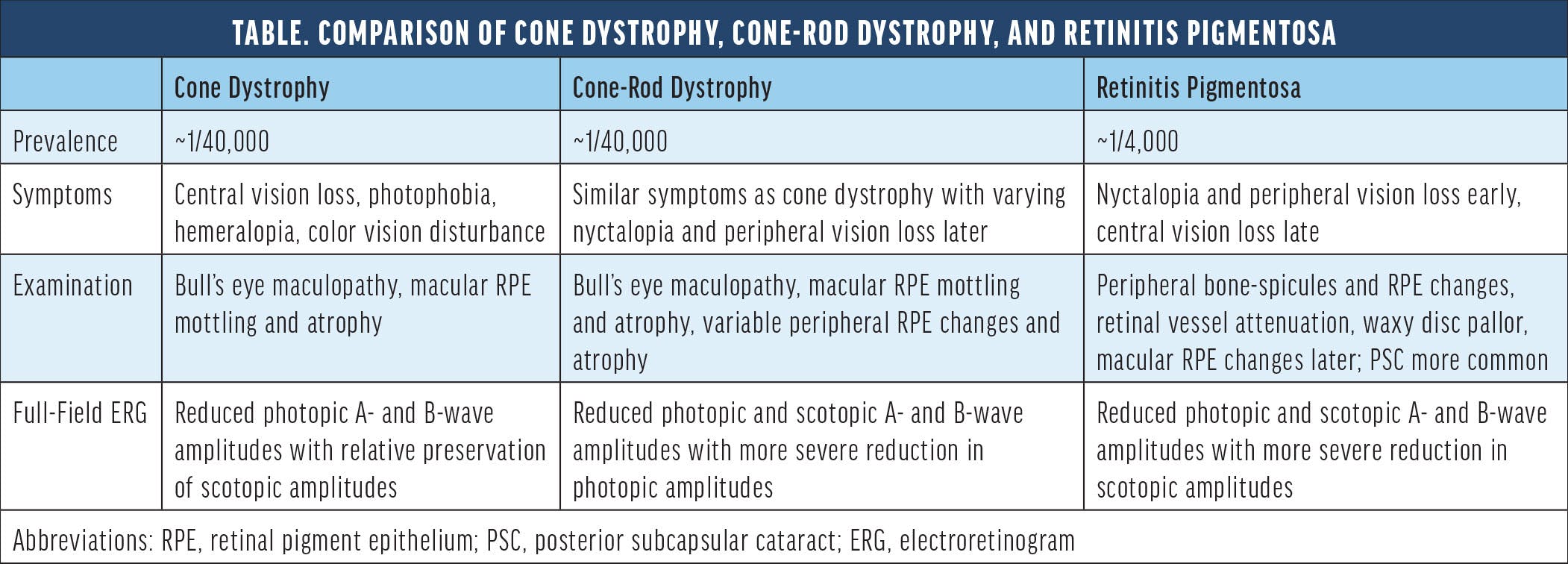
The physical examination is often variable. The macula may appear normal, particularly early in the disease course, or patients may present with subtle macular retinal pigment epithelium (RPE) mottling or a classic bull’s eye maculopathy. The optic disc may be normal or present with temporal pallor. With CORD and more significant rod involvement, patients may demonstrate peripheral RPE changes such as mottling, pigment clumping, or frank bone-spicules.
DIAGNOSTIC PEARLS
The standard for the diagnosis of COD/CORD is full-field electroretinography (ffERG). COD is characterized by reduced photopic amplitudes with overall preserved scotopic amplitudes, while CORD demonstrates both photopic and scotopic reduction with the photopic amplitudes more severely depressed.4 Delayed 30 Hz flicker ERG implicit time may be the earliest finding. With more progressive cone degeneration, photopic responses demonstrate a reduction in A- and B-wave amplitudes.1,5 While most ffERG findings are not specific to a particular gene, a specific pattern with generalized cone dysfunction and supranormal rod function can be pathognomonic of KCNV2-associated retinopathy.6
Fundus autofluorescence (FAF) may reveal hypo- and hyperautofluorescent changes in the macula and periphery and can be used to follow disease progression (Figure).7 Ultra-widefield FAF can be important for identifying any peripheral retinal changes.
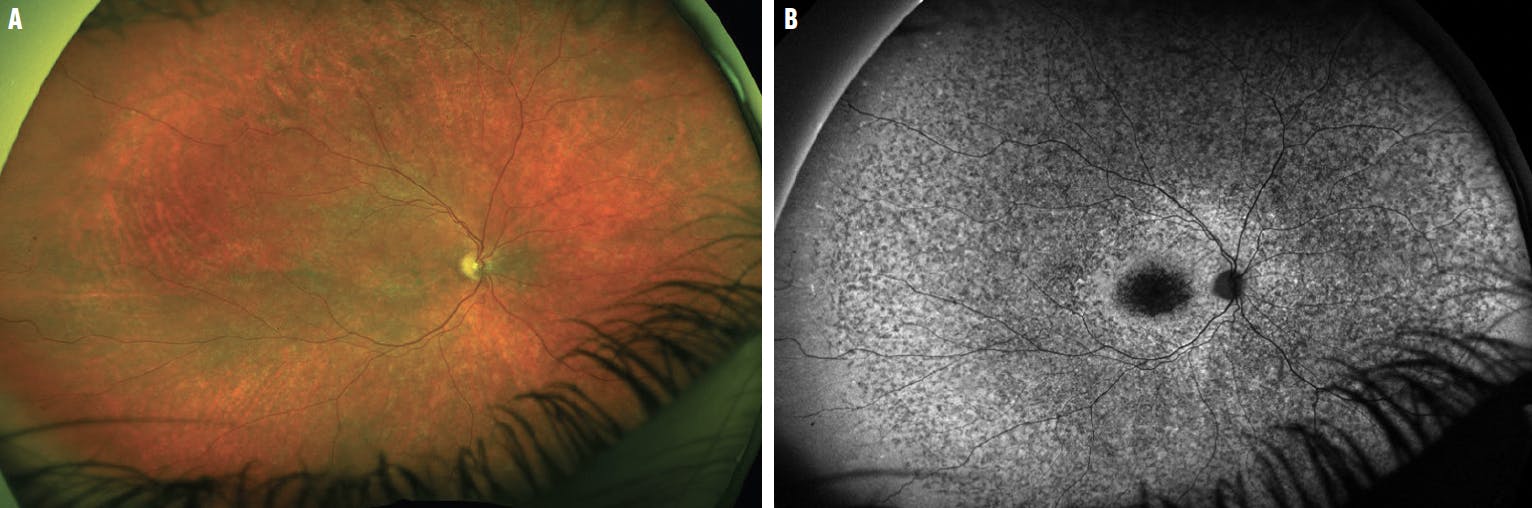
Figure. Ultra-widefield fundus imaging of a 22-year-old woman with ABCA4-associated CORD demonstrates granular RPE mottling with poorly delineated subretinal flecks (A). Ultra-widefield FAF better demonstrates the widespread RPE abnormality with granular hypoautofluorescence and hyperautofluorescence in the macula and periphery (B).
Macular OCT will typically demonstrate outer retinal abnormalities, particularly in the central macula where cones have the highest concentration. The interdigitation zone is typically absent, the ellipsoid zone may be attenuated or absent, and more severe RPE atrophy can be seen.8-10
Color vision testing can be important to detect early dyschromatopsia. Kinetic visual field testing typically demonstates a central scotoma with relative preservation of peripheral isopters in COD and varying levels of peripheral field loss in CORD.
Adaptive optics, where available, allow visualization of photoreceptors and demonstrate decreased cone density in COD and decreased cone and rod density in CORD.11
GENETIC TESTING
More than 30 genes—involved in phototransduction, outer segment morphogenesis, and intraflagellar transport—can cause COD/CORD.12-15 The causative gene can be identified in up to 80% of cases.3 Most COD/CORD is autosomal recessive but can be autosomal dominant or X-linked as well. In autosomal dominant and X-linked disease, the most common genetic mutations involve GUCY2D and RPGR, respectively.1 The most common causative gene for autosomal recessive COD/CORD is ABCA4.
LONG-TERM MANAGEMENT
While an understanding of current clinical trials is important, clinicians must offer low vision services and social resources to patients with COD/CORD. Given the high risk of depression, anxiety, and feelings of social isolation, these resources should be offered early and at follow-up visits.16
CLINICAL PIPELINE
Few clinical trials specifically target COD/CORD, although some patients may be eligible for gene-specific trials. Most interventions in COD/CORD are focused on mutations in ABCA4. When this gene is dysfunctional, bis-retinoids accumulate as lipofuscin deposits in the RPE, leading to RPE dysfunction and death, and, eventually, photoreceptor loss.17
Splice Bio and AAVantgarde aim to replace the defective ABCA4 gene. Splice Bio is currently recruiting for a phase 1/2 clinical trial (NCT06435000), while AAVantgarde is recruiting for an observational study (NCT06591806). Ascidian Therapeutics, which has developed RNA exon-editing technology, is recruiting for a phase 1/2 trial (NCT06467344).18
OCU410ST (Ocugen) uses an AAV vector to deliver human retinoic acid-related orphan receptor alpha—a nuclear hormone receptor involved in controlling inflammation and lipogenesis.19 Preliminary data from the phase 1 trial (NCT05956626) is promising, with decreased lesion growth and improved visual function.20
Optogenetics use a viral vector to transfect bipolar ganglion cells with a light sensitive opsin, thereby giving them photosensitive properties.21 Nanoscope Therapeutics is evaluating a single intravitreal injection of a multi-characteristic opsin (MCO-010) delivered via an AAV vector (NCT05417126).22 Some patients with COD/CORD phenotypes may be eligible for these trials.
MORE RESOURCES

Foundation Fighting Blindness provides important educational resources for you and your patients, including disease state education, genetic testing, and clinical trial updates.
Pharmacologic interventions aim to reduce the production of harmful components of the retinoid cycle.22 Belite Bio is recruiting for a phase 2/3 study (NCT04489511) evaluating tinlarebant, an oral therapy that reduces retinal binding protein 4, the major transport protein for vitamin A in the bloodstream.23 Alkeus Pharmaceuticals is in late-stage clinical trials (NCT04239625) for gildeuretinol (ALK-001), a modified form of vitamin A designed to reduce the acculmuation of toxic vitamin A dimers in the retina. Other therapeutic targets include C5 inhibition (avacincaptad pegol, Astellas; NCT03364153) and visual cycle modulators (Emixustat, Kubota Vision; NCT03772665).22
RARE, BUT BLINDING
While COD/CORD is rare, advances in genetic testing, imaging, and potential therapies offer improved counseling, earlier diagnosis, and possible eligibility for clinical trials for these young patients with blinding disease.
1. Gill JS, Georgiou M, Kalitzeos A, Moore AT, Michaelides M. Progressive cone and cone-rod dystrophies: clinical features, molecular genetics and prospects for therapy. Br J Ophthalmol. Jan 24 2019;103(5):711-720.
2. Thiadens AA, Phan TM, Zekveld-Vroon RC, et al. Clinical course, genetic etiology, and visual outcome in cone and cone-rod dystrophy. Ophthalmology. 2012;119(4):819-826.
3. Georgiou M, Robson AG, Fujinami K, et al. Phenotyping and genotyping inherited retinal diseases: Molecular genetics, clinical and imaging features, and therapeutics of macular dystrophies, cone and cone-rod dystrophies, rod-cone dystrophies, Leber congenital amaurosis, and cone dysfunction syndromes. Prog Retin Eye Res. May 2024;100:101244.
4. Langwińska-Wośko E, Szulborski K, Zaleska-Żmijewska A, Szaflik J. Electrophysiological testing as a method of cone-rod and cone dystrophy diagnoses and prediction of disease progression. Doc Ophthalmol. 2015;130(2):103-109.
5. Hamel CP. Cone rod dystrophies. Orphanet J Rare Dis. 2007;2:7.
6. Georgiou M, Robson AG, Fujinami K, et al. KCNV2-associated retinopathy: genetics, electrophysiology, and clinical course-KCNV2 study group report 1. Am J Ophthalmol. 2021;225:95-107.
7. Oishi M, Oishi A, Ogino K, et al. Wide-field fundus autofluorescence abnormalities and visual function in patients with cone and cone-rod dystrophies. Invest Ophthalmol Vis Sci. 2014;55(6):3572-3577.
8. Lima LH, Sallum JM, Spaide RF. Outer retina analysis by optical coherence tomography in cone-rod dystrophy patients. Retina. Oct 2013;33(9):1877-1880.
9. Inui E, Oishi A, Oishi M, et al. Tomographic comparison of cone-rod and rod-cone retinal dystrophies. Graefes Arch Clin Exp Ophthalmol. Jul 2014;252(7):1065-1069.
10. Sergouniotis PI, Holder GE, Robson AG, Michaelides M, Webster AR, Moore AT. High-resolution optical coherence tomography imaging in KCNV2 retinopathy. Br J Ophthalmol. Feb 2012;96(2):213-217.
11. Samelska K, Szaflik JP, Guszkowska M, Kurowska AK, Zaleska-Żmijewska A. Characteristics of rare inherited retinal dystrophies in adaptive optics—A study on 53 eyes. Diagnostics (Basel). 2023;13(15).
12. Shaikh RS, Reuter P, Sisk RA, et al. Homozygous missense variant in the human CNGA3 channel causes cone-rod dystrophy. Eur J Hum Genet. 2015;23(4):473-480.
13. Udar N, Yelchits S, Chalukya M, et al. Identification of GUCY2D gene mutations in CORD5 families and evidence of incomplete penetrance. Hum Mutat. 2003;21(2):170-171.
14. Conley SM, Naash MI. Gene therapy for PRPH2-associated ocular disease: challenges and prospects. Cold Spring Harb Perspect Med. 2014;4(11):a017376.
15. Hosch J, Lorenz B, Stieger K. RPGR: role in the photoreceptor cilium, human retinal disease, and gene therapy. Ophthalmic Genet. 2011;32(1):1-11.
16. Gong J, Cheung S, Fasso-Opie A, et al. The impact of inherited retinal diseases in the United States of America (US) and Canada from a cost-of-illness perspective. Clin Ophthalmol. 2021;15:2855-2866.
17. Molday RS, Garces FA, Scortecci JF, Molday LL. Structure and function of ABCA4 and its role in the visual cycle and Stargardt macular degeneration. Prog Retin Eye Res. Jul 2022;89:101036.
18. Doi A, Delaney C, Tanner D, Burkhart K, Bell RD. RNA exon editing: Splicing the way to treat human diseases. Mol Ther Nucleic Acids. 2024;35(3):102311.
19. Akula M, McNamee SM, Love Z, et al. Retinoic acid related orphan receptor alpha is a genetic modifier that rescues retinal degeneration in a mouse model of Stargardt disease and dry AMD. Gene Ther. 2024;31(7-8):413-421.
20. Ocugen, Inc. announces FDA alignment on phase 2/3 pivotal confirmatory clinical trial for modifier gene therapy candidate OCU410ST for Stargardt disease [press release]. Ocugen. February 27, 2025. Accessed May 14, 2025. bit.ly/4juOlVE
21. Batabyal S, Gajjeraman S, Pradhan S, Bhattacharya S, Wright W, Mohanty S. Sensitization of ON-bipolar cells with ambient light activatable multi-characteristic opsin rescues vision in mice. Gene Ther. 2021;28(3-4):162-176.
22. Ghenciu LA, Hațegan OA, Stoicescu ER, Iacob R, Șișu AM. Emerging therapeutic approaches and genetic insights in Stargardt disease: a comprehensive review. Int J Mol Sci. 2024;25(16).
23. Steinhoff JS, Lass A, Schupp M. Biological functions of RBP4 and its relevance for human diseases. Front Physiol. 2021;12:659977.


