
AT A GLANCE
- Usher syndrome is the main genetic cause of combined vision and hearing loss conditions, affecting between one and four per 25,000 people.
- In Usher syndrome type 2—the most common subtype—patients present with moderate to severe hearing loss at birth and decreased night vision by adolescence, leading to severe vision loss by midlife.
- During the clinic visit, the presence of a sign language interpreter is important, and clinicians should perform the fundus examination after any activity requiring the patient’s attention, orientation, and navigation.
First described by Albrecht von Graefe in 1858 and later named by Charles Usher, Usher syndrome is a panretinal dystrophy characterized by the occurrence of retinal changes associated with hearing loss and/or impaired balance.1 Inherited as an autosomal recessive condition, it is the main genetic cause of combined vision and hearing loss syndromes, affecting between one and four per 25,000 people.2-4 It is caused by mutations in genes that are essential for the development and function of the cilia, which are present in sensory cells of the ear and retina. As a result, vision, hearing, and balance are affected with significant phenotypical variability. To date, 16 loci have been associated with Usher syndrome, nine in Usher syndrome type 1 (USH1), three in type 2 (USH2), and two in type 3 (USH3), and at least 13 causative genes have been identified.5
CLINICAL PRESENTATION
Patients with Usher syndrome may present with varying grades of ophthalmic, auditory, and vestibular involvement. USH1 is the most severe subtype, with patients experiencing profound bilateral congenital sensorineural hearing loss and impaired balance since birth. Moreover, affected patients are often diagnosed with retinitis pigmentosa (RP) within the first decade of life. These patients experience decreased night vision by 10 years of age, progressively leading to severe vision loss in midlife.
In USH2—the most common subtype—patients present with moderate to severe hearing loss at birth and decreased night vision by adolescence, leading to severe vision loss by midlife. Balance is usually unaffected; however, vestibular abnormalities have been reported sporadically.6 Lastly, USH3 presents with progressive hearing loss during childhood or early adolescence. The severity and age of onset may vary for visual impairment and are mostly sporadic. Impaired night vision usually begins during adolescence, with severe vision loss by midlife. As with USH2, balance is not typically affected.7
Fundus examination findings are consistent with RP, with peripheral bone spicules, attenuated vessels, and optic disc pallor (Figure 1). Cataracts and cystoid macular edema can occur.8 Early night blindness and loss of peripheral vision are frequent symptoms due to the degeneration of rod photoreceptors. As the disease progresses to cone photoreceptor degeneration, central vision is often affected.2,3
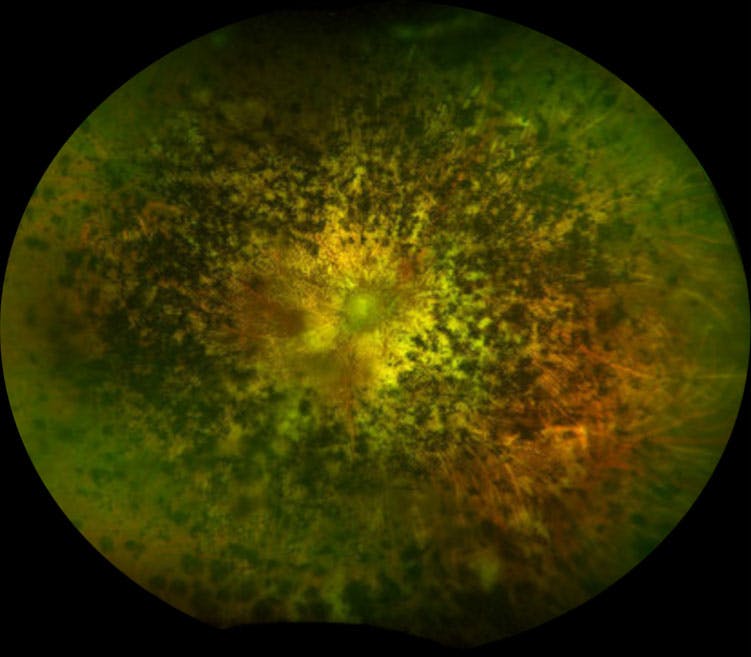
Figure 1. Fundus imaging of a patient with USH1 shows optic disc pallor, attenuated vessels, and peripheral bone spicules.
MULTIMODAL IMAGING
While the clinical ophthalmic and systemic features often indicate the diagnosis, multimodal imaging offers valuable insights that help elucidate the condition, further confirmed by positive genetic testing. Fundus autofluorescence demonstrates the characteristic hyperautofluorescent ring centrally with hypoautofluorescent mottling peripherally consistent with bone spicules (Figure 2A). Spectral-domain OCT reveals outer retinal loss with progressive shortening of the ellipsoid zone, gradually involving the fovea (Figure 2B). Full-field electroretinography usually demonstrates reduced rod photoreceptor function, with impaired cone function in advanced disease.7
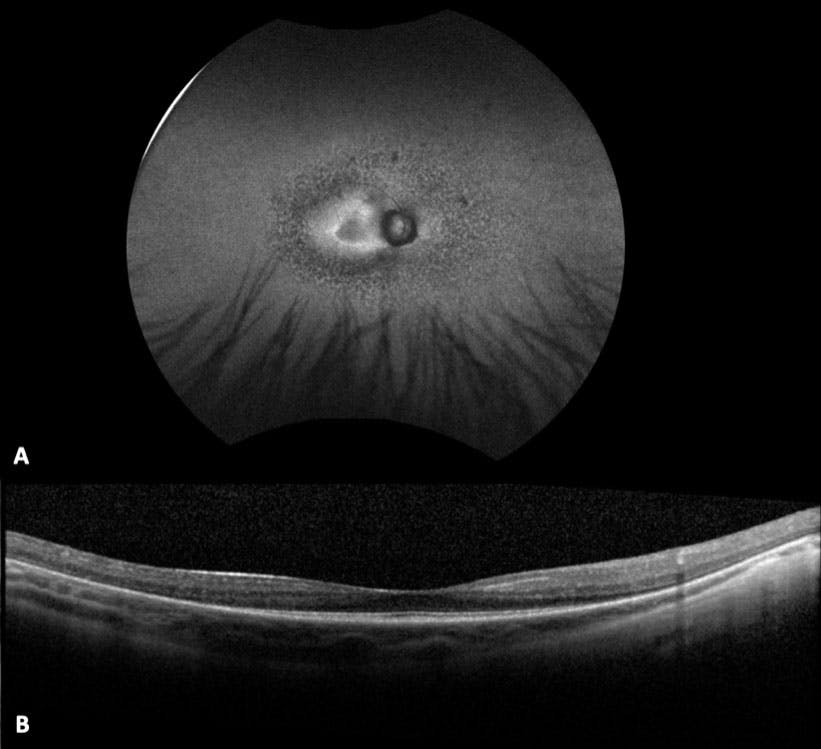
Figure 2. In this patient with Usher syndrome, fundus autofluorescence demonstrates the characteristic hyperautofluorescent ring with surrounding bone spicules (A). OCT reveals retinal pigment epithelium and photoreceptor loss, as well as progressive shortening of the ellipsoid zone, which remains preserved in the foveal region in this patient (B).
MANAGEMENT
Due to the dual vision/hearing impairment, there are several considerations during the clinic visit, including the presence of a sign language interpreter. Furthermore, the fundus examination should be performed after any activity requiring the patient’s attention, orientation, and navigation because the bright lights used during the examination can temporarily impair the patient’s ability to see the sign language interpreter. To date, treatment is symptomatic and aimed at improving function based on the severity of hearing loss and visual impairment with the assistance of vision rehabilitation services.
Similar to patients with RP, we recommend avoiding high-dose supplementation of vitamin E (greater than 30 IU/day).9 In recent analyses, vitamin A supplementation (15,000 IU/day) has not been shown to be beneficial in patients with RP and had adverse effects in patients with USH2A mutations.9 Lastly, sunglasses are recommended to avoid further damage from ultraviolet rays.
MORE RESOURCES

Foundation Fighting Blindness provides important educational resources for you and your patients, including disease state education, genetic testing, and clinical trial updates.
CLINICAL TRIALS
Several clinical trials are underway for Usher syndrome and RP, exploring both mutation-dependent and mutation-independent approaches.1
Subretinal delivery of AAVB-081 (AAVantgarde Bio) is currently being investigated for USH1B patients (carrying a mutation in MYO7A gene) in a phase 1/2 multicenter clinical trial (NCT06591793). This technology uses two AAV8 vectors to express two different halves of the MYO7A transgene, allowing for recombination of the transgenes into a single gene in the cell.
The phase 2b LUNA trial is evaluating the role of ultevursen (Sepul Bio), an antisense oligonucleotide, in patients with mutations in exon 13 in the USH2A gene (NCT06627179). Antisense oligonucleotides involve the use of specific molecules that target the mutation by creating a steric block that modifies downstream RNA processing.10
1. Castiglione A, Möller C. Usher syndrome. Audiol Res. 2022;12(1):42-65.
2. Kimberling WJ, Hildebrand MS, Shearer AE, et al. Frequency of Usher syndrome in two pediatric populations: Implications for genetic screening of deaf and hard of hearing children. Genet Med. 2010;12(8):512-516.
3. Hartong DT, Berson EL, Dryja TP. Retinitis pigmentosa. Lancet. 2006;368(9549):1795-1809.
4. Boughman JA, Vernon M, Shaver KA. Usher syndrome: Definition and estimate of prevalence from two high-risk populations. J Chronic Dis. 1983;36(8):595-603.
5. Mathur P, Yang J. Usher syndrome: Hearing loss, retinal degeneration and associated abnormalities. Biochim Biophys Acta. 2015;1852(3):406-420.
6. Magliulo G, Iannella G, Gagliardi S, et al. Usher’s syndrome type II: A comparative study of genetic mutations and vestibular system evaluation. Otolaryngol Head Neck Surg. 2017;157(5):853-860.
7. Toms M, Pagarkar W, Moosajee M. Usher syndrome: clinical features, molecular genetics and advancing therapeutics. Ophthalmol Eye Dis. 2020;12:2515841420952194.
8. Walia S, Fishman GA, Hajali M. Prevalence of cystic macular lesions in patients with Usher II syndrome. Eye. 2009;23(5):1206-1209.
9. Comander J, Weigel DiFranco C, Sanderson K, et al. Natural history of retinitis pigmentosa based on genotype, vitamin A/E supplementation, and an electroretinogram biomarker. JCI Insight. 2023;8(15):e167546.
10. Dias N, Stein CA. Antisense oligonucleotides: basic concepts and mechanisms. Mol Cancer Ther. 2002;1(5):347-355.