


With the plethora of recently approved injectables, deciding which to offer is becoming increasingly complicated. The logistical and financial considerations I discuss in this article are applicable to almost any consumable with a J-code. Assuming that comparable clinical efficacy is a given, the next logical consideration is the cost basis. Additional considerations may include time associated with drug acquisition, processing, and tracking; insurance coverage and authorizations; payment cycles; and global inventory management.
COST CONSIDERATIONS
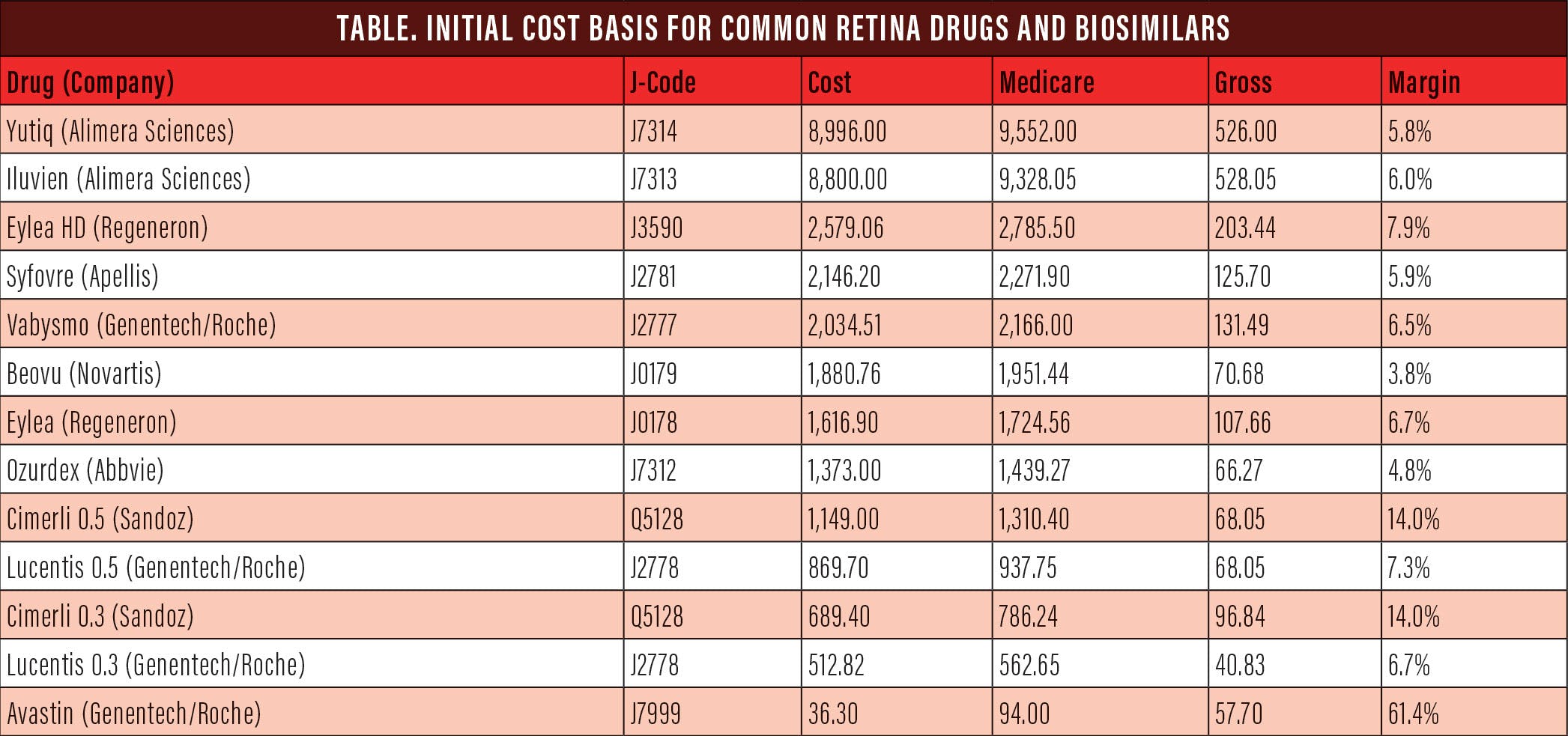
In medical school, we are taught to monitor the ins and outs of our patients, such as fluid intake versus output. Cost basis is the financial equivalent to this principle, but it’s more complicated than simply price minus purchase cost, as purchase cost can be variable, given that most insurance plans pay a negotiated percentage of listed CMS rates. Because the percentage varies between individual commercial plans and practices, I will focus on the CMS.1 The table represents common injectable costs for Q1 2024 (these examples, while accurate, are solely meant for illustrative purposes). Notice that the average allowable markup is 6% to 7%, and the margins for biosimilars and bevacizimab (Avastin, Genentech/Roche) are notably higher, ranging from 14% to 60%. Theoretically, the CMS-regulated price should help minimize any financial incentive to use higher-priced medications.
For comparison, the common markup in retail varies from 15% for regular groceries to as much as 500% for wine at an upscale restaurant. The typical retail percentage is 50%, however, known as the keystone markup.2
CPT Codes
The second component regarding reimbursement is the associated CPT code fee for the actual procedure. Most injection procedures pay around $110 (CPT 67028). However, different injection procedures require varying amounts of time to perform. Refilling a surgical reservoir takes longer than a standard intravitreal injection, and an injection using a prefilled syringe takes less time than one that requires drawing medication from a vial. Anesthesia requirements also add cost and procedural time.
Pharmacy Rebate Offers
To further convolute the issue of effective purchase price, most pharmaceutical companies offer rebates or discount programs. Typically, these are volume-based programs; the more units you order (and presumably use), the greater the benefit in terms of the rebate amount. The perks range from cash rebates to discounted pricing on future purchases. These programs can present both an ethical dilemma and potential tax issues, which are beyond the scope of this article.
Intangible Factors
Calculating the “output” is more difficult because there are both tangible and intangible factors, such as time. How much time are you spending on billing issues such as authorization, resubmittals, and appeals? How much chair time is needed for the workup, consent, questions, and actual procedure? Do you have to answer questions regarding biosimilars, off-label usage, or direct-to-consumer marketing? Do you have to explain step therapy or preauthorization? Even if you delegate almost the entire encounter to your staff, you still have to cover their payroll.
Payment Schedule
The next potential landmine is the payment cycle—the time between purchase and payment. The clock starts the moment you order from the distributor. There is the deadtime between delivery and actual use, the delay between filing the claim and the insurer graciously deciding to honor their contract by actually reimbursing you. The clock ends with your credit card or purchase order due date.
The average payment time for a “clean claim” varies from 3 to 4 weeks. To help attenuate the monetary whiplash imposed by insurance denials and resubmittals, most vendors offer a payment grace period between 30 and 180 days, although this is a courtesy and may be changed. Some practices will try and extend their payment window or further maximize profit by purchasing drugs with credit cards. Depending on the volume of your practice, you may have a floating financial exposure of $5 to $10 million.
WHAT CAN GO WRONG?
Once upon a time (February 21, 2024, actually), there was a cyberattack. Physicians witnessed firsthand the potential practice-ending catastrophe of not being able to pay their credit card bill. As a major clearing house for prescriptions, insurance claims, and payment, Change Healthcare’s disruption effectively crippled medical services for a substantial part of the United States. Practices were at risk of bankruptcy due to lack of cash flow; the American Medical Association published the results of an informal survey assessing the effects on practices.3 Practices reported losing revenue due to the inability to either fill or get paid on claims, extra staff time was required for successful claims, and some physicians considered closing their practices, selling to either a private equity firm or a hospital system, or using their personal savings to cover payroll.
WHAT CAN WE DO?
There is an entire discipline dedicated to the deadtime between product purchase and delivery and usage. On-demand supply, management strategies such as LEAN, and data analytics/logistics were developed to better manage the supply chain. The great toilet paper crisis of 2020 showed what happens when the chain gets tangled. It is not that there was a shortage of product—there was an inability to distribute. Every minute your drug sits in storage negatively affects your cost basis. There is the impending payment due date and the intrinsic cost of storage. Furthermore, there is the cost of drug management. Lost/wasted medication is expensive. How much storage space does your inventory require? Will you need another refrigerator if you add another product line? How much time is required to track and check inventory? Refrigerators, management software, and payroll are all expensive as well.
As Dr. Leonard “Bones” McCoy, the greatest physician of the 24th century within the Star Trek universe, said, “Dammit Jim, I am a doctor, not a [insert title here].” There are simply too many factors to keep track of, not to mention you still have to make time to be a physician. The AAO, the American Academy of Ophthalmic Executives, and the American Society of Retina Specialists provide a wealth of information and assistance. My advice: Hire and empower the proper staff, and “trust but verify.”
1. Physician fee schedule. Centers for Medicare & Medicaid Services. Accessed November 13, 2024. www.cms.gov/medicare/payment/fee-schedules/physician
2. Dela Cruz A. Retail Markup Definition, Calculation & Formula. Accessed November 14, 2024. study.com/academy/lesson/initial-maintained-retail-markup-definition-calculation.html
3. Change Healthcare cyberattack impact. American Medical Association. Accessed November 13, 2024. www.ama-assn.org/system/files/change-healthcare-survey-results.pdf


