A 39-year-old woman presented with low vision since infancy. Her medical history included epilepsy, microcephaly, short stature, brachydactyly, and intellectual impairment. Her BCVA was 20/200 OU.
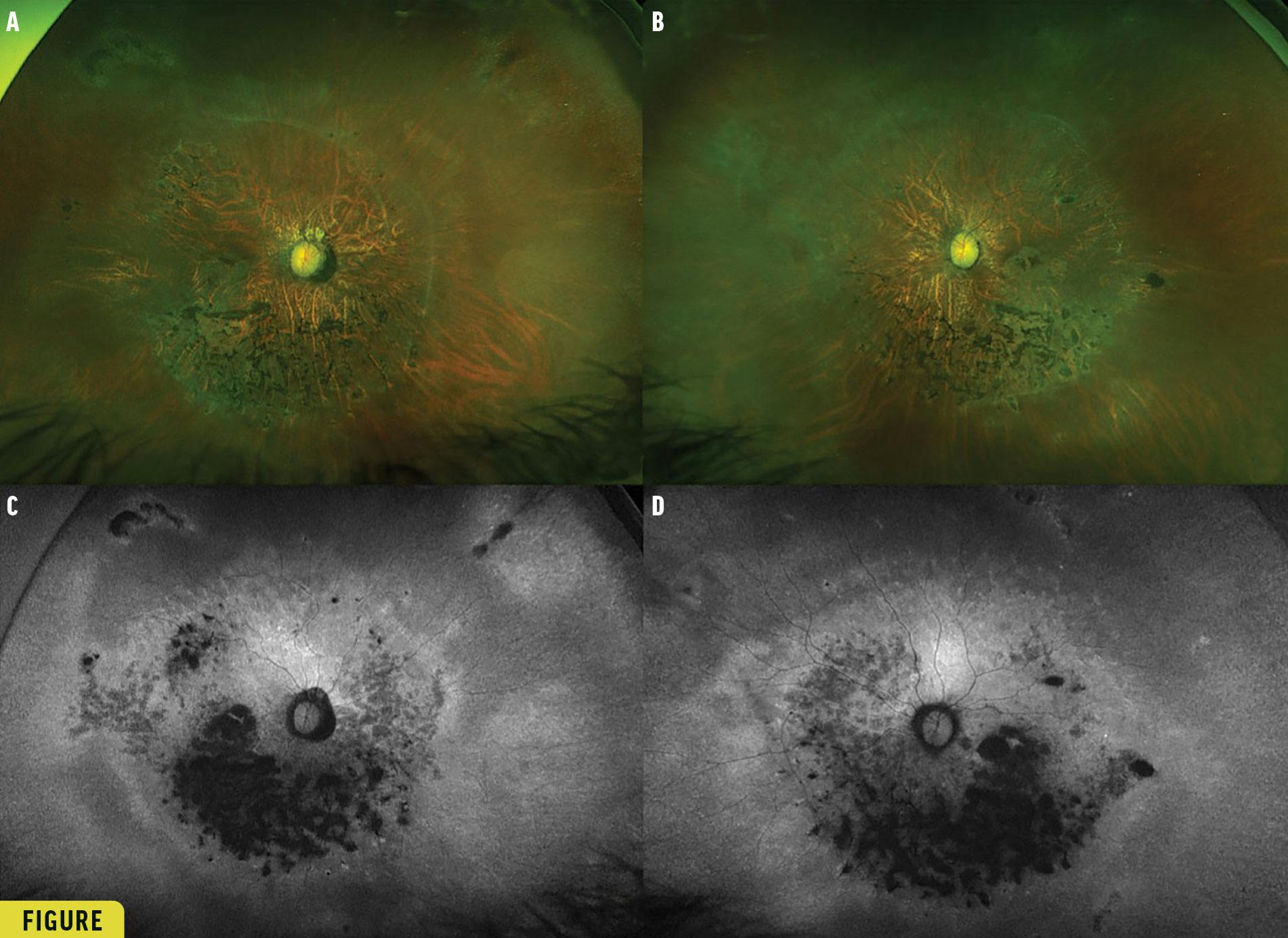
Fundus examination revealed bilateral pale optic discs, attenuated vessels, diffuse retinal pigment epithelial degeneration, and symmetric pigment clumping in the posterior pole and inferior midperiphery, which was visible on ultra-widefield fundus photography (Figure A, B). Fundus autofluorescence revealed a corresponding symmetric, irregular comet-shaped area of decreased autofluorescence located inferiorly (Figure C, D).
NEXT STEP: GENETIC TESTING
Whole-exome sequencing revealed a likely pathogenic frameshift variant in the gene KIF11 (NM_004523.4:c.1912del p.(Met638*)), which is responsible for encoding a motor protein belonging to the kinesin-like protein family. Mutations in the KIF11 gene are recognized as a cause of an autosomal dominant disorder characterized by microcephaly with or without chorioretinopathy, lymphedema, and intellectual disability.1,2 In our case, the patient’s impaired vision was primarily attributable to pathological manifestations of chorioretinopathy.
If you have images you would like to share, email Manish Nagpal, MS, FRCS, FASRS, at drmanishnagpal@yahoo.com.
Note: Photos should be 400 dpi or higher and at least 10 inches wide.
1. Li JK, Fei P, Li Y, et al. Identification of novel KIF11 mutations in patients with familial exudative vitreoretinopathy and a phenotypic analysis. Sci Rep. 2016;6:26564.
2. Malvezzi JV, H Magalhaes I, S Costa S, et al. KIF11 microdeletion is associated with microcephaly, chorioretinopathy and intellectual disability. Hum Genome Var. 2018;5:18010.