


Recently, advances in multimodal imaging have allowed retina specialists to identify and characterize previously unrecognized diseases. One such discovery is multizonal outer retinopathy and retinal pigment epitheliopathy (MORR), a condition that presents with disctint clinical and imaging features.1
Although initially misclassified under the broad umbrella of acute zonal occult outer retinopathy (AZOOR), MORR stands apart as a unique entity.2 With its hallmark outer retinal and retinal pigment epithelium (RPE) alterations, striking changes observed on fundus autofluorescence (FAF), and a distinct progression pattern involving both the peripapillary and far-peripheral retina, MORR demands attention from the retina community. In this article, I introduce the clinical features and imaging characteristics of MORR and discuss its significance in retinal diagnostics and patient management.
BACKGROUND: AZOOR AND MORR
AZOOR was first described in 1992, characterized by rapid loss of outer retinal function in one or more zones and often presenting with scotomata, photopsia, and minimal fundoscopic changes.3 Over time, AZOOR has been applied to a variety of retinal conditions with similar symptoms, leading to diagnostic confusion. The advent of multimodal imaging has provided a clearer understanding of diseases that affect the outer retina, including MORR.2
MORR was identified through a retrospective review of patients previously diagnosed with AZOOR. MORR is defined by a unique pattern of outer retinal disruption, particularly affecting the RPE and photoreceptors, and is marked by distinct imaging features that allow it to be differentiated from AZOOR and other white-dot syndromes. With a chronic and progressive nature, MORR affects multiple retinal zones and demonstrates a characteristic pattern of disease progression, making early recognition and management essential for retina specialists.1
CLINICAL PRESENTATION AND MULTIMODAL IMAGING
MORR primarily affects middle-aged adults, with most cases presenting bilaterally. Key symptoms include bilateral scotomata, photopsia, and lesions in the peripapillary and far-peripheral retina. Unlike AZOOR, which can be occult and challenging to detect early, MORR exhibits well-defined fundoscopic changes that can be visualized on imaging, even in the initial stages of the disease.1 Funduscopic examination of MORR typically shows a peripapillary lesion characterized by a well-defined, yellow-gray zone of RPE alterations and bordered by a thin demarcation line of pigmentary changes.
Multimodal imaging is crucial in diagnosing MORR. On FAF imaging, peripapillary lesions are characterized by a speckled hyperautofluorescent core surrounded by a demarcation line of hyperautofluorescence, which can be continuous or interrupted with fringe-like hyperautofluorescent features radiating outward. In more advanced cases, this demarcation line becomes thinner and less defined as the disease progresses.
OCT imaging provides additional insights into MORR’s progression. Early lesions typically show RPE disruption, with areas of focal RPE atrophy interspersed with intact tissue. As the disease advances, OCT imaging reveals complete RPE atrophy, loss of the ellipsoid zone, and thinning of the outer nuclear layer. Importantly, the inner retina remains unaffected, helping to distinguish MORR from other retinal degenerations. Fluorescein angiography (FA) typically shows a window defect due to the disruption of the RPE (Figure 1).1
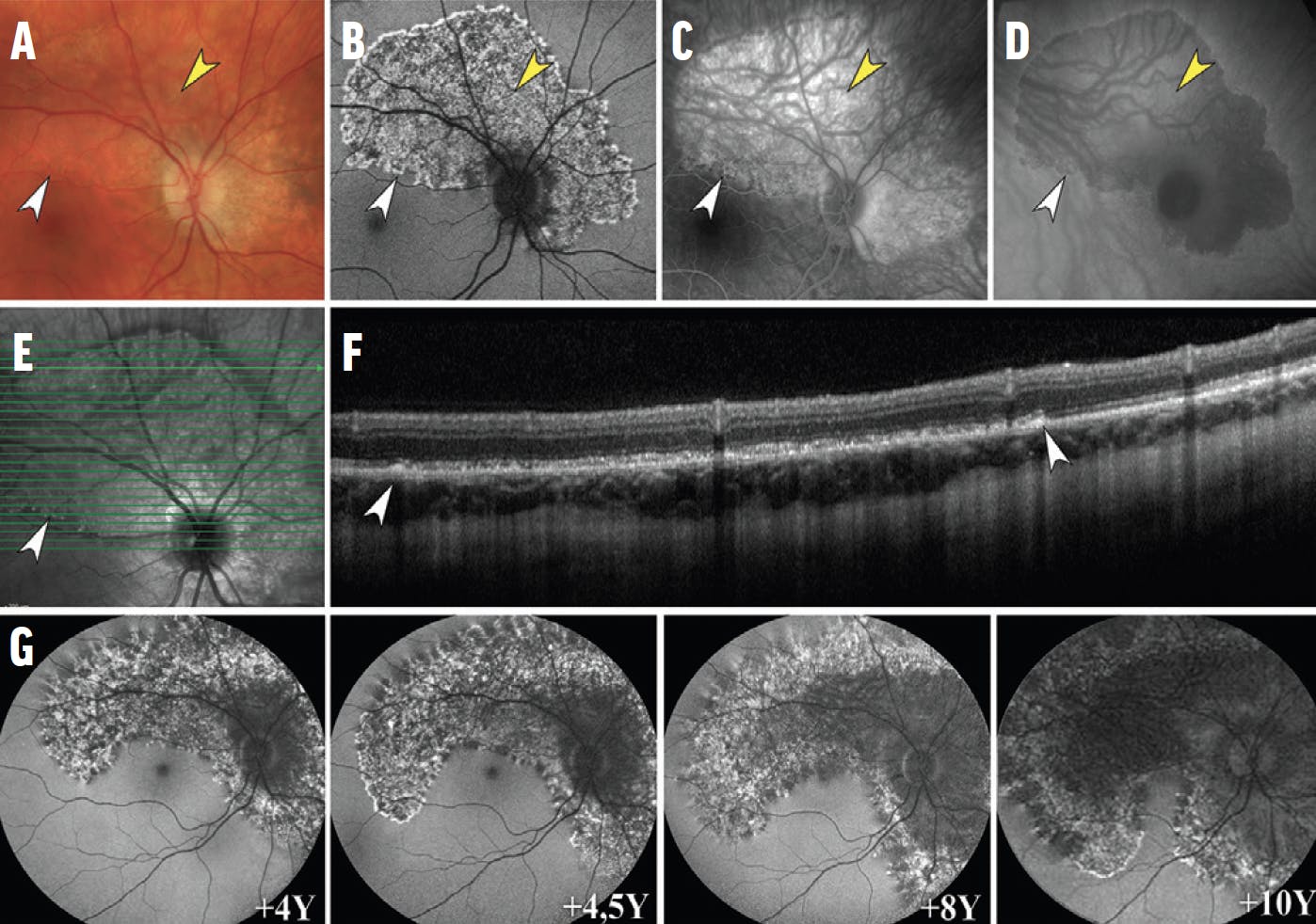
Figure 1. At baseline, color fundus photography (A) of the right eye shows a peripapillary lesion characterized by a well-demarcated yellow-gray core of RPE alterations (yellow arrowhead) bordered by a thin hyperpigmented demarcation line (white arrowhead). The FAF image (B) shows the peripapillary lesion characterized by a speckled hyperautofluorescent core (yellow arrowhead) surrounded by a thin, continuous, hyperautofluorescent demarcation line (white arrowhead). Intermediate-phase FA (C) shows a hyperfluorescent peripapillary core (window defect, yellow arrowhead) and blockage of the pigmented demarcation line (white arrowhead). Note the absence of optic disc or retinal vascular staining or leakage. Late-phase ICG angiography (D) shows hypofluorescence of the peripapillary core (reduced RPE uptake, yellow arrowhead). The demarcation line shows no distinctive features on ICG angiography (white arrowhead). The near-infrared reflectance image (E) shows the peripapillary lesion with hyperreflective changes within the demarcation line (white arrowhead). The corresponding OCT B-scan (F) shows RPE disruption at the core, including RPE thickening interspersed with focal RPE atrophy (between white arrowheads). The hyperautofluorescent demarcation line colocalizes with focal RPE mottling (white arrowheads). The ellipsoid zone is attenuated but still visible above the areas of RPE alterations. Follow-up FAF images (G) acquired up to 10 years later show centrifugal extension of the hypoautofluorescent core and shifting of the demarcation line toward the periphery. Note the episodic pattern of progression.
Additionally, ultra-widefield imaging plays a key role in detecting far-peripheral lesions, which are often missed by standard imaging techniques. Far-peripheral lesions can be identified in the early stages of the disease and may act as an important diagnostic marker (Figures 2 and 3).1
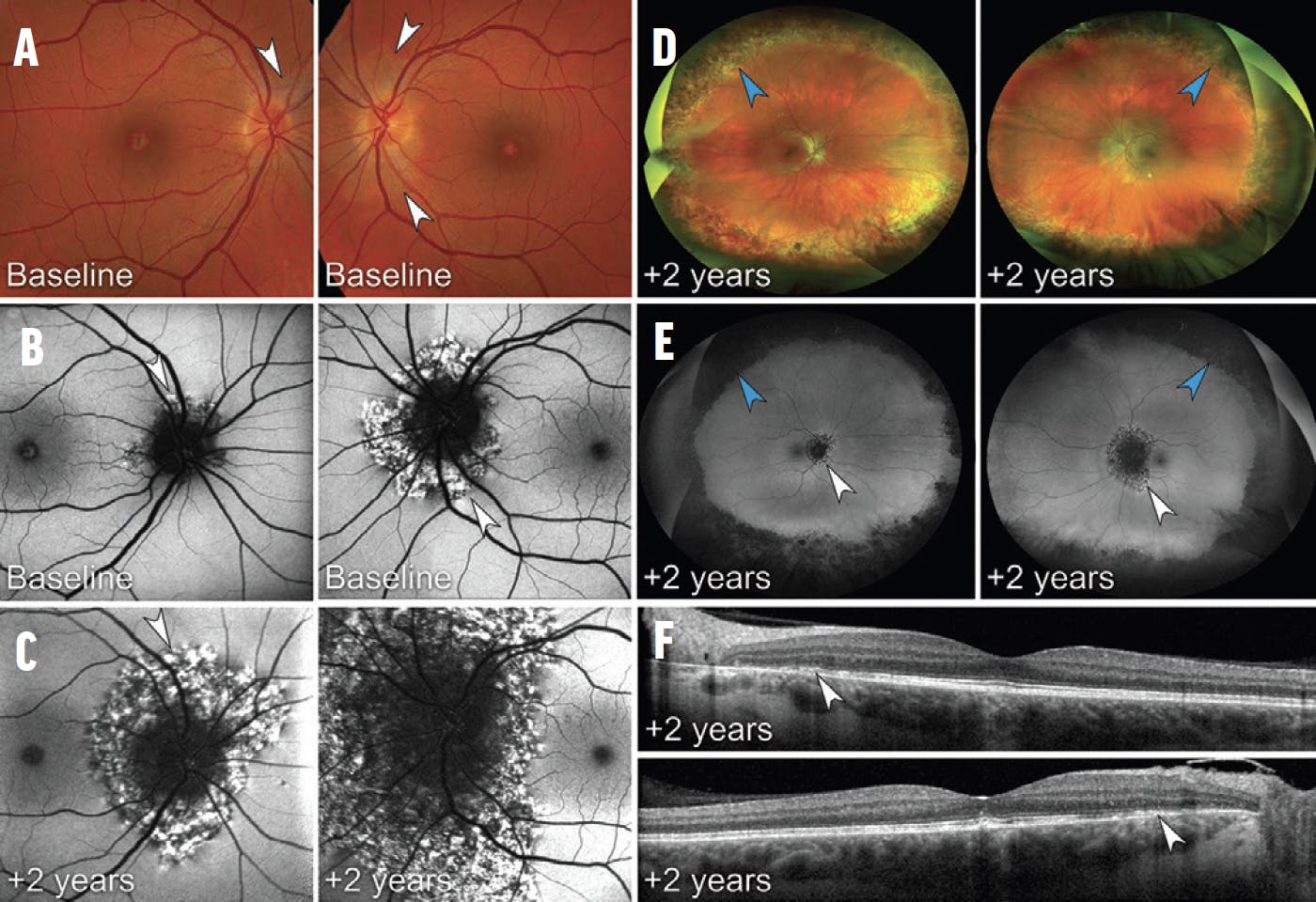
Figure 2. At baseline, color fundus photography (A) of the right eye shows a subtle peripapillary gray lesion of the RPE (white arrowhead). The left eye shows a more apparent peripapillary gray lesion of the RPE surrounded by an orange demarcation line (white arrowheads). FAF (B) of the right eye shows a subtle peripapillary lesion with hyperautofluorescent features (white arrowhead). The left eye shows a peripapillary lesion with a speckled hyperautofluorescent core surrounded by a thin, continuous, hyperautofluorescent demarcation line (white arrowhead). At 2 years, FAF images (C) of the right and left eye show centrifugal progression of the peripapillary lesions characterized by a hypoautofluorescent core surrounded by a large interrupted demarcation line with fringe-like hyperautofluorescent features radiating outwards (white arrowhead). Ultra-widefield pseudocolor fundus photographs (D) of the right and left eye show far-peripheral lesions characterized by well-demarcated 360° annular zones of RPE atrophy accompanied by large spots of RPE hyperpigmentation (blue arrowheads). The ultra-widefield FAF images (E) of the right and left eye show peripapillary lesions (white arrowheads) and far-peripheral annular lesions (blue arrowheads). OCT B-scans (F) through the fovea of the right and left eye show peripapillary RPE disruption and attenuation of the ellipsoid zone (white arrowheads).
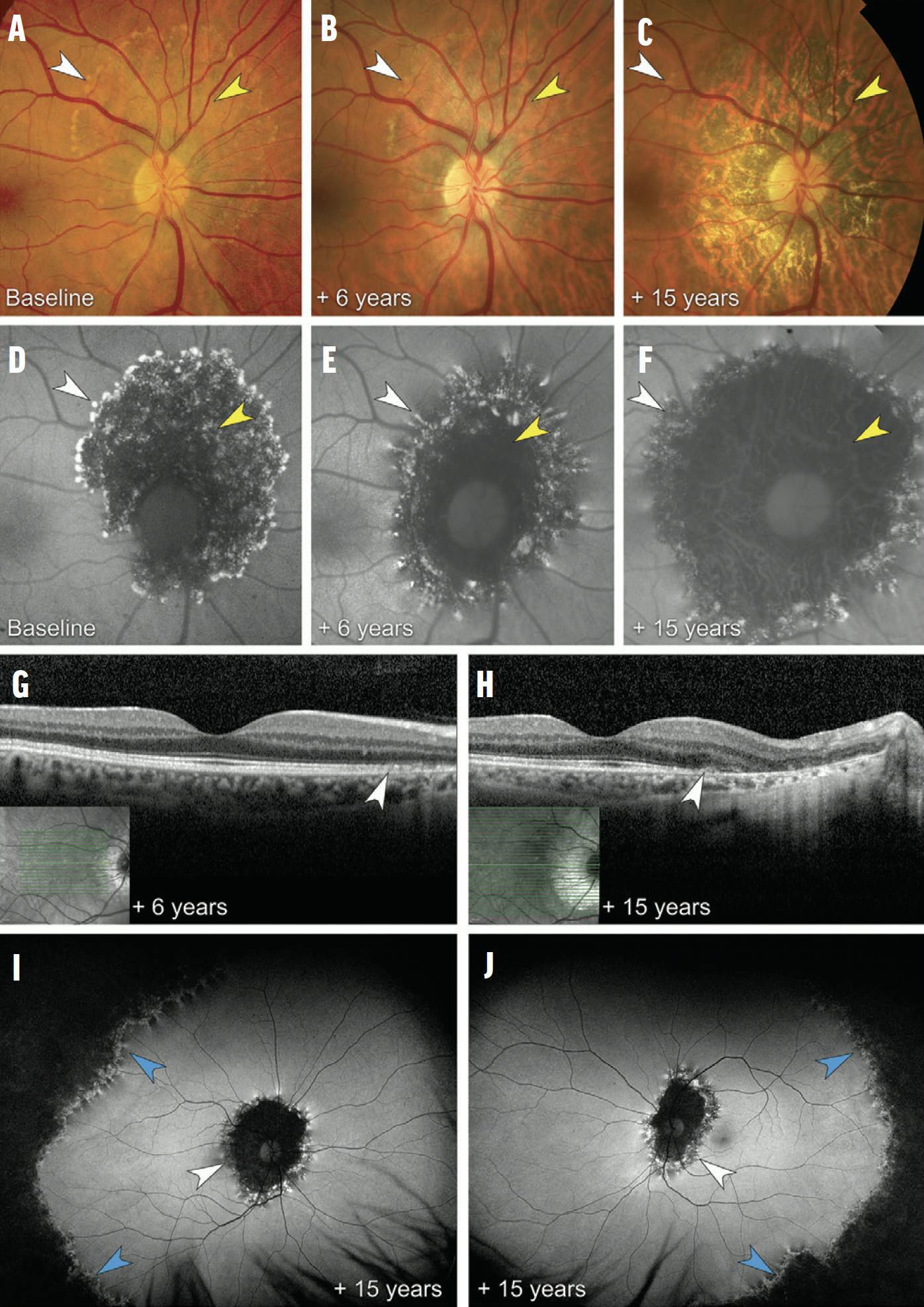
Figure 3. At baseline, color fundus photography (A) of the right eye shows a well-demarcated yellow-gray core of RPE alterations (yellow arrowhead) bordered by a thin, yellowish, drusen-like demarcation line (white arrowhead). At 6 years (B), the peripapillary lesion (yellow arrowhead) is stable, and attenuation of the demarcation line (white arrowhead) is noted. At 15 years (C), centrifugal progression of the peripapillary lesion is noted. The core (yellow arrowhead) shows extension of the RPE atrophy and increased visibility of the choroidal vasculature. The demarcation line is shifted toward the periphery (white arrowhead). At baseline, the FAF image (D) shows a speckled hyperautofluorescent core (yellow arrowhead) surrounded by a thin, continuous, hyperautofluorescent demarcation line (white arrowhead). At 6 years (E), extension of the hypoautofluorescent core (yellow arrowhead) is noted. The pattern of the demarcation line progresses into a larger interrupted border with fringe-like hyperautofluorescent features radiating outwards (white arrowhead). At 15 years (F), centrifugal extension of the hypoautofluorescent core (yellow arrowhead) is noted. The demarcation line is shifted toward the periphery (white arrowhead). Note the thinning of the demarcation line and the reduced amount of hyperautofluorescent features radiating outwards. At 6 years, the OCT B-scan (G) through the fovea shows subtle RPE alterations in the peripapillary area (white arrowhead). The overlying ellipsoid zone is attenuated. At 15 years (H), progression of the RPE atrophy toward the fovea (white arrowhead) is noted. At 15 years, ultra-widefield FAF images of the right (I) and left (J) eye show bilateral intermediate-stage peripapillary lesions (white arrowheads). Note the far-peripheral, annular hypoautofluorescent lesions bordered by an interrupted demarcation line with fringe-like hyperautofluorescent features (blue arrowheads).
NATURAL HISTORY AND PROGRESSION
MORR is a chronic, gradually progressive disease characterized by episodic bursts of rapid lesion expansion, interspersed with periods of relative stability. It follows a stereotypical pattern of progression, with peripapillary lesions extending centrifugally from the optic disc toward the periphery, while far-peripheral lesions progress centripetally. Over time, these two zones can converge, leading to widespread outer retinal and RPE atrophy (Figure 4).1
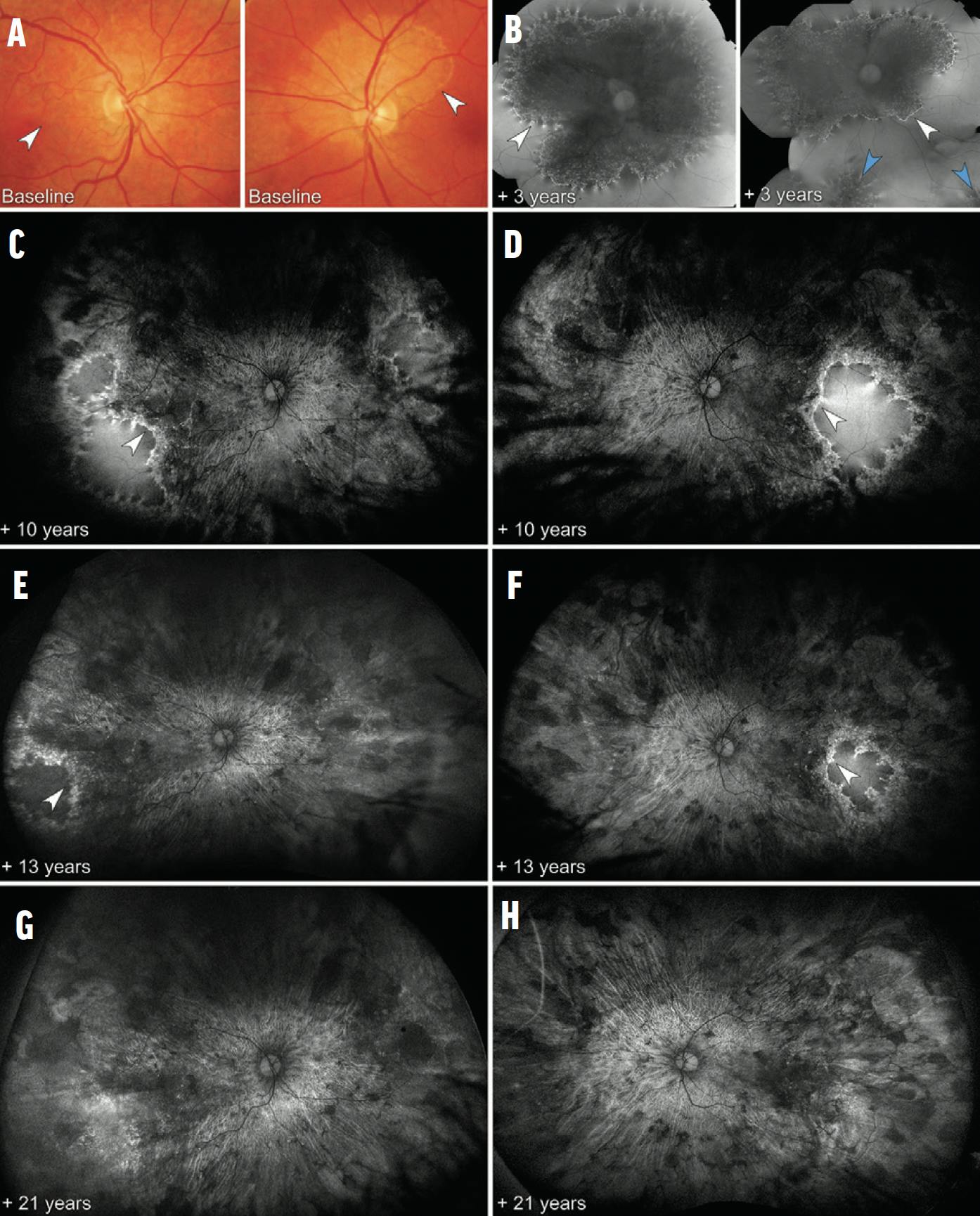
Figure 4. At baseline, fundus photography (A) of the right eye shows peripapillary RPE alterations involving the fovea (white arrowhead) and a well-demarcated, peripapillary yellowish-gray lesion surrounded by an orange demarcation line in the left eye (white arrowhead). At 3 years, FAF images (B) of the right eye show a peripapillary lesion with a hypoautofluorescent core and a large interrupted demarcation line with fringe-like hyperautofluorescent features (white arrowhead). The left eye shows lesion progression with a hypoautofluorescent core and a large interrupted demarcation line with fringe-like hyperautofluorescent features (white arrowhead). Note the far-peripheral lesions bordered by a large interrupted demarcation line with fringe-like hyperautofluorescent features (blue arrowheads). The ultra-widefield FAF images of the right and left eye, acquired at 10 (C and D), 13 (E and F), and 21 (G and H) years, show the peripapillary lesion (white arrowheads) with centrifugal extension of the hypoautofluorescent core and shifting of the demarcation line toward the periphery. Merging of the peripapillary and far-peripheral lesions resulted in complete outer retinal and RPE degeneration at the final visit.
While some patients present with fovea-sparing lesions, many develop foveal involvement, causing significant visual impairment. The mean final BCVA in MORR is approximately 20/200, with some cases progressing to hand-motion vision.1
DIFFERENTIATING MORR FROM OTHER RETINAL DISEASES
One of the most significant challenges with MORR is differentiating it from other retinal conditions, such as AZOOR and idiopathic multifocal choroiditis. AZOOR typically involves a rapid onset of visual field loss and minimal fundoscopic changes, while idiopathic multifocal choroiditis presents with inflammatory chorioretinal lesions. MORR, however, is distinct in its imaging and clinical presentation.2
Unlike AZOOR, which may be difficult to detect early due to the absence of clear fundoscopic signs, MORR shows well-demarcated lesions on imaging from the onset. Its characteristic multizonal involvement, affecting both the peripapillary and far-peripheral retina, sets it apart from other conditions. In addition, genetic testing performed on MORR patients has not revealed any correlation with inherited retinal diseases, differentiating it from conditions such as autosomal dominant vitreoretinochoroidopathy.1
MANAGEMENT IMPLICATIONS
Recognizing MORR as a unique retinal condition carries significant implications for retina specialists. Early diagnosis is crucial in managing its progression and mitigating the risk of complications such as subretinal fibrosis and choroidal neovascularization. Multimodal imaging such as FAF and OCT plays a critical role in identifying MORR and allowing clinicians to monitor disease progression over time.1
While no standardized treatment protocol exists for MORR, immunosuppressive therapies, including corticosteroids and anti-TNF agents, have been used in some cases, although with limited effectiveness.1 Long-acting intravitreal corticosteroid implants have shown promise in certain patients, offering temporary stabilization or even regression of the lesions. However, further research is needed to determine the most effective treatment approach for MORR.1
ATTENTION TO DETAIL
MORR represents a newly recognized clinical entity with distinct imaging characteristics that set it apart from other retinal diseases. Its hallmark features include both peripapillary and far-peripheral lesions, which follow a stereotypical progression pattern. This distinct combination of clinical presentation and imaging findings underscores the importance of early recognition of MORR, particularly with multimodal and ultra-widefield imaging techniques.
1. Ramtohul P, Marchese A, Introini U, et al. Multizonal outer retinopathy and retinal pigment epitheliopathy (MORR): a newly recognized entity or an unusual variant of AZOOR? Retina. 2023;43:1890-1903.
2. Cicinelli MV, Ramtohul P, Marchese A, et al. Latest advances in white spot syndromes: new findings and interpretations. Prog Retin Eye Res. 2023;97:101207.
3. Gass JDM. Acute zonal occult outer retinopathy. Retina. 2003;23(6 Suppl):79-97.


