




The advent of AI is set to redefine the landscape of eye care. This transformative technology, especially using AI chatbots powered by large language models (LLMs) such as ChatGPT and Google Gemini, promises a new era of efficiency and precision in diagnosing and treating retinal diseases. The integration of these advanced tools into clinical practice could significantly enhance patient management, streamline workflows, and improve overall outcomes. Although the potential benefits are vast, several challenges must be addressed before AI can seamlessly integrate into everyday clinical practice.1
EXAMPLES OF AI IN RETINA
Several AI-powered devices based on deep-learning algorithms have already received regulatory approval and have been implemented into retinal imaging software. For example, RetinAI Discovery (Retinai) works with color fundus photography and OCT to identify biomarkers in diseases such as diabetic retinopathy, AMD, and epiretinal membranes. In addition, VUNO Med-Fundus AI (Vuno) identifies biomarkers and provides heatmaps of abnormal findings for these conditions. RetInSight Fluid Monitor (RetInSight) quantifies intraretinal and subretinal fluid on OCT images to assist physicians in managing neovascular AMD. Finally, the Scanly Home OCT Monitoring Program (Notal Vision) uses AI to enable more frequent monitoring of AMD, diabetic macular edema, and retinal vein occlusion by automating the detection of retinal fluid.2
These applications have demonstrated the practical value of AI in enhancing diagnostic accuracy and treatment planning. By segmenting OCT images and linking them to real-world referral recommendations, AI contributes to more proactive interventions and, potentially, better outcomes for patients. However, more research is needed to ensure these devices are safe and effective, which requires collaboration between clinicians, researchers, and regulatory bodies.
ADVANTAGES OF AI IN DIAGNOStiCS
AI tools can assist in the diagnostic process by automating routine tasks, analyzing imaging data, flagging potential abnormalities, and providing detailed reports. Moreover, the ability of AI to analyze vast amounts of data and identify patterns facilitates the development of personalized treatment plans by considering individual patient characteristics and predicting disease progression. To this point, AI chatbots have demonstrated remarkable capabilities in suggesting surgical plans for retinal detachment (RD) based on the analysis of RD records. In our study, we found that ChatGPT-4 achieved an 84% agreement with expert vitreoretinal surgeons when proposing plans for RD repair (Figure).3
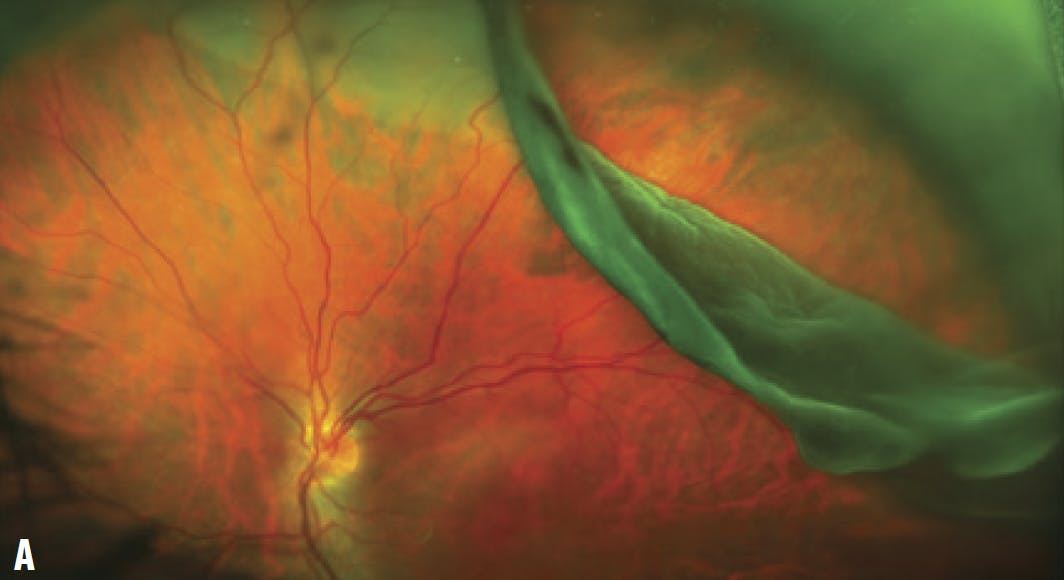
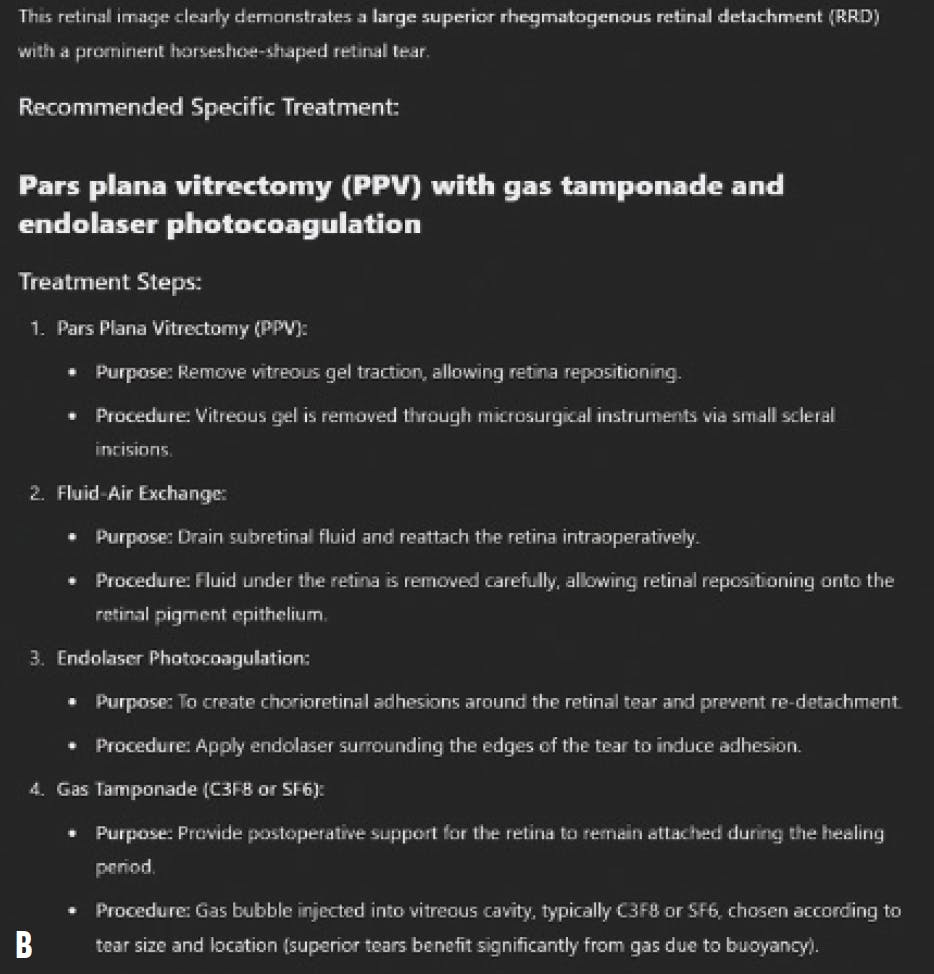
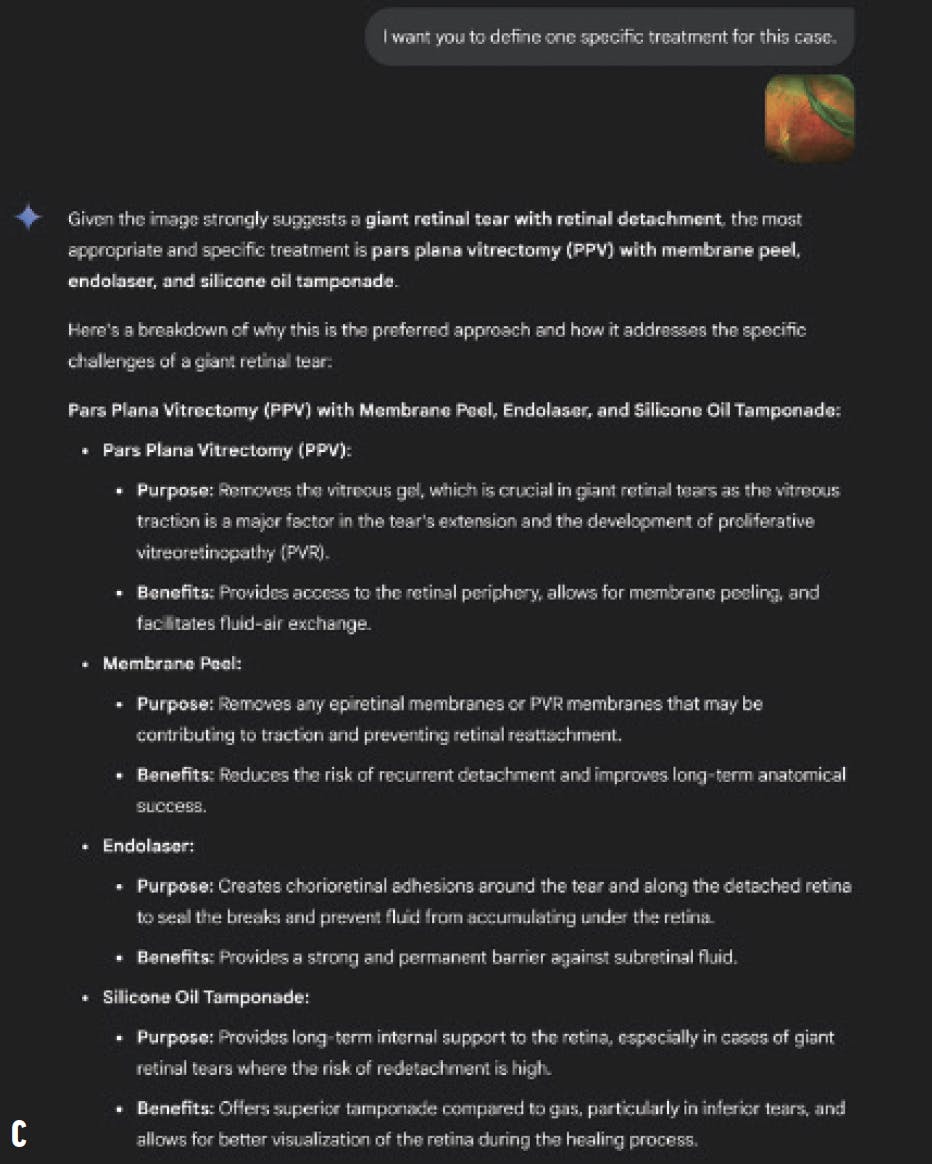
Figure. An image of a rhegmatogenous RD with a giant tear (A) was fed to two AI chatbots, ChatGPT-4.5 (B) and Gemini 2.0 (C), which provided suggestions for surgical management.
While impressive, these results were inherently limited by a lack of multimodal integration of data from diverse sources, which is key for real-world application of LLMs.3 These shortfalls have been addressed in newer chatbots, which now offer the ability to integrate data from numerous sources. In a more recent study from our group, ChatGPT-4’s diagnostic capabilities were tested on OCT and OCT angiography scans and achieved a 78% accuracy rate for various retinal diseases, outperforming Gemini Advanced.4 These findings underscored the cutting-edge potential of AI-assisted diagnosis.
CHALLENGES WITH AI
Integrating AI into clinical workflows presents several hurdles, such as the limited diagnostic capability of current LLMs. While it can excel at identifying common retinal conditions, it often struggles with rarer diseases or complex cases. This limitation suggests there is a need for continuous training and refinement of algorithms to expand their diagnostic capabilities. In addition, realizing the full potential of AI requires the seamless integration of various data sources, including the patient’s clinical history, tests and imaging, genetic information, and lifestyle factors. A holistic understanding of the patient’s condition is essential for developing precise and personalized treatment strategies.5
Various ethical considerations loom large in the adoption of AI in health care, such as data privacy, algorithmic bias, and potential misuse, which cannot be ignored. Establishing robust ethical frameworks and guidelines is warranted to ensure responsible development and deployment of these tools.6 It is crucial to emphasize that AI chatbots should augment, never replace, the role of ophthalmologists; maintaining human oversight remains essential for patient safety and the appropriate application of AI insights.
Another factor is the lack of a standardized regulatory pathway for AI-enabled medical devices, which poses potential risks related to patient safety and efficacy.
A critical aspect of AI integration is the development of a collaborative ecosystem in which AI and human expertise work in synergy. As AI technology evolves, the capabilities of these chatbots to analyze increasingly complex data, including multimodal inputs such as videos and photos, will expand. This future necessitates ongoing research and development to address current limitations, refine algorithms, and expand the scope of AI applications in retina care.
THE FUTURE IS HERE
The integration of AI chatbots into the retina care offer the potential to revolutionize patient management by enhancing efficiency, precision, and personalization in treatment strategies. However, realizing this potential requires overcoming several challenges, including expanding diagnostic capabilities, ensuring multimodal data integration, and establishing robust regulatory and ethical frameworks. The journey toward fully integrating AI into retina care is only beginning, but the goal is clear: a future in which AI augments human expertise to deliver better patient outcomes.
1. Momenaei B, Mansour HA, Kuriyan AE, et al. ChatGPT enters the room: what it means for patient counseling, physician education, academics, and disease management. Curr Opin Ophthalmol. 2024;35(3):205-209.
2. Danese C, Kale AU, Aslam T, et al. The impact of artificial intelligence on retinal disease management: Vision Academy retinal expert consensus. Curr Opin Ophthalmol. 2023;34(5):396-402.
3. Carla MM, Gambini G, Baldascino A, et al. Exploring AI-chatbots’ capability to suggest surgical planning in ophthalmology: ChatGPT versus Google Gemini analysis of retinal detachment cases. Br J Ophthalmol. 2024;108(10):1457-1469.
4. Carla MM, Crincoli E, Rizzo S. Retinal imaging analysis performed by ChatGPT-4o Aad Gemini Advanced: the turning point of the revolution? [Preprint published December 11, 2024]. Retina.
5. Sabaner MC, Anguita R, Antaki F, et al. Opportunities and challenges of chatbots in ophthalmology: a narrative review. J Pers Med. 2024;14(12):1165.
6. Ning Y, Teixayavong S, Shang Y, et al. Generative artificial intelligence and ethical considerations in health care: a scoping review and ethics checklist. Lancet Digit Health. 2024;6(11):e848-e856.

-1_1748961738.jpg?auto=compress,format&w=70)


