






Peripheral exudative hemorrhagic chorioretinopathy (PEHCR) is a rare, degenerative disease of the choroid and retina characterized by subretinal or sub-retinal pigmented epithelium (RPE) hemorrhage and an exudative mass outside the macula, usually near the periphery. It predominantly affects elderly (ie, mean age of 80 years of age) female patients and can be unilateral or bilateral.1 Because of the far peripheral location of these lesions and their variable presentations, diagnosis may be difficult; consequently, PEHCR is sometimes mistaken for other ocular conditions, such as choroidal melanoma or retinal detachment (RD). Although the exact etiology is unknown, systemic hypertension has been found in approximately 51% of patients.1 Additionally, research has suggested possible associations with AMD and polypoidal choroidal vasculopathy, given their similar hemorrhagic and exudative properties.2
This article details a case example of PEHCR and provides an overview of the pertinent literature on various management approaches.
CASE REPORT
An 81-year-old man presented on an emergency basis with cloudy, obscured vision in his left eye for 1 to 2 days. His past medical history included type 2 diabetes, and his ocular history included chronic subtotal RD and vitreous syneresis in his right eye, epiretinal membrane that was worse in his right eye than his left, and nuclear sclerosis in each eye. He denied symptoms of RD. His BCVA at presentation was 20/30 OD and 20/40 OS with no improvement with pinhole. A dilated examination revealed a new posterior vitreous detachment in his left eye.
Four days after presentation, fundus photography revealed an inferotemporal and inferonasal opaque elevation in his left eye with a white exudative pattern, appearing yellow and green on pseudocolor widefield imaging (Figure 1). Early-frame widefield fluorescein angiography (FA) of his left eye demonstrated appropriate filling times but with limited visualization of the inferotemporal area and a blocking defect (Figure 2). Late-frame widefield FA of the left eye showed central leakage consistent with cystoid macular edema (CME) and peripheral subretinal vascular leakage inferotemporally, likely due to hemorrhage (Figure 3). A diagnosis of PEHCR was subsequently made.
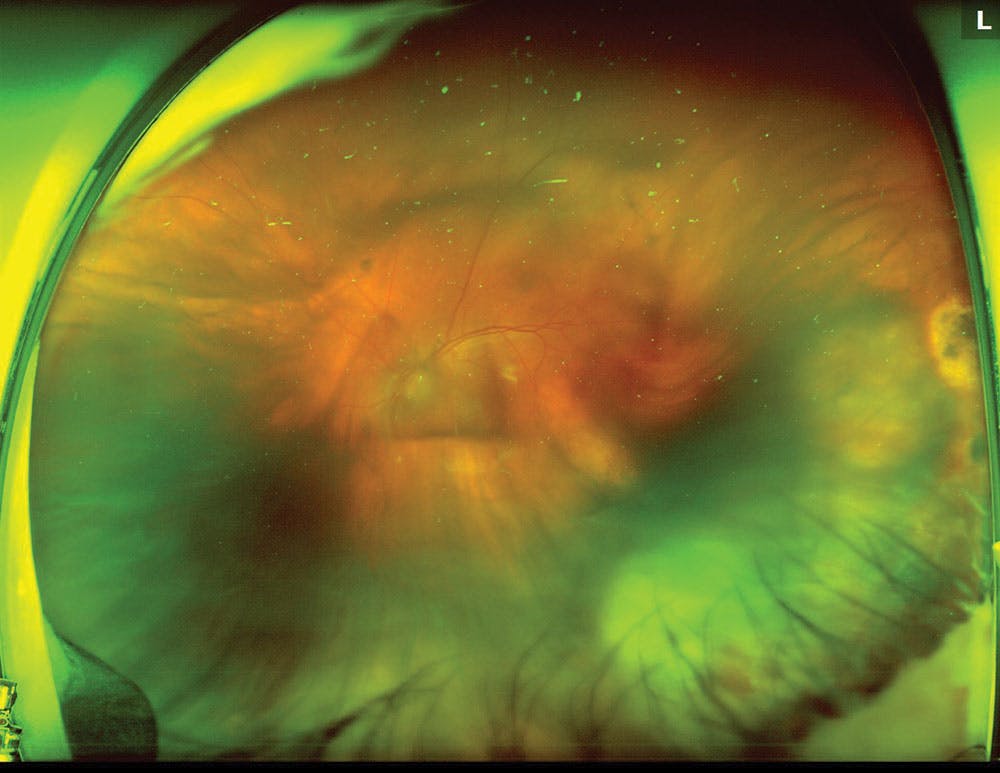
Figure 1. Fundus photography of the patient’s left eye 4 days after presentation showed an inferotemporal and inferonasal opaque elevation with a white exudative pattern, appearing yellow and green in the pseudocolor imaging.
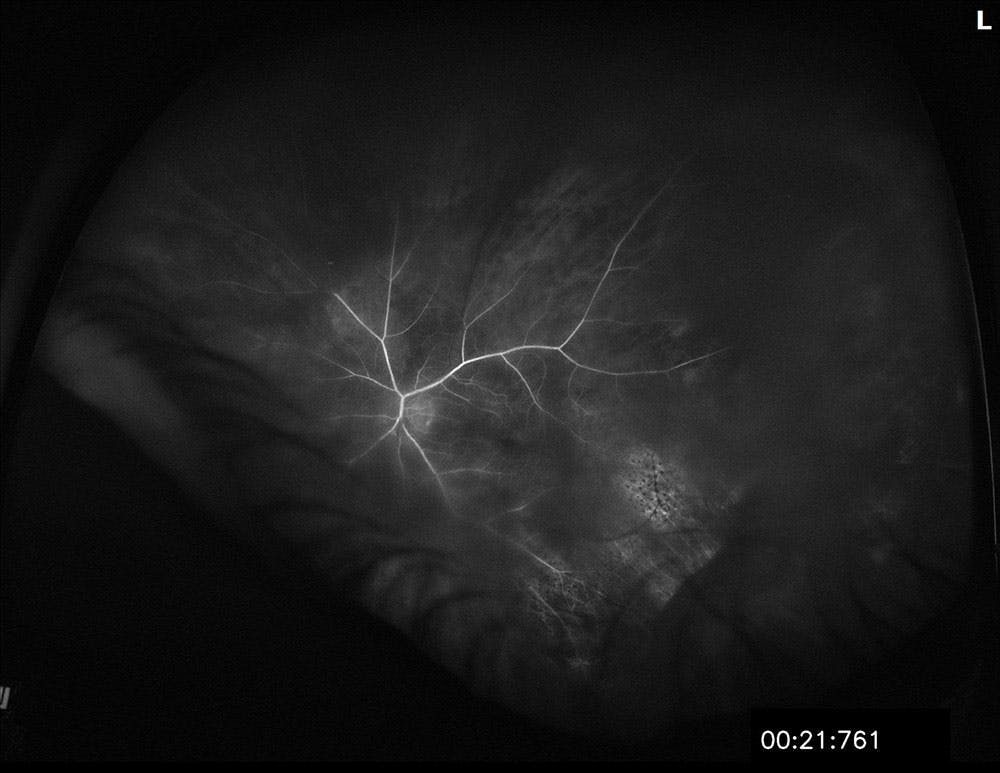
Figure 2. Early-frame widefield FA of his left eye at 21.8 seconds demonstrated appropriate filling times but with limited visualization of the area inferotemporally and a blocking defect.
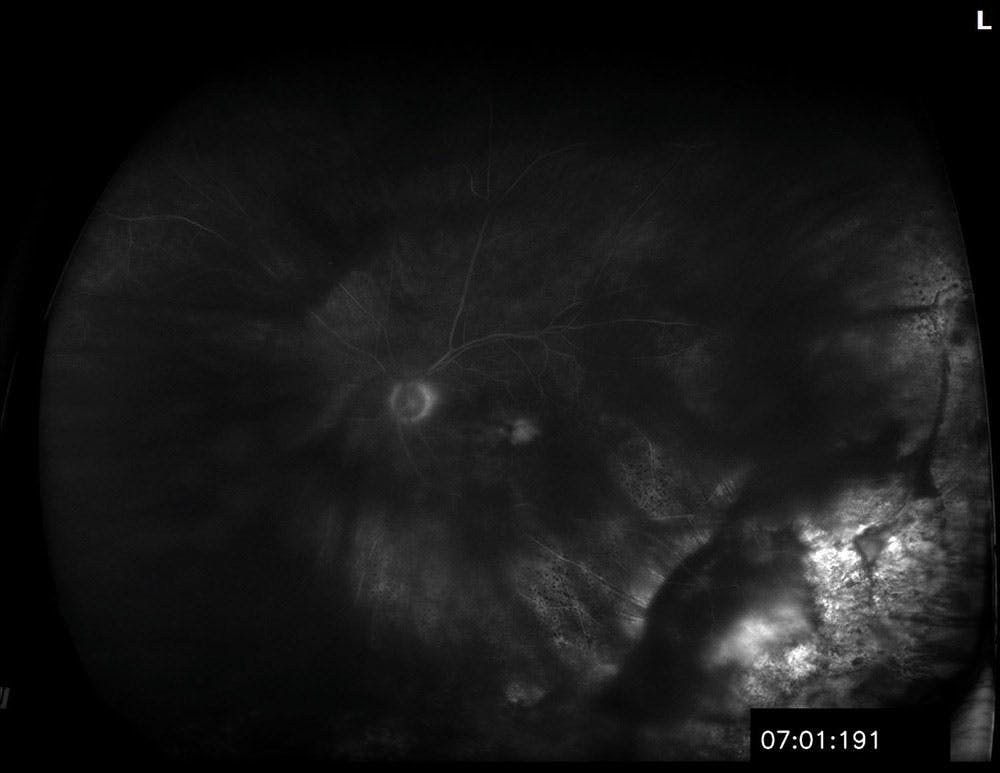
Figure 3. Late-frame FA of his left eye at 7 minutes and 1 second showed central leakage consistent with CME, along with inferotemporal peripheral subretinal vascular leakage, likely due to hemorrhage.
Because of his relatively preserved vision, the patient was initially observed and scheduled for a follow-up appointment 4 days later. Given findings consistent with active exudative choroidal neovascularization (CNV) in his left eye, intravitreal anti-VEGF therapy with bevacizumab (Avastin, Genentech/Roche) was initiated to decrease exudation.
At follow-up 141 days after initial presentation and after four bevacizumab injections, his BCVA was 20/60 OS, improving to 20/50 OS with pinhole. The lesion appeared improved and more fibrotic (Figure 4). At 417 days after presentation, following eight bevacizumab injections, his BCVA was 20/70 OS with no improvement on pinhole. Fundus photography showed marked regression of the hemorrhage and atrophic fibrosis (Figure 5). At 1,166 days, following nine bevacizumab injections, six aflibercept injections (Eylea, Regeneron), and four high-dose aflibercept injections (Eylea HD, Regeneron), fundus photography showed resolution of the subretinal hemorrhage with fibrosis (Figure 6).
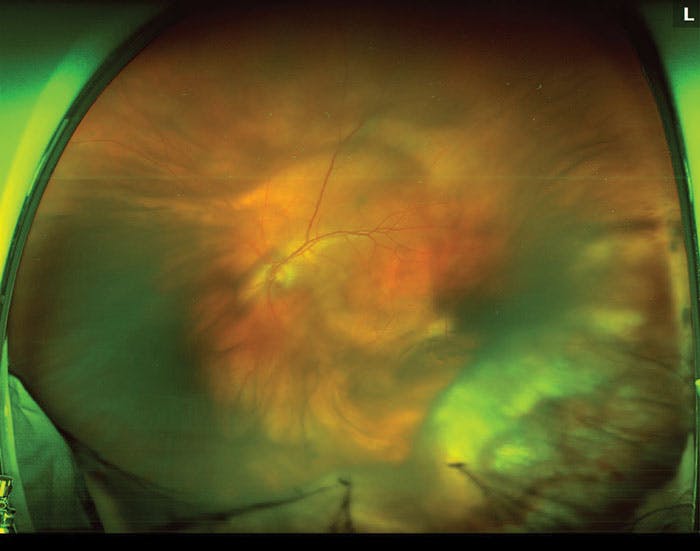
Figure 4. Fundus photography of his left eye 141 days after presentation showed lesion regression and partial resorption of blood with increasing fibrosis.
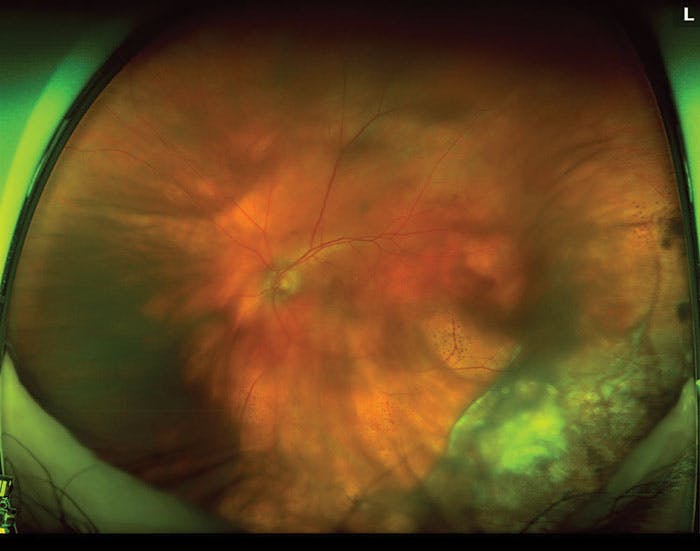
Figure 5. Fundus imaging of his left eye 417 days after presentation showed marked regression of the hemorrhage and subretinal fibrosis.
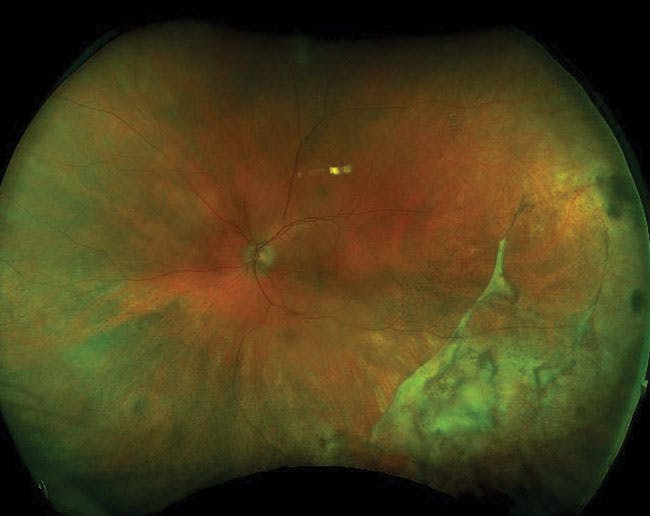
Figure 6. Fundus photography of the left eye 1,166 days after initial presentation showed resolution of the subretinal hemorrhage with fibrosis.
DIAGNOSTIC AND MANAGEMENT PEARLS
PEHCR is often difficult to diagnose due to its far peripheral location, low incidence, and frequently asymptomatic presentation.1 In the largest case series to date, involving 173 patients, Shields et al reported that 42% of patients were asymptomatic.1 Among symptomatic individuals, decreased visual acuity, flashes, and floaters were the most common symptoms.1 In a separate case series of 46 patients, Mantel et al noted that some patients may less commonly experience metamorphopsia, scotomas, and pain.2
About 21% of eyes have decreased visual acuity secondary to PEHCR due to vitreous hemorrhage (14%), subretinal hemorrhage (5%), or subretinal fluid extending into the macula (2%).1 Lesions are typically located temporally (77%) or inferiorly (43%), with nasal (20%) and superior (20%) involvement being less frequent. Some eyes demonstrate multi-quadrant involvement. The average visual acuity in affected patients can range from 20/20 to 20/40.1-3
Shields et al also found that macular findings such as drusen, RPE changes, and CNV were present in 48% of ipsilateral eyes and 56% of contralateral eyes.1 Although the exact etiology of PEHCR remains unclear, CNV is believed to play a significant role in its pathogenesis.4 Mantel et al suggested some macular changes may be age-related rather than disease-specific and that PEHCR may occur independently of AMD.2 Drusen, a hallmark feature of AMD, are often absent in PEHCR lesions; however, Mantel et al’s case series demonstrated a higher prevalence of AMD (68.9%), likely due to the older average age of their cohort.2
Multimodal imaging is critical for diagnosing and monitoring PEHCR. Shields et al described key features that can help distinguish it from choroidal melanoma.1 OCT is useful for assessing the amount of exudation into the peripheral choroidal thickness. Ultrasound typically reveals a dome-shaped or plateau-shaped lesion with an average thickness of 3 mm and low-to-moderate internal echogenicity. Widefield FA can show blocking defects in the presence of subretinal or sub-RPE hemorrhage, hypofluorescence due to RPE atrophy or hyperplasia, and CNV. In contrast, choroidal melanoma often has low internal echogenicity but may show high internal echogenicity of intrinsic vascular components.
Management Strategies
Most PEHCR lesions can be observed, as they tend to regress on their own over time. However, several treatment modalities have been explored for vision-threatening lesions, including anti-VEGF therapy, cryotherapy, and laser photoablation.5,6 Vandefonteyne et al conducted a large case series (84 eyes) involving ranibizumab (Lucentis, Genentech/Roche), aflibercept, and bevacizumab, in addition to laser photocoagulation, photodynamic therapy (PDT), vitrectomy, and cryotherapy.7 In this study, vitrectomy was indicated for persistent vitreous hemorrhage and the only intervention associated with significant improvement in visual acuity. This likely reflects the benefit of clearing the vitreous cavity, while other therapies treated peripheral lesions that had less involvement with the macula.7 Another study showed favorable results with ranibizumab, suggesting it is comparable in efficacy with bevacizumab.8
Safir et al observed significant disease regression with repeat bevacizumab injections, but there was no statistically significant difference in visual acuity compared with untreated groups.5 Zicarelli et al reported that among 50 eyes, 18 were observed, 18 received combined anti-VEGF and PDT, 13 received anti-VEGF only, and one underwent PDT.3 No significant difference in macular involvement was found between treatment groups.3 However, four of the 18 eyes that were observed developed vitreous hemorrhage or macular involvement, suggesting anti-VEGF therapy may reduce the risk of posterior extension and be useful in treating macular- or vision-threatening disease.3
Photocoagulation may be beneficial for polypoidal lesions but is generally ineffective against the underlying choroidal vascular network.3 Alforja et al caution that photocoagulation can exacerbate subretinal hemorrhage,9 while others have noted its potential to induce CME.10 Cryopexy may also worsen subretinal hemorrhage and lead to fibrosis.9
Overall, while these treatments are useful for lesion regression, they have demonstrated limited efficacy in improving visual outcomes.
CONSIDER PEHCR WHEN PERIPHERAL LESIONS ARE PRESENT
PEHCR should be included in the differential diagnosis when peripheral lesions are noted, as accurate diagnosis and appropriate management are essential to avoid unnecessary interventions. While the prognosis for PEHCR is generally good, with 89% of lesions stabilizing or regressing over a 15-month observation period,1 anti-VEGF therapy should be considered when exudative or hemorrhagic properties involve the macula and threaten vision.
1. Shields CL, Salazar PF, Mashayekhi A, Shields JA. Peripheral exudative hemorrhagic chorioretinopathy simulating choroidal melanoma in 173 eyes. Ophthalmology. 2009;116(3):529-535.
2. Mantel I, Uffer S, Zografos L. Peripheral exudative hemorrhagic chorioretinopathy: a clinical, angiographic, and histologic study. Am J Ophthalmol. 2009;148(6):932-938.e1.
3. Zicarelli F, Preziosa C, Staurenghi G, Pellegrini M. Peripheral exudative haemorrhagic chorioretinopathy: a widefield imaging study. Br J Ophthalmol. 2021;105(10):1410-1414.
4. Badawi AH, Semidey V, Magliyah M, Al-Dhibi H. Updated systematic review and clinical spectrum of peripheral exudative hemorrhagic chorioretinopathy. Middle East Afr J Ophthalmol. 2020;27(1):4-9.
5. Safir M, Zloto O, Fabian ID, et al. Peripheral exudative hemorrhagic chorioretinopathy with and without treatment: clinical and multimodal imaging characteristics and prognosis. PLoS One. 2022;17(9):e0275163.
6. Huang J, Gajewski A, Cesaro T, et al. Peripheral exudative hemorrhagic chorioretinopathy in patients with nonexudative age-related macular degeneration. Fed Pract. 2017;34(5):20-22.
7. Vandefonteyne S, Caujolle JP, Rosier L, et al. Diagnosis and treatment of peripheral exudative haemorrhagic chorioretinopathy. Br J Ophthalmol. 2020;104(6):874-878.
8. Takayama K, Enoki T, Kojima T, et al. Treatment of peripheral exudative hemorrhagic chorioretinopathy by intravitreal injections of ranibizumab. Clin Ophthalmol. 2012;6:865-869.
9. Alforja MS, Sabater N, Giralt J, et al. Intravitreal bevacizumab injection for peripheral exudative hemorrhagic chorioretinopathy. Jpn J Ophthalmol. 2011;55(4):425-427.
10. Vine AK, Johnson MW. Peripheral choroidal neovascularization. Eur J Ophthalmol. 1996;6(1):44-49.


