



AT A GLANCE
- Long-acting intravitreal corticosteroid implants remain foundational therapeutic choices for chronic noninfectious uveitis of the posterior segment.
- For steroid-sparing therapy, systemic antimetabolites and adalimumab are well-established, while infliximab is used off-label for refractory cases.
- Near-term readouts most likely to alter practice include intraocular non-steroidal cytokine therapy for uveitic macular edema, oral precision immunology, and topical steroid-sparing therapy for anterior disease.
Noninfectious uveitis (NIU) comprises a heterogeneous group of inflammatory disorders in which therapy is shaped by anatomic phenotype, systemic associations, and relapse risk. Local corticosteroid options, conventional antimetabolites, and anti-tumor necrosis factor (anti-TNF) therapy anchor current practice. Nonetheless, steroid-related ocular adverse events and systemic treatment constraints have motivated a pipeline focused on cytokine-specific biologics and oral pathway inhibitors, together with steroid-sparing topical and local candidates for anterior disease and uveitic macular edema (UME).
This article focuses on agents under investigation for the treatment of NIU/UME. To help you navigate the robust list, each therapy is tagged with a color-coordinated clinical readiness tier (CRT), defined as the following:
🟩 CRT-5: on-label standard
🟢 CRT-4: off-label standard with prospective evidence/broad use
🟡 CRT-3: promising, late-phase
🟠 CRT-2: early/uncertain
🟥 CRT-1: negative/not recommended
⬜ CRT-0: perioperative only
CORTICOSTEROIDS
Long-acting intravitreal corticosteroid implants remain foundational therapeutic choices for chronic NIU of the posterior segment (NIU-PS). The FDA-approved options include the 0.7 mg dexamethasone biodegradable intravitreal implant 🟩 (Ozurdex, Abbvie; Figure), the 0.59 mg fluocinolone acetonide implant 🟩 (Retisert, Bausch + Lomb), the 0.18 mg fluocinolone acetonide insert 🟩 (Yutiq, Ani)— which will effectively be replaced by the 0.19 mg implant 🟩 (Illuvien, Ani)—and suprachoroidal triamcinolone acetonide 🟩 (Xipere, Clearside Biomedical/Bausch + Lomb).
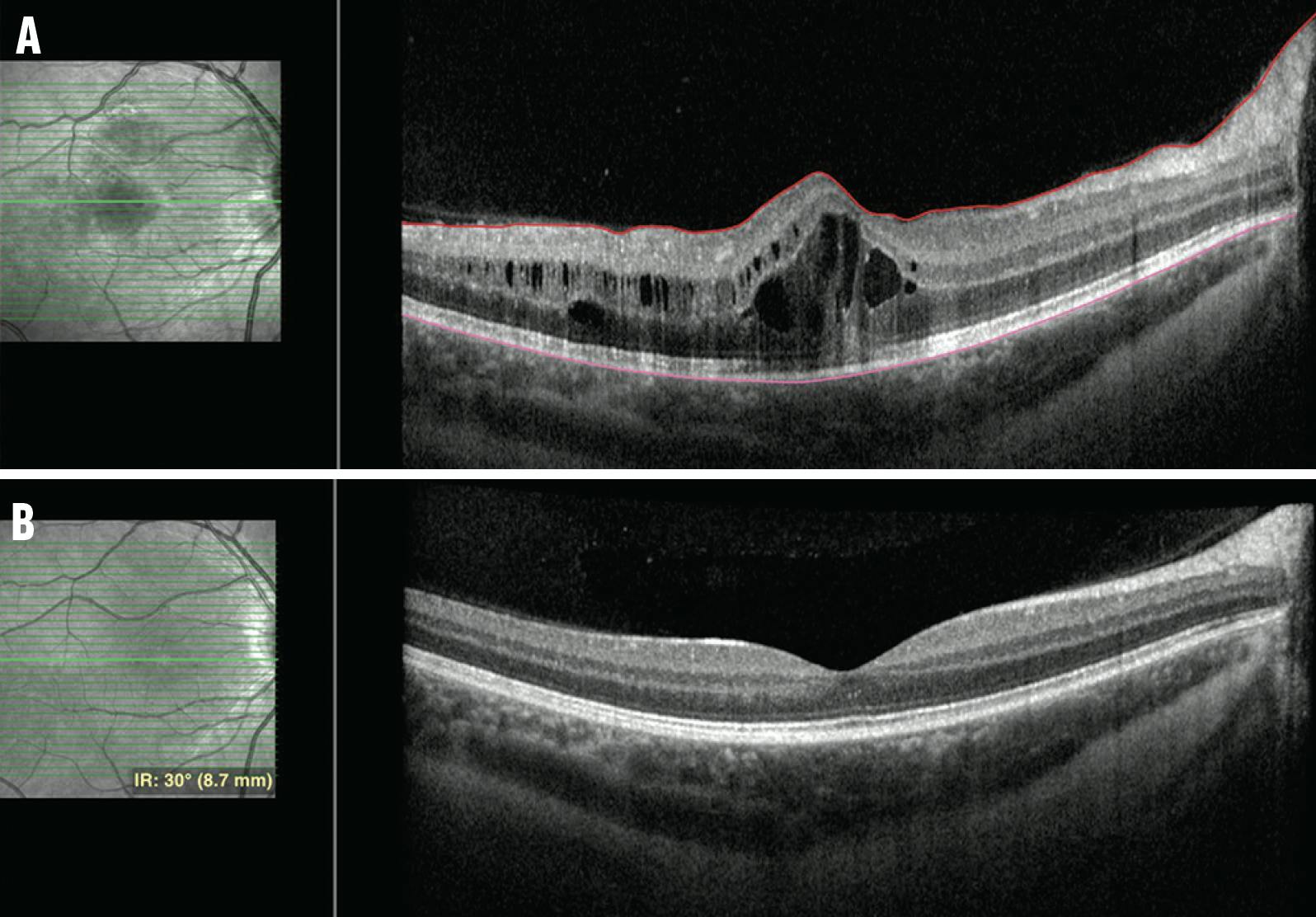
Figure. OCT imaging shows significant cystoid macular edema in a patient with sarcoid anterior/intermediate uveitis (A). One month after treatment with a dexamethasone intravitreal implant, the edema has resolved (B).
Two perioperative depots—9% dexamethasone intraocular suspension ⬜ (Dexycu, EyePoint) and the 0.4 mg dexamethasone intracanalicular insert ⬜ (Dextenza, Ocular Therapeutix)—are used during cataract surgery but are not chronic NIU therapies. Dexamethasone nanoparticle eye drops ⬜ (OCS-01, Oculis) are under investigation for uveitis-related/post-surgical macular edema (NCT05608837).
ANTIMETABOLITES
Systemic methotrexate 🟢 (MTX; generic) and mycophenolate mofetil 🟢 (CellCept, Genentech/Roche) are guideline-concordant, first-line steroid-sparing agents. In the FAST randomized trial, overall efficacy was similar; exploratory analyses favored methotrexate in intermediate/posterior/panuveitis phenotypes.1
Intravitreal MTX 🟡 (generic) has advanced beyond case series. In the MERIT trial, the dexamethasone implant outperformed intravitreal MTX and ranibizumab (Lucentis, Genentech/Roche) at 12 to 24 weeks based on OCT outcomes in UME; however, intravitreal MTX remains a pragmatic option when steroid-induced IOP or systemic issues dominate.2
ANTI-TNF-α AGENTS
Adalimumab 🟩 (Humira, Abbvie) is the established systemic biologic for NIU. The VISUAL 1 and 2 randomized trials reduced time to treatment failure versus placebo.3,4 In juvenile idiopathic arthritis–associated uveitis (JIA-U), adalimumab plus MTX improved control in two randomized studies.5-8
Infliximab 🟢 (Remicade, Janssen) is widely used off-label for severe Behçet/NIU-PS and cases refractory to antimetabolites and/or adalimumab; however, the evidence comes from prospective and retrospective series rather than modern phase 3 randomized controlled trials.9,10 Additional systemic TNF inhibitors are employed off-label when adalimumab is inadequate or not tolerated. Golimumab 🟢 (Simponi, Janssen) has supportive cohort data in refractory JIA-U,11 and certolizumab pegol 🟢 (Cimzia, UCB) reduced acute anterior uveitis (AAU) flares in axial spondyloarthritis in the open-label phase 4 C-VIEW study.12
Local anti-TNF agents remain investigational. Intravitreal adalimumab 🟠 is under investigation compared with systemic dosing (NCT02706704). Intravitreal infliximab 🟥 shows mixed outcomes and safety signals in small studies (eg, for Behçet posterior uveitis) and is not recommended as a substitute for systemic therapy.9,10 Etanercept 🟥 (Enbrel, Amgen) is not favored in uveitis based on neutral/negative trials and reports of paradoxical worsening of uveitis.13-16
ANTI-CYTOKINE ANTIBODIES (NON-TNF)
Systemic IL-6 inhibition with tocilizumab 🟢 (Actemra, Genentech/Roche) shows bioactivity in a prospective NIU study (NCT01717170) and is used in refractory UME, particularly after anti-TNF failure.17 In pediatric JIA-U, the phase 2 APTITUDE trial did not meet its primary endpoint; signals of benefit were most evident in eyes with persistent UME (greater central subfield thickness reduction and visual acuity trend) and in patients requiring anti-TNF rescue, with subsequent observational data suggesting more rapid edema resolution with intravenous versus subcutaneous dosing in some series.18-20 Intravitreal tocilizumab 🟠 for UME is limited to small/early reports; most evidence reflects systemic administration.21-23
Vamikibart 🟡 (RO7200220/RG6179, Genentech/Roche) is an investigational human monoclonal antibody against IL-6; it is injected intravitreally and is under investigation in the phase 3 MEERKAT and SANDCAT trials for UME (NCT05642312 and NCT05642325). MEERKAT recently met its primary endpoint (the proportion of patients with a 15-letter or more improvement from baseline in BCVA at week 16), and while SANDCAT showed similar vision gains, it did not meet the primary endpoint.24
Targeting IL-12/23 with ustekinumab 🟠 (Stelara, Janssen) has supportive observational signals in a phase 2 trial (NCT02911116) for NIU/Behçet but no phase 3 program. However, targeting IL-17A has produced divergent results. Ixekizumab 🟠 (Taltz, Eli Lilly) is recruiting an open-label proof-of-concept study in refractory NIU (NCT06085079). Secukinumab 🟠 (Cosentyx, Novartis) failed to meet the primary endpoints across three phase 3 subcutaneous trials25; however, small open-label data suggested activity with intravenous dosing in uveitis.26 Finally, the high-affinity, small-protein IL-17A blocker izokibep 🟥 (Acelyrin/Affibody) did not meet the primary endpoint in a phase 2b/3 NIU study (NCT05384249).
JAK/STAT AND TYK2 PATHWAY INHIBITORS
Oral small-molecule inhibitors are another significant innovation in the uveitis space. Brepocitinib 🟡 (Priovant Therapeutics), a dual JAK1/TYK2 inhibitor, completed a positive phase 2 NIU study (NCT05523765) and is in phase 3 (NCT06431373). The selective TYK2 inhibitor ESK-001 🟡 (Alumis) is in a randomized phase 2 proof-of-concept study for non-anterior NIU (NCT05953688).
Baricitinib 🟠 (Olumiant, Eli Lilly), a JAK1/2 inhibitor, is under study in pediatric JIA-U (NCT04088409).27 Upadacitinib 🟠 (Rinvoq, Abbvie) is being evaluated prospectively to reduce AAU flares in axial spondyloarthritis (NCT07018206), addressing prevention rather than treatment of NIU. Tofacitinib 🟠 (Xeljanz, Pfizer) has encouraging adult and pediatric case series data (including for Blau syndrome and JIA-U) but no dedicated phase 3 NIU program.28-30 Although filgotinib 🟥 (Gilead), a preferential JAK1 inhibitor, showed efficacious signals in randomized testing, the NIU program (NCT03207815) was terminated.31
NOVEL MECHANISMS
Dazdotuftide 🟡 (TRS01, Tarsier Pharma) is a first-in-class topical non-steroidal immunomodulatory eye drop for NIU; a phase 3 trial is completed, and a Special Protocol Assessment has been granted for the next registrational trial (NCT05042609). Sirolimus 🟠 (DE-109, Santen), a novel mammalian target of rapamycin inhibitor, showed dose-related bioactivity but missed its primary endpoint in the phase 3 SAKURA trial (NCT01358266).32,33
TREATING UVEITIS IN YOUR CLINIC TODAY AND TOMORROW
Near-term readouts most likely to alter practice include: (1) intraocular non-steroidal cytokine therapy for UME (vamikibart); (2) oral precision immunology for non-anterior NIU (brepocitinib and ESK-001); and (3) topical steroid-sparing therapy for anterior disease (dazdotuftide).
Until then, local corticosteroids (ie, Ozurdex and Illuvien), systemic antimetabolites (methotrexate and mycophenolate), and adalimumab remain anchors, while infliximab is valuable for select cases that require higher dose modulation or are refractory to previous therapy.
1. Jaffe GJ, Martin D, Callanan D, et al; Fluocinolone Acetonide Uveitis Study Group. Fluocinolone acetonide implant (Retisert) for noninfectious posterior uveitis: thirty-four-week results of a multicenter randomized clinical study. Ophthalmology. 2006;113(6):1020-1027.
2. Jaffe GJ, Foster CS, Pavesio CE, Paggiarino DA, Riedel GE. Effect of an injectable fluocinolone acetonide insert on recurrence rates in chronic noninfectious uveitis affecting the posterior segment: twelve-month results. Ophthalmology. 2019;126(4):601-610.
3. Jaffe GJ, Pavesio CE; Study Investigators. Effect of a fluocinolone acetonide insert on recurrence rates in noninfectious intermediate, posterior, or panuveitis: three-year results. Ophthalmology. 2020;127(10):1395-1404.
4. Yeh S, Khurana RN, Shah M, et al; PEACHTREE Study Investigators. Efficacy and safety of suprachoroidal CLS-TA for macular edema secondary to noninfectious uveitis: phase 3 randomized trial. Ophthalmology. 2020;127(7):948-955.
5. Multicenter study on the efficacy and safety of OCS-01 in subjects with uveitis related and post surgical macular edema (LEOPARD). Accessed October 1. clinicaltrials.gov/study/NCT05608837
6. Rathinam SR, Gonzales JA, Thundikandy R, et al; FAST Research Group. Effect of corticosteroid-sparing treatment with mycophenolate mofetil vs methotrexate on inflammation in patients with uveitis: a randomized clinical trial. JAMA. 2019;322(10):936-945.
7. Multicenter Uveitis Steroid Treatment Trial (MUST) Research Group, Writing Committee; Acharya NR, Vitale AT, Sugar EA, et al. Intravitreal therapy for uveitic macular edema-ranibizumab versus methotrexate versus the dexamethasone implant: The MERIT trial results. Ophthalmology. 2023;130(9):914-923.
8. Jaffe GJ, Dick AD, Brézin AP, et al. Adalimumab in patients with active noninfectious uveitis. N Engl J Med. 2016;375(10):932-943.
9. Takeuchi M, Usui Y, Namba K, et al. Ten-year follow-up of infliximab treatment for uveitis in Behçet disease patients: A multicenter retrospective study. Front Med (Lausanne). 2023;10:1095423.
10. Liu W, Bai D, Kou L. Comparison of infliximab with adalimumab for the treatment of non-infectious uveitis: a systematic review and meta-analysis. BMC Ophthalmol. 2023;23(1):240.
11. Lanz S, Seidel G, Skrabl-Baumgartner A. Golimumab in juvenile idiopathic arthritis-associated uveitis unresponsive to adalimumab. Pediatr Rheumatol Online J. 2021;19(1):132.
12. van der Horst-Bruinsma IE, van Bentum RE, Verbraak FD, et al. Reduction of anterior uveitis flares in patients with axial spondyloarthritis on certolizumab pegol treatment: final 2-year results from the multicenter phase IV C-VIEW study. Ther Adv Musculoskelet Dis. 2021;13:1759720X211003803.
13. Ramanan AV, Dick AD, Jones AP, et al; SYCAMORE Study Group. Adalimumab plus methotrexate for uveitis in juvenile idiopathic arthritis. N Engl J Med. 2017;376(17):1637-1646.
14. Quartier P, Baptiste A, Despert V, et al; ADJUVITE Study Group. ADJUVITE: a double-blind, randomised, placebo-controlled trial of adalimumab in early onset, chronic, juvenile idiopathic arthritis-associated anterior uveitis. Ann Rheum Dis. 2018;77(7):1003-1011.
15. Smith JA, Thompson DJ, Whitcup SM, et al. A randomized, placebo-controlled, double-masked clinical trial of etanercept for the treatment of uveitis associated with juvenile idiopathic arthritis. Arthritis Rheum. 2005;53(1):18-23.
16. Foster CS, Tufail F, Waheed NK, Chu D, Miserocchi E, Baltatzis S, Vredeveld CM. Efficacy of etanercept in preventing relapse of uveitis controlled by methotrexate. Arch Ophthalmol. 2003;121(4):437-440.
17. Sepah YJ, Sadiq MA, Chu DS, et al. Primary (month-6) outcomes of the STOP-Uveitis Study: evaluating the safety, tolerability, and efficacy of tocilizumab in patients with noninfectious uveitis. Am J Ophthalmol. 2017;183:71-80.
18. Ramanan AV, Dick AD, Guly C, et al; APTITUDE Trial Management Group. Tocilizumab in patients with anti-TNF refractory juvenile idiopathic arthritis-associated uveitis (APTITUDE): a multicentre, single-arm, phase 2 trial. Lancet Rheumatol. 2020;2(3):e135-e141.
19. Kherani S, Alapati A, Begaj T, et al. Efficacy of subcutaneous and intravenous tocilizumab in noninfectious uveitis. Ophthalmology. 2025;132(2):253-254.
20. Vegas-Revenga N, Calvo-Río V, Mesquida M, et al. Anti-IL6-receptor tocilizumab in refractory, noninfectious uveitic cystoid macular edema: multicenter study of 25 patients. Am J Ophthalmol. 2019;200:85-94.
21. Adán A, Llorenç V, Mesquida M, Pelegrín L. Tocilizumab treatment for recalcitrant uveitic macular edema. Graefes Arch Clin Exp Ophthalmol. 2013 Sep;251(9):2249-2250.
22. Vegas-Revenga N, Calvo-Río V, Mesquida M, et al. Anti-IL6-receptor tocilizumab in refractory and noninfectious uveitic cystoid macular edema: multicenter study of 25 patients. Am J Ophthalmol. 2019;200:85-94.
23. Leclercq M, Andrillon A, Maalouf G, et al. Anti-tumor necrosis factor α versus tocilizumab in the treatment of refractory uveitic macular edema: a multicenter study from the french uveitis network. Ophthalmology. 2022;129(5):520-529.
24. Genentech presents new phase III pivotal data for vamikibart in uveitic macular edema (UME), a serious cause of vision loss [press release]. Genentech. October 17, 2025. Accessed October 22, 2025. tinyurl.com/2ptzryrt
25. Dick AD, Tugal-Tutkun I, Foster S, et al. Secukinumab in the treatment of noninfectious uveitis: results of three randomized, controlled clinical trials. Ophthalmology. 2013;120(4):777-787.
26. Letko E, Yeh S, Foster CS, et al; AIN457A2208 Study Group. Efficacy and safety of intravenous secukinumab in noninfectious uveitis requiring steroid-sparing immunosuppressive therapy. Ophthalmology. 2015;122(5):939-948.
27. Ramanan AV, Guly CM, Keller SY, et al. Clinical effectiveness and safety of baricitinib for the treatment of juvenile idiopathic arthritis-associated uveitis or chronic anterior antinuclear antibody-positive uveitis: study protocol for an open-label, adalimumab active-controlled phase 3 clinical trial (JUVE-BRIGHT). Trials. 2021;22(1):689.
28. Paley MA, Karacal H, Rao PK, Margolis TP, Miner JJ. Tofacitinib for refractory uveitis and scleritis. Am J Ophthalmol Case Rep. 2018;13:53-55.
29. Dutta Majumder P, Abraham S, Sudharshan S, Janarthanan M, Ramanan AV. Tofacitinib for refractory uveitis and scleritis in children: a case series. Ocul Immunol Inflamm. 2024;32(9):2092-2095.
30. Zhang S, Cai Z, Mo X, Zeng H. Tofacitinib effectiveness in Blau syndrome: a case series of Chinese paediatric patients. Pediatr Rheumatol Online J. 2021;19(1):160.
31. Srivastava SK, Watkins TR, Nguyen QD, et al. Filgotinib in active noninfectious uveitis: the HUMBOLDT randomized clinical trial. JAMA Ophthalmol. 2024;142(9):789-797.
32. Nguyen QD, Merrill PT, Clark WL, et al. Sirolimus study assessing double-masked uveitis treatment (SAKURA) Study Group. Intravitreal sirolimus for noninfectious uveitis: a phase III sirolimus study assessing double-masked uveitis treatment (SAKURA). Ophthalmology. 2016;123(11):2413-2423.
33. Merrill PT, Clark WL, Banker AS, et al; Sirolimus Study Assessing Double-Masked Uveitis Treatment (SAKURA) Study Group. Efficacy and safety of intravitreal sirolimus for noninfectious uveitis of the posterior segment: results from the sirolimus study assessing double-masked uveitis treatment (SAKURA) program. Ophthalmology. 2020;127(10):1405-1415.


