The 23rd Duke Advanced Vitreous Surgery (AVS) Course, held May 16 – 17, 2025, included an excellent series of lectures and panel discussions from leaders in vitreoretinal surgery, medical retina, uveitis, inherited retinal disease, and ocular oncology. The 11th annual fellows AVS (fAVS) Course, which occurred the day prior, focused on critical tips for first-year vitreoretinal surgery fellows. Led by Course Director Lejla Vajzovic, MD, and Co-Diretors Dilraj Grewal, MD; Xi Chen, MD, PhD; and Durga S. Borkar, MD, MMCi, both courses boasted world-renowned faculty. Here, we share highlights from both events.
FELLOWS EDUCATION AND PARTICIPATION
The fAVS Course involved a day of curated lectures focused on fellow education and an exciting wet lab experience. The course also invited residents to attend following a rigorous selection process.
The day started with talks by Carl C. Awh, MD; Sharon Fekrat, MD; and Avni P. Finn, MD, MBA, on financial pearls for retina specialists and tips and tricks for new retina surgeons. Lizzy Rossin, MD, PhD, highlighted the importance of scleral buckling and then discussed how to choose the right patients for the procedure, the best buckling elements for certain cases, and the steps to the procedure itself.
Next, Nick Ulrich, MD, and Jason Fan, MD, PhD, discussed billing and retinal detachment (RD) repair costs, respectively, giving attendees a glimpse into the economics of practice.
The remaining lectures focused on a variety of topics ranging from biosimilars (by Stefanie G. Schuman, MD) and retinal vein occlusion (by Michael J. Allingham, MD, PhD) to inherited retinal disease (by Oleg Alekseev, MD, PhD), retinoblastoma (by Arpita S. Maniar, MBBS, MD), dry AMD (by Eleonora G. Lad, MD, PhD), and autoimmune retinopathy (by Ramiro S. Maldonado, MD).
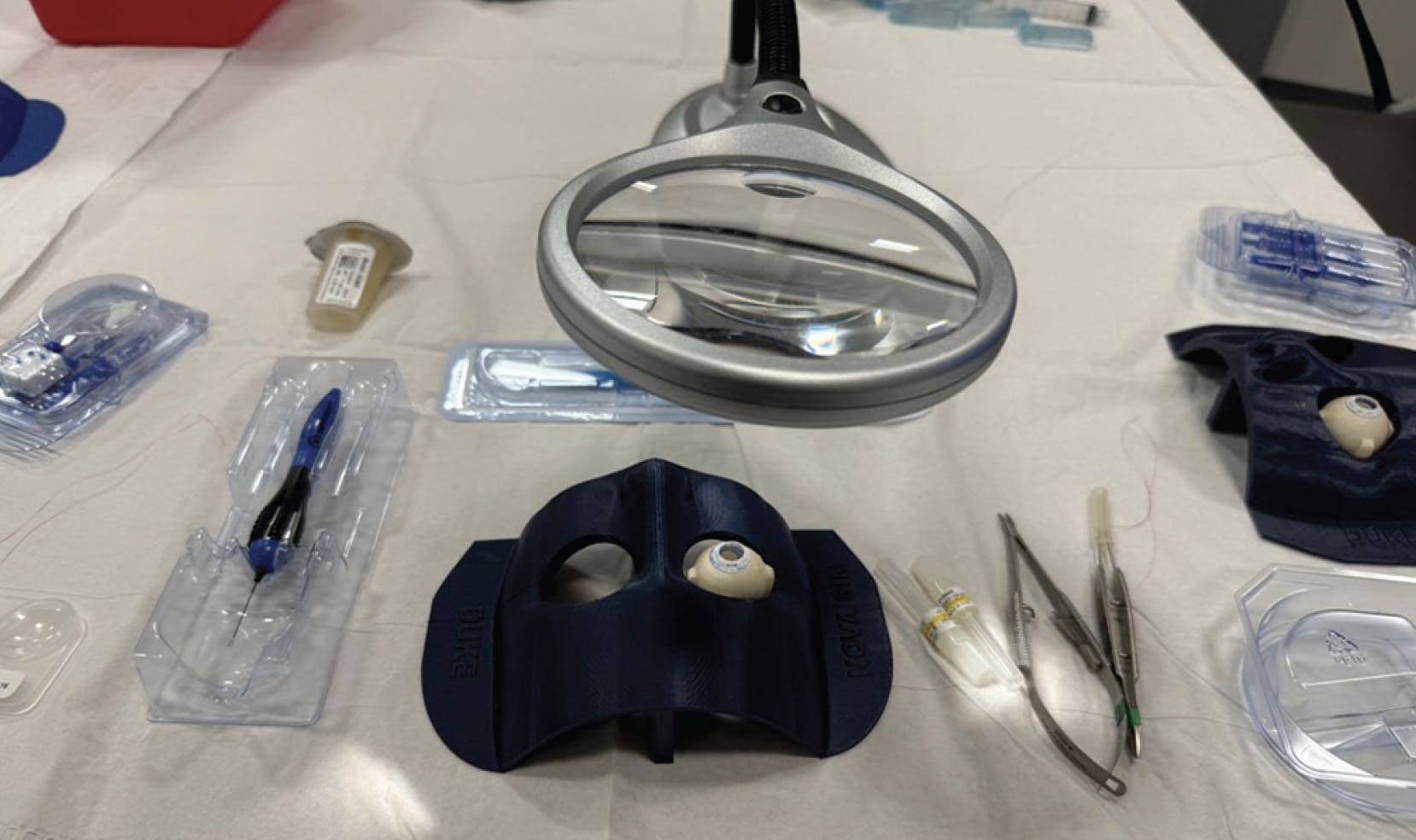
During the hands-on wet lab, attendees rotated through 14 stations to practice key aspects of retina surgery under the guidance of world-renowned mentors. The lab featured vitrectomy systems from Alcon (including the new Unity system), Bausch + Lomb, and DORC; it also featured the newly FDA-approved revakinagene taroretcel-lwey implant (Encelto, Neurotech Pharmaceuticals) for macular telangiectasia type 2. Other stations were dedicated to membrane peeling, subretinal delivery, RD repair, and scleral fixating IOLs (Figure). Dr. Fekrat and Jason Hsu, MD, led a station for virtual reality implant placement of the port delivery system (PDS; Susvimo, Genentech/Roche), while Cynthia A. Toth, MD, and Daniel S.W. Ting, MD, PhD, led a station demonstrating intraoperative OCT. Another station focused on 3D visualization systems and diagnostic vitrectomy.
The course concluded with “The Great Job Search Panel” moderated by Dr. Fekrat and Glenn J. Jaffe, MD. During this well-loved annual panel, faculty in different career stages and different practice settings shared their pearls for first-year fellows who are about to embark on their job search.
ATTENDING EDUCATION
The AVS Course started with talks focused on suprachoroidal buckling, timing and techniques for RD repair, proliferative vitreoretinopathy management, and laser light sources. The next scientific session highlighted new treatment paradigms with talks on the PDS, gene therapy, complement inhibition, Fas inhibition, and AI. A fellows’ surgical video panel then featured five fellows from around the world highlighting their surgical talent, which left the audience in awe.
The afternoon boasted a macular surgery section, during which Dr. Awh shared ways to minimize peel-induced maculopathy, which may be associated with decreased retinal sensitivity. Javier Elizalde, MD, PhD, discussed traumatic macular holes and his preferred approach: vitrectomy and dye-assisted internal limiting membrane peeling. Dr. Finn presented several types of flaps, including inverted, temporal, hinged, cabbage leaf or star, and free flaps. Dr. Ulrich discussed techniques for complex macular holes, including plugging/scaffold techniques, autologous retinal transplant, and amniotic membrane grafts.
The second day of the AVS Course opened with talks on diabetic retinopathy (DR). Dr. Allingham presented emerging therapeutic approaches for DR, including anti-VEGF agents, the PDS, gene therapy, small molecules, receptor tyrosine kinase inhibitors, steroids, and oral drugs. He emphasized that diabetic eye disease stands to benefit from treatments targeting multiple mechanisms of action. Majda Hadziahmetovic, MD, then discussed the effect of glucagon-like peptide-1 receptor agonists on DR. Other talks by Sally Ong, MD, and Shohista Saidkasimova, FRCOPhth, focused on the surgical management of proliferative DR.
The next session touched on secondary IOLs, intraocular tumors, and uveitis. Dr. Elizalde shared his technique for transvitreal biopsy of choroidal tumors that are posterior to the equator. He uses 27-gauge vitrectomy, makes a focal retinotomy, obtains a sample with the mouth of the vitrector port while maintaining good hemostasis with IOP control, and then back-flushes the contents into a collection tube.
Gavin Tan, MD, PhD, then discussed his surgical technique for endoresection of choroidal melanoma, which can be an alternative to enucleation for tumors too large for plaque brachytherapy or as salvage therapy after brachytherapy. Miguel A. Materin, MD, explored the risk stratification in uveal melanoma with PRAM testing and possible new treatments. Dr. Grewal gave an overview of new uveitis therapeutics in the pipeline, including a systemic JAK1/TYK2 inhibitor brepocitinib (currently in phase 3), intravitreal IL-6 inhibitors, and a new topical therapy, dazdotuftide.
In the next session, Dr. Hsu discussed treatment options and outcomes for patients with submacular hemorrhages, followed by Andrea Govetto, MD, PhD, who discussed metamorphopsia in epiretinal membrane (ERM) and strategies to optimize surgical outcomes. William E. Smiddy, MD, then discussed how ERMs stabilize after formation and rarely require early removal. His conclusion: If visual acuity is good, observe; if it’s poor, consider surgical intervention.
Dr. Tan then presented on myopic tractional maculopathy and macular holes. He emphasized that vitrectomy is considered in cases with outer foveal detachment, progressive schisis, or declining BCVA with anatomic changes. His surgical technique involves the use of brilliant blue dye and intraoperative OCT to guide membrane peeling.
The AVS Course finished with a pediatric retina session. Dr. Chen shared her tips and tricks for tackling the pediatric hyaloid, as it can be very adherent, and vitreoschisis is common. She also discussed how more than one surgery is needed to repair a pediatric RD and the importance of placing a scleral buckle in young patients, especially those without a posterior vitreous detachment.
Dr. Vajzovic highlighted the many manifestations of pediatric retinal diseases in adulthood, and she emphasized the importance of genetic testing for Stickler syndrome in any patient with a family history of RDs, considering that these patients can receive prophylactic laser.
Finally, Dr. Chen discussed how handheld OCT in preterm infants can guide our understanding and management of retinopathy of prematurity. In particular, OCT can highlight the presence of macular edema, whether an RD involves the fovea, and the difference between retinoschisis and RD.
Fellows and practicing retina specialists left the course invigorated and refreshed with new knowledge and techniques to bring back to their various institutions, with the overall goal of enhancing patient care.
SAVE THE DATE: MARCH 27 – 28, 2026
12th Annual Duke fAVS Course