



In medicine, some conditions can be hard to detect. In the field of retina, some of the most challenging cases to diagnose are those with inherited retinal disease (IRD). These are chronic conditions that affect the retina and/or choroid and involve progressive retinal pigment epithelium (RPE) and photoreceptor loss.1 While most IRDs are identifiable by characteristic fundus traits, further confirmed by structural and electrofunctional examination, others can be challenging to diagnose.
Here, I present the case of a patient diagnosed with occult macular dystrophy (OMD), a rare condition affecting the photoreceptors and causing loss of central vision.
THE CASE
A 32-year-old woman was referred to our genetics clinic for optic atrophy in each eye. She reported low visual acuity since childhood but overall stability for as long as she could remember. She noted that her mother suffers from progressive vision loss that started at 57 years of age and progressed to severe vision loss at 70 years of age and that her grandmother had mild vision loss associated with wet AMD and was treated with anti-VEGF injections.
Upon examination, the patient’s BCVA was 20/50 OU. No abnormalities were noted during the anterior or posterior segment examination, except for the presence of trace temporal pallor in each eye.
Fundus autofluorescence, microperimetry, and OCT imaging were unremarkable. A more detailed examination revealed an indistinct ellipsoid zone (EZ; Figure 1). A full-field electroretinogram (ERG) was performed, and its findings were compatible with moderate, generalized cone dysfunction in each eye. A multifocal ERG showed bilateral foveal suppression (Figure 2).
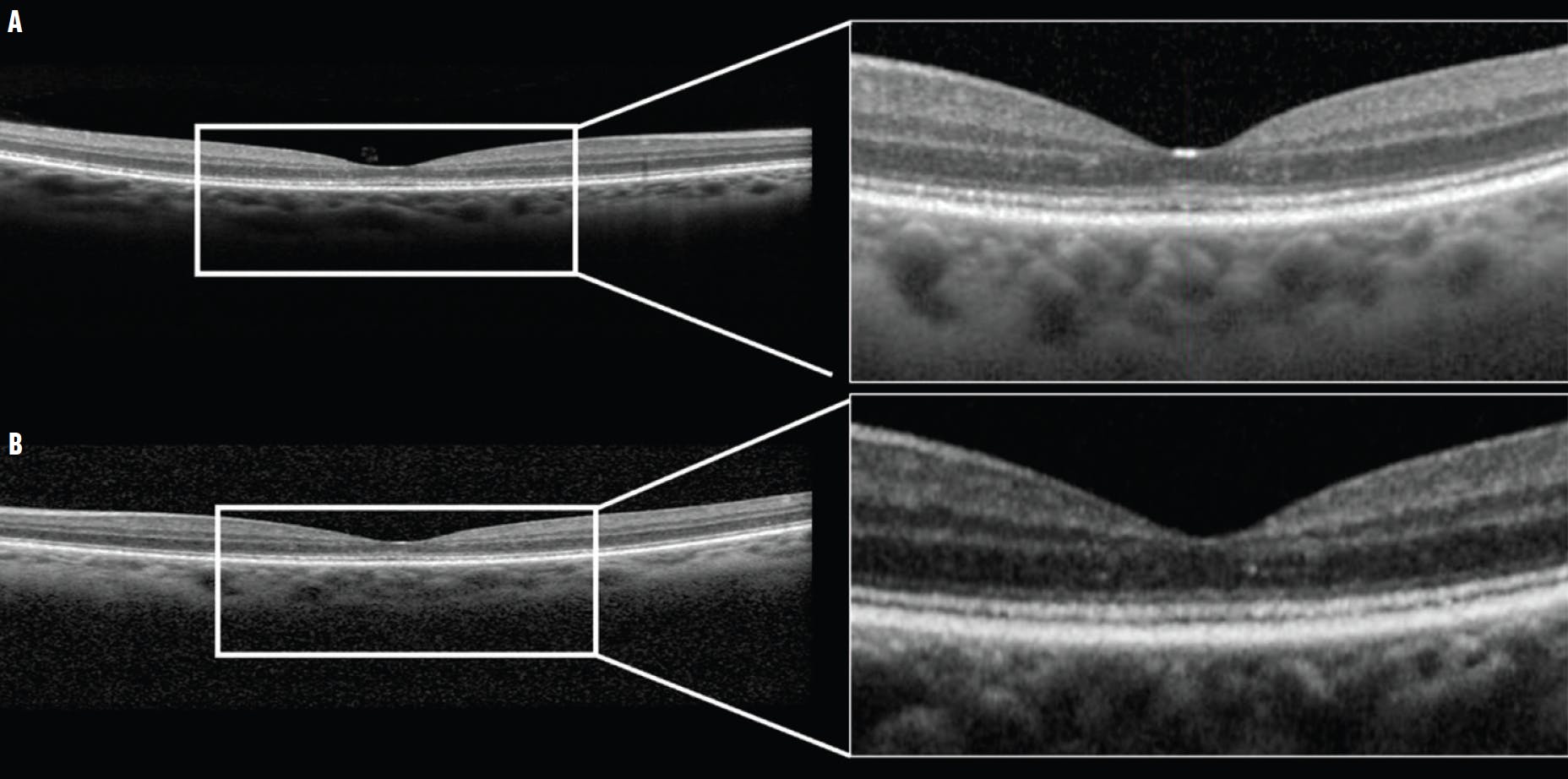
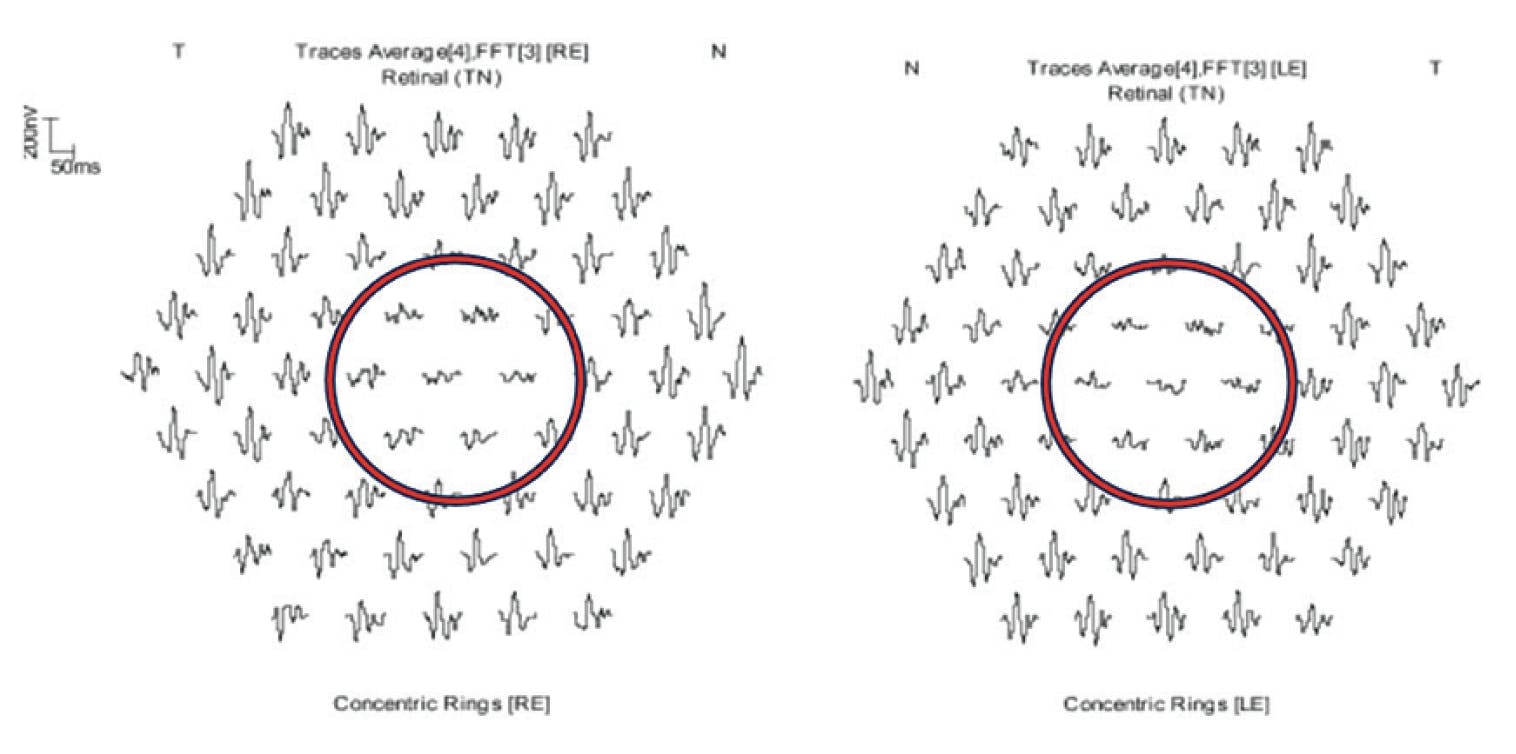
Genetic testing revealed the presence of a heterozygous variant in the RP1L1 gene, which is known to be associated with OMD.
DISCUSSION
First described in 1989, OMD is an inherited macular dystrophy characterized by central cone cell dysfunction resulting in loss of vision in the absence of striking abnormalities on fundus examination.2,3 The disease is caused by a mutation in the RP1L1 gene, whose expression is specific to the retina. Studies conducted on mice have shown RP1L1 to be located in the outer segments and connecting cilia of the photoreceptor cells, affecting photosensitivity and outer segment morphogenesis of the rod photoreceptors.4 Due to its rarity, its precise epidemiology is unknown.5
Patients often present with a gradual decrease in visual acuity, frequent photophobia, and light sensitivity.6-8 Classic OMD is characterized by a blurred EZ and the absence of the interdigitation zone on OCT. Based on the severity of interdigitation zone and EZ involvement, the clinical presentation of OMD can be categorized into three stages, which appear to be related to the duration of disease onset.6,9,10 In late stages, studies have reported thinning of the outer nuclear layer with preservation of the RPE.11-13 Full-field ERG may show a reduced cone response (although variable), and multifocal ERG often shows a reduced response in the foveal area, playing a key role in OMD diagnosis.6
Interestingly, the use of adaptive optics in OMD patients was associated with an increase in cone spacing, resulting in a reduction in cone density.14 This appears to be related to the cone deficits evidenced on full-field ERG.
Other studies have reported variability in the phenotypical spectrum of RP1L1 deficiency.10,15 Some research has shown that a single nucleotide polymorphism located on the RP1L1 gene plays a protective role in diabetic retinopathy.3 Further studies are required to better characterize the disease spectrum of OMD.
READ THE SIGNS
Although rare, OMD can have a significant clinical effect. Patient symptoms of progressive vision loss despite a normal fundus appearance should raise suspicion for OMD. Confirmation with genetic testing helps avoid an unnecessary and burdensome diagnostic workup for quicker, accurate diagnosis.
1. Georgiou M, Fujinami K, Michaelides M. Inherited retinal diseases: therapeutics, clinical trials and end points—a review. Clin Exp Ophthalmol. 2021;49(3):270-288.
2. Miyake Y, Ichikawa K, Shiose Y, Kawase Y. Hereditary macular dystrophy without visible fundus abnormality. Am J Ophthalmol. 1989;108(3):292-299.
3. Liu J, Hayden MR, Yang Y. Research progress of RP1L1 gene in disease. Gene. 2024;912:148367.
4. Akahori M, Tsunoda K, Miyake Y, et al. Dominant mutations in RP1L1 are responsible for occult macular dystrophy. Am J Hum Genet. 2010;87(3):424-429.
5. Fujinami K, Yang L, Joo K, et al. Clinical and genetic characteristics of east Asian patients with occult macular dystrophy (Miyake disease). Ophthalmology. 2019;126(10):1432-1444.
6. Kikuchi S, Kameya S, Gocho K, et al. Cone dystrophy in patient with homozygous RP1L1 mutation. BioMed Res Int. 2015;2015: 545243.
7. Zobor D, Zobor G, Hipp S, et al. Phenotype variations caused by mutations in the RP1L1 gene in a large mainly German cohort. Invest Ophthalmol Vis Sci. 2018;59(7):3041-3052.
8. Tsunoda K, Usui T, Hatase T, et al. Clinical characteristics of occult macular dystrophy in family with mutation of RP1L1 gene. Retina. 2012;32(6):1135-1147.
9. Yang L, Joo K, Tsunoda K, et al. Spatial functional characteristics of east Asian patients with occult macular dystrophy (Miyake disease); EAOMD Report No. 2. Am J Ophthalmol. 2021;221:169-180.
10. Manayath GJ, Rokdey M, Verghese S, Ranjan R, Saravanan VR, Narendran V. An extended phenotype of RP1L1 maculopathy – case report. Ophthalmic Genet. 2022;43(3):392-399.
11. Nakamura N, Tsunoda K, Mizuno Y, et al. Clinical stages of occult macular dystrophy based on optical coherence tomographic findings. Invest Ophthalmol Vis Sci. 2019;60(14):4691-4700.
12. Brockhurst RJ, Sandberg MA. Optical coherence tomography findings in occult macular dystrophy. Am J Ophthalmol. 2007;143(3):516-518.
13. Koizumi H, Maguire JI, Spaide RF. Spectral domain optical coherence tomographic findings of occult macular dystrophy. Ophthalmic Surg Lasers Imaging. 2009;40(2):174-176.
14. Tojo N, Nakamura T, Ozaki H, Oka M, Oiwake T, Hayashi A. Analysis of macular cone photoreceptors in a case of occult macular dystrophy. Clin Ophthalmol. 2013;7:859-864.
15. Noel NCL, MacDonald IM. RP1L1 and inherited photoreceptor disease: a review. Surv Ophthalmol. 2020;65(6):725-739.


