



At the 53rd annual ARDS meeting, held March 1 – 5, 2025, John Kitchens, MD, delivered two lectures with broad applicability to the retina community (Figure). Here, I summarize his pearls for improving efficiencies in and out of the OR and how to avoid lawsuits.
EFFICIENCIES IN THE OR AND CLINIC
Dr. Kitchens’ first lecture was a masterclass in building habits and systems that save time, reduce errors, and improve outcomes—all rooted in the idea that true efficiency is not about speed but intention, preparation, and precision.
One of the first practical tips he shared was his preference for a 26-gauge, 3/8-inch needle. Shorter and stiffer than other options, this tool offers better control for delicate procedures such as silicone oil infusion and subretinal fluid drainage. Dr. Kitchens also shared an innovative technique for cryo-depression. Rather than first marking retinal breaks and then treating them, he uses the cryo-probe to identify and immediately treat the break. While the probe is still frozen to the eye, his assistant marks the spot, eliminating an entire step without sacrificing precision.
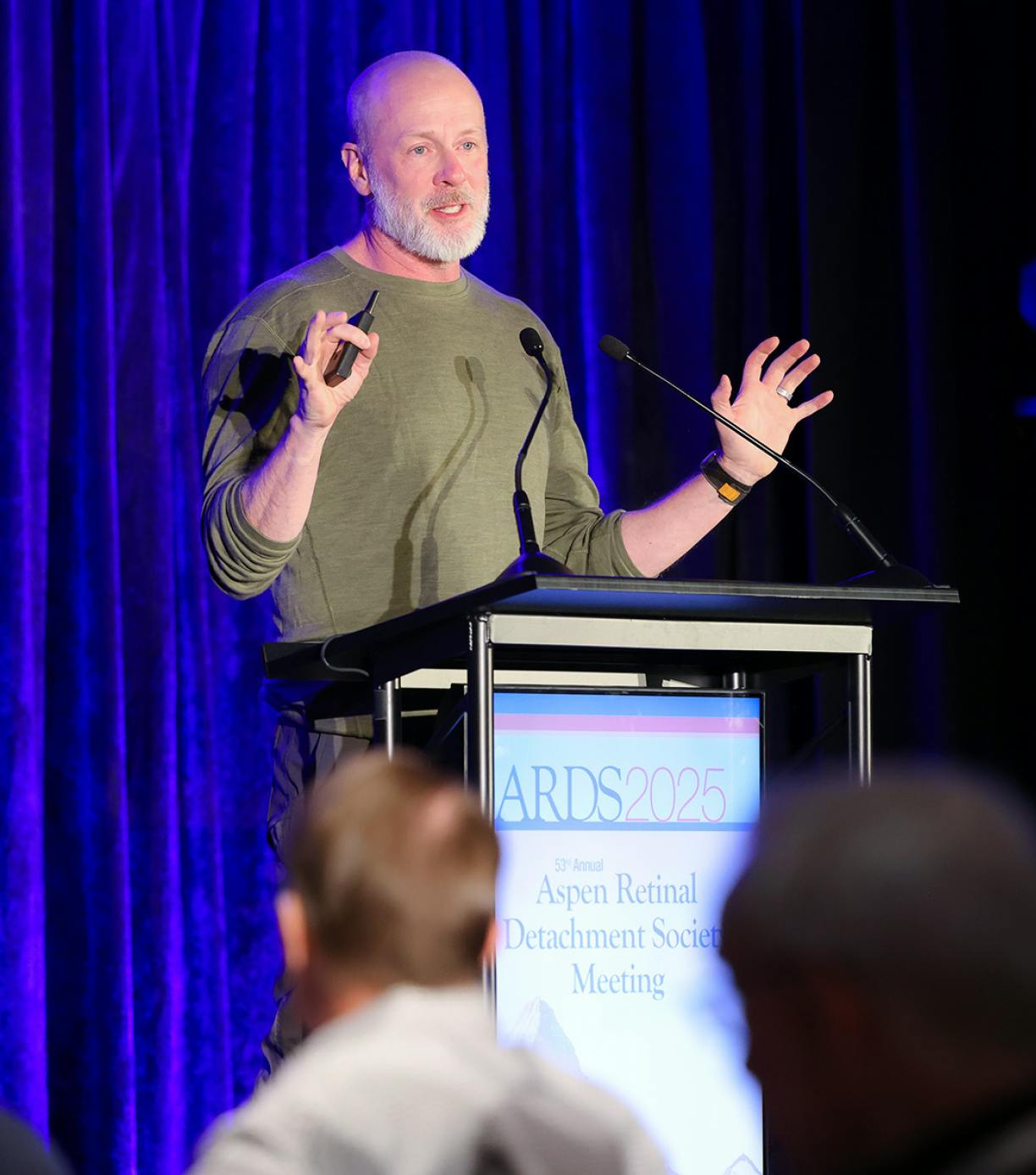
Figure. Dr. Kitchens had the ARDS audience scrambling to take note of his pearls that could help improve their OR and clinic efficiency. Image courtesy of Kevin Caldwell Photography.
Biome buckling was another technique highlighted that provides a vitrectomy-like wide-angle view, which improves visualization, teaching, and safety. A surprisingly effective trick came not from a colleague but from an industry representative: When the biome lens fogs up mid-surgery, simply lift and swipe the lens with a gloved finger. It’s a tiny move that helps maintain momentum during surgery.
When addressing macular holes, he uses what he calls the soft tip pucker technique. With high IOP and a soft tip cannula open to air, he gently nudges the edges of large or flat macular holes to break adhesions, enhancing the likelihood of closure.
On the postoperative side, Dr. Kitchens has simplified his regimen dramatically. For nearly all surgeries (with the exclusion of IOL-related procedures), he now prescribes only antibiotic ointment twice daily for a week. This streamlined protocol reduces patient burden and avoids high pharmacy costs. His institution’s data, presented at ARVO 2024, confirmed there was no significant difference in outcomes using this approach.
Perhaps most intriguing was his integration of nutraceuticals into postoperative care. Inspired by Sharon Fekrat, MD, Dr. Kitchens began prescribing curcumin to patients with retinal detachments. The data suggest a reduced risk of proliferative vitreoretinopathy and epiretinal membrane formation,1 all for roughly $100 per 6-month course.
Dr. Kitchens’ talk then transitioned to the theme of simplification in clinical practice. He emphasized the often-overlooked value of scribes. He praised his own scribe for anticipating needs, answering patient questions, and flagging clinical concerns before he even stepped into the room.
Dr. Kitchens next dove into AI, describing it as a versatile assistant that can summarize medical literature, draft patient handouts, and translate complex terms into plain language. He showed how ChatGPT Pro’s “Deep Research” mode could simulate a digital research assistant, retrieving expert commentary and patient perspectives across the web.
Of the many anecdotes provided, one memorable example involved using ChatGPT to explain retinal detachment to a patient in Korean. In another instance, he had AI interpret a rare OCT finding from a smartphone photograph and deliver a spot-on diagnostic explanation.
AI’s administrative potential was also on display, as Dr. Kitchens used it to craft polished and accurate emails to peers. He even fed a clinic schedule into ChatGPT and asked it to optimize flow for 80 patients in a half-day; he received a detailed, workable plan in return.
AVOIDING LAWSUITS: LESSONS FROM AN EXPERT WITNESS
During his second presentation, Dr. Kitchens cited statistics showing that between 75% and 99% of physicians will face a malpractice lawsuit, with about 7% sued annually.2 The financial stakes are substantial: Average malpractice payouts range from $200,000 to $400,000, he said. Despite this, Dr. Kitchens reassured the audience that most malpractice cases never go to trial or are dismissed, and even when they do reach a jury verdict, physicians win approximately 95% of the time. This framed the talk’s main objective: strategies to avoid getting sued altogether.
Dr. Kitchens identified common reasons why ophthalmologists get sued, including misdiagnosis, surgical and medication errors, failure to treat, lack of proper informed consent, and mismanagement of postoperative complications. Based on his experience as an expert witness, Dr. Kitchens noticed three recurring themes in lawsuits: the patient suffered a poor outcome, the patient had a strained relationship with the physician, and there was poor or absent documentation. He explained that if one of these elements is missing, the physician usually survives the lawsuit, but when all three are present, litigation is almost certain.
Next, Dr. Kitchens discussed the legal concept of standard of care, which refers to the quality of care expected from a competent practitioner under similar circumstances. Expert witnesses often argue whether a physician’s actions met this standard. He recommended surgeons avoid performing surgeries that are not clearly indicated, as unnecessary or overly aggressive surgery increases risk.
He stressed that poor documentation is a major contributor to malpractice claims. The old adage, “If it’s not documented, it wasn’t done,” remains true. Lack of detailed and accurate records increases the risk of successful lawsuits and larger payouts. Never alter the medical record after a lawsuit is filed, he said, noting that forensic methods can detect changes, and such actions can worsen the legal situation. Overall, he recommended documenting key clinical details clearly and warned against using ambiguous or nonstandard abbreviations that can confuse reviewers who are not specialists.
Informed consent is another major source of malpractice claims. Dr. Kitchens emphasized that patients rarely retain all information explained preoperatively, especially when anxious about vision loss. He advised simplifying the explanation, involving family members in the discussions, and ensuring all staff provide consistent messaging. Consent should cover diagnosis, treatment options, risks, benefits, and alternatives in a routine, repeatable format, tailored slightly for specific cases.
Dr. Kitchens recommended dictation to improve documentation. He himself dictates notes in front of patients and promptly sends copies to patients and referring doctors. He criticized the use of generic OR templates, which often fail to document unexpected complications or deviations, and stressed that every case deserves a unique, dictated operative note with justification for the procedure and explanation of options discussed.
Dr. Kitchens also addressed the crucial role of the doctor-patient relationship in malpractice risk. Research shows that busy surgeons with high surgical volumes and a history of lawsuits tend to get sued more, not necessarily because they perform more surgeries, but because they appear rushed or indifferent. Effective communication by physicians and their staff is vital. Patients may sue for perceived neglect or poor communication even if the clinical care was appropriate. He underscored the importance of humility and apology. Patients appreciate when doctors acknowledge poor outcomes and express regret sincerely.
SAVE THE DATE
The meeting was packed with other clinical pearls and top-notch panel discussions. Head to retinatoday.com to catch up on other meeting summaries, including: ARDS 2025: Surgical Pearls and Top Panel Discussions at ARDS 2025. And don’t forget to register for the 54th annual ARDS meeting in Snowmass Village, set for February 28 – March 4, 2026!
1. Zheng Y, Valikodath N, Woodward R, Allen A, Grewal DS, Fekrat S. Oral curcumin to reduce risk of proliferative vitreoretinopathy following rhegmatogenous retinal detachment repair. Retina. 2024;44(10):1741-1747.
2. Jena AB, Seabury S, Lakdawalla D, Chandra A. Malpractice risk according to physician specialty. N Engl J Med. 2011;365(7):629-636.


