


AT A GLANCE
- During membrane peeling surgery, surgeons can use real-time, high-resolution intraoperative OCT imaging to confirm that the membrane is completely peeled.
- Intraoperative OCT can reveal tractional hemorrhage caused by persistent hyaloid tension mimicking a central retinal vein occlusion.
- During pediatric lens cases, surgeons can use intraoperative OCT to ensure optimal vitrector positioning as the capsule collapses.
OCT is a well-established imaging modality to diagnose and monitor treatment of retinal diseases in the clinic. However, its utility in the OR is less established, as clinicians struggle to integrate the tool into their surgical workflows and OR technology platforms.
At Bascom Palmer Eye Institute, we have successfully integrated intraoperative OCT (iOCT) and find it useful in many cases. For imaging under anesthesia, we placed a Heidelberg Spectralis system on a multi-axis mounting arm and have found that this setup allows for maximum flexibility to patient anatomy during examination under anesthesia when clinical imaging can’t be obtained during routine visits due to age, ability to cooperate with the imaging specialist, and potential need for anesthesia. For iOCT, the Rescan system (Carl Zeiss Meditec) provides good quality imaging to evaluate and monitor pathology in real time during surgery, which can be particularly helpful with surgical management decisions. Here, we highlight a few examples of these advantages.
MEMBRANE PEELING IN ADULTS WITH AN IOL
Many adult patients opt for multifocal IOLs at the time of their cataract surgery. While these lenses can provide excellent vision, they make it difficult to visualize macular pathology, particularly for membrane peeling procedures. When a multifocal IOL is present, the surgeon must constantly shift focus to account for the different optical zones of the IOL. In our ORs, we use the Finesse Sharkskin forceps (Alcon) to maintain a firm grip on the membranes and minimize re-grabbing or slippage that may occur due to the shift in focal planes. However, the view through a multifocal IOL can be deceptive, and it can be challenging to know whether the entire membrane was removed despite having good surgical tools and honed surgical technique.
As seen in Figure 1, the retina does not immediately relax following peeling of a mature epiretinal membrane in an eye following cataract surgery. This can leave the surgeon wondering if the entire membrane was successfully removed. In these cases, surgeons can use real-time, high-resolution iOCT imaging to confirm that the membrane is completely peeled and ensure that, with time, the retina will flatten, thus maximizing the surgical outcome.
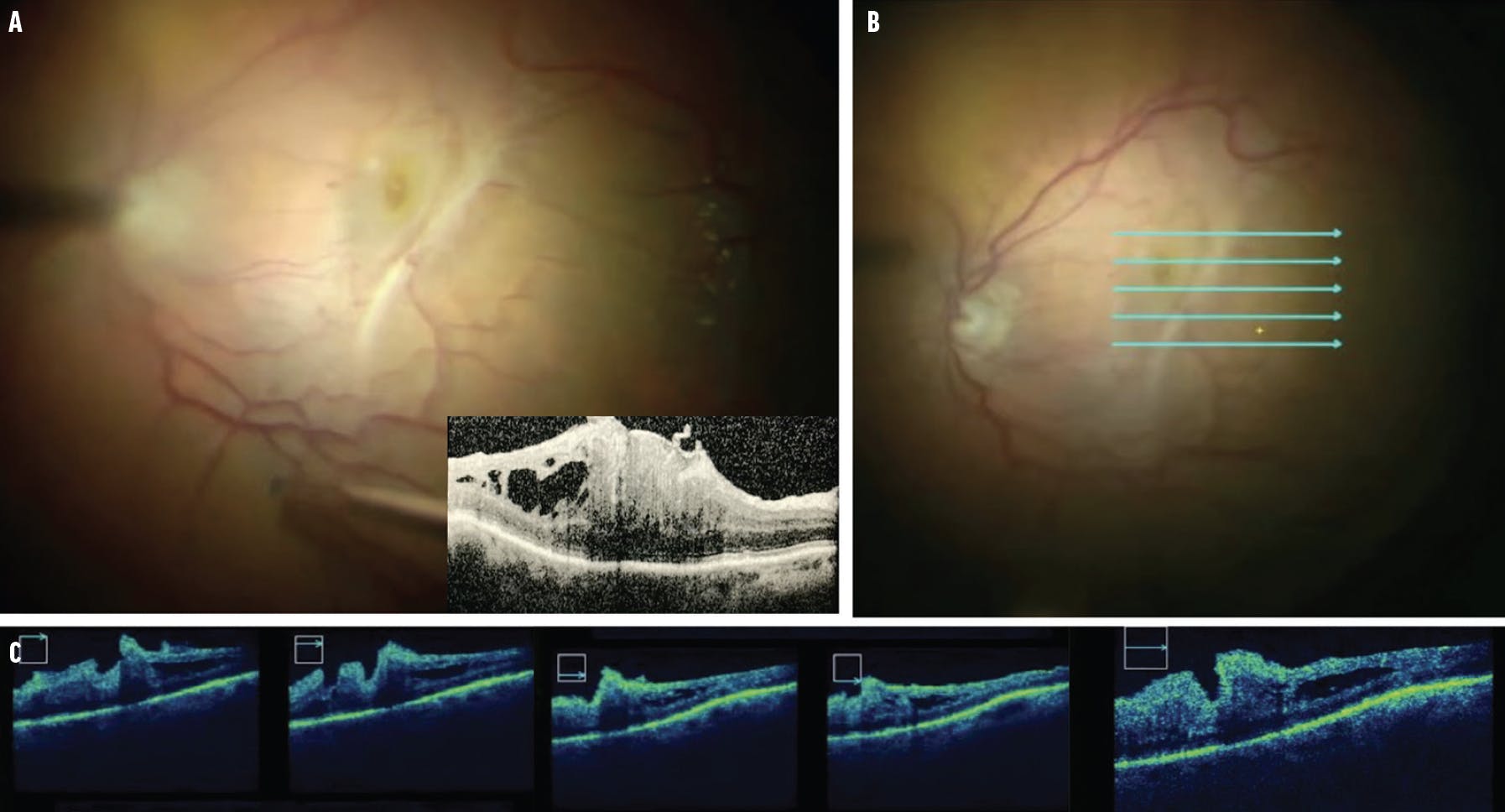
Figure 1. This is the intraoperative view before (A) and after (B) a membrane peel for an epiretinal membrane, with the corresponding clinic OCT prior to surgery (A, inset). Note the persistent folds in the retina. In the B-scan images of each iOCT roster scan in B, the persistent retinal folds are visualized with some cystoid changes due to chronicity but no remaining epiretinal membrane is seen (C).
CHALLENGING PEDIATRIC CASES REIMAGINED
Pediatric cases present with their own challenges, given that the patients are young and their fibrotic tissue responses are robust. Intraoperative imaging can be helpful to ensure that membrane peeling for complex detachments or profound inflammatory reactions to underlying pathology is complete.
For example, as illustrated in Figure 2, a 7-year-old patient with a history of retinopathy of prematurity had been referred for a suspected central retinal vein occlusion (CRVO). During the surgery, iOCT revealed the true etiology for the patient’s vision loss: a tractional hemorrhage caused by persistent hyaloid tension on the retinal vessels, mimicking a CRVO. With the help of iOCT, the surgeon can address the membranes with the vitrector alone to minimize trauma from repeat cycling of instrumentation through the cannulas. The same OCT imaging modality could subsequently confirm all tractional components are removed prior to ending the surgery, again maximizing long-term stability of the retina and a successful surgical outcome.
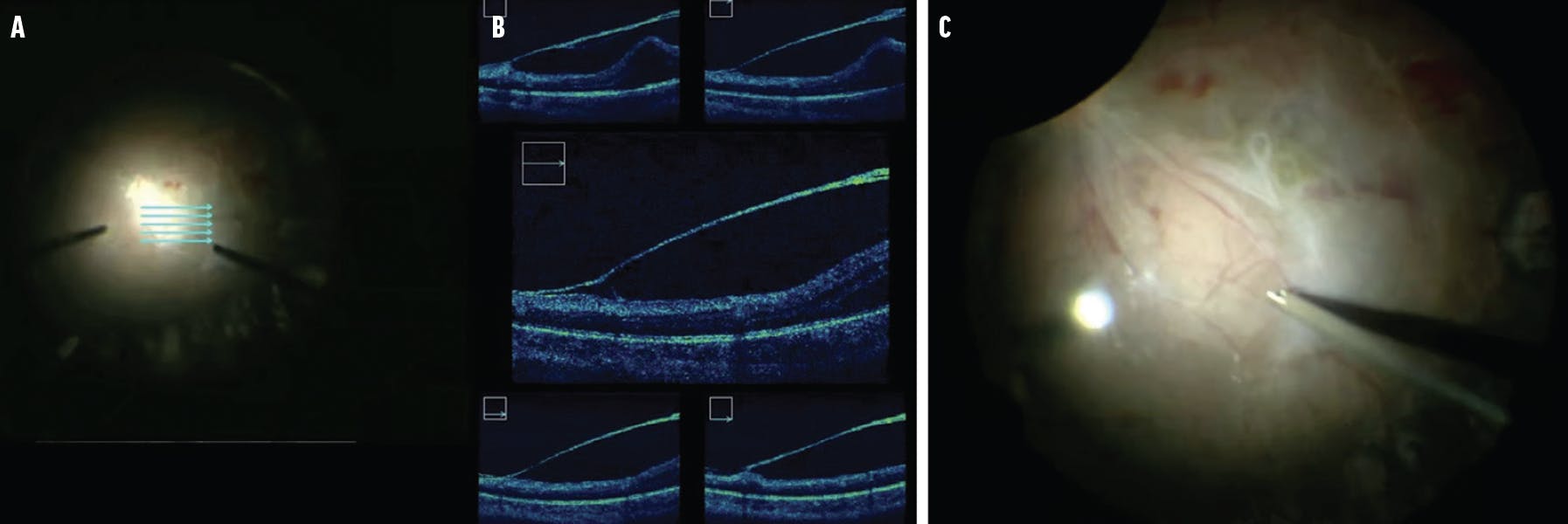
Figure 2. During surgery in the eye of a 7-year-old with a suspected CRVO (A), the iOCT roster scans demonstrate a mature tractional membrane over the macula and a potential surgical plane (B). After initiating membrane removal with the vitrector (C), note the small loop of fibrotic material that released after entering the surgical plane.
The same surgical principles can also be applied to optic pit maculopathy cases when the surgeon needs to confirm that the posterior hyaloid over the macula and nerve is separated before propagating a posterior vitreous detachment (Figure 3). These cases are best set up by starting with a Finesse Flex Loop (Alcon) and moving radially from the center before initiating the lifting of the posterior hyaloid to the nerve.
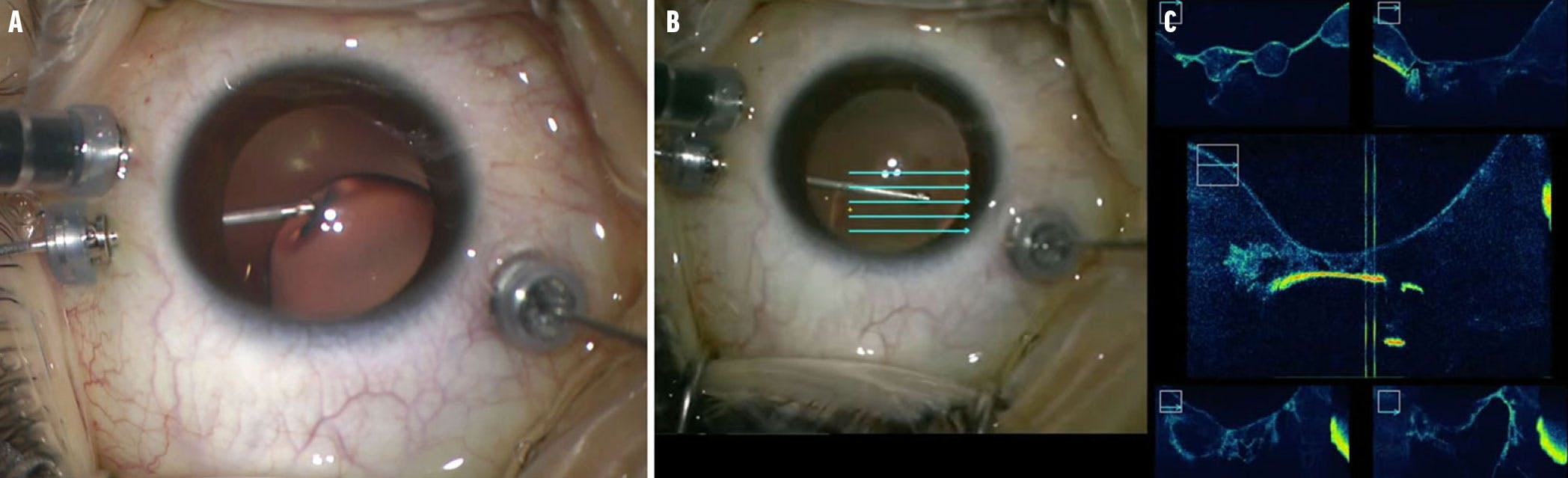
Figure 3. This case of optic pit maculopathy is obvious due to the hypopigmentation around the nerve with significant involvement of the nasal macula (A). Dilute Kenalog was used to visualize the hyaloid before using a Finesse Flex Loop. iOCT confirmed the removal of the hyaloid from the macula (B). Note the single vitreous strand attached to the nerve. The vitrector was used to cut the remaining vitreous band and propagate the posterior vitreous detachment (C).
INTRAOPERATIVE LENS ASPIRATION IN MARFAN SYNDROME
We have also found iOCT useful in pediatric lens cases. Figure 4 shows a pediatric patient with a subluxed lens due to Marfan syndrome. During crystalline lens removal, it can be challenging to efficiently penetrate the capsule without dislocating the lens capsule complex into the vitreous chamber, thus increasing risk and prolonging the surgery. Using iOCT, the surgeon can localize the cutter onto the anterior capsule, aspirate, cut, and then smoothly enter the capsule to remove the lens material before taking the capsule. All these maneuvers can be done under iOCT to ensure optimal vitrector positioning as the capsule collapses.
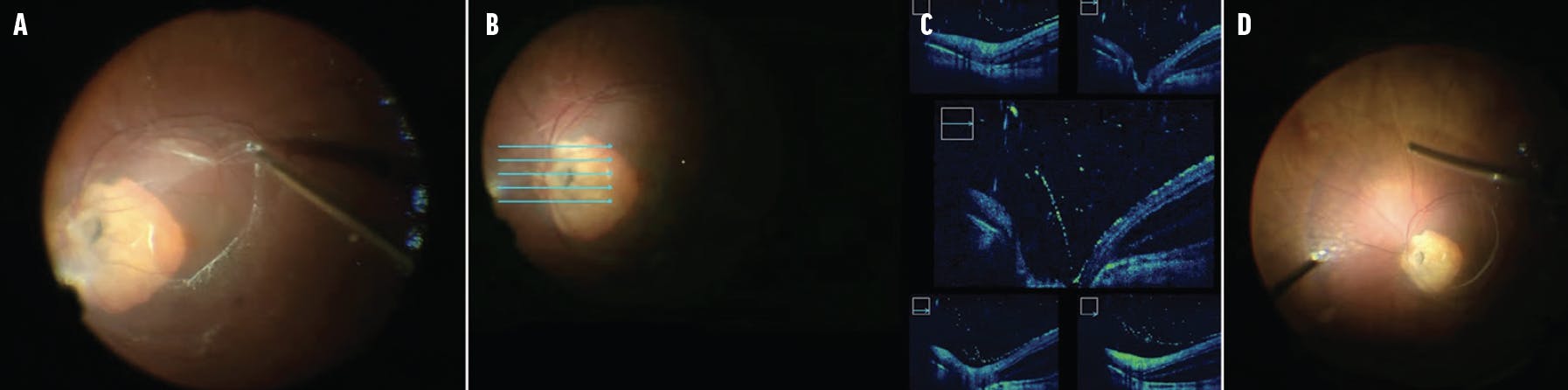
Figure 4. This pediatric patient presented with a superotemporally subluxed crystalline lens (A). During surgery, the vitrector mouth is placed facing the capsule, and aspiration is used to fill the vitrector mouth before cutting an opening in the capsule. The vitrector removes the crystalline lens material (B), and the surgeon uses iOCT to verify that the vitrector is fully within the capsule as illustrated by the increased hyperreflective signal corresponding to the vitrector surface (C, D).
PERSISTENT FETAL VASCULATURE: COMPLEX ANATOMY, REAL-TIME DECISIONS
Persistent fetal vasculature remains one of the more intricate diseases in pediatric retina, as residual fibrotic material can serve as a nidus for tractional membrane formation. We have found that careful dissection around the hyaloid artery followed by confirmation with iOCT minimizes this risk. Furthermore, as these patients have poor vision initially, assessing the macula, and the foveal structure in particular, can aid in prognostication of vision potential after the immediate postoperative period. This is helpful not only for the surgeon but also for the parents who are understandably nervous. Having this information allows for incremental discussions to manage parent (and patient) expectations for vision, as well as any intervention that may be needed to correct vision deprivation such as patching or glasses/contact lens wear.
IMAGING AS A SURGICAL AND DIAGNOSTIC REVOLUTION
As highlighted by these cases, iOCT can be an instructive tool to help surgeons obtain the best outcomes for patients. Although new technology is tempting to use, surgeons should always be mindful of how and why the technology is being employed. Clinicians should always focus on minimalism and precision, and iOCT can allow these principles to flourish in the OR.
Hopefully with more time and investment, OCT will be easily deployable and used in most surgeries, perhaps even elucidating new pathophysiology of common retinal disease we only thought we knew and providing the means to intervene sooner and more efficiently to preserve and restore vision.


