


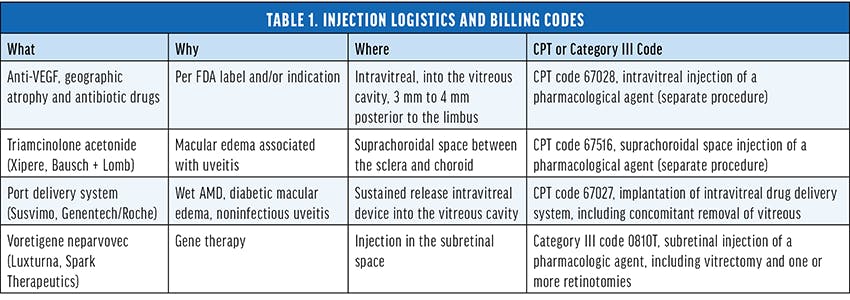
Accurate coding for retina procedures requires careful consideration of key components of the patient encounter and management approach. From where the medication is delivered to what type of implanted material is removed, these crucial questions must be answered to submit a clean claim (Table 1). The clinical scenarios explored below can help you properly code your next patient visit.
WHERE WAS THE MEDICATION INJECTED?
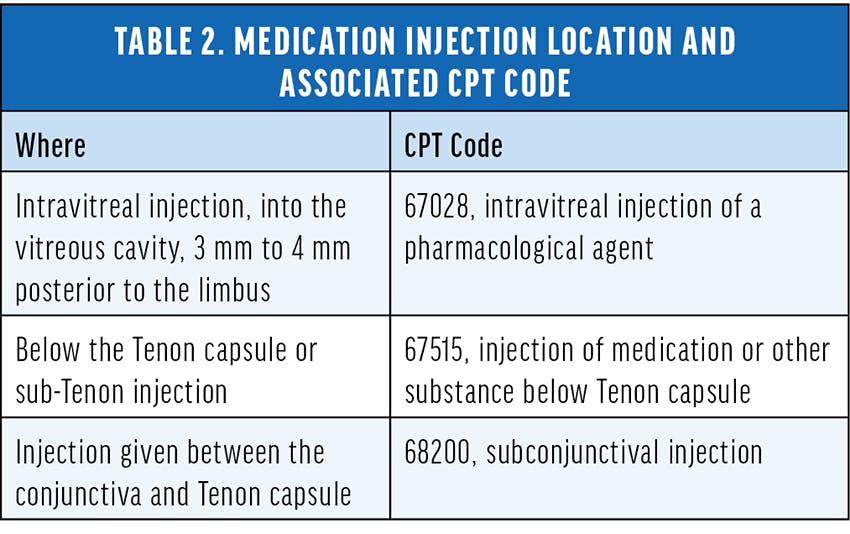
The documentation and superbill note a Kenalog injection in the left eye. Although it is clear which medication was injected, to confirm the correct coding for this case, a crucial question remains: Where was the medication injected? The answer, which should be clearly documented in the medical record, will dictate the appropriate CPT code for the procedure (Table 2).
WHY WAS THE INJECTION PERFORMED?
For all intravitreal injections performed (CPT code 67028), the first question is what drug was used? Following that inquiry is why? The “why” is the indication, or diagnosis for the treatment, and will support the medical necessity. Each drug has FDA-approved indications, and reporting these diagnoses will ensure claim approval, unless the payer has a policy with expanded coverage.
Pitfalls to avoid during chart documentation include unspecified indications. For example, do not report choroidal neovascularization, ICD-10 H31.8, or retinal neovascularization, unspecified, H350.052, when injecting faricimab-svoa (Vabysmo, Genentech/Roche). Instead, use the more specific diagnosis of exudative wet macular degeneration with active choroidal neovascularization, ICD-10 H35.3221.
WHAT WAS REMOVED?
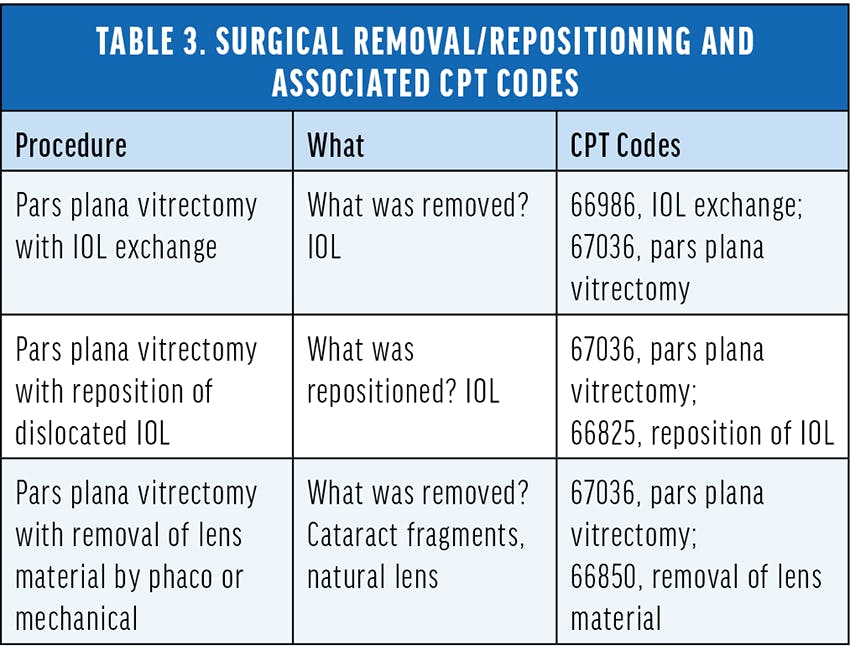
When performing surgery to remove any implanted material, the first two questions are: 1) What is being removed, and 2) how?
Consider a procedure described as a removal of a dislocated lens. In this situation, be sure to confirm if this is a removal of a dislocated IOL or a removal of cataract fragments following surgery. The answer will guide the appropriate coding (Table 3).
WHY WAS THE PROCEDURE PERFORMED?
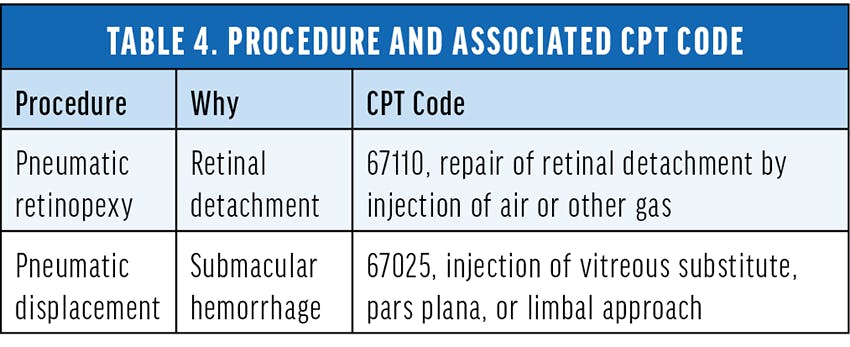
A frequent procedure in retina clinics, pneumatic retinopexy (injection of gas), is typically performed for retinal detachment. But that isn’t the only indication—when the diagnosis is submacular hemorrhage, the coding is much different (Table 4).
WHERE IS THE PATIENT RESIDING?
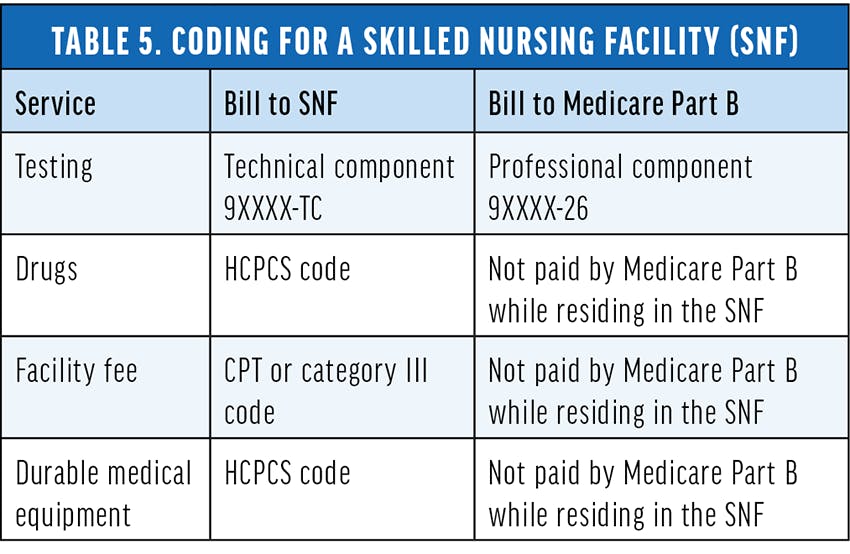
Is the patient living in a skilled nursing facility (SNF) following an injury and being rehabilitated? Due to consolidated billing for SNFs, there are specific services that are not covered by Medicare Part B when the beneficiary is residing in the facility.1 These services would be paid for by the SNF from its consolidate payment. Prior arrangements with the SNF can streamline reimbursement (Table 5).
When a registered hospital inpatient is seen in the office, services provided are made under the physician fee schedule facility rate.2 As a result, the physician providing the services must report the place of service 21, inpatient hospital, as this represents the setting where the patient is currently receiving care, not place of service 11, office. If not reported appropriately, Medicare will deny or recoup the reimbursement due to an incorrect claim submission. Additionally, reimbursement for the medications provided during inpatient status is often bundled with the facility and not separately payable.
1. Consolidated billing. CMS. Accessed September 2, 2025. bit.ly/4piFRoP
2. Medicare claims processing manual. CMS. Accessed September 2, 2025. bit.ly/3I3VYWx


