


Several forms of noninfectious choroidites—including idiopathic multifocal choroiditis (MFC), serpiginous choroiditis (SC), Vogt-Koyanagi-Harada disease (VKH), and HLA-A29 birdshot retinochoroiditis—can have a deleterious evolution if early, prolonged immunosuppressive treatment is not applied.1,2 The pattern of treatment typically comprises multiple steroidal and nonsteroidal immunosuppressive agents or biologic agents. The most frequently used therapeutics in our clinic are prednisone (for short-term use), azathioprine, cyclosporine, tacrolimus, mycophenolic acid, and, rarely, methotrexate or biologics (ie, anti-TNF-α antibodies, anti-IL-6 antibodies, or rituximab).3 The most reliable biomarker for determining the treatment course and monitoring effectiveness is ICG angiography (ICGA), as only ICGA can precisely show stabilization of severe choriocapillaritis or choroidal stromal inflammation.4
This article examines each of these vision-threatening choroidites and details cases in which aggressive immunosuppression was applied with good visual outcomes.
CASE NO. 1: MFC
A 46-year-old woman presented for emergency care complaining of photopsias and scotomas. She had experienced a similar episode 17 years earlier, which had been treated after a delay, resulting in a significant decrease in vision. She presented with ill-defined peripapillary chorioretinal lesions on fundus photography, numerous hypofluorescent spots on ICGA, peripapillary hyperautofluorescence on fundus autofluorescence (FAF), areas of photoreceptor loss in the outer segments on OCT, and a peripapillary scotoma on visual field (VF) testing (Figure 1).
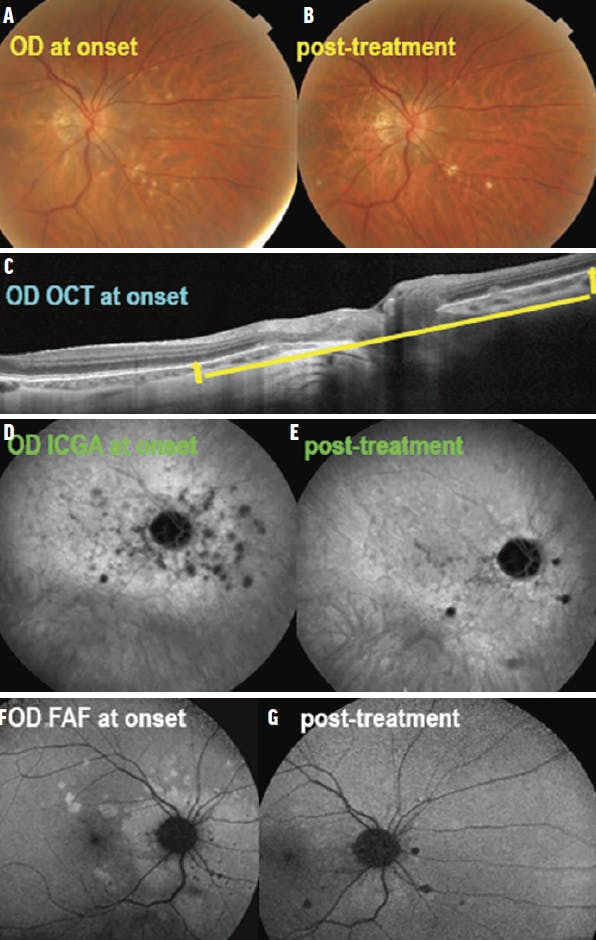
Figure 1. The peripapillary foci present at onset (A) regressed after treatment, leaving only three small, punched-out chorioretinal scars (B). OCT at presentation showed outer segment loss (yellow line) corresponding to the areas of hyperautofluorescence (C). Numerous hypofluorescent occult (ie, not seen on fluorescein angiography) lesions on ICGA (D) resolved after treatment, leaving only three hypofluorescent scars (E). Peripapillary fundus hyperautofluorescence resolved after treatment (F, G).
The patient received prednisone tapered over 6 months, cyclosporine tapered over 13 months, and mycophenolic acid tapered over 21 months. After 21 months, the fundus foci, ICGA lesions, and FAF findings had resolved except for rare punched-out scars. Her functional visual acuity was retained, and her VF had normalized.
CASE NO. 2: SC
A 38-year-old man with bilateral tuberculosis-related SC (TB-SC) who was treated sequentially with prednisone monotherapy and then with anti-TB antibiotherapy, which did not halt the progression of disease. However, the disease responded to a combination of multiple immunosuppressants (prednisone, cyclosporine, and infliximab) and anti-TB quadritherapy. ICGA showed substantial reperfusion of the occluded choriocapillaris (Figure 2). The total duration of immunosuppressive therapy was 36 months, and the duration of anti-TB therapy was 14 months.
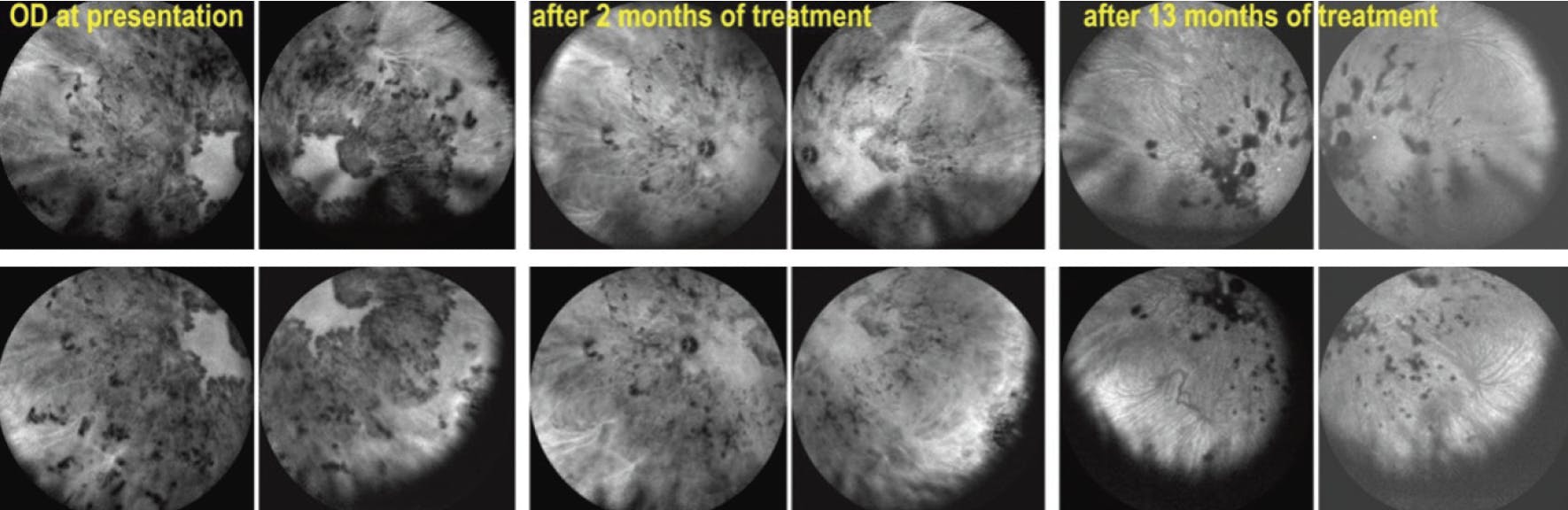
Figure 2. Extended areas of choriocapillaris nonperfusion were noted at presentation. After 2 months of immunosuppressive treatment and anti-TB therapy, substantial reperfusion of the choriocapillaris was apparent. Additional reperfusion of the choriocapillaris was noted at 13 months; the remaining dark areas correspond to chorioretinal atrophic scars.
SC is the most aggressive form of choriocapillaritis, resulting in extensive chorioretinal scars if not managed diligently. Treatment with multiple immunosuppressive agents has been robustly advocated.5-11 For all cases of SC with possible TB involvement, Bacilli infection must be ruled out by performing an interferon-gamma release assay; if the result is positive, the case should be considered TB-SC. Such cases not only require multiple immunosuppressive treatments, but also concomitant antibiotics to treat the TB.12
CASE NO. 3: VKH
A 38-year-old woman with findings indicating acute VKH was treated early (ie, within 2 weeks of first symptoms) with triple immunosuppressants: prednisone tapered for 13 months, cyclosporine tapered for 15 months, and mycophenolic acid for 51 months (Figure 3). The patient was followed for 8 years and remained recurrence-free without treatment.
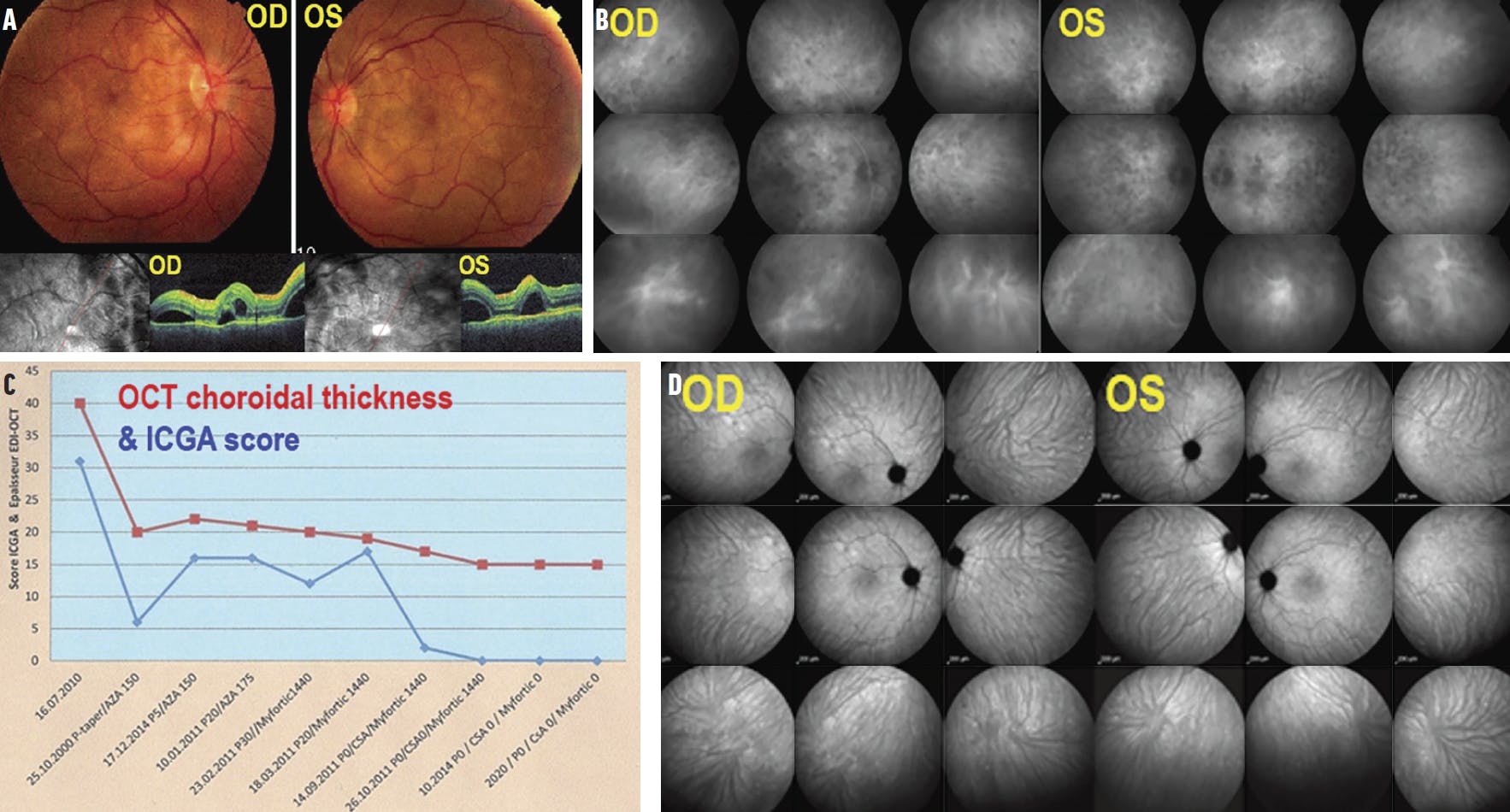
Figure 3. This patient presented with serous retinal detachments observed on fundus photography and OCT (A). Pre-treatment ICGA shows numerous hypofluorescent dark dots and choroidal vasculitis (fuzzy indistinct vessels; B). The graph (C) shows the fine-tuning of immunosuppressive therapy according to the ICGA angiographic score (blue line); the red line indicates choroidal thickness measured by OCT, an unreliable biomarker to monitor disease evolution. After 8 years of follow-up, the choroidal stroma remained inflammation-free (D).
If early, prolonged ICGA-assisted treatment with steroidal and nonsteroidal immunosuppressive agents is not applied, acute VKH is likely to evolve into chronic disease with a relentless course and risk of various complications, including sunset glow fundus, cataract, glaucoma, and subretinal fibrosis.13 Treatment with multiple immunosuppressive agents and ICGA-controlled tapering until absence of stromal choroidal inflammation can prevent chronic evolution and sunset glow fundus depigmentation and enhance the prospect of treatment-free resolution.14-16
CASE NO. 4: HLA-A29 BRC
A 45-year-old woman patient with stromal choroiditis due to BRC was treated with periocular steroids (systemic prednisone was contraindicated) and mycophenolic acid for 6 months without satisfying efficacy. The anti-TNF-α agent, infliximab, was added for another 6 months with persistent choroiditis in the form of numerous dark, hypofluorescent dots. After adding cyclosporine, these dots vanished after 5 weeks of treatment (Figure 4).
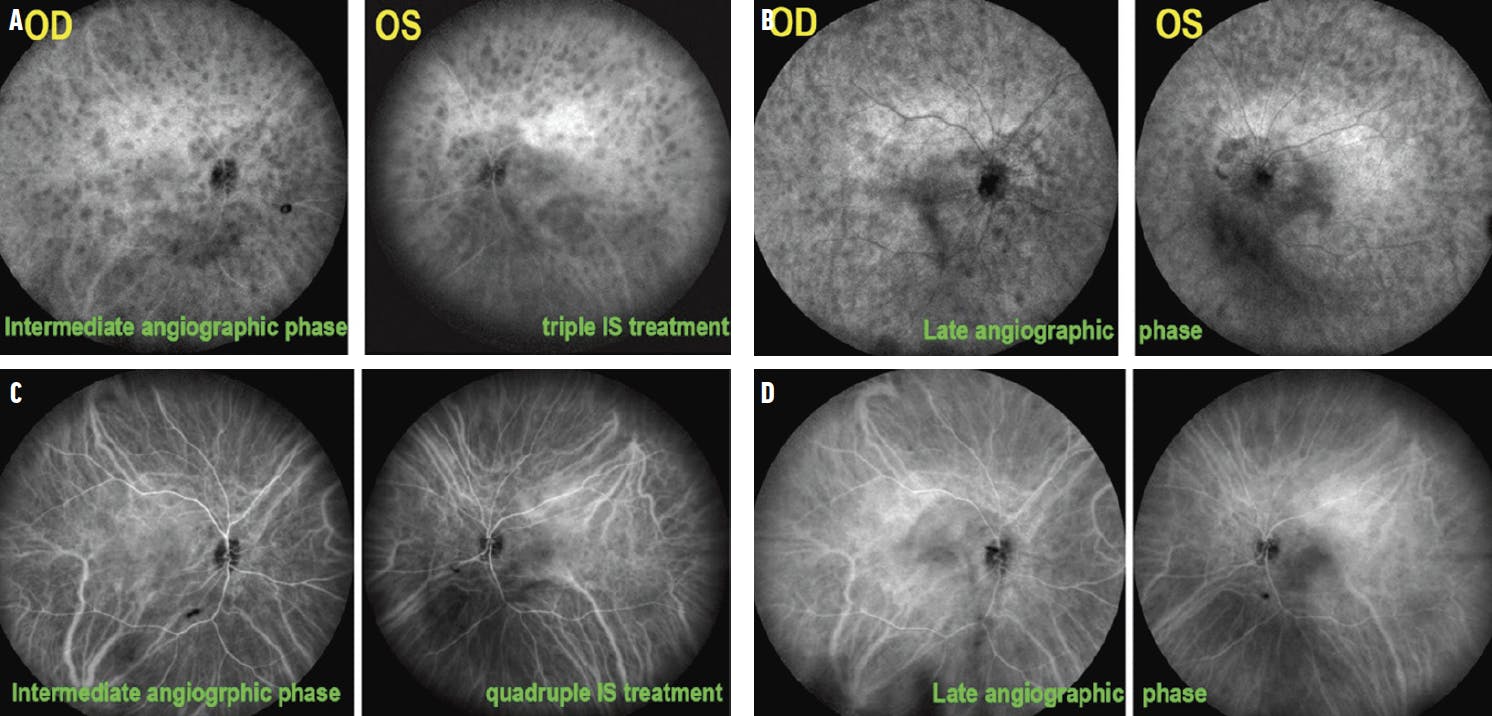
Figure 4. This patient was treated for 12 months with periocular steroids, mycophenolic acid, and the anti-TNF-α agent infliximab with numerous, persistent hypofluorescent dark dots and choroidal vasculitis with unrecognizable course of choroidal vessels both in the intermediate (A) and late angiographic phases (B). After 5 weeks of additional cyclosporine, the hypofluorescent dark dots vanished, and the choroidal vessels appeared normal with their course clearly visible in the intermediate and late angiographic phases (C and D).
Similar to VKH, stromal choroiditis in BRC often requires treatment with early, combined immunosuppressive agents and ICGA to help guide choice of therapy and monitoring of treatment efficacy. In such cases, oval-shaped birdshot fundus lesions may be prevented in the same fashion as sunset glow fundus in VKH.17,18 However, whereas in VKH the primary inflammatory process occurs exclusively in the choroid and only secondarily involves the retina, in BRC, there is dual independent retinal and choroidal involvement.19,20
ACT DECISIVELY TO PRESERVE VISION
The range of immunosuppressive/immunomodulatory agents available has expanded substantially in parallel with the availability of precise imaging biomarkers for choroidal inflammatory activity, such as ICGA. Such advances have allowed for better fine-tuning of immunosuppressive management. For these vision-threatening conditions, ophthalmologists should consider the use of immunosuppressive therapy with multiple agents.
1. Herbort CP Jr, Mantovani A, Tugal-Tutkun I, Papasavvas I. Classification of non-infectious and/or immune mediated choroiditis: a brief overview of the essentials. Diagnostics (Basel). 2021;11(6):939.
2. Neri P, Herbort CP Jr, Hedayatfar A, et al. “White dot syndromes,” an inappropriate and outdated misnomer. Int Ophthalmol. 2022;42(1):1-6.
3. Papasavvas I, Tugal-Tutkun I, Herbort CP Jr. Mechanisms, pathophysiology and current immunomodulatory/immunosuppressive therapy of non-infectious and/or immune-mediated choroiditis. Pharmaceuticals (Basel). 2022;15(4):398.
4. Papasavvas I, Tucker WR, Mantovani A, Fabozzi L, Herbort CP Jr. Choroidal vasculitis as a biomarker of inflammation of the choroid: indocyanine green angiography (ICGA) spearheading for diagnosis and follow-up, an imaging tutorial. J Ophthalmic Inflamm Infect. 2024;14(1):63.
5. Hooper PL, Kaplan HJ. Triple agent immunosuppression in serpiginous choroiditis. Ophthalmology. 1991;98(6):944-51;discussion 951-952.
6. Akpek EK, Baltatzis S, Yang J, Foster CS. Long-term immunosuppressive treatment of serpiginous choroiditis. Ocul Immunol Inflamm. 2001;9(3):153-167.
7. Nazari Khanamiri H, Rao NA. Serpiginous choroiditis and infectious multifocal serpiginoid choroiditis. Surv Ophthalmol. 2013;58(3):203-232.
8. Markomichelakis NN, Halkiadakis I, Papaeythymiou-Orchan S, Giannakopoulos N, Ekonomopoulos N, Kouris T. Intravenous pulse methylprednisolone therapy for acute treatment of serpiginous choroiditis. Ocul Immunol Inflamm. 2006;14(1):29-33.
9. Venkatesh P, Tayade A, Gogia V, Gupta S, Shah BM, Vohra R. Short-term intensive immunosuppression: a randomized, three-arm study of intravenous pulse methylprednisolone and cyclophosphamide in macular serpiginous choroiditis. Ocul Immunol Inflamm. 2018;26(3):469-476.
10. Ebrahimiadib N, Modjtahedi BS, Davoudi S, Foster CS. Treatment of serpiginous choroiditis with chlorambucil: a report of 17 patients. Ocul Immunol Inflamm. 2018;26(2):228-238.
11. Chinchurreta Capote A, Requena Jiménez JM, Lorenzo Soto M, Romero Gómez C, García de Lucas MD. Effectiveness of adalimumab for refractory serpiginous choroiditis. Ocul Immunol Inflamm. 2014;22(5):405-408.
12. Papasavvas I, Jeannin B, Herbort CP Jr. Tuberculosis-related serpiginous choroiditis: aggressive therapy with dual concomitant combination of multiple anti-tubercular and multiple immunosuppressive agents is needed to halt the progression of the disease. J Ophthalmic Inflamm Infect. 2022;12(1):7.
13. Al-Kharashi AS, Aldibhi H, Al-Fraykh H, Kangave D, Abu El-Asrar AM. Prognostic factors in Vogt-Koyanagi-Harada disease. Int Ophthalmol. 2007;27(2-3):201-210.
14. Abu El-Asrar AM, Dosari M, Hemachandran S, Gikandi PW, Al-Muammar A. Mycophenolate mofetil combined with systemic corticosteroids prevents progression to chronic recurrent inflammation and development of ‘sunset glow fundus’ in initial-onset acute uveitis associated with Vogt-Koyanagi-Harada disease. Acta Ophthalmol. 2017;95(1):85-90.
15. Herbort CP Jr, Abu El Asrar AM, Yamamoto JH, et al. Reappraisal of the management of Vogt-Koyanagi-Harada disease: sunset glow fundus is no more a fatality. Int Ophthalmol. 2017;37(6):1383-1395.
16. Herbort CP Jr, Abu El Asrar AM, Takeuchi M, et al. Catching the therapeutic window of opportunity in early initial-onset Vogt-Koyanagi-Harada uveitis can cure the disease. Int Ophthalmol. 2019;39(6):1419-1425.
17. Papadia M, Pavésio C, Fardeau C, et al. HLA-A29 birdshot retinochoroiditis in its 5th decade: selected glimpses into the intellectual meanderings and progresses in the knowledge of a long-time misunderstood disease. Diagnostics (Basel). 2021;11(7):1291.
18. Knecht PB, Papadia M, Herbort CP Jr. Early and sustained treatment modifies the phenotype of birdshot retinochoroiditis. Int Ophthalmol. 2014;34(3):563-574.
19. Herbort CP, Probst K, Cimino L, Tran VT. Differential inflammatory involvement in retina and choroïd in birdshot chorioretinopathy. Klin Monbl Augenheilkd. 2004;221(5):351-356.
20. Galand J, Papasavvas I, Herbort CP Jr. Retinal vasculitis in HLA-A29 birdshot retinochoroiditis, particularities and imaging narrative of an under-estimated and diagnostic component of the disease. J Ophthalmic Inflamm Infect. 2024;14(1):31.


